

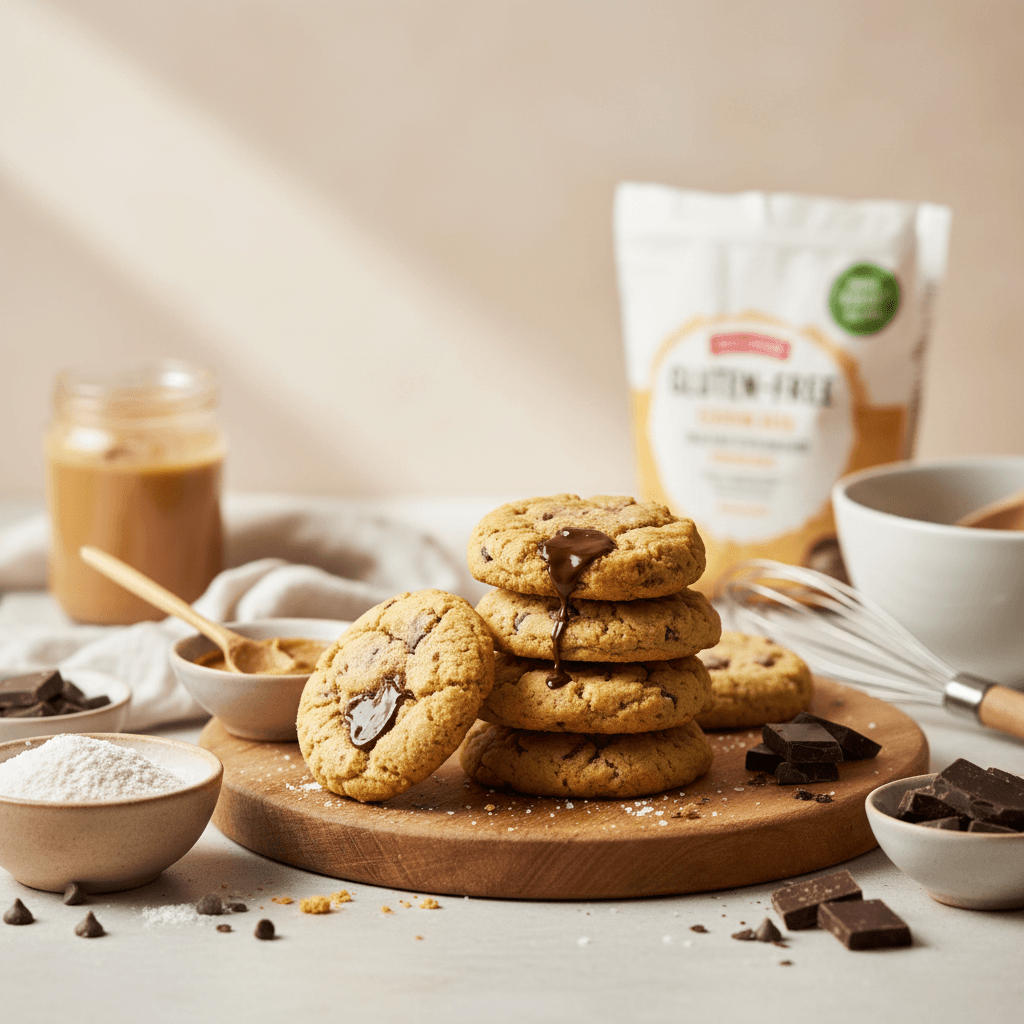
If you've tried gluten-free chocolate chip cookies and ended up with flat, gritty, or crumbly discs, you're not alone — and it's almost certainly not your fault. Most recipes floating around online don't account for how gluten-free flours behave differently with fat and sugar. Here are five proven approaches that consistently produce cookies worth eating, plus the science behind why they work.
Key takeaways
- The best gluten-free chocolate chip cookies use a blend of flours and starches, not a single flour — this prevents grittiness and improves texture.
- Almond flour-based recipes produce the chewiest cookies with the richest flavor, but they spread more and need chilling time.
- A commercial flour blend like Bob's Red Mill 1-to-1 or King Arthur Measure for Measure gives the most "normal" results with the least effort.
- Xanthan gum or psyllium husk is essential for binding — skip it and your cookies will crumble apart.
- Chilling gluten-free cookie dough for at least 30 minutes (ideally overnight) dramatically reduces spreading and improves flavor.
- Brown sugar produces chewier cookies than white sugar because of its higher moisture content and acidity.
Why gluten-free chocolate chip cookies fail (and how to fix it)
The most common reason gluten-free chocolate chip cookies disappoint is that they're either gritty, too crumbly, or spread into flat puddles. Each problem has a specific cause. Grittiness comes from coarse rice flour that hasn't been finely milled — check our guide to the best rice flour for gluten-free baking if you suspect your flour is the issue. Crumbliness means you're missing a binder. And over-spreading usually means the dough wasn't chilled or there's too much fat relative to the flour's absorption capacity.
Understanding these failure points is what separates a recipe that "works sometimes" from one that works every time. Let's look at the five approaches that consistently deliver.
Approach 1: Commercial flour blend cookies (easiest and most reliable)
A good commercial gluten-free flour blend is the fastest path to chocolate chip cookies that taste like the ones you remember. These blends are pre-formulated with a mix of rice flour, starches, and sometimes a binder, so the ratio work is done for you.
We covered the top options in our gluten-free flour blend brand comparison. For chocolate chip cookies specifically, blends that include tapioca starch tend to produce the best chew. King Arthur Measure for Measure and Bob's Red Mill 1-to-1 are both solid choices.
What makes this approach work
Commercial blends mimic the protein-to-starch ratio of all-purpose wheat flour. The tapioca starch provides elasticity and chew, while rice flour gives structure. Most blends include xanthan gum, which replaces gluten's binding function.
Common mistakes with flour blend cookies
- Not checking if the blend already contains xanthan gum. If it does and you add more, your cookies will be gummy and rubbery. Read the label.
- Measuring by volume instead of weight. Gluten-free flours pack differently than wheat flour. A kitchen scale eliminates this variable entirely.
- Skipping the chill. Even with a blend, GF cookie dough benefits from at least 30 minutes in the fridge to let starches hydrate.
If you're just getting started with gluten-free baking, we put together the Confident Gluten-Free Baker Toolkit to help you build a foundation that makes recipes like these work consistently from the start. It covers the principles behind flour selection, binder ratios, and the adjustments that most recipes don't tell you about.
Approach 2: Almond flour chocolate chip cookies (grain-free and naturally chewy)
Almond flour produces some of the most naturally delicious gluten-free chocolate chip cookies because of its high fat content and fine texture. These cookies tend to be rich, chewy in the center, and slightly crisp on the edges — very close to a bakery-style cookie.
The science behind almond flour cookies
Almond flour is roughly 50% fat by weight, which means it creates a tender crumb without needing as much added butter or oil. The natural oils also help with moisture retention, so these cookies stay soft longer than rice flour-based versions. The downside is that all that fat means more spreading. You absolutely need to chill the dough — overnight is ideal.
For the best results, use blanched, superfine almond flour. We compared the top options in our almond flour brand comparison. Coarser almond meal will give you a grainier, more fragile cookie.
Typical almond flour cookie formula
| Ingredient | Amount (per dozen) | Purpose |
|---|---|---|
| Blanched almond flour | 2 cups (200g) | Structure and fat |
| Tapioca starch | 2 tablespoons | Chew and binding |
| Baking soda | 1/2 teaspoon | Leavening and browning |
| Salt | 1/2 teaspoon | Flavor |
| Butter or coconut oil | 1/4 cup | Moisture and spread |
| Brown sugar | 1/2 cup | Sweetness and chew |
| Egg | 1 large | Binding and structure |
| Vanilla extract | 1 teaspoon | Flavor |
| Chocolate chips | 3/4 cup | The whole point |
Common mistakes with almond flour cookies
- Using almond meal instead of almond flour. The coarser grind doesn't hold together well and produces a sandy texture.
- Skipping the starch. A small amount of tapioca starch dramatically improves chew. Without it, almond flour cookies can be cakey or crumbly.
- Baking at too high a temperature. Almond flour browns faster than wheat flour. Drop your oven to 325°F and use an oven thermometer to verify — most ovens run hot.
Approach 3: Oat flour chocolate chip cookies (hearty and wholesome)
Oat flour makes a chocolate chip cookie with a slightly nutty, wholesome flavor and a satisfyingly chewy texture. It's also one of the most affordable gluten-free flours, which is a nice bonus when you're baking regularly.
Why oat flour works for cookies
Oat flour has a moderate protein content (around 13%) and absorbs moisture well, which means it creates a dough that holds together without being dense. The natural beta-glucan in oats acts as a mild binder, so you need less xanthan gum than you would with a rice flour base. The flavor is subtly sweet and pairs beautifully with chocolate.
The critical detail: make sure you're using certified gluten-free oats. Conventional oats are heavily cross-contaminated with wheat. You can make your own oat flour by pulsing certified GF rolled oats in a food processor until fine.
Common mistakes with oat flour cookies
- Not letting the dough rest. Oat flour needs time to absorb liquid. If you bake immediately, the cookies will spread too much and taste raw in the center. Rest the dough for at least 20 minutes.
- Using oats that aren't certified gluten-free. This is a safety issue, not just a texture one.
- Adding too much xanthan gum. Because oat flour has its own binding properties, you only need about 1/4 teaspoon per cup of flour. More than that and the cookies become chewy in a rubbery, unpleasant way.
Approach 4: Custom flour blend cookies (for experienced bakers who want total control)
Once you understand how different gluten-free flours and starches work together, you can build your own blend specifically optimized for cookies. This gives you the most control over texture, flavor, and chew — but it requires some knowledge of what each component does.
How to build a cookie-optimized flour blend
A good cookie blend follows a roughly 40/40/20 ratio: 40% whole grain flour for flavor and protein, 40% starch for tenderness and chew, and 20% medium-weight flour for structure. Here's what that looks like in practice:
| Component | Best options | What it does |
|---|---|---|
| Whole grain flour (40%) | Sorghum flour, brown rice flour, oat flour | Provides protein, flavor, and color |
| Starch (40%) | Tapioca starch, potato starch, cornstarch | Creates tenderness and chew |
| Medium-weight flour (20%) | White rice flour, sweet rice flour, millet flour | Adds structure without heaviness |
You'll also need a binder. For cookies, xanthan gum at 1/2 teaspoon per cup of flour blend is the standard. Some bakers prefer guar gum for a slightly softer result. Our guide on gluten-free baking fundamentals goes deeper into how these binders work.
The secret weapon: sweet rice flour
If there's one flour that makes the biggest difference in gluten-free chocolate chip cookies, it's sweet rice flour (also called mochiko or glutinous rice flour — it's naturally gluten-free despite the confusing name). It's stickier and more elastic than regular rice flour, which gives cookies that stretchy, chewy quality you get from wheat-based recipes. Swapping just 20% of your blend for sweet rice flour can transform the texture.
Common mistakes with custom blends
- Using too much starch. Starch-heavy blends produce cookies that are crispy when hot but turn hard and brittle once cool.
- Forgetting to sift. Different flours and starches clump at different rates. A quick pass through a flour sifter ensures even distribution.
- Not testing in small batches. Make a half-dozen cookies first before committing to a full batch with a new blend.
Approach 5: Flourless chocolate chip cookies (naturally gluten-free, no specialty flours needed)
Flourless cookies sidestep the flour question entirely by using nut butters, eggs, and sugar as the base. These are naturally gluten-free without any adaptation, which means they tend to be more reliable than converted wheat recipes.
Why flourless cookies work
Nut butters (peanut butter, almond butter, or cashew butter) provide fat, protein, and structure all in one ingredient. The eggs bind everything together and provide lift. Because there's no flour to hydrate, these cookies come together in minutes and don't need chilling.
The simplest version is just nut butter, sugar, an egg, and chocolate chips. It sounds too simple, but it genuinely works. The cookies are fudgy, rich, and deeply satisfying.
Common mistakes with flourless cookies
- Overbaking. These cookies look underdone when they're actually perfect. Pull them when the edges are set but the centers still look slightly wet — they'll firm up as they cool on the pan.
- Using natural nut butter without adjusting. Natural nut butters (the kind with oil separation) have a different moisture content than processed ones like Skippy or Jif. If using natural, add an extra tablespoon of sugar to help with structure.
- Not lining the pan. These cookies stick aggressively. Use parchment paper or a silicone baking mat — don't just grease the sheet.
Which approach is right for you?
| Approach | Best for | Skill level | Texture |
|---|---|---|---|
| Commercial flour blend | Quick, reliable results | Beginner | Most like traditional cookies |
| Almond flour | Grain-free, rich flavor | Beginner to intermediate | Chewy, fudgy |
| Oat flour | Budget-friendly, wholesome | Beginner | Hearty, slightly nutty |
| Custom flour blend | Total control over texture | Intermediate to advanced | Varies (you decide) |
| Flourless | Minimal ingredients, fastest | Beginner | Fudgy, dense |
If you're brand new to gluten-free baking, start with a commercial blend or the flourless approach. Both are forgiving and produce consistently good results. Our beginner cookie recipe guide covers additional styles and techniques if you want to explore further.
Universal tips for better gluten-free chocolate chip cookies
Regardless of which approach you choose, these techniques will improve your results across the board:
- Weigh your ingredients. Gluten-free flours vary in density far more than wheat flour. A scale removes the biggest source of inconsistency.
- Use brown sugar for chew. Brown sugar contains molasses, which is acidic and hygroscopic (it attracts moisture). This gives you chewier cookies that stay soft longer. A 2:1 ratio of brown to white sugar is a good starting point.
- Chill your dough. This gives starches time to hydrate and fats time to solidify, which means less spreading and more complex flavor. Thirty minutes minimum, overnight is better.
- Don't overbake. Gluten-free cookies firm up significantly as they cool. Pull them from the oven when they look slightly underdone — the edges should be set and lightly golden, but the centers should still appear soft.
- Let cookies cool on the pan for 5-10 minutes. They're fragile when hot. Moving them too soon is the number one cause of broken cookies.
Frequently asked questions
What is the best gluten-free flour for chocolate chip cookies?
For most bakers, a commercial gluten-free flour blend like King Arthur Measure for Measure or Bob's Red Mill 1-to-1 produces the most reliable chocolate chip cookies. These blends are formulated to mimic all-purpose flour, so you can use them in most standard cookie recipes with minimal adjustments. See our full flour blend comparison for detailed recommendations.
Why are my gluten-free chocolate chip cookies crumbly?
Crumbly gluten-free cookies are almost always caused by a missing or insufficient binder. Without gluten to hold things together, you need xanthan gum, psyllium husk, or an extra egg to provide structure. Check whether your flour blend already contains a binder — if not, add 1/2 teaspoon of xanthan gum per cup of flour. Our dry and crumbly troubleshooting guide covers additional causes and fixes.
Can I use almond flour instead of a gluten-free flour blend for cookies?
Yes, but it's not a direct 1:1 swap. Almond flour is much higher in fat and has no starch, so cookies made with it will be denser, richer, and more prone to spreading. You'll need to reduce the butter or oil in the recipe and add a small amount of tapioca starch for chew. Our almond flour vs coconut flour guide explains how these nut flours behave differently from grain-based options.
Do gluten-free chocolate chip cookies need xanthan gum?
In most cases, yes. Xanthan gum replaces the binding function that gluten provides in wheat-based cookies. Without it (or another binder like guar gum or psyllium husk), your cookies will likely fall apart. The exception is flourless cookies made with nut butter, where the eggs and nut butter provide enough binding on their own. Use 1/4 to 1/2 teaspoon per cup of flour.
How do I keep gluten-free chocolate chip cookies from spreading too much?
Chill your dough for at least 30 minutes before baking — this is the single most effective way to reduce spreading. Cold fat melts more slowly in the oven, giving the cookie structure time to set before it flattens out. Also make sure your oven temperature is accurate (use a thermometer), avoid over-softened butter, and consider adding an extra tablespoon of flour or starch if spreading is a persistent problem.

Written by
Co-founder, BakingSubs
Co-founder of BakingSubs, where he turns the science of ingredient substitutions into tested, reliable guidance for home bakers.
Related Posts
Bake with Confidence
See all
Confident Gluten-Free Baker Toolkit
The science-based system that replaces gluten's seven invisible jobs so your baking turns out soft, fluffy, and foolproof — every time.

Gluten-Free Recipe Vault
Instant access to our complete library of proven gluten-free recipes — no waiting, no guesswork, just results that work tonight.

Fix Your Gluten-Free Bread
Learn the 3-step formula to make bread rise and stay soft, discover why your loaves collapse, and get a tested sandwich bread recipe that actually works.