

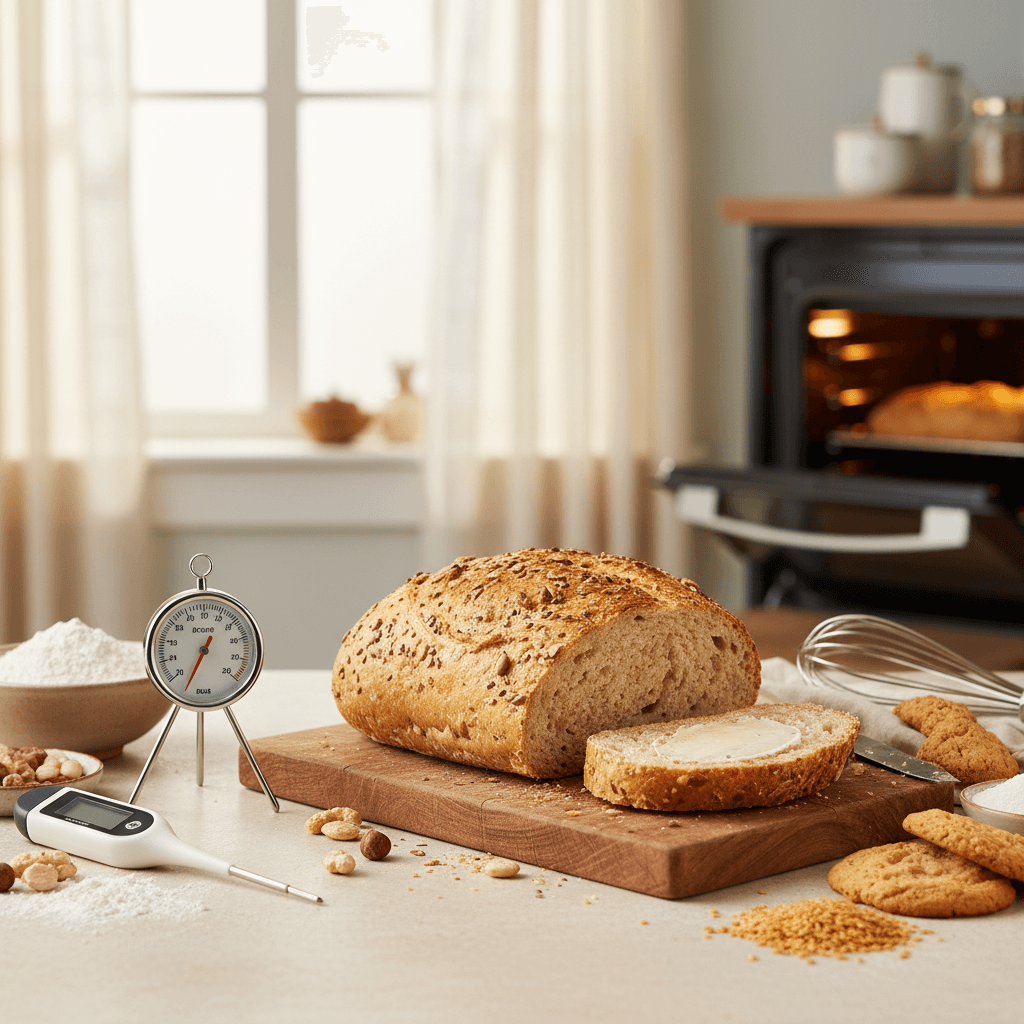
Your oven is probably lying to you. Most home ovens are off by 25-50 degrees, and when you're baking gluten-free (where precision is everything), that gap can mean the difference between a perfect loaf and a gummy, underbaked mess. Here are the best oven thermometers that will tell you what's actually happening inside your oven.
Key takeaways
Most home ovens are off by 25-50 degrees Fahrenheit, which is enough to ruin gluten-free baked goods that depend on precise temperatures.
The ThermoWorks DOT is our top overall pick for its accuracy, large display, and probe-based design that lets you monitor temperature without opening the oven door.
A basic hang-or-stand oven thermometer like the Rubbermaid or CDN costs under $10 and is a massive upgrade over trusting your oven's built-in reading.
For gluten-free bread baking specifically, pairing an oven thermometer with an instant-read thermometer gives you the most reliable results.
Digital probe thermometers are more accurate (within 1-2 degrees) than analog dial thermometers (within 5-10 degrees), but both are far better than nothing.
Place your oven thermometer in the center of the oven, on the rack where you actually bake, for the most useful reading.
Quick Answer: The best oven thermometer for baking accuracy is the ThermoWorks DOT ($38–45). It's accurate within 1.8°F, has a remote probe so you don't lose heat opening the oven, and is the top choice for gluten-free bakers who need precision. For budget bakers, the Rubbermaid FGTHO550 ($6–9) is the best under-$10 option.
Why oven temperature accuracy matters for gluten-free baking
Gluten-free batters and doughs are far less forgiving than their wheat-based counterparts. Without gluten's structural network, your baked goods rely heavily on precise temperature to set starches, activate leaveners, and develop crust at exactly the right moment. An oven that runs 25 degrees too low can leave you with dense, gummy textures, while one that runs hot can burn the outside before the center is done.
For example, gluten-free bread that keeps collapsing after baking can come down to an oven running 40 degrees cold, a problem a $7 oven thermometer would reveal right away.
If you're still building out your gluten-free kitchen, our Confident Gluten-Free Baker Toolkit walks you through every essential tool and technique you need, including how to calibrate your setup for consistent results.
What to look for in an oven thermometer
Not all oven thermometers are created equal. Here's what actually matters when you're choosing one for baking.
Accuracy range
The best oven thermometers are accurate within 1-2 degrees Fahrenheit. Digital probe models consistently outperform analog dial types. For most gluten-free baking, accuracy within 5 degrees is acceptable, but tighter is always better.
Analog vs. digital
Analog (dial) thermometers hang from or sit on the oven rack and give you a constant reading you can see through the oven window. Digital probe thermometers sit outside the oven with a heat-resistant probe cable running inside, which means you can monitor temperature without opening the door and losing heat.
Readability
You need to be able to actually read the thing. Analog thermometers with small faces and cramped markings are frustrating, especially through a foggy oven window. Look for large numbers and clear markings.
Durability
Your oven thermometer lives in a harsh environment. Cheap models can lose calibration over time. Stainless steel construction and heat-resistant components are non-negotiable.
The 6 best oven thermometers for baking accuracy
We evaluated these based on accuracy, ease of use, durability, and real-world value for home bakers. Here's how they stack up.
Thermometer | Type | Accuracy | Price range | Best for |
|---|---|---|---|---|
ThermoWorks DOT | Digital probe | +/- 1.8 degrees F | $38-45 | Best overall |
ThermoWorks ChefAlarm | Digital probe | +/- 1.8 degrees F | $55-65 | Serious bakers |
Rubbermaid FGTHO550 | Analog dial | +/- 5 degrees F | $6-9 | Best budget pick |
CDN POT750X | Analog dial | +/- 5 degrees F | $8-12 | Best value analog |
KT Thermo Large Dial | Analog dial | +/- 5 degrees F | $8-11 | Easy readability |
Taylor 3506 TruTemp | Analog dial | +/- 10 degrees F | $5-8 | Ultra-budget option |
1. ThermoWorks DOT -- best overall oven thermometer
The ThermoWorks DOT is our top pick for gluten-free bakers who want the most reliable temperature monitoring. It uses a probe-based system with a heat-resistant cable that runs through the oven door seal, so the large digital display sits on your counter where you can read it from across the kitchen.
Pros:
Accuracy within 1.8 degrees Fahrenheit -- lab-grade precision
Large, easy-to-read display you don't have to squint at through the oven window
High-temperature alarm alerts you when the oven reaches your target
Rotating display so you can orient it however you want
Splash-proof and built to last
Cons:
At $38-45, it's significantly more expensive than analog options
Requires a battery (included)
The probe measures air temperature at a single point, so it won't show you hot spots
If you already use a good kitchen scale and an instant-read thermometer, the DOT completes the precision trifecta for gluten-free baking.
2. ThermoWorks ChefAlarm -- best for serious bakers
The ThermoWorks ChefAlarm does everything the DOT does, plus adds a programmable timer, min/max temperature tracking, and a backlit display. It's overkill for someone who just wants to verify their oven temp, but if you're baking gluten-free bread regularly and want to track temperature trends over time, it's worth the upgrade.
Pros:
Same 1.8-degree accuracy as the DOT
Built-in countdown and count-up timer
Min/max temperature memory helps you understand oven cycling patterns
Adjustable high and low alarms
Cons:
Most expensive option on this list at $55-65
More features than most home bakers need
Slightly bulkier than the DOT
3. Rubbermaid FGTHO550 -- best budget oven thermometer
The Rubbermaid FGTHO550 is the thermometer we recommend to anyone who says "I don't want to spend a lot." At under $9, it's accurate within about 5 degrees, has a clear dial face, and hangs directly from the oven rack. It's the single best bang-for-your-buck upgrade you can make to your baking setup.
Pros:
Under $9 -- literally the cheapest meaningful improvement you can make
No batteries needed
Stainless steel construction holds up well
Hooks onto the rack or stands on its own
Cons:
Accuracy within 5 degrees (not 1-2 like digital models)
Can be hard to read through the oven window depending on your oven
No alarms or alerts
4. CDN POT750X ProAccurate -- best value analog
The CDN POT750X is a slight step up from the Rubbermaid with a larger, easier-to-read face and a wider temperature range (100-750 degrees F). It's a favorite among baking instructors and culinary schools for good reason.
Pros:
Large, clear dial face with bold markings
Wide temperature range covers everything from low-and-slow to pizza baking
Stainless steel with a sturdy hook and base
NSF certified
Cons:
Slightly more expensive than the Rubbermaid without being more accurate
Still analog, so no remote monitoring
5. KT Thermo large dial oven thermometer -- best for easy reading
The KT Thermo Large Dial has the biggest face of any analog option here, making it the easiest to read through the oven window. If you have vision concerns or your oven window is particularly small or foggy, this is the one to get.
Pros:
Extra-large 2.5-inch dial face
Clear, high-contrast markings
Hangs or stands
Affordable at $8-11
Cons:
The larger size can interfere with taller baked goods if placed on the same rack
Some users report it takes a few minutes longer to stabilize than smaller models
6. Taylor 3506 TruTemp -- ultra-budget option
The Taylor 3506 is the thermometer you'll find in most grocery stores, and while it's not the most precise option, it's better than nothing by a wide margin. If you're spending under $6, this is what to grab.
Pros:
Available almost everywhere, often under $6
Compact and unobtrusive
Stainless steel construction
Cons:
Accuracy within about 10 degrees -- the least precise on this list
Small face can be difficult to read
May lose calibration faster than higher-quality options
How to use your oven thermometer for the best results
Buying a thermometer is step one. Using it properly is where the real improvement happens.
Place it in the center of the oven. Hang or stand your thermometer on the middle rack, roughly centered. Temperatures vary significantly between the top, bottom, and sides of your oven, so the center gives you the most representative reading.
Preheat longer than you think. Most ovens signal that they've reached temperature when the air hits the target, but the walls, racks, and floor haven't caught up yet. We recommend preheating for at least 20-25 minutes for gluten-free baking, and your thermometer will confirm when the temperature has truly stabilized.
Check for hot spots. Move your thermometer to different positions over several baking sessions. If you find your oven runs 15 degrees hotter on the left side, you'll know to rotate your baking pans halfway through.
Recalibrate or replace periodically. Analog thermometers can drift over time. Check yours against a known-accurate digital thermometer once or twice a year, and replace it if it's consistently off.
Common mistakes when using an oven thermometer
Even with a good thermometer, these mistakes can undermine your results.
Placing it too close to the oven wall. The sides and back of your oven radiate extra heat. Keep the thermometer centered for an accurate ambient reading.
Opening the door to check it constantly. Every time you open the oven door, you lose 25-50 degrees of heat. This is where digital probe thermometers really shine -- you can monitor from outside. If you're using an analog model, limit yourself to quick glances through the window.
Ignoring oven cycling. Your oven doesn't maintain a steady temperature. It heats up past the target, shuts off, cools down below it, then heats again. This is normal. What matters is the average. If your thermometer swings between 340 and 360 when set to 350, that's fine.
Using it only for oven temperature. For gluten-free bread specifically, internal dough temperature matters just as much as oven temperature. Pair your oven thermometer with an instant-read thermometer for the full picture.
Analog vs. digital oven thermometers: which should you choose?
For most gluten-free home bakers, the answer depends on your budget and how seriously you take temperature control.
Feature | Analog (dial) | Digital (probe) |
|---|---|---|
Accuracy | Within 5-10 degrees F | Within 1-2 degrees F |
Price | $5-12 | $35-65 |
Batteries needed | No | Yes |
Remote monitoring | No (must look through window) | Yes (display sits outside oven) |
Alarms | No | Yes |
Durability | Good, but can lose calibration | Excellent with proper care |
If you're just starting out with gluten-free baking, grab a Rubbermaid or CDN analog thermometer. It's a $10 investment that will immediately improve your results. If you're baking bread regularly and want lab-grade accuracy, the ThermoWorks DOT is worth every penny.
Either way, having any oven thermometer puts you ahead of the vast majority of home bakers. As part of setting up a gluten-free baking kitchen, it's one of the first tools we recommend alongside a reliable kitchen scale.
Frequently asked questions
How do I know if my oven temperature is accurate?
Place an oven thermometer in the center of your oven, set the oven to 350 degrees F, and wait 25 minutes for it to fully stabilize. Compare the thermometer reading to the oven's display. If they differ by more than 10 degrees, your oven is miscalibrated. Most ovens can be recalibrated through the settings menu, or you can simply adjust your temperature setting to compensate.
Where should I put an oven thermometer for the most accurate reading?
Place your oven thermometer in the center of the middle rack, which is where most baking happens. Avoid placing it near the walls, heating elements, or the door, as these areas have temperature extremes that don't reflect what your baked goods actually experience.
Do I need both an oven thermometer and an instant-read thermometer for gluten-free bread?
Yes, ideally you want both. An oven thermometer tells you the environment your bread is baking in, while an instant-read thermometer tells you when the bread itself is done (typically 205-210 degrees F internally for gluten-free loaves). Together, they virtually eliminate the guesswork that leads to gummy or underbaked results.
How often should I replace my oven thermometer?
Digital probe thermometers can last 5-10 years with proper care. Analog dial thermometers should be checked for accuracy every 6-12 months by comparing them against a known-accurate digital thermometer. If an analog model is consistently off by more than 10 degrees and can't be recalibrated, replace it. At under $10, there's no reason to keep using one you can't trust.
Can a bad oven temperature cause gluten-free bread to collapse?
Absolutely. An oven that runs too low won't set the starches and proteins fast enough, causing the structure to collapse as it cools. An oven that runs too hot can set the crust before the interior has finished rising, trapping steam and creating a dense, sunken center. Accurate oven temperature is one of the most important and most overlooked factors in successful gluten-free bread baking.

Written by
Co-founder, BakingSubs
Co-founder of BakingSubs, where he turns the science of ingredient substitutions into tested, reliable guidance for home bakers.
Related Posts
Bake with Confidence
See all
Confident Gluten-Free Baker Toolkit
The science-based system that replaces gluten's seven invisible jobs so your baking turns out soft, fluffy, and foolproof — every time.

Gluten-Free Recipe Vault
Instant access to our complete library of proven gluten-free recipes — no waiting, no guesswork, just results that work tonight.

Fix Your Gluten-Free Bread
Learn the 3-step formula to make bread rise and stay soft, discover why your loaves collapse, and get a tested sandwich bread recipe that actually works.