

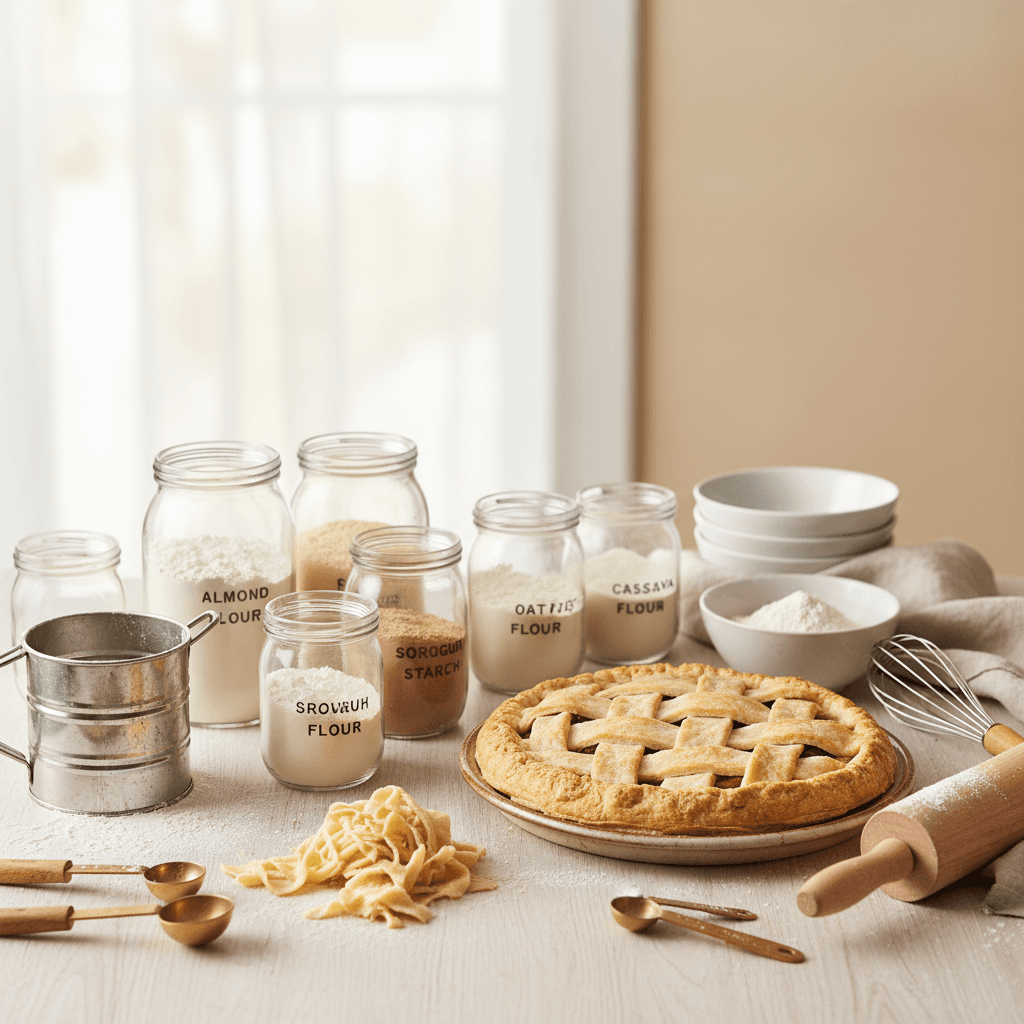
The most reliable gluten-free pie crust starts with a starch-heavy gluten-free flour blend (rice flour plus tapioca and potato starch, bound with about 1/2 teaspoon of xanthan gum per cup), very cold butter, and dough that is chilled before you roll it between sheets of parchment. A ready-made 1-to-1 blend like Bob's Red Mill 1-to-1 or Cup4Cup is the simplest starting point, almond flour gives you a grain-free press-in crust, and if you'd rather skip the dough entirely, frozen gluten-free pie shells and pie crust mixes are the shortcut.
Key takeaways
- For a classic rolled crust, use a starch-heavy blend such as Bob's Red Mill 1-to-1 or Cup4Cup. Pie crust needs tenderness, not structure.
- Rice flour on its own makes a gritty, crumbly crust. It needs to be finely ground and combined with starches like tapioca and potato starch.
- Almond flour makes a grain-free press-in crust with a cookie-like texture rather than flaky layers. Cassava flour is the grain-free, nut-free option that can be rolled out.
- Use about 1/2 teaspoon of xanthan gum per cup of flour, or about 1 teaspoon of psyllium husk. Too much binder makes the crust gummy or tough.
- Cold fat, a 30-minute chill, and rolling between parchment matter even more in gluten-free pie crust than in wheat crust.
- Blind bake the crust for custard and cream pies. Gluten-free crusts absorb moisture from wet fillings quickly.
- Store-bought shortcuts include frozen shells (Wholly Wholesome), a graham-style ready-made crust (Mi-Del), and pie crust mixes from King Arthur, Bob's Red Mill and Cup4Cup.
What makes gluten-free pie crust work
In a wheat pie crust, gluten does two jobs: it forms an elastic network that holds the dough together while you roll it, and it gives the crust enough chew to feel substantial rather than sandy. A gluten-free crust has to replace both functions and still stay tender. In wheat baking, low-protein pastry flour is preferred for pie because less gluten means a more tender crust, and the same principle applies to gluten-free flours: you want ingredients that stay tender rather than build structure.
That's why starch-heavy blends are the better fit for pie crust. Starches like arrowroot, tapioca starch and potato starch create a smooth, pliable dough that mimics the tenderness of wheat pastry flour. Protein-heavy flours like chickpea or sorghum can make a crust tough or bready when they dominate the blend.
Binding comes from xanthan gum, psyllium husk or egg. Each binds in a slightly different way, and a good crust uses at least one of them deliberately.
Absorption also matters. A flour that absorbs too much moisture (like coconut flour) leaves you with a dry, cracking dough, while one that absorbs too little makes a sticky dough that's hard to roll out. For pie crust, you want moderate absorption and a fine grind.
If you're still building out your gluten-free pantry, our Confident Gluten-Free Baker Toolkit walks you through exactly which flours and starches to stock for every type of baking — including pie crust.
Best gluten-free flours for pie crust compared
Here's how the main options compare for pie crust, based on what's in each flour and the style of crust it suits.
| Flour / Blend | Best for | Expected texture | Flavor | Ease of use |
|---|---|---|---|---|
| Bob's Red Mill 1-to-1 | All-around best | Tender, slightly flaky | Neutral | Very easy (1:1 swap) |
| Cup4Cup Original | Closest to a traditional crust | Flaky, delicate | Neutral, buttery | Very easy (1:1 swap) |
| King Arthur Measure for Measure | Sturdy lattice crusts | Firm, slightly tender | Neutral | Easy (1:1 swap) |
| Almond flour | Grain-free / low-carb | Cookie-like, crumbly | Nutty, rich | Moderate (press-in only) |
| Custom rice flour + starch blend | Control and customization | Tender if balanced right | Mild | Advanced |
| Cassava flour | Nut-free, grain-free | Pliable, slightly chewy | Mild, slightly earthy | Moderate |
| Coconut flour | Not recommended alone | Dry, crumbly | Coconut flavor | Difficult |
Bob's Red Mill 1-to-1 gluten-free baking flour
Bob's Red Mill 1-to-1 is the best starting point for most gluten-free pie crusts. It's widely available and affordable, and it contains rice flour, tapioca starch, potato starch and xanthan gum — the components a pie crust needs, already combined.

Bob's Red Mill Gluten Free 1 to 1 Baking Flour, 22oz (4 Pack)
Check price on Amazon →Why it works for pie crust: The starch-heavy formula favors tenderness, and the built-in xanthan gum provides enough binding for the dough to hold together when you roll it out. The fine grind avoids the grittiness that is common with cheaper rice flour blends. If gritty texture has been your problem in past attempts, a finely milled blend like this one addresses it.
Pros:
- True 1:1 swap for all-purpose flour in pie crust recipes
- Xanthan gum already included — no extra measuring
- Starch-heavy formula suited to a tender, rollable dough
- Available at most grocery stores
Cons:
- No milk powder, so it lacks the browning help built into Cup4Cup
- Contains rice flour, so not suitable for rice-free diets
- Dough is more fragile than wheat dough and needs to stay cold
Bob's Red Mill 1-to-1 Baking Flour also works in cookies and quick breads, so it earns its pantry space beyond pie season.
Cup4Cup original blend
Cup4Cup is the blend designed to come closest to a traditional flaky pie crust. It was developed by a former Thomas Keller pastry chef and engineered to mimic wheat flour as closely as possible.

Cup4Cup Multipurpose Flour, 2 Pounds, Certified Gluten Free, Dairy Free Flour, 1:1 All Purpose Flour Substitution, Non-GMO, Kosher, Made in the USA
Check price on Amazon →Why it works for pie crust: Cup4Cup combines cornstarch, white rice flour, tapioca flour and milk powder. The milk powder is the key differentiator: it adds fat and protein that help the crust brown and develop flakiness. The starch ratio is also higher than in many blends, which keeps the crust delicate.
Pros:
- Formulated specifically to mimic wheat flour
- Milk powder helps browning and adds a slightly buttery flavor
- High starch ratio for a delicate, tender crust
- 1:1 swap for all-purpose flour
Cons:
- Contains milk powder (not dairy-free)
- Significantly more expensive than Bob's Red Mill
- Harder to find in regular grocery stores
If budget isn't a concern and you want the closest thing to a wheat-flour pie crust, Cup4Cup Original Blend is the one to pick, especially for holiday pies.
King Arthur Measure for Measure flour
King Arthur Measure for Measure is a middle-ground option. It makes a slightly sturdier crust than the other two blends, which suits lattice-top pies or any crust that needs to hold its shape.
Why it works for pie crust: This blend uses rice flours, tapioca starch, potato starch and rice starch, with xanthan gum included. It has a bit more structure than Cup4Cup, so the crust is less delicate but also less likely to fall apart when you're weaving a lattice or transferring the dough to the pan.
Pros:
- Sturdy enough for decorative crusts
- Dairy-free (no milk powder)
- Good availability at grocery stores and online
- 1:1 swap with xanthan gum included
Cons:
- Less tender and delicate than Cup4Cup
- Can turn slightly firm if overworked
King Arthur Measure for Measure is the pick for pies with lattice or other decorative crust work. For a standard single-crust pie, the two blends above are the more tender choices.
Almond flour for grain-free pie crust
Almond flour is the best option if you need a grain-free or low-carb pie crust. It makes a rich, cookie-like crust suited to custard pies, cheesecakes and tarts. It won't give you traditional flakiness — it's a different style of crust entirely.
Why it works differently: Almond flour is high in fat and protein but contains no starch. Without starch, you can't create the layered, flaky structure of a traditional pie crust. Instead, almond flour crusts are pressed into the pan (not rolled) and have a dense, buttery, shortbread-like texture. For more on how it compares to other alternatives, see our almond flour vs coconut flour comparison.
Pros:
- Grain-free and naturally gluten-free
- Rich, nutty flavor that suits sweet fillings
- Simple press-in method — no rolling required
- Works for no-bake and par-baked crusts
Cons:
- Not flaky — cookie or shortbread texture only
- Can't be rolled out
- Higher calorie and fat content
- Nut allergen
Use finely ground blanched almond flour, not almond meal. Almond meal has the skins on and a coarser grind, which makes a gritty, crumbly crust. We compare brands in our best almond flour for baking guide.
Custom rice flour and starch blend
If you want full control over texture, you can build your own blend from rice flour and starches. This lets you fine-tune the ratio for the tenderness and flakiness you want.
A good starting point for pie crust:
- 2 parts white rice flour (fine grind)
- 2/3 part tapioca starch
- 1/3 part potato starch
- 1/2 teaspoon xanthan gum per cup of flour blend
Why it works: White rice flour provides the base structure, tapioca starch adds chewiness and pliability, and potato starch contributes tenderness and moisture. Use a finely ground white rice flour — coarse rice flour is the number one cause of gritty gluten-free pie crust.
Pros:
- Full control over texture and flavor
- Can be made allergen-free (no dairy, no nuts)
- Often cheaper than commercial blends
- Ratios can be adjusted for different pie types
Cons:
- Requires more knowledge and experimentation
- Easy to get ratios wrong
- Need to source multiple ingredients
- You must add your own binder (xanthan gum or psyllium husk)
If you go this route, weigh your ingredients with a kitchen scale. Small ratio changes make a big difference in pie crust, and volume measurements aren't precise enough.
Cassava flour for nut-free, grain-free pie crust
Cassava flour is a strong option if you need a grain-free crust but can't use nuts. It's made from the whole cassava root (not just the starch, like tapioca), which makes it behave more like a flour than pure starches do.
Why it works for pie crust: Cassava flour has a neutral flavor and a soft, pliable texture when hydrated. Unlike almond flour, it can be rolled out, so you can make a more traditional-looking crust. It absorbs more moisture than wheat flour, so you'll need to add extra liquid.
Pros:
- Grain-free, nut-free and naturally gluten-free
- Can be rolled out for a traditional crust
- Mild, neutral flavor
- Single-ingredient flour (no blending needed)
Cons:
- High moisture absorption — recipes need adjustment
- Can become gummy if overworked or over-hydrated
- Slightly chewy texture (less flaky than starch-based blends)
- Quality varies significantly between brands
Why coconut flour is not recommended for pie crust
Coconut flour absorbs roughly 3 to 4 times more liquid than wheat flour, which makes it very difficult to use in pie crust. The dough tends to crack, crumble and fall apart, and it carries a noticeable coconut flavor that doesn't suit every filling.
As a swap for a flour blend in a rolled crust, it isn't recommended. When coconut flour does appear in pie crust, it's usually a small, secondary ingredient alongside another flour like almond flour, or it's held together by several eggs in a press-in crust (approach 4 below). If you're dealing with dry, crumbly results in your baking, coconut flour's extreme absorption is often the culprit.
5 ways to make gluten-free pie crust from scratch
These are five approaches rather than finished recipes. Where proportions are given, treat them as starting points and adjust the liquid to your flour.
Approach 1: Classic rolled crust with a rice flour blend
This is the closest thing to a standard all-butter pie crust. The base is white rice flour, tapioca starch and potato starch — the same combination used in many commercial blends (see the custom blend ratio above). Rice flour provides bulk and a neutral flavor, tapioca starch adds slight chewiness and helps with browning, and potato starch contributes tenderness and moisture retention. Add about 1/2 teaspoon of xanthan gum per cup of blend.
Technique: Cut cold butter into the flour until you have pea-sized pieces — a food processor or a pastry cutter both work. Add ice water one tablespoon at a time until the dough just comes together, press it into a disc, wrap it and refrigerate for at least 30 minutes. Roll it between two sheets of parchment paper, since gluten-free dough sticks to everything. If it cracks while rolling, let it warm for 2–3 minutes and press the cracks together with your fingers.
Best for: traditional double-crust and fruit pies. Use shortening instead of butter for a dairy-free crust.
Approach 2: Almond flour press-in crust
This is the easiest gluten-free pie crust to make, and it's grain-free. The dough is pressed straight into the pie plate, with no rolling. Almond flour's fat content keeps it tender, and it binds with a little help from an egg or melted butter, so no gum is needed. Typical proportions are about 1.5 cups of finely ground blanched almond flour, 2–3 tablespoons of melted butter or coconut oil, a pinch of salt and, optionally, a tablespoon of sugar.
Best for: pies where you blind bake the crust first and then fill it — pumpkin, key lime, chocolate cream or any custard pie — plus cheesecakes and tarts. It doesn't suit double-crust fruit pies because it can't be rolled or draped.
Watch for: overbaking. Almond flour browns quickly because of its fat and sugar content, so check it after the 10-minute mark and tent the edges with foil if they darken. Don't skip the par-bake for custard pies; an unbaked almond crust under a wet filling turns soggy fast.
Approach 3: Sorghum and oat flour crust
For more flavor than a plain rice flour blend, combine sorghum flour with certified gluten-free oat flour. Sorghum has a mild, slightly sweet flavor and protein that helps with structure, oat flour adds softness, and tapioca starch plus a binder make it rollable. A typical ratio is 1 cup sorghum flour, 1/2 cup oat flour, 1/2 cup tapioca starch and 1/2 teaspoon xanthan gum, with cold butter cut in as in approach 1.
Oat safety: if you're baking for someone with celiac disease, the oat flour must be certified gluten-free. Regular oats are commonly cross-contaminated with wheat during processing. Our guide to setting up a gluten-free baking kitchen covers cross-contamination in more detail.
Watch for: bitterness. Sorghum can taste slightly bitter in too high a proportion. If you notice an aftertaste, swap a couple of tablespoons of the sorghum for more tapioca starch.
Best for: savory pies, quiche and pot pies.
Approach 4: Coconut flour crust for grain-free and paleo baking
This is the least forgiving approach. Because coconut flour is so absorbent, you use far less of it — typically only 1/3 to 1/2 cup for a full crust — with 2–3 eggs for moisture and binding and a generous amount of butter or coconut oil. The eggs do most of the structural work, so it doesn't adapt well to egg-free baking; our guide to choosing egg substitutes explains the tradeoffs.
Watch for: too much coconut flour, which makes a dry, crumbly crust. Measure by weight with a kitchen scale, since coconut flour compacts in a measuring cup, and let the mixture rest for 5 minutes before pressing it into the pan so the flour can fully hydrate.
Best for: cream pies and tropical-flavored pies. If you don't specifically need a coconut flour crust, almond flour (press-in) or cassava flour (rolled) is the easier grain-free route.
Approach 5: Commercial gluten-free flour blend
Using a commercial gluten-free flour blend is a completely legitimate approach: the ratios are already set, so results are more consistent. Look for a blend that contains a base flour (usually rice flour) and at least one starch (tapioca, potato or cornstarch). Bob's Red Mill 1-to-1 and King Arthur Measure for Measure are two of the most widely available.
Technique adjustment: don't swap a blend into a wheat pie crust recipe with no other changes. Gluten-free blends are thirstier than wheat flour, so expect to add 1–2 extra tablespoons of ice water, and you may need a little more fat. The dough is ready when a squeezed handful holds together without being sticky.
Watch for: doubling up on xanthan gum. Check whether your blend already contains it before adding more (if it doesn't, add 1/2 teaspoon per cup). Too much gum is one of the fastest routes to a rubbery crust.
Which approach should you choose?
| Approach | Best for | Difficulty | Dietary notes |
|---|---|---|---|
| Rice flour blend (rolled) | Traditional double-crust pies, fruit pies | Moderate | Can be dairy-free with shortening |
| Almond flour (press-in) | Custard pies, cheesecakes, tarts | Easy | Grain-free, low-carb friendly |
| Sorghum and oat flour | Savory pies, quiche, pot pies | Moderate | Must use certified GF oats |
| Coconut flour (press-in) | Cream pies, tropical pies | Moderate | Grain-free, paleo; needs eggs |
| Commercial blend | Any pie, convenience baking | Easy | Varies by blend |
If you're new to gluten-free pie, the two simplest starting points are the almond flour press-in crust (for ease) and the commercial blend approach (for the most traditional result with the least fuss). Custom flour blends give you more control once you're comfortable.
Common mistakes and how to fix them
| Problem | Cause | Fix |
|---|---|---|
| Dough crumbles when rolling | Too dry or too cold | Add ice water 1 tsp at a time; let dough warm slightly |
| Crust is tough and chewy | Too much xanthan gum or overworked dough | Reduce xanthan to 1/2 tsp per cup flour; handle less |
| Crust shrinks during blind baking | Not enough resting time; no pie weights | Chill at least 30 min; use pie weights or dried beans |
| Gritty texture | Coarse rice flour | Use finely ground rice flour or sift before measuring |
Gritty texture is one of the most common complaints in gluten-free baking. Our guide on fixing gritty texture in gluten-free baking goes deeper on the causes and solutions.
Best store-bought gluten-free pie crusts and mixes
If you'd rather not make dough from scratch, there are two shortcuts: ready-made crusts, which skip the dough entirely, and pie crust mixes, which you finish with butter and water.
Frozen and ready-made gluten-free pie crusts
| Product | Type | Best for | Notes |
|---|---|---|---|
| Wholly Wholesome GF Pie Shells | Frozen shells, 2-pack | All pies | Easy to keep in the freezer for heavy fillings like pumpkin and pecan |
| Mi-Del GF Pie Crust | Graham-style, ready-made | Cream pies, cheesecake, key lime pie | No-bake option |
| Schar Shortcrust Pastry | Frozen dough | Pies and tarts | Rollable dough you shape yourself |
Gluten-free pie crust mixes
Mixes sit between fully homemade and fully store-bought: you add butter and water, and the flour, starch and binder are measured for you.
- King Arthur Gluten Free Pie Crust Mix — one box makes two crusts.
- Bob's Red Mill GF Pie Crust Mix — widely available in grocery stores.
- Cup4Cup Gluten Free Pie Crust Mix — the premium option, from the same brand as the Cup4Cup flour blend above.
If you want a little more control than a mix without blending your own flours, use a 1-to-1 flour blend in your usual recipe (approach 5).
Holiday timing: if you're ordering mixes or frozen crusts online, place your order by the first week of November. Shipping delays are common around the holidays and gluten-free products can sell out. If you're buying locally, check stock by mid-November — many stores increase their gluten-free inventory for the holidays but can still run out of popular items.
For complete store-bought gluten-free pies and naturally gluten-free fillings like pumpkin and pecan, see our gluten-free Thanksgiving pie guide.
Tips for better gluten-free pie crust with any flour
- Keep everything cold. Cold butter, cold water, cold bowl — and chill the flour too if your kitchen is warm. Cold fat creates steam pockets during baking, which is what makes a crust flaky.
- Weigh your ingredients. Gluten-free flours vary widely in density; a cup of rice flour can weigh anywhere from 120g to 160g depending on how you scoop it. A kitchen scale removes the guesswork.
- Get the binder right. Most commercial blends include xanthan gum. For a custom blend, add about 1/2 teaspoon per cup of flour. Without it the dough won't hold together; with too much it turns gummy.
- Add a splash of vinegar or vodka. A little apple cider vinegar or vodka in the ice water helps keep the crust tender. The alcohol evaporates during baking.
- Roll between parchment. Gluten-free dough is stickier than wheat dough. Rolling between two sheets of parchment prevents sticking without adding extra flour, which can make the crust tough.
- Chill twice. Rest the dough in the fridge for at least 30 minutes before rolling so it hydrates fully (skip this and you'll fight cracking), then chill the shaped crust for at least 30 minutes before baking so the fat firms up and the crust holds its shape.
- Blind bake properly. Line the crust with parchment, fill it with pie weights or dried beans, and bake at 375°F for 15 minutes before removing the weights. For custard and cream pies, make sure the crust is fully set before filling — gluten-free crusts absorb moisture quickly and are more prone to slumping.
- Check your oven temperature. If your oven runs 25 degrees hot, the crust browns too fast on the outside while staying raw inside. An accurate oven thermometer is a small investment that makes a big difference.
Frequently asked questions
What is the best gluten-free flour for pie crust?
For a traditional rolled crust, a starch-heavy 1-to-1 blend. Bob's Red Mill 1-to-1 Gluten Free Baking Flour is the best all-around option for availability and price. Cup4Cup Original Blend is formulated to come closest to a wheat-flour crust but costs more and contains milk powder. King Arthur Measure for Measure is sturdier, which suits lattice tops. Avoid using a single flour like rice flour on its own. For grain-free crusts, use almond flour (press-in) or cassava flour (rolled). We compare more brands in our gluten-free flour blend brand comparison.
What is the best store-bought gluten-free pie crust?
It depends on the pie. For a ready-made crust, Wholly Wholesome frozen pie shells suit standard pies like pumpkin and pecan, the Mi-Del graham-style crust suits cream pies and cheesecake, and Schar Shortcrust Pastry is a frozen dough you roll yourself. If you'd rather bake the crust fresh, King Arthur's gluten-free pie crust mix makes two crusts per box, Bob's Red Mill's mix is the easiest to find in grocery stores, and Cup4Cup's is the premium option.
Why is my gluten-free pie crust crumbly or cracking?
Usually the dough is too dry, too cold, or missing a binder — or the flour absorbs too much liquid. Make sure your blend includes xanthan gum, and add ice water one teaspoon at a time until the dough holds together when squeezed. If the dough has been in the fridge a long time, let it sit at room temperature for about 5 minutes before rolling, and roll between parchment for more even pressure. If your crust is consistently dry and crumbly, switch to a starch-heavier flour blend.
Do I need xanthan gum in gluten-free pie crust?
For a rolled crust, you need a binder, and xanthan gum is the most common: use about 1/2 teaspoon per cup of flour, since too much makes the crust gummy. Psyllium husk powder is an alternative at about 1 teaspoon per cup, and some bakers use guar gum. Almond flour press-in crusts don't need added binder because the egg and fat hold them together. Our binder comparison guide covers how each option behaves.
Is almond flour or rice flour better for gluten-free pie crust?
It depends on the style you want. Rice flour blended with starches produces a more traditional, flaky crust that can be rolled out. Almond flour creates a rich, shortbread-like press-in crust that's better suited to tarts, custard pies and cheesecakes. For a classic double-crust pie, go with a rice flour blend.
Do I need to blind bake a gluten-free pie crust?
For custard pies, cream pies and any filling that's wet or cooks quickly, yes. Gluten-free crusts absorb moisture faster than wheat crusts, so an unbaked bottom turns soggy. For fruit pies with a long bake time you can skip it, but placing the pie on a preheated baking sheet helps the bottom crust cook through.
Can I freeze gluten-free pie crust dough?
Yes. Wrap the dough disc tightly in plastic wrap, then in foil or a freezer bag, and freeze for up to 3 months. Thaw it overnight in the refrigerator before rolling. You can also freeze a crust already fitted into the pie plate; wrap the whole thing well and thaw it in the fridge before filling and baking.

Written by
Co-founder, BakingSubs
Co-founder of BakingSubs, where he turns the science of ingredient substitutions into tested, reliable guidance for home bakers.
Related Posts
Bake with Confidence
See all
Confident Gluten-Free Baker Toolkit
The science-based system that replaces gluten's seven invisible jobs so your baking turns out soft, fluffy, and foolproof — every time.

Gluten-Free Recipe Vault
Instant access to our complete library of proven gluten-free recipes — no waiting, no guesswork, just results that work tonight.

Fix Your Gluten-Free Bread
Learn the 3-step formula to make bread rise and stay soft, discover why your loaves collapse, and get a tested sandwich bread recipe that actually works.