

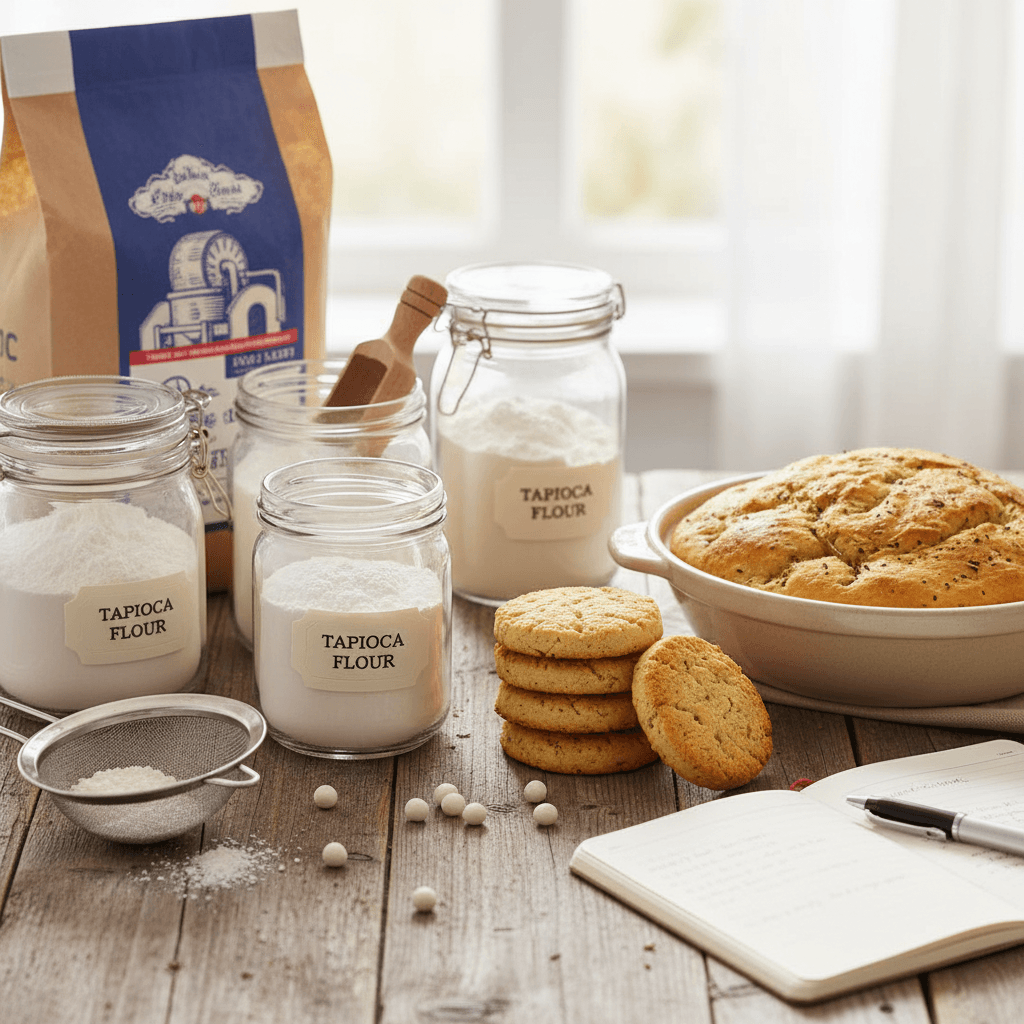
Tapioca flour (also called tapioca starch) is one of the most important starches in gluten-free baking, responsible for that chewy, stretchy texture we all miss from wheat-based recipes. But not all brands perform the same. Here are the 7 best tapioca flour and starch brands we recommend.
Key takeaways
- Tapioca flour and tapioca starch are the same product — the names are interchangeable, though labeling varies by brand.
- Bob's Red Mill Tapioca Flour is our top overall pick for its consistent grind, wide availability, and reliable performance in gluten-free flour blends.
- Price ranges from roughly $0.20 to $0.60 per ounce depending on brand, package size, and whether the product is certified organic.
- Always look for a fine, powdery texture with no grittiness — coarse tapioca starch can ruin the crumb of baked goods.
- Tapioca starch works best blended with other flours like brown rice flour or almond flour rather than used alone.
- Weighing your tapioca starch with a kitchen scale is essential — it's extremely light and easy to over-measure with cups.
What to look for when buying tapioca flour for baking
The best tapioca flour for baking should be ultra-fine, pure white, and completely free of lumps or off-odors. Beyond that, here are the specific things we check before recommending a brand:
- Grind fineness: A silky, powdery texture is non-negotiable. Coarser grinds don't hydrate evenly and leave a starchy mouthfeel in finished baked goods.
- Gluten-free certification: While tapioca is naturally gluten-free, cross-contamination during processing is a real concern. Look for brands that are certified gluten-free or produced in dedicated facilities.
- Packaging: Resealable bags keep moisture out. Tapioca starch clumps quickly when exposed to humidity, so good packaging matters more than you'd think.
- Source transparency: The best brands tell you where their cassava root is sourced. This isn't just about ethics — sourcing affects quality and consistency batch to batch.
- Single ingredient: The ingredient list should say "tapioca starch" or "tapioca flour" and nothing else. Some cheaper brands add fillers or anti-caking agents.
If you're building out your gluten-free pantry, our Confident Gluten-Free Baker Toolkit walks you through exactly which starches and flours to stock, how to combine them, and the ratios that actually work. It takes the guesswork out of creating your own blends.
The 7 best tapioca flour and starch brands for baking
We compared these brands on grind, gluten-free certification, packaging, sourcing, ingredients, and price, with an eye to the main ways tapioca gets used — Brazilian cheese bread (pao de queijo), gluten-free flour blends, pie fillings, and cookies. Here's how they stack up.
1. Bob's Red Mill tapioca flour — best overall
Bob's Red Mill Tapioca Flour is our top recommendation for most gluten-free home bakers. It's consistently fine-milled, widely available at grocery stores and online, and it's a dependable choice across all of those applications.

Bob's Red Mill Tapioca Flour, 16oz (Pack of 4) - Non GMO, Gluten Free, Vegan, Paleo Friendly, Kosher
Check price on Amazon →Bob's Red Mill tests for gluten and processes in a dedicated gluten-free facility, which gives us confidence recommending it for anyone with celiac disease. The 20-ounce resealable bag is a practical size for regular bakers, and you can also find it in bulk 25-pound bags if you bake frequently.
Pros:
- Certified gluten-free and processed in a dedicated facility
- Ultra-fine, consistent grind batch after batch
- Available at most grocery stores, Costco, and Amazon
- Resealable packaging
Cons:
- Slightly more expensive per ounce than some lesser-known brands
- The bag can be hard to reseal tightly after many uses
Price range: $0.30–$0.40/oz depending on package size
2. Anthony's tapioca flour — best value for frequent bakers
Anthony's Tapioca Flour delivers excellent quality at a lower per-ounce cost, especially in the 5-pound bag. The grind is very fine — comparable to Bob's Red Mill — and it's a dependable all-purpose choice.
It's verified gluten-free and batch-tested, though it's not produced in a fully dedicated gluten-free facility. For most gluten-free bakers this is perfectly fine, but if you have severe celiac disease, you may want to stick with Bob's Red Mill.
Pros:
- Excellent price per ounce in bulk sizes
- Very fine, consistent texture
- Verified gluten-free and non-GMO
Cons:
- Not produced in a dedicated gluten-free facility
- 5-pound bag is a lot if you're a casual baker
Price range: $0.20–$0.25/oz in the 5-lb bag
3. Otto's Naturals cassava flour — best for paleo and grain-free baking
A quick note: Otto's Naturals Cassava Flour is technically cassava flour, not tapioca starch. Cassava flour is made from the whole root, while tapioca starch is extracted from the root. We include it here because many bakers searching for tapioca flour are actually looking for a starchy, neutral flour for 1:1 wheat flour substitution — and Otto's is the gold standard for that.
It behaves very differently from pure tapioca starch. It's denser, absorbs more liquid, and can sometimes be used as a near 1:1 swap for all-purpose flour in simpler recipes. Don't use it interchangeably with tapioca starch in gluten-free flour blends.
Pros:
- Closest thing to a 1:1 wheat flour replacement for simple recipes
- Certified gluten-free, non-GMO, and paleo-friendly
- Very fine, smooth texture
Cons:
- Not a true tapioca starch — different behavior in recipes
- Significantly more expensive than pure tapioca flour
- Can make baked goods gummy if you use too much
Price range: $0.50–$0.60/oz
4. Let's Do Organic tapioca starch — best organic option
Let's Do Organic Tapioca Starch is a solid choice if organic certification matters to you. It's USDA organic, non-GMO verified, and the texture is appropriately fine for baking. As a pure tapioca starch, it should behave much like Bob's Red Mill in flour blends.
The main drawback is the small package size (6 ounces). If you bake regularly, you'll burn through these quickly and the per-ounce cost adds up. It's a good option for occasional bakers or for trying tapioca starch for the first time.
Pros:
- USDA certified organic
- Fine, consistent grind
- Small package is great for occasional bakers
Cons:
- Small package size (6 oz) makes it expensive for regular use
- Harder to find in stores — mostly an online purchase
Price range: $0.35–$0.50/oz
5. Expandex modified tapioca starch — best for gluten-free bread
Expandex Modified Tapioca Starch is a specialty product that's been pre-gelatinized, meaning it absorbs more water and creates a chewier, more bread-like texture than regular tapioca starch. If you're serious about making gluten-free bread that rises properly, Expandex is worth trying.
It's not a 1:1 swap for regular tapioca starch in most recipes — you typically replace about 25-50% of your tapioca starch with Expandex. In bread, it's meant to deliver better crumb structure, more moisture retention, and a chew that's closer to wheat bread.
Pros:
- Dramatically improves gluten-free bread texture
- Helps with moisture retention and shelf life
- Works well alongside binders like psyllium husk
Cons:
- More expensive than regular tapioca starch
- Requires recipe adjustment — not a direct swap
- Can be hard to find; mostly available online
Price range: $0.40–$0.55/oz
6. Authentic Foods superfine tapioca flour — best for delicate baking
Authentic Foods Superfine Tapioca Flour is milled superfine, which matters most in delicate applications like cakes, pastry cream, and thin cookies. If you've ever had a slightly gritty result with tapioca starch, this is the brand to try.
Authentic Foods is a well-respected name in the gluten-free baking community, and their tapioca flour is produced in a dedicated gluten-free facility.
Pros:
- Superfine grind
- Dedicated gluten-free facility
- Excellent for cakes, pastries, and delicate baked goods
Cons:
- Higher price point
- Only available online for most people
Price range: $0.35–$0.45/oz
7. NOW Foods tapioca flour — best budget option
NOW Foods Tapioca Flour is a reliable budget pick. The grind is fine (though not quite as silky as Authentic Foods or Bob's Red Mill), and it works well in flour blends, thickening, and general baking. NOW Foods is a trusted supplement and natural foods brand, and their tapioca flour is non-GMO verified.
Pros:
- Very affordable
- Widely available online and in health food stores
- Non-GMO verified
Cons:
- Grind is slightly less fine than premium brands
- Not certified gluten-free (though tested)
- Packaging is not resealable
Price range: $0.18–$0.25/oz
Brand comparison at a glance
| Brand | Best for | Certified GF | Organic | Price/oz |
|---|---|---|---|---|
| Bob's Red Mill | Overall pick | Yes | No | $0.30–$0.40 |
| Anthony's | Frequent bakers / value | Verified | No | $0.20–$0.25 |
| Otto's Naturals | Paleo / grain-free (cassava flour) | Yes | No | $0.50–$0.60 |
| Let's Do Organic | Organic certification | No | Yes | $0.35–$0.50 |
| Expandex | Gluten-free bread | Yes | No | $0.40–$0.55 |
| Authentic Foods | Delicate baking | Yes | No | $0.35–$0.45 |
| NOW Foods | Budget option | No | No | $0.18–$0.25 |
Common mistakes when buying and using tapioca flour
Even experienced gluten-free bakers trip up on these. Here are the most common mistakes:
Confusing tapioca starch with cassava flour. As we mentioned with Otto's above, these are different products from the same plant. Tapioca starch is extracted from the cassava root and is a pure starch. Cassava flour uses the whole root and behaves more like a traditional flour. Swapping one for the other will wreck your recipe.
Measuring by volume instead of weight. Tapioca starch is incredibly light and fluffy. A loosely scooped cup can weigh 30% less than a packed one. Always weigh it. A good kitchen scale is the single most important tool for consistent gluten-free baking.
Using too much tapioca starch in a blend. Tapioca gives chewiness and stretch, but too much makes baked goods gummy and rubbery. Most well-balanced gluten-free flour blends use tapioca starch at about 20-30% of the total blend. If your bread is coming out gummy in the middle, excess tapioca starch could be the culprit.
Skipping the sifting step. Tapioca starch clumps easily, especially in humid environments. Running it through a flour sifter before measuring ensures even distribution in your blend and prevents pockets of pure starch in your batter.
Storing it improperly. Keep tapioca starch in an airtight container in a cool, dry place. It absorbs moisture from the air quickly, which changes how it behaves in recipes and can lead to clumping.
How tapioca starch works in gluten-free baking
Tapioca starch serves several important functions in gluten-free recipes. It adds chewiness and elasticity that other gluten-free flours can't provide on their own. It also helps with browning — recipes that include tapioca starch tend to develop a more appealing golden crust.
In flour blends, tapioca starch is typically paired with a protein-rich flour (like brown rice flour or almond flour) and sometimes another starch like arrowroot powder. This combination mimics the protein-starch balance of wheat flour. If you're learning how to build your own blends, our guide on how to substitute all-purpose flour in gluten-free baking breaks down the ratios.
For thickening pie fillings, sauces, and puddings, tapioca starch creates a glossy, clear finish that cornstarch can't match. It also holds up better to freezing and reheating, making it ideal for make-ahead baked goods.
Frequently asked questions
Is tapioca flour the same as tapioca starch?
Yes, tapioca flour and tapioca starch are the same product. The names are used interchangeably by manufacturers. Both refer to the pure starch extracted from cassava root. The confusion comes from brands using different labels, but you can use them identically in recipes.
Can I substitute arrowroot powder for tapioca starch in baking?
You can substitute arrowroot powder for tapioca starch at a 1:1 ratio in most recipes, but the results will be slightly different. Arrowroot produces a lighter, more tender crumb, while tapioca adds chewiness and stretch. For bread, tapioca is usually the better choice. For cakes and muffins, arrowroot can work well.
How much tapioca starch should I use in a gluten-free flour blend?
Most successful gluten-free flour blends use tapioca starch at 20-30% of the total blend by weight. For example, a common ratio is 40% brown rice flour, 30% tapioca starch, and 30% potato starch. Going above 30% can make baked goods overly chewy or gummy in texture.
Does tapioca flour need to be certified gluten-free?
Tapioca flour is naturally gluten-free since it comes from cassava root, not a grain. However, cross-contamination can happen during manufacturing. If you have celiac disease, we recommend choosing a brand that is certified gluten-free or processed in a dedicated gluten-free facility, like Bob's Red Mill or Authentic Foods.
Why does my tapioca starch clump in the bag?
Tapioca starch absorbs moisture from the air very easily, which causes clumping. Store it in an airtight container in a cool, dry place. If it has already clumped, sift it before using. The clumps don't mean it's gone bad — just that it's been exposed to humidity. A good flour sifter will break up any clumps in seconds.

Written by
Co-founder, BakingSubs
Co-founder of BakingSubs, where he turns the science of ingredient substitutions into tested, reliable guidance for home bakers.
Related Posts
Bake with Confidence
See all
Confident Gluten-Free Baker Toolkit
The science-based system that replaces gluten's seven invisible jobs so your baking turns out soft, fluffy, and foolproof — every time.

Gluten-Free Recipe Vault
Instant access to our complete library of proven gluten-free recipes — no waiting, no guesswork, just results that work tonight.

Fix Your Gluten-Free Bread
Learn the 3-step formula to make bread rise and stay soft, discover why your loaves collapse, and get a tested sandwich bread recipe that actually works.