

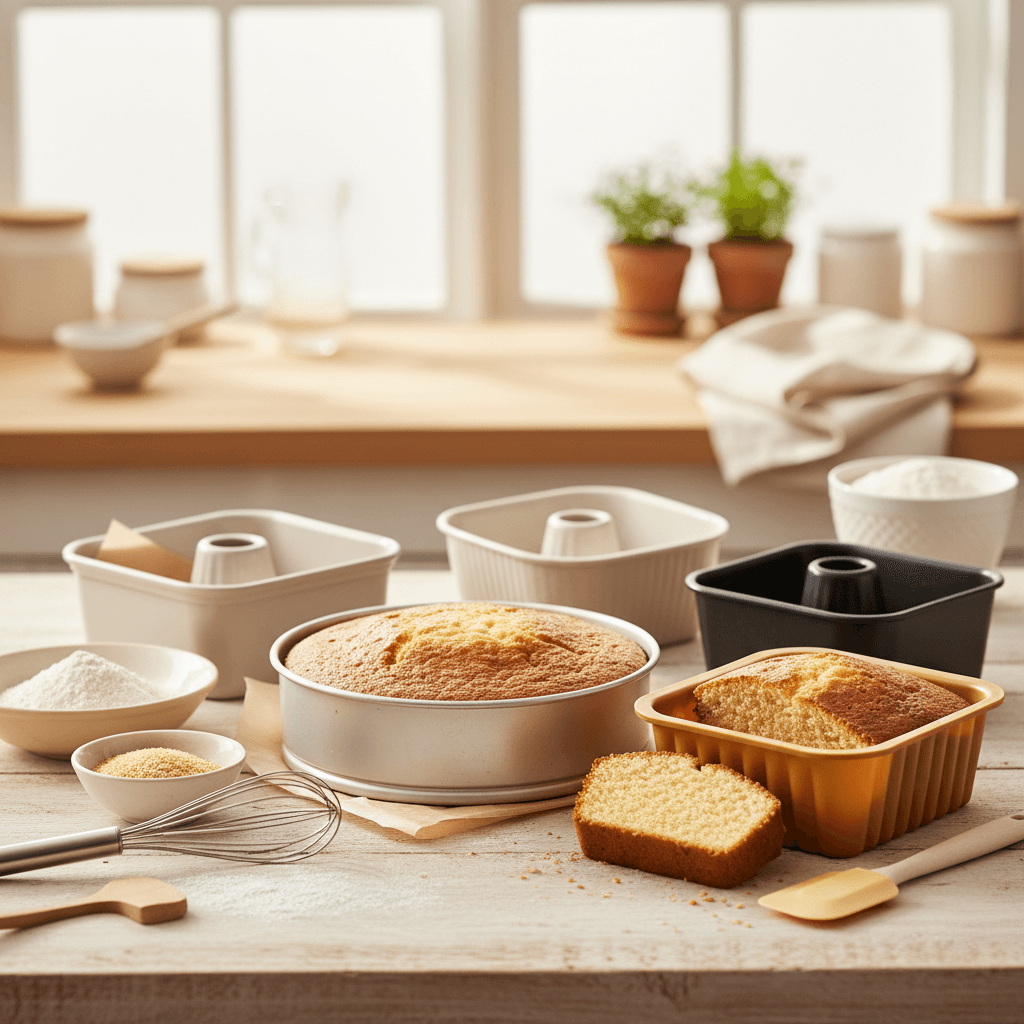
Your gluten-free cake recipe might be perfect, but the wrong pan can still ruin it. Gluten-free batters are more delicate than conventional ones, and pan material, size, and construction directly affect how evenly your cake bakes — and whether it sinks, sticks, or falls apart when you try to unmold it.
Key takeaways
- Light-colored aluminum pans provide the most even heat distribution for fragile gluten-free cake batters, reducing the risk of overbrowning edges while the center stays underdone.
- Darker nonstick pans absorb more heat and can cause gluten-free cakes to set too quickly on the outside, trapping moisture and leading to sinking.
- Straight-sided pans give gluten-free cakes structural support as they rise, while flared or decorative pans create weak points in already fragile crumbs.
- Removable-bottom and springform pans are essential for gluten-free cakes because they let you unmold without flipping — reducing breakage.
- Using the exact pan size your recipe calls for matters more in gluten-free baking, since batter depth affects bake time and internal moisture.
- A quality pan is a one-time investment that solves problems no recipe adjustment can fix.
Why pan choice matters more for gluten-free cakes
Gluten-free cakes lack the protein network that gives conventional cakes their structural resilience. Without gluten, your cake depends entirely on starches, eggs, and binders to hold its shape — and that structure is far more sensitive to uneven heat. If the edges of your cake set and crust over while the center is still liquid, the rising center has nowhere to go and your gluten-free cake sinks as it cools.
The pan you use determines how heat reaches your batter. A thin, dark pan blasts the outside with heat while leaving the center undercooked. A heavy, light-colored pan distributes heat gently and evenly, giving the entire cake time to set at roughly the same rate. This is the single biggest equipment factor in whether your gluten-free cake comes out level or cratered.
What to look for in a gluten-free cake pan
The best pans for gluten-free cakes share a few key characteristics. Here's what actually matters:
Material and color
Light-colored, heavy-gauge aluminum is the gold standard. It conducts heat evenly without absorbing too much, which prevents the edges from overbaking before the center sets. Anodized aluminum is even better — it's more durable and naturally nonstick without the dark coating that causes problems.
Avoid dark nonstick pans for gluten-free cakes. The dark surface absorbs radiant heat and can raise the effective baking temperature by 10-15 degrees at the pan walls. That's enough to set the outer ring of your cake too fast, trapping steam and causing a gummy center or collapse. If you've been troubleshooting gummy centers in gluten-free baking, your pan color might be the culprit.
Construction and sides
Straight, tall sides give gluten-free cake batter something to cling to as it rises. Pans with flared or angled sides look pretty but create thinner edges that overbake and a thicker center that underbakes — exactly the opposite of what fragile GF batters need.
Release mechanism
Gluten-free cakes are more prone to crumbling and breaking than wheat-based ones. A removable bottom or springform mechanism lets you release the cake without flipping it, which is often where things go wrong. Even with perfect greasing and parchment, inverting a delicate GF cake is risky.
If you're building out your gluten-free kitchen, our Confident Gluten-Free Baker Toolkit walks you through all the essential equipment decisions — pans included — so you stop guessing and start baking with confidence.
7 best baking pans for gluten-free cakes
We've researched these pans specifically with gluten-free baking in mind. Here are our top picks.
1. Fat Daddio's anodized aluminum round cake pan
This is our top overall pick. The Fat Daddio's round cake pan is made from heavy-gauge anodized aluminum with straight sides and a removable bottom. It distributes heat beautifully, releases cleanly, and comes in every size you'd need (6", 8", 9", 10"). Professional bakers swear by these, and they're even more valuable for gluten-free work where even baking is critical.
Best for: Layer cakes, single-layer cakes, and any recipe where even baking and clean release are priorities.
2. USA Pan nonstick round cake pan
The USA Pan round cake pan uses aluminized steel with a light-colored silicone nonstick coating. It's a great middle ground — the coating is light enough to avoid the dark-pan heat problems, and the corrugated surface improves airflow. It doesn't have a removable bottom, but the nonstick release is excellent.
Best for: Bakers who want nonstick convenience without the downsides of dark coatings.
3. Nordic Ware naturals aluminum cake pan
Nordic Ware's Naturals line uses uncoated pure aluminum. The Nordic Ware Naturals cake pan is lightweight, affordable, and provides outstanding heat distribution. You'll need to grease and line it with parchment, but the even baking performance is hard to beat at this price point.
Best for: Budget-conscious bakers who don't mind a little extra prep.
4. Fat Daddio's anodized aluminum springform pan
For cheesecakes, mousse cakes, or any gluten-free cake you absolutely cannot flip, the Fat Daddio's springform pan is our pick. Same excellent anodized aluminum construction as their round pans, with a tight-sealing springform mechanism that won't leak.
Best for: Cheesecakes, tortes, and any cake too fragile to invert.
5. Wilton Performance Pans aluminum square cake pan
If you're baking square or sheet-style gluten-free cakes, the Wilton Performance Pans are solid and affordable. They're made from heavy-gauge aluminum with straight sides. Not as premium as Fat Daddio's, but they perform well and are widely available.
Best for: Sheet cakes, snack cakes, and square layer cakes.
6. Parrish Magic Line round cake pan
Another professional favorite, Parrish Magic Line pans are made from heavy-gauge aluminum with perfectly straight 2" or 3" sides. They've been the industry standard in bakeries for decades. No removable bottom, but the quality is exceptional and they last forever.
Best for: Serious home bakers who want bakery-grade equipment.
7. USA Pan bakeware half sheet pan
For gluten-free sheet cakes, jelly rolls, and thin sponge layers, a quality half sheet pan matters. The USA Pan half sheet pan has the same aluminized steel construction and light nonstick coating. It bakes sheet cakes evenly edge to edge.
Best for: Sheet cakes, Swiss rolls, and thin sponge layers.
Pan comparison at a glance
| Pan | Material | Removable bottom | Best use | Price range |
|---|---|---|---|---|
| Fat Daddio's Round | Anodized aluminum | Yes | Layer cakes | $$ |
| USA Pan Round | Aluminized steel | No | Everyday cakes | $$ |
| Nordic Ware Naturals | Pure aluminum | No | Budget pick | $ |
| Fat Daddio's Springform | Anodized aluminum | Yes (springform) | Cheesecakes, tortes | $$ |
| Wilton Performance | Heavy-gauge aluminum | No | Square cakes | $ |
| Parrish Magic Line | Heavy-gauge aluminum | No | Professional quality | $$ |
| USA Pan Half Sheet | Aluminized steel | No | Sheet cakes | $$ |
How pan size affects gluten-free cake baking
Using the wrong pan size is one of the most common reasons gluten-free cakes fail. If your batter is too deep in a small pan, the center takes significantly longer to bake through. During that extra time, the leavening gases escape, and the cake sinks as it cools. If the batter is too shallow in a large pan, it overbakes and dries out.
Always use the exact pan size your recipe specifies. If you need to substitute, adjust your bake time accordingly — a general rule is to reduce time by about 5 minutes when going up one pan size, and increase by 5 minutes when going down. Use a toothpick or instant-read thermometer to check doneness rather than relying on time alone. An internal temperature of 200-210°F usually means a gluten-free cake is done.
Accurate measuring also plays a role here. If your flour measurements are off, even the right pan won't save you. We always recommend using a kitchen scale for gluten-free baking — it's the single most impactful tool upgrade you can make.
Tips for getting the best results from your pans
Even the best pan needs proper technique. Here are the practices that make the biggest difference with gluten-free cakes:
- Grease and line with parchment. Even with nonstick pans, a parchment round on the bottom is cheap insurance. Gluten-free cakes stick more aggressively than conventional ones.
- Don't overfill. Fill cake pans no more than two-thirds full. Gluten-free batters often rise more unpredictably than wheat-based ones, and overflow creates a mess and a sunken center.
- Rotate halfway through baking. Most home ovens have hot spots. Rotating your pan 180 degrees at the halfway mark helps the cake bake evenly.
- Cool in the pan for 10-15 minutes. Gluten-free cakes need time to set their structure before unmolding. Removing them too early leads to crumbling and breakage.
- Use pan strips for tall layer cakes. Wet fabric strips wrapped around the outside of your pan insulate the edges and slow their baking, helping the cake rise more evenly. This is especially helpful for gluten-free batters.
If your cakes are coming out crumbly regardless of your pan, the issue might be your binder. Check out our guide to gluten-free binders that actually work to make sure you're using the right one for cakes.
Pans to avoid for gluten-free cakes
Some pans that work fine for conventional cakes are a poor choice for gluten-free baking:
- Dark nonstick pans: As mentioned, they absorb too much heat and cause uneven baking. This is the most common pan-related problem.
- Glass baking dishes: Glass conducts heat slowly and unevenly. Gluten-free cakes baked in glass often have overbaked edges and underdone centers.
- Silicone pans: They're flexible and nonstick, but silicone is a poor heat conductor. Cakes baked in silicone take longer, brown unevenly, and often lack the structure that gluten-free batters need from the pan walls.
- Intricate bundt or decorative pans: The thin spots and complex shapes create too many opportunities for fragile gluten-free cake to stick and break. If you must use a bundt pan, choose one with a simple design and grease it very thoroughly.
For more on the full range of tools that set you up for success, take a look at our essential gluten-free baking equipment list.
Frequently asked questions
Do I need special pans for gluten-free cakes?
You don't need pans marketed specifically as "gluten-free," but you do need pans that distribute heat evenly. Light-colored, heavy-gauge aluminum pans perform best because they prevent the uneven baking that causes gluten-free cakes to sink or develop gummy centers. Avoid dark nonstick, glass, and silicone for best results.
Why does my gluten-free cake stick to the pan?
Gluten-free batters contain more moisture and sugar relative to their structure, which makes them stickier than conventional cake batter. Always grease your pan, line the bottom with parchment, and let the cake cool in the pan for 10-15 minutes before unmolding. A pan with a removable bottom also helps enormously.
Can I use a dark nonstick pan for gluten-free cake?
We don't recommend it. Dark pans absorb more radiant heat, which can raise the effective temperature at the pan walls by 10-15 degrees. This causes the edges of your gluten-free cake to set too quickly while the center stays liquid, often resulting in sinking. If you must use a dark pan, reduce your oven temperature by 25°F. For more on sinking issues, see our guide on why your gluten-free cake sinks.
What size cake pan is best for gluten-free baking?
Use whatever size your recipe calls for — pan size matters more in gluten-free baking than conventional. An 8" or 9" round pan that's 2" deep is the most versatile choice. If you're building a collection, start with two matching round pans for layer cakes and add a springform for cheesecakes and tortes.
Are springform pans good for gluten-free cakes?
Yes, springform pans are excellent for gluten-free cakes because they let you release the cake without flipping it. Since gluten-free cakes are more fragile and prone to crumbling, avoiding the inversion step can be the difference between a beautiful cake and a pile of crumbs. Look for one made from anodized aluminum with a tight seal.

Written by
Co-founder, BakingSubs
Co-founder of BakingSubs, where he turns the science of ingredient substitutions into tested, reliable guidance for home bakers.
Related Posts
Bake with Confidence
See all
Confident Gluten-Free Baker Toolkit
The science-based system that replaces gluten's seven invisible jobs so your baking turns out soft, fluffy, and foolproof — every time.

Gluten-Free Recipe Vault
Instant access to our complete library of proven gluten-free recipes — no waiting, no guesswork, just results that work tonight.

Fix Your Gluten-Free Bread
Learn the 3-step formula to make bread rise and stay soft, discover why your loaves collapse, and get a tested sandwich bread recipe that actually works.