

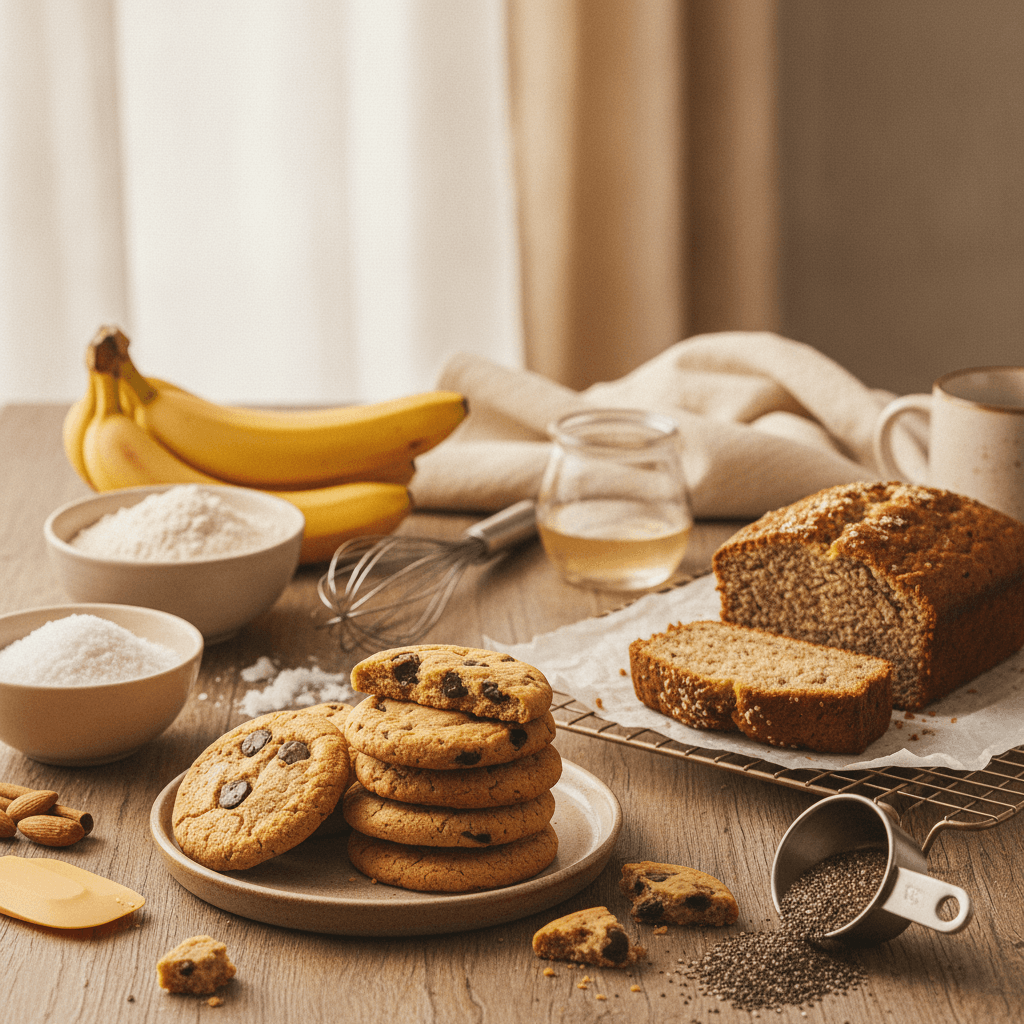
Swapping sugar for monk fruit, replacing butter with applesauce, or adding protein powder to muffins should make baking healthier. But most of these swaps change the chemistry of your batter in ways that produce dry, dense, or oddly textured results. Here are the seven most common healthy baking mistakes, why they happen, and what to adjust so the final product is actually worth eating.
Key takeaways
- Replacing 100% of the sugar in a recipe with a sugar-free sweetener almost always causes texture problems because sugar does far more than sweeten — it holds moisture, tenderizes crumb, and helps browning.
- Protein powder absorbs significantly more liquid than flour, so adding it without extra moisture is the single fastest way to get a dry, crumbly bake.
- Fat substitutes like applesauce or pumpkin puree work well at partial replacement (around 50%) but tend to produce gummy or dense results at full replacement.
- Whole grain and alternative flours often need more liquid, more leavening, or both — dropping them in at a 1:1 ratio with all-purpose flour is a setup for failure.
- Cutting too many ingredients at once (sugar and fat and eggs) removes multiple structural elements simultaneously, leaving nothing to hold the crumb together.
- Overbaking is more common in healthy baking because lower-sugar and higher-protein batters dry out faster at standard bake times.
Mistake 1: Replacing all the sugar with a zero-calorie sweetener
This is the most common healthy baking mistake, and it is the hardest one to fix completely. Sugar is not just a sweetener in baking — it is a structural ingredient. It holds moisture through hygroscopy, tenderizes gluten, feeds yeast in bread, helps Maillard browning, and stabilizes egg foams in cakes. When you remove all of it and drop in erythritol or stevia, you lose every one of those functions.
The result is usually a bake that is dry, pale, and either crumbly or rubbery. Erythritol in particular can recrystallize as the baked good cools, producing a gritty or cooling sensation on the tongue. An erythritol-sweetened banana bread, for example, can seem perfect out of the oven and turn gritty by the next morning — a textbook recrystallization problem.
The fix is to replace only 25–50% of the sugar initially and see how the texture holds up. If you want to go further, allulose behaves more like sugar in terms of moisture retention and browning than erythritol or stevia do, though it is only about 70% as sweet. Blending sweeteners — say, part allulose and part monk fruit — can get you closer to a full replacement without as many texture problems. For a deeper comparison, the sugar alcohols in baking guide covers how each one behaves differently in dough and batter.
One thing worth knowing: sugar performs at least six distinct functions in baking beyond sweetness, and no single alternative sweetener replicates all of them. Going in with that expectation saves a lot of frustration.
Mistake 2: Adding protein powder without adjusting liquid
Protein powder — whether whey, casein, or plant-based — absorbs far more liquid than flour does. Whey concentrate is one of the milder offenders, but casein and pea protein can absorb roughly two to three times their weight in liquid. If you scoop 30g of protein powder into a muffin batter without adding extra moisture, you are effectively pulling water away from the starch and gluten that need it.
The outcome is predictable: dry, crumbly protein baked goods that taste chalky.
The general approach that works is to add roughly 15–30ml of extra liquid (milk, yogurt, or even just water) for every 30g of protein powder you add. The exact amount depends on the protein type — casein needs more, whey isolate needs less. Starting with a smaller substitution, replacing no more than about 25% of the flour with protein powder, keeps the texture recognizable as a baked good rather than a protein bar.
Greek yogurt and cottage cheese are underrated moisture sources here. They add protein and liquid at the same time, which sidesteps the absorption problem. Cottage cheese and Greek yogurt each have tradeoffs in terms of texture and protein content, but either one paired with a moderate amount of protein powder tends to produce better results than protein powder alone.
For a breakdown of which powders cause the least trouble, the protein powder baking comparison ranks ten brands by how they affect crumb.
Mistake 3: Swapping out 100% of the fat with a puree
Applesauce for butter. Pumpkin puree for oil. Mashed avocado for shortening. These swaps show up in every healthy baking article, and they do work — partially. The problem is that most advice says to replace "all" of the fat, and that is where things fall apart.
Fat does three things in baking that purees cannot fully replicate: it coats flour proteins to limit gluten development (tenderizing), it creates air pockets during creaming (leavening), and it slows moisture loss during and after baking (shelf life). Purees add moisture, which is good, but they do not coat proteins or trap air the same way. At 100% replacement, you typically get a bake that is dense, gummy in the center, and stales within hours.
Pumpkin puree as an oil substitute works well at about a 50% swap in quick breads and muffins. Beyond that, the vegetable flavor becomes noticeable and the crumb gets heavy. Zucchini as a fat substitute has a similar ceiling — it adds moisture but cannot replicate the tenderizing effect of fat.
A practical approach: replace half the fat with your puree of choice and keep the other half as actual fat. The remaining fat handles the structural work while the puree reduces the total fat content meaningfully. For a cake recipe calling for 120g of butter, using 60g of butter and 60g of unsweetened applesauce typically produces a noticeably lighter result in terms of fat content without sacrificing the crumb.
Mistake 4: Using alternative flours at a straight 1:1 ratio
Almond flour, coconut flour, oat flour, buckwheat flour — none of these behave like all-purpose flour, and treating them as drop-in replacements is one of the most common healthy baking mistakes. Each alternative flour has different protein content, fat content, fiber content, and water absorption. Coconut flour, for example, absorbs roughly three to four times as much liquid as wheat flour. Using it at a 1:1 ratio produces something closer to cardboard than cake.
Here is a quick reference for how common alternative flours compare:
| Flour | Absorption vs. AP flour | Typical max substitution | Key adjustment needed |
|---|---|---|---|
| Almond flour | Lower | Up to 100% in some applications | Reduce liquid slightly; expect denser crumb |
| Coconut flour | Much higher (3–4x) | 25–30% of total flour | Add significantly more liquid and eggs |
| Oat flour | Slightly higher | Up to 100% in cookies/muffins | Add a small amount of extra liquid |
| Buckwheat flour | Slightly higher | 50–100% depending on application | Blend with a milder flour to manage flavor |
| Chickpea flour | Comparable | 25–50% | Manage beany flavor; works best in savory |
The safer approach is to start by replacing 25–50% of the all-purpose flour with your alternative flour, keeping the rest as-is. This lets you learn how the flour behaves without risking the entire batch. Coconut flour is especially unforgiving — even an extra tablespoon can turn a batter from pourable to paste-like.
Mistake 5: Cutting sugar, fat, and eggs all at once
This is the "triple threat" mistake. Each of those ingredients plays a structural role, and removing one requires compensation from the others. Remove all three, and there is nothing left to hold the crumb together, create tenderness, or retain moisture.
Picture brownies made with no sugar (stevia only), no butter (black bean puree), and no eggs (flax eggs). The likely result is a dense brick that tastes like beans. That is not a failure of any single substitution — each of those swaps can work in isolation. The failure is making all three at once.
The practical rule: change one variable at a time. If you are cutting sugar, keep the fat and eggs. If you are replacing eggs, keep the sugar and fat. Once you have a version that works with one substitution, you can try a second. But going from a traditional recipe to a sugar-free, low-fat, egg-free version in one step almost never produces something edible.
This is especially true for cakes and cookies, where sugar, fat, and eggs each contribute to structure in ways that are difficult to replace simultaneously. Quick breads and muffins are slightly more forgiving because they rely less on creaming and more on chemical leavening, but even there, removing two of the three tends to cause problems.
Mistake 6: Overbaking because you are used to standard timing
Healthy baking substitutions almost always change how fast a baked good dries out in the oven. Higher-protein batters (from protein powder, chickpea flour, or added cottage cheese) set faster and lose moisture more quickly. Lower-sugar batters brown less, which tricks bakers into leaving them in longer — "it doesn't look done yet" — when they are actually already overbaked inside.
The fix has two parts. First, check for doneness 5–7 minutes earlier than the original recipe suggests. A toothpick or cake tester is more reliable than visual browning when sugar has been reduced. Second, pull the bake when the center is just barely set — it will continue cooking from residual heat (carryover cooking) for several minutes after leaving the oven.
This is particularly important with protein-enriched baked goods, where the difference between a moist muffin and a dry hockey puck can be as little as 3 minutes of oven time. An oven thermometer is worth the $7–$12 investment if you do not already have one, because many home ovens run 10–25 degrees hotter than the dial says.
Mistake 7: Not accounting for fiber's effect on texture and moisture
Adding fiber to baked goods — through bran, psyllium husk, inulin, or high-fiber flours — is a common healthy baking goal. But fiber absorbs water aggressively, and different types of fiber behave very differently in batter.
Psyllium husk, for example, forms a gel that can make bread doughs more cohesive (it is widely used in gluten-free baking for exactly this reason). But add too much and the crumb becomes gummy and dense. Wheat bran and oat bran add bulk and absorb moisture, but they also create a coarser, more crumbly texture. Inulin can partially replace sugar while adding fiber, but it has well-documented digestive side effects (bloating, gas) for many people at higher doses — generally above about 10g per serving.
The mistake is treating fiber as a free addition — something you can just throw in without consequences. Every gram of fiber you add needs to be matched with additional liquid, and there is a ceiling on how much fiber a baked good can absorb before the texture suffers. For most applications, replacing more than about 20–25% of the flour with a high-fiber ingredient starts to produce noticeably drier or denser results.
The guide to adding fiber to baked goods covers eight different fiber sources and their practical limits in various applications.
Why fixing one mistake at a time matters more than a perfect recipe
The contrarian take on healthy baking: the goal should not be to make a recipe as healthy as possible in one shot. The bakers who get consistently good results are the ones who change one ingredient per batch and evaluate the result before changing the next thing. That is slower and less dramatic than a complete overhaul, but it produces baked goods that people actually want to eat — which is the whole point.
A muffin that is 30% lower in sugar and uses half the oil is a meaningful improvement over the original. A muffin that is sugar-free, fat-free, egg-free, and made with 100% coconut flour is a science experiment. There is nothing wrong with science experiments, but calling the result a "muffin" sets up unrealistic expectations.
The most useful mental model: every substitution has a cost. Cutting sugar costs you moisture and browning. Cutting fat costs you tenderness. Adding protein costs you softness. Adding fiber costs you lightness. The skill of healthy baking is deciding which costs you are willing to pay and compensating for them — not pretending they do not exist.
Frequently asked questions
Why do my healthy baked goods always turn out dry?
The most likely cause is that your substitutions — protein powder, alternative flours, or reduced fat — are absorbing more moisture than the original ingredients without enough extra liquid to compensate. Protein powder and coconut flour are especially aggressive absorbers. Try adding 15–30ml of extra liquid per 30g of protein powder, or reduce your bake time by 5–7 minutes. This guide to dry protein baked goods covers the most common causes and fixes.
Can I replace all the sugar in a recipe with erythritol?
You can, but the results will be noticeably different. Erythritol does not hold moisture, caramelize, or feed yeast the way sugar does, and it tends to recrystallize as baked goods cool, creating a gritty texture. Replacing 25–50% of the sugar with erythritol produces more predictable results. Erythritol and xylitol behave quite differently in baking, so the type of sugar alcohol matters. Allulose is generally a better option for higher replacement ratios because it resists crystallization and browns more like sugar.
What is the best fat substitute for healthy baking?
It depends on the application. Pumpkin puree and applesauce work well in muffins and quick breads at about a 50% replacement. Greek yogurt adds moisture and protein while reducing fat. Olive oil does not reduce calories but replaces saturated fat with unsaturated fat, which some bakers prefer. No single substitute replicates every function of butter or oil, so partial replacement is usually more successful than full replacement.
How much protein powder can I add to a baking recipe before it ruins the texture?
A common guideline is to replace no more than about 25% of the flour with protein powder. Beyond that, the batter becomes too dry and the crumb turns dense or rubbery. Adding a moisture source like Greek yogurt or cottage cheese alongside the protein powder helps extend that limit somewhat, but there is a practical ceiling for any given recipe.
Is it better to use allulose or monk fruit as a sugar replacement in baking?
They serve different roles. Allulose provides bulk, moisture retention, and browning similar to sugar, making it better for structure-dependent bakes like cakes and cookies. Monk fruit extract is intensely sweet but provides no bulk or moisture, so it needs a bulking agent (often erythritol) to work in baking. Many bakers blend the two — allulose for structure, monk fruit for extra sweetness — to get closer to sugar's full performance. The sugar substitute comparison ranks nine options by how they perform in actual baking.

Written by
Co-founder, BakingSubs
Co-founder of BakingSubs, where he turns the science of ingredient substitutions into tested, reliable guidance for home bakers.
Related Posts


Bake with Confidence
See all
Confident Gluten-Free Baker Toolkit
The science-based system that replaces gluten's seven invisible jobs so your baking turns out soft, fluffy, and foolproof — every time.

Gluten-Free Recipe Vault
Instant access to our complete library of proven gluten-free recipes — no waiting, no guesswork, just results that work tonight.

Fix Your Gluten-Free Bread
Learn the 3-step formula to make bread rise and stay soft, discover why your loaves collapse, and get a tested sandwich bread recipe that actually works.