

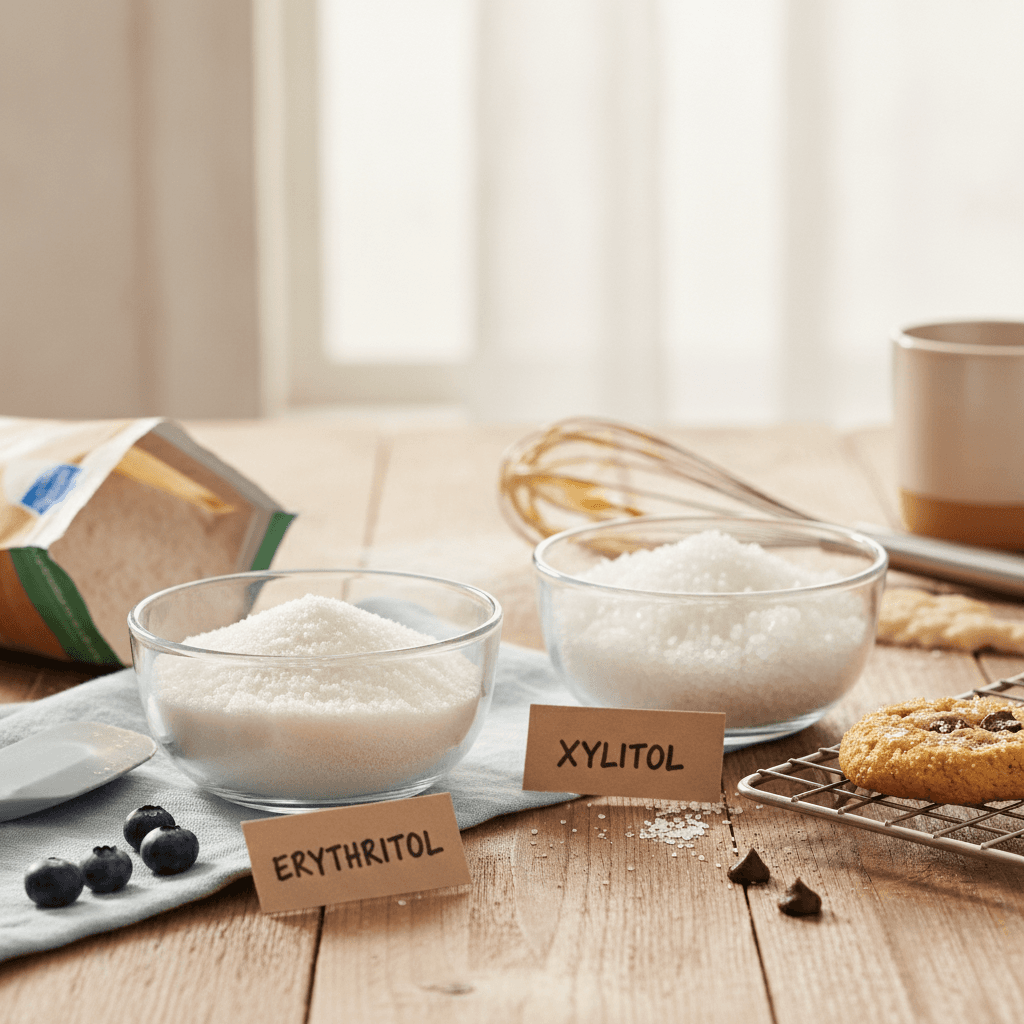
Erythritol and xylitol are both sugar alcohols, both low in calories, and both show up in every "sugar-free baking" recommendation list. But they behave very differently once they hit your mixing bowl. Here are the specific differences that matter for bakers, and when each one is the better pick.
Key takeaways
- Xylitol matches sugar's sweetness almost 1:1, while erythritol is roughly 60–70% as sweet — meaning you need more erythritol or a secondary sweetener to hit the same perceived sweetness.
- Erythritol has a well-known cooling effect on the tongue that becomes especially noticeable in uncooked or lightly baked applications like frostings and no-bake bars.
- Xylitol browns and caramelizes somewhat like sugar; erythritol barely browns at all, which changes the crust color and flavor of cookies and quick breads.
- Erythritol tends to recrystallize as baked goods cool, producing a gritty or crunchy surface — a dealbreaker in soft cookies and cakes unless you take steps to prevent it.
- Xylitol is toxic to dogs even in small amounts. If you bake in a home with pets, this is a serious safety consideration.
- Digestive tolerance differs significantly: erythritol is generally well tolerated even at moderate doses, while xylitol can cause digestive discomfort in smaller amounts for some people.
How erythritol and xylitol compare side by side
Before getting into the baking-specific details, here is a quick reference table covering the properties that matter most when you are deciding between these two sweeteners.
| Property | Erythritol | Xylitol |
|---|---|---|
| Sweetness vs sugar | 60–70% | ~100% (equal to sugar) |
| Calories per gram | ~0.2 kcal | ~2.4 kcal |
| Glycemic index | 0 | ~7–13 |
| Browning/Maillard reaction | Minimal | Moderate |
| Cooling sensation | Strong | Mild to moderate |
| Recrystallization tendency | High | Low |
| Hygroscopic (absorbs moisture) | No | Yes |
| Digestive tolerance (typical) | High | Moderate — can cause GI discomfort |
| Toxic to dogs | No known toxicity | Yes — even small amounts are dangerous |
Those numbers set the stage, but the real differences show up when you actually bake with them.
Sweetness level and how to adjust your ratios
Xylitol is the simpler swap. Because it matches sugar's sweetness almost gram for gram, most bakers substitute it at a 1:1 ratio by weight. A cookie recipe calling for 200g of granulated sugar gets 200g of xylitol, and the sweetness lands in the same range.
Erythritol is trickier. At 60–70% the sweetness of sugar, a straight 1:1 swap leaves baked goods tasting flat. Some bakers compensate by increasing the amount — using roughly 130g of erythritol for every 100g of sugar called for — but that extra bulk changes the texture and increases the risk of recrystallization. A more reliable approach is to use erythritol at a 1:1 ratio by weight and then add a high-intensity sweetener like monk fruit extract or stevia to close the sweetness gap. Many commercial "erythritol baking blends" already do this — brands like Lakanto blend erythritol with monk fruit, and Truvia blends erythritol with stevia leaf extract.
If you are baking keto or low-carb and sweetness accuracy matters, check out our broader rundown of keto-friendly sugar substitutes for baking to see how these two stack up against allulose and other options.
Why erythritol recrystallizes (and how to reduce it)
This is the single biggest complaint bakers have about erythritol: it recrystallizes as the baked good cools. The result is a gritty, sandy, or crunchy texture on the surface and sometimes throughout the crumb. In cookies, the top can develop a white, almost frosted appearance that crunches when you bite into it.
The reason is straightforward. Erythritol has relatively low solubility compared to sugar or xylitol. It dissolves when heated, but as the temperature drops, it comes out of solution and forms crystals. The effect is most dramatic in recipes with low moisture content — think shortbread, biscotti, or thin cookies.
A few strategies help reduce (but rarely eliminate) the problem:
- Use powdered erythritol instead of granular. Grinding it in a blender or buying it pre-powdered reduces crystal size. Smaller crystals are less noticeable on the palate, though they still form.
- Combine erythritol with a humectant sweetener. Allulose, for example, holds moisture and resists crystallization. A 50/50 blend of erythritol and allulose significantly reduces grittiness in many baked goods.
- Add a small amount of fat or a binding ingredient. Recipes with higher butter or oil content tend to mask the crystalline texture better than lean recipes.
- Eat baked goods warm. This is not a real fix, but it is worth knowing: erythritol-sweetened cookies and muffins taste noticeably better within the first hour out of the oven, before full recrystallization occurs.
Xylitol does not have this problem. It stays dissolved and actually absorbs moisture from the air (it is hygroscopic), which keeps baked goods softer longer. That moisture-absorbing quality is a double-edged sword, though — xylitol-sweetened cookies can become sticky or soft in humid storage conditions.
Browning, crust color, and the Maillard reaction
Sugar does more than sweeten baked goods. It participates in the Maillard reaction and caramelization, which produce the golden-brown color and complex flavor notes you expect from cookies, quick breads, and cakes. This is one of the key functions of sugar in baking that often gets overlooked when people swap in alternatives.
Xylitol participates in browning reactions to a moderate degree. It will not produce exactly the same depth of color as sucrose, but cookies made with xylitol still develop a visible golden hue. The flavor notes are slightly different — less caramel complexity — but recognizable.
Erythritol barely browns at all. Cookies come out pale, almost white on top. Quick breads lack the warm crust color that signals "done" to most bakers. This is purely cosmetic in some cases, but it also means you lose the toasty, caramelized flavor layer that browning creates. If crust color and flavor matter to the final product (and in most cookies and cakes, they do), erythritol is at a clear disadvantage.
One workaround: add a small amount of a browning-friendly ingredient. A tablespoon of molasses, a teaspoon of barley malt syrup, or even a splash of milk (the lactose contributes to Maillard browning) can restore some color. Of course, those additions affect the nutritional profile, which may or may not matter depending on your goals.
The cooling effect and where it becomes a problem
Both erythritol and xylitol produce an endothermic reaction when they dissolve — they absorb heat, creating a cooling sensation on the tongue. This is the same effect you feel in sugar-free gum and mints. But the intensity differs.
Erythritol has a pronounced cooling effect. In baked goods where the sweetener is fully incorporated into a cooked matrix (like a cake crumb), it is less noticeable. But in frostings, glazes, no-bake bars, or anything where the sweetener sits closer to the surface, the cooling sensation can be distracting. Some people describe it as a "minty" feeling without the mint flavor.
Xylitol also has a cooling effect, but it is milder and generally less noticeable in baked applications. In frosting, it is still perceptible but not as dominant as erythritol.
If you are making buttercream, royal icing, or any application where the sweetener is not fully cooked, xylitol is typically the better choice of the two. For fully baked goods like muffins and cakes, the cooling effect from either sweetener is usually subtle enough to be acceptable.
Texture and moisture in the final bake
Sugar is hygroscopic — it attracts and holds moisture, which is part of why sugar-sweetened baked goods stay soft for days. When you remove sugar and replace it with a sugar alcohol, you change the moisture dynamics of the recipe.
Xylitol is also hygroscopic, so it partially replicates sugar's moisture-holding behavior. Muffins and cakes made with xylitol tend to stay reasonably moist for 2–3 days, though they may feel slightly stickier than their sugar-sweetened counterparts.
Erythritol is not hygroscopic. It does not attract or retain moisture. Baked goods made with erythritol tend to dry out faster and can feel crumbly or chalky, especially in recipes that already lean dry (like scones or biscotti). This drying effect compounds the recrystallization issue — you get a baked good that is both gritty and dry, which is not a great combination.
If you are working on fixing texture in low-sugar baking, understanding this moisture difference is essential. Adding extra fat, an extra egg yolk, or a tablespoon of a humectant like honey or allulose can offset erythritol's drying tendency — though each of those additions changes the nutritional math.
Which works better in specific baked goods
Rather than declaring one universally "better," here is how they compare across common baking categories:
| Baked good | Better choice | Why |
|---|---|---|
| Soft cookies (chocolate chip, snickerdoodle) | Xylitol | Stays soft, browns, no recrystallization |
| Crisp cookies (shortbread, biscotti) | Either — with caveats | Erythritol's crunch can work here, but grittiness is still noticeable |
| Cakes and cupcakes | Xylitol (or erythritol/allulose blend) | Moisture retention and browning favor xylitol; erythritol alone dries the crumb |
| Muffins and quick breads | Xylitol | Better browning, softer crumb, less grittiness |
| Frosting and icing | Xylitol (slight edge) | Less cooling effect; erythritol's cooling is very noticeable in uncooked applications |
| Meringue | Neither works well | Sugar alcohols do not stabilize foam the way sucrose does |
| Yeast bread | Neither feeds yeast | Sugar alcohols are not fermentable by standard baker's yeast |
That last point catches a lot of bakers off guard. If your bread recipe relies on sugar to feed the yeast, neither erythritol nor xylitol will work as a replacement for that function. You will need a small amount of real sugar, honey, or another fermentable carbohydrate to get proper rise. For more on building low-carb bread, the flour choice matters just as much as the sweetener.
For a broader look at how sugar substitutes perform specifically in cookies — where texture differences are most obvious — see our comparison of sugar substitutes for baking cookies.
Pet safety: a non-negotiable difference
This is not a baking performance issue, but it is arguably the most important difference between these two sweeteners. Xylitol is extremely toxic to dogs. Even small amounts — as little as 0.1g per kilogram of body weight — can cause a rapid, dangerous drop in blood sugar (hypoglycemia) and, at higher doses, liver failure. The ASPCA and veterinary poison control centers consistently list xylitol as one of the most dangerous household substances for dogs.
Erythritol does not appear to have the same toxicity in dogs, though research is more limited.
If you bake at home with dogs in the house, or if you sell baked goods to customers who might share scraps with pets, this is a serious consideration. A xylitol-sweetened cookie dropped on the floor is a veterinary emergency. Many home bakers, including those running home bakery businesses, choose erythritol partly for this reason — the liability and ethical concerns around xylitol and pets are real.
Digestive tolerance
Sugar alcohols as a category are known for causing digestive discomfort — bloating, gas, and laxative effects — when consumed in excess. But tolerance varies significantly between erythritol and xylitol.
Erythritol is the best-tolerated sugar alcohol. About 90% of ingested erythritol is absorbed in the small intestine and excreted unchanged in urine, meaning very little reaches the large intestine where fermentation (and gas) happens. Most people can consume 0.5–1g per kilogram of body weight without issues. For a 70kg person, that is 35–70g — well above what you would get from a couple of cookies or a slice of cake.
Xylitol is less forgiving. It is only partially absorbed in the small intestine, and the unabsorbed portion is fermented by gut bacteria in the colon. Doses above 20–30g in a single sitting commonly cause bloating, cramping, or diarrhea in sensitive individuals. A single xylitol-sweetened muffin probably will not cause problems for most people, but eating three or four might.
If you are baking for others — especially for a home bakery where you sell specialty items — it is worth noting on your labeling which sugar alcohol you use. Customers with IBS or other digestive sensitivities will appreciate the transparency.
Cost and availability
Both sweeteners are more expensive than granulated sugar, but the gap between them has narrowed over the past few years.
Erythritol typically runs $6–$10 per pound when purchased in bulk bags from brands like NOW Foods or Anthony's. Granular and powdered forms are widely available online and in health food stores.
Xylitol is in a similar range — roughly $7–$12 per pound — though birch-derived xylitol tends to cost more than corn-derived xylitol. Some bakers prefer birch-derived for perceived quality reasons, but functionally they perform the same in baking.
For reference, granulated sugar costs roughly $0.50–$0.80 per pound. So either sugar alcohol represents a roughly 10–15x increase in sweetener cost. In a batch of 24 cookies using 150g of sweetener, you are looking at roughly $2–$3.50 in sweetener cost compared to about $0.25 for sugar. That matters if you are pricing baked goods for sale.
A contrarian take: neither one is great on its own
Here is an opinion that goes against most sugar-free baking advice: neither erythritol nor xylitol performs well enough as a solo sugar replacement in most baked goods. The best results almost always come from blending them with each other or with a third sweetener like allulose, which handles moisture, browning, and texture better than either sugar alcohol alone.
A blend of 50% erythritol and 50% allulose, for example, gets you closer to sugar's behavior than either ingredient on its own. Or a blend of xylitol with a small amount of monk fruit extract can reduce the total xylitol needed (lowering digestive risk and cost) while maintaining sweetness.
Thinking of sugar alcohols as ingredients in a blend — rather than as drop-in sugar replacements — is the shift that tends to produce the best baked goods. For more on how to choose between sugar alternatives, our guide covers the broader landscape beyond just these two.
Frequently asked questions
Can you substitute erythritol for xylitol 1:1 in baking?
Not by sweetness. Erythritol is only 60–70% as sweet as xylitol, so a 1:1 swap by weight will produce a noticeably less sweet result. You would need to increase the erythritol amount or add a high-intensity sweetener like monk fruit or stevia to compensate. The texture will also differ — erythritol tends to recrystallize and produce a grittier result, while xylitol stays smoother.
Does erythritol or xylitol taste more like sugar?
Xylitol is generally considered closer to sugar in taste. It matches sugar's sweetness level almost exactly and has a clean, sweet flavor without strong off-notes. Erythritol is less sweet and has a noticeable cooling sensation, especially in frostings and other uncooked applications. Both lack the caramel complexity that sugar develops through browning.
Is erythritol or xylitol better for keto baking?
Erythritol has a glycemic index of 0 and essentially zero net carbs, making it the more popular choice in strict keto baking. Xylitol has a glycemic index of roughly 7–13 and contains about 2.4 calories per gram, so it is not zero-impact — but it is still dramatically lower than sugar. For strict keto, erythritol (often blended with monk fruit) is the more common pick. For low-carb baking where a small glycemic impact is acceptable, xylitol's superior baking performance may be worth the tradeoff. See our full list of keto-friendly sugar substitutes for more options.
Why do my erythritol cookies have a gritty or sandy texture?
Erythritol recrystallizes as baked goods cool because it has lower solubility than sugar. The crystals form on and within the cookie, creating that sandy or crunchy texture. Using powdered erythritol, blending it with allulose, or increasing the fat content in your recipe can reduce — but usually not fully eliminate — the grittiness.
Is xylitol safe to use in baking if I have dogs?
Xylitol is extremely toxic to dogs, even in small amounts. A single xylitol-sweetened cookie dropped on the floor could be a veterinary emergency. If you bake at home with dogs, erythritol is the safer choice. If you sell baked goods made with xylitol, clearly labeling the ingredient is important so customers with pets can make informed decisions.

Written by
Co-founder, BakingSubs
Co-founder of BakingSubs, where he turns the science of ingredient substitutions into tested, reliable guidance for home bakers.
Related Posts
Bake with Confidence
See all
Confident Gluten-Free Baker Toolkit
The science-based system that replaces gluten's seven invisible jobs so your baking turns out soft, fluffy, and foolproof — every time.

Gluten-Free Recipe Vault
Instant access to our complete library of proven gluten-free recipes — no waiting, no guesswork, just results that work tonight.

Fix Your Gluten-Free Bread
Learn the 3-step formula to make bread rise and stay soft, discover why your loaves collapse, and get a tested sandwich bread recipe that actually works.