
Should You Specialize or Sell Variety as a Home Baker? The Real Tradeoffs Nobody Talks About
Should you specialize or sell variety as a home baker? Use this 5-variable decision framework with real pricing data to find the approach that maximizes your profit per hour.

Malik
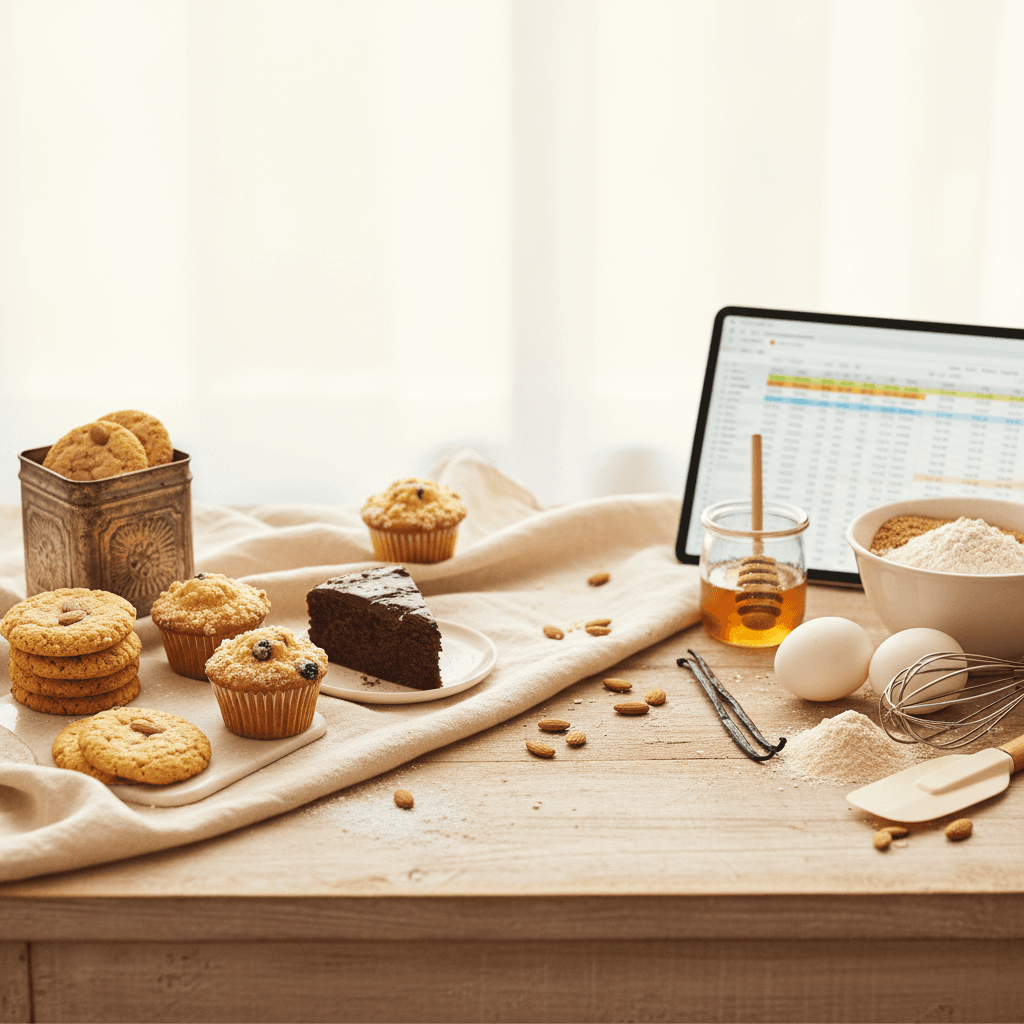
This question haunts every home baker who's moved past the hobby stage. The honest answer is that it depends on five specific variables — and most advice you'll find online ignores at least three of them. Here's the framework I use and what I've seen work (and fail) across dozens of home bakeries.
Key takeaways
- Specializing typically increases profit per hour by 25–40% because of ingredient consolidation and faster production times, but it caps your total addressable market.
- Variety menus work best in underserved areas with fewer than 3 competing home bakers within a 15-mile radius.
- The highest-earning home bakers I've tracked ($3,200–$4,800/month) almost always started with variety, then narrowed to 2–3 high-margin categories within 6–12 months.
- Your cottage food law limits matter more than your preference — some states cap annual revenue at $25,000, which changes the math entirely.
- The "specialize or diversify" decision should be revisited every 6 months as your customer base, capacity, and burnout level shift.
Why the standard advice to "just pick a niche" misses the point
You've probably heard it a hundred times: niche down, become known for one thing, dominate your local market. And there's real logic behind it. But that advice was designed for businesses with employees, commercial kitchens, and marketing budgets. A solo home baker operating under cottage food law in a 120-square-foot kitchen faces a completely different set of constraints.
The real question isn't "should I specialize?" — it's "given my specific situation, which approach puts more money in my pocket per hour of work while keeping me sane?"
Rachel, a home baker in suburban Ohio, tried going all-in on custom decorated cookies. She charged $48 per dozen for decorated sugar cookies and her work was beautiful. But her town of 14,000 people only generated 3–5 decorated cookie orders per month. She was making $600/month when she needed $2,000. Adding brownies, banana bread, and cinnamon rolls to her menu tripled her revenue within 8 weeks — not because she was better at marketing, but because the market was too small for a single-product business.
Meanwhile, Tanya in Austin focused exclusively on sourdough loaves at $12 each. She sells 40 loaves every Saturday through a pre-order system. That's $480/week from one product with one dough recipe and one bake day. She tried adding pastries and it actually decreased her weekly revenue because the prep time cut into her loaf capacity.
Same question, opposite answers. The difference is the variables.
The 5 variables that actually determine your answer
Before you decide anything, score yourself on these five factors. They matter more than your personal preference.
1. Local market size and competition density
If you're in a metro area with 100,000+ people within delivery range and 15 other home bakers posting on Instagram, specializing is almost always the right move. You need to be the person for something specific. "I make cakes and cookies and bread" doesn't cut it when customers have 15 other options.
If you're in a town of 8,000–25,000 with one or two other home bakers, variety often wins. There simply aren't enough people wanting decorated cookies every week to sustain a specialist.
2. Your production capacity in hours per week
This one is brutally practical. If you're running your bakery alongside a full-time job and have 12–15 hours per week for baking, a varied menu will destroy you. Every different product means a different prep timeline, different ingredients to stock, and different packaging. At 12 hours a week, you need ruthless efficiency — and that means fewer products.
At 30+ hours per week (full-time home baking), you have room for a curated variety menu of 6–8 items because you can batch different categories across different days.
3. Your revenue target vs. your state's cottage food cap
If your state caps cottage food sales at $25,000/year and you're targeting $20,000, you have very little room for experimentation. Every dollar matters, and you need to maximize profit per item. Specialization usually wins here because you can command higher prices as a specialist — a baker known for incredible cinnamon rolls can charge $6 each, while a baker selling "assorted baked goods" struggles to get past $4.
If your state has no cap (or a high one like $150,000 in Texas), variety gives you more revenue channels and protects you from seasonal dips.
4. Ingredient overlap and waste rate
I tracked my own ingredient waste for 3 months when I was running a 9-item menu vs. a 4-item menu. The 9-item menu generated 14% ingredient waste (expired heavy cream, specialty flours going stale, fruit I couldn't use fast enough). The 4-item menu dropped waste to 3%. On $800/month in ingredient costs, that's the difference between $112 thrown away and $24.
Products that share a base — like cookies, brownies, and blondies all using butter, sugar, eggs, and flour — waste less than a menu spanning bread, cakes, and decorated cookies.
5. Your burnout threshold
This isn't soft advice — it's a business variable. Burnout kills more home bakeries than bad pricing does. Some bakers thrive on repetition: making the same 3 products 50 times a week is meditative. Others lose their minds doing the same thing and need creative variety to stay motivated.
Be honest about which camp you're in. A burned-out baker produces inconsistent work, misses deadlines, and eventually quits. The "optimal" business strategy means nothing if you can't sustain it for 18 months.
A decision framework you can actually use
Here's the framework I recommend. It's not perfect, but it's better than guessing.
| Factor | Lean toward specializing | Lean toward variety |
|---|---|---|
| Population within delivery range | 50,000+ | Under 30,000 |
| Competing home bakers nearby | 5 or more | 0–2 |
| Weekly baking hours available | Under 15 hours | 25+ hours |
| Cottage food revenue cap | Under $35,000 | $50,000+ or no cap |
| Your personality | Loves perfecting one thing | Needs creative variety |
| Revenue goal | $1,500–$2,500/month | $3,000+/month |
Count your columns. If you have 4 or more in one direction, that's your starting point. If it's 3-3, read the next section — you're in hybrid territory.
The hybrid approach most successful home bakers actually use
Here's what I've seen work better than pure specialization or pure variety: a focused core with strategic add-ons.
This means you pick 1–2 signature products that define your brand and generate 60–70% of your revenue. Then you offer 2–3 complementary items that share ingredients and production methods with your core.
Megan, a home baker in North Carolina, built her business around custom cakes. That's her brand — when people in her area think "birthday cake," they think of Megan. But she also sells cake pops (made from cake scraps, so zero waste) and cupcakes (same batter, different format). Her custom cakes average $165 each and bring in about $2,400/month. The cake pops and cupcakes add another $800/month with almost no additional ingredient cost.
Compare that to a baker trying to be known for cakes AND sourdough AND cookies AND pie. There's no brand clarity, the ingredient lists don't overlap, and the production schedule is chaos.
How to structure a hybrid menu
Pick your anchor category — the one product where you can price confidently, produce efficiently, and genuinely stand out. Then add items that meet at least 2 of these 3 criteria:
- They share 70%+ of the same ingredients as your anchor
- They can be produced in the same bake session without adding more than 45 minutes
- They appeal to the same customer (someone ordering a birthday cake also wants cupcakes for the office)
Items that fail all three criteria should be cut, no matter how much you enjoy making them. This is where learning to say no becomes essential.
The real numbers: specialization vs. variety profitability
I ran the numbers on two hypothetical (but realistic) home bakery models operating 20 hours per week with $600/month in ingredient budget. Both are in a mid-size suburban market.
| Metric | Specialist (sourdough only) | Variety (8-item menu) | Hybrid (2 core + 3 add-ons) |
|---|---|---|---|
| Monthly revenue | $2,080 | $2,640 | $2,880 |
| Ingredient cost | $390 | $620 | $510 |
| Ingredient waste | $12 (3%) | $87 (14%) | $31 (6%) |
| Packaging cost | $85 | $195 | $120 |
| Net profit | $1,593 | $1,738 | $2,219 |
| Profit per hour | $19.91 | $21.73 | $27.74 |
| Unique SKUs to manage | 3 (flavors) | 8 | 5 |
The variety model generates more gross revenue but eats it in waste, extra packaging, and production inefficiency. The hybrid model wins on profit per hour because it captures variety revenue without variety overhead.
These numbers shift based on your pricing. If you're still undercharging, fixing your prices matters more than your menu structure.
When to specialize from day one
There are specific situations where going narrow immediately makes sense:
- You're entering a saturated market. If there are already 10+ home bakers in your area selling "a little of everything," the only way to stand out is to be the best at one thing. The generalist slot is taken.
- You're targeting a premium price point. Customers pay $75 for a specialty item from an expert. They won't pay $75 for the same item from someone who also sells $3 muffins. Perceived expertise drives willingness to pay.
- You have a genuine skill advantage. If your laminated dough is legitimately better than anything available locally, lean into croissants and Danish. Don't dilute that advantage with mediocre banana bread.
- You want wholesale or corporate accounts. Coffee shops and offices want a reliable supplier for one category, not a baker who does a bit of everything. Corporate clients especially value consistency and simplicity in their vendor relationships.
When variety is the smarter play
And here's when casting a wider net actually makes more business sense:
- You're in a small or underserved market. If the nearest bakery is 20 miles away, you ARE the bakery. People need birthday cakes, holiday cookies, and Saturday morning pastries. Being the local one-stop shop is a legitimate strategy.
- You're still figuring out what sells. In your first 3–6 months, variety is market research. Track what sells fastest, what gets reordered, and what gets the most word-of-mouth. Then narrow based on data, not guesses. This is part of validating your bakery concept.
- Your revenue depends on seasonal spikes. A cookie specialist might crush it in December but struggle in July. A varied menu smooths out the revenue curve. You can still price seasonal items at a premium while maintaining year-round staples.
- You're building a weekly pre-order model. Weekly pre-order menus thrive on rotation. Customers order every week because there's something new. A rotating menu of 4–5 items per week (from a bank of 12–15 recipes) keeps regulars engaged without the chaos of unlimited options.
The narrowing timeline: how to transition from variety to focus
If you're currently running a big menu and feeling scattered, here's a practical timeline for narrowing down without losing customers.
Month 1: Audit. Pull your last 90 days of orders. Calculate actual profit per item (not revenue — profit, after ingredients, packaging, and your time at a minimum of $20/hour). I guarantee 2–3 items are subsidizing the rest.
Month 2: Test removal. Drop your lowest-profit item from the menu. Don't announce it — just stop offering it. See if anyone notices. (Usually, nobody does.)
Month 3: Double down. Take the production time you freed up and make more of your top seller. Promote it harder. Raise the price by $1–2 if you haven't already.
Month 4–6: Repeat. Cut one more low performer. Add a variation of your best seller instead (new flavor, different size, gift packaging). Your menu gets smaller but your revenue per item goes up.
By month 6, most bakers land on 3–5 products that generate 85%+ of their revenue. That's your natural niche — discovered through data, not decided by a blog post.
A contrarian take: the "best" strategy changes as you grow
Here's something most niche-down advice won't tell you: the right answer at $500/month is different from the right answer at $3,000/month.
Early stage ($0–$1,000/month): Variety wins. You need volume, you need data, and you need word-of-mouth from as many customers as possible. This is survival mode.
Growth stage ($1,000–$3,000/month): Hybrid wins. You've identified what sells. Now cut the losers, double down on winners, and build a brand around your strengths. Your brand identity starts to crystallize.
Mature stage ($3,000+/month): Specialization usually wins. You're capacity-constrained, so every hour needs to generate maximum profit. A tight menu with premium pricing and a waitlist is the endgame for most successful home bakers. At this point, your business model sustainability depends on efficiency.
The mistake is treating this as a permanent decision. It's not. It's a strategy that should evolve as your business does.
Frequently asked questions
How many items should a home bakery menu have?
Most profitable home bakeries I've seen operate with 4–7 items available at any given time. That doesn't mean you only know how to make 7 things — it means you only sell 7 things. A rotating weekly menu can draw from a bank of 15–20 recipes while only offering 5 per week. This keeps production manageable and customers interested without the overhead of stocking ingredients for 20 products simultaneously.
Can you make good money as a home baker without specializing?
Yes, but it requires more discipline. Bakers running variety menus who earn $2,500+/month typically use strict ingredient overlap rules (every item shares at least 70% of the same base ingredients), batch production schedules, and rotating menus rather than an always-available catalog. Without those systems, variety menus tend to plateau around $1,200–$1,500/month because production inefficiency eats into capacity. Efficient batch baking systems are non-negotiable for variety menus.
What is the most profitable niche for a home bakery?
Custom decorated cookies and custom cakes consistently show the highest profit margins — typically 65–75% after ingredients and packaging — because customers are paying for skill and design, not just ingredients. However, they also require the most time per order. On a profit-per-hour basis, simple drop cookies and bars sold in bulk (farmers markets, weekly pre-orders) often outperform custom work because production time is a fraction of the decorating time. The "most profitable" niche is the one where your speed and skill intersect with local demand. Check out our home bakery niche ideas breakdown for specific comparisons.
Should I specialize in one type of baked good or offer seasonal variety?
Seasonal variety within a specialty is the sweet spot. For example, a baker who specializes in sourdough can offer pumpkin spice sourdough in fall, rosemary olive oil in winter, and jalapeño cheddar in summer — all using the same base dough and process. This gives customers the novelty they want while keeping your production streamlined. The key is that your seasonal additions should never require new equipment, new techniques, or more than 1–2 additional ingredients beyond your standard pantry.
When should I stop offering a product on my home bakery menu?
Cut a product when it meets two or more of these criteria: it generates less than 10% of your monthly revenue, its profit margin is under 50% after ingredients and packaging, it requires unique ingredients that nothing else on your menu uses, or it takes disproportionately long to produce relative to what you charge. Run this audit quarterly. Most bakers hold onto low performers out of emotional attachment ("but my lemon bars are so good!") rather than business logic. If a product isn't earning its spot, replace it with more of what's already working.

Written by
Co-founder, BakingSubs
Co-founder of BakingSubs, where he turns the science of ingredient substitutions into tested, reliable guidance for home bakers.
Related Posts
Bakery Recipe Cost Sheet: How to Cost a Recipe in 6 Steps (With a Table You Can Copy)
Home Bakery Order Form Template: A Copy-Paste Layout That Cuts Mistakes by Half
Cottage Food Label Requirements and Template: What Every State Demands (With a Copy-Paste Layout)
Bake with Confidence
See all
Confident Gluten-Free Baker Toolkit
The science-based system that replaces gluten's seven invisible jobs so your baking turns out soft, fluffy, and foolproof — every time.

Gluten-Free Recipe Vault
Instant access to our complete library of proven gluten-free recipes — no waiting, no guesswork, just results that work tonight.

Fix Your Gluten-Free Bread
Learn the 3-step formula to make bread rise and stay soft, discover why your loaves collapse, and get a tested sandwich bread recipe that actually works.