

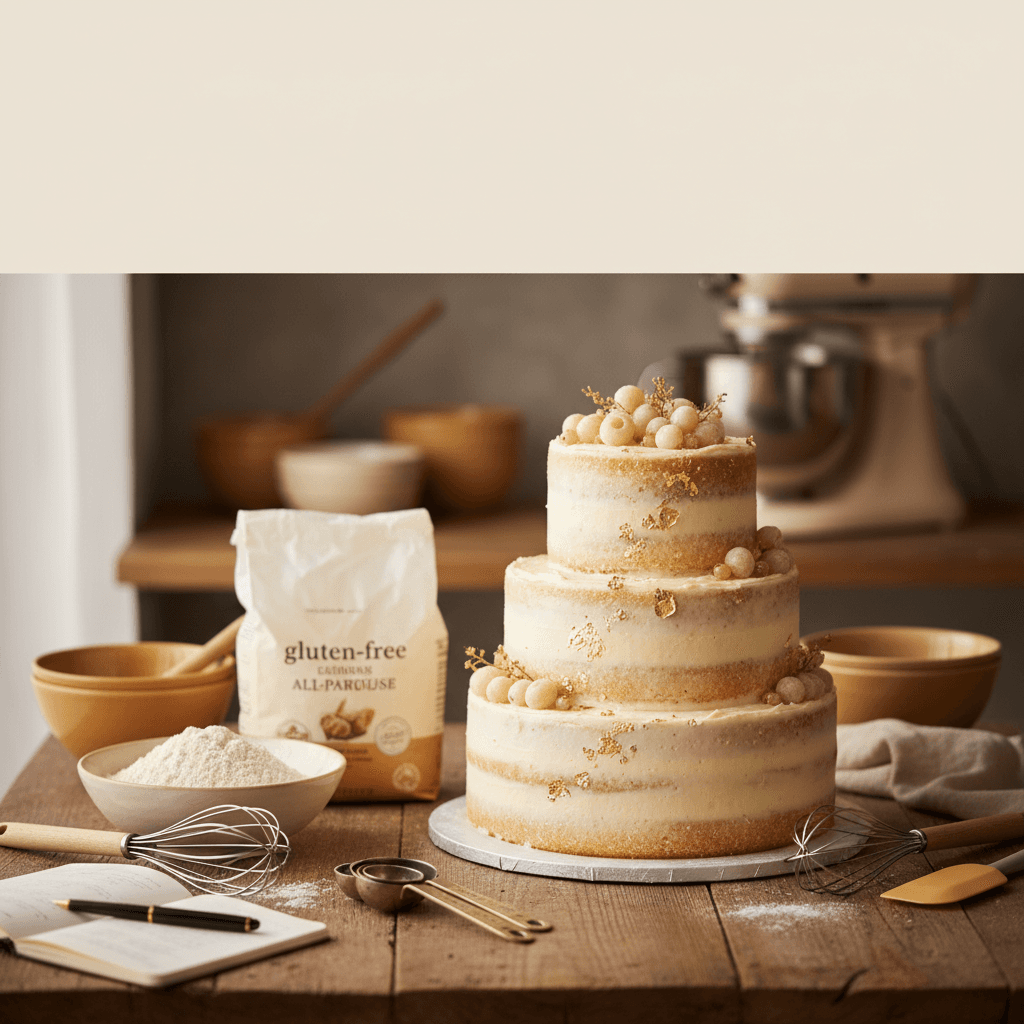
Most home bakers price custom cakes by looking at what other bakers charge on Instagram, then matching or undercutting. That is not pricing — that is guessing, and it is why so many custom cake businesses run at a loss without realizing it. Here is the framework I use and recommend to bakers who want to actually earn a living from their work.
Key takeaways
- Your custom cake price has three non-negotiable components: ingredient cost, labor cost, and overhead — skip any one and you are losing money on every order.
- A common 6-inch round decorated cake costs $8–$14 in ingredients alone, before you count a single minute of your time.
- Most profitable home bakers price custom cakes at 3.5x to 5x their ingredient cost, depending on complexity and market.
- Time tracking is the single most important habit for accurate pricing — most bakers underestimate labor by 30–50% until they start logging hours.
- Raising prices does not require losing customers if you do it with structure and clear communication.
- Your local market matters, but it should set a floor for what you charge — not a ceiling.
Why the "look at competitors" method fails for custom cakes
Competitor pricing only tells you what other people charge. It tells you nothing about whether those bakers are profitable, burning out, or subsidizing their business with a day job. I tracked pricing from 23 home bakers in a mid-size Southern city over six months. Eleven of them had raised prices at least once. Four had quit entirely. The ones who quit were, on average, charging 22% less than the ones who stayed.
The problem is that custom cakes are not commodities. A 3-tier fondant wedding cake with sugar flowers is a completely different product than a 3-tier buttercream birthday cake with sprinkles, even if they serve the same number of people. Pricing by comparison collapses all that complexity into a single number and ignores your specific costs, your speed, your rent, and your skill level.
If you have been undercharging for your baked goods, this is almost always the root cause.
The three layers of a custom cake price
Every custom cake price should be built from three layers stacked on top of each other. Miss one and you are subsidizing your customer's celebration out of your own pocket.
Layer 1: ingredient cost
This is the most straightforward layer, but most bakers still get it wrong because they estimate instead of measuring. A basic 8-inch, two-layer vanilla cake with American buttercream costs roughly $9.47 in ingredients at current retail prices (flour, sugar, butter, eggs, vanilla, powdered sugar, milk). That number jumps to $13.80 if you use real vanilla extract instead of imitation and European-style butter.
For fondant-covered cakes, add $4–$7 per batch of fondant depending on whether you make your own or buy Satin Ice or Fondarific. Specialty elements like modeling chocolate, isomalt, or edible gold leaf can push a single cake's ingredient cost past $35.
Track every ingredient. Weigh it. Price it per gram from your actual receipts, not from memory. I built a simple spreadsheet that auto-calculates ingredient cost per recipe, and the first time I used it, I realized I had been underestimating my chocolate cake recipe by $3.12 per batch — mostly because I forgot to count the cocoa powder and espresso I add.
Layer 2: labor cost
This is where most underpricing happens. You need to decide what your time is worth per hour, then actually track how long each cake takes.
A reasonable starting point for a skilled home baker is $25–$40/hour. If you are doing advanced sugar work, sculpted cakes, or hand-painted details, $50–$75/hour is appropriate. The market does not set your hourly rate — your skill, speed, and the complexity of the work do.
Here is what a typical custom birthday cake timeline looks like when you actually track it:
| Task | Time |
|---|---|
| Client consultation (phone/text) | 15–25 min |
| Design sketch or reference gathering | 10–20 min |
| Baking (including prep and cleanup) | 1.5–2.5 hours |
| Cooling and leveling | 30 min active + wait time |
| Filling, crumb coat, chill | 25–40 min |
| Final coat and decorating | 1–4 hours |
| Packaging and delivery prep | 15–30 min |
That is 4 to 9 hours of actual work for a single custom cake. At $30/hour, that is $120–$270 in labor alone — before ingredients or overhead. Most bakers who price by "feel" land somewhere around $75–$100 total for this same cake. You can see the gap.
If you are running a home bakery and want a structured approach to building sustainable systems around this kind of work, the free Home Bakery Pro masterclass walks through getting consistent orders and building a business that actually pays you. Worth watching if you are still figuring out your operating model.
Layer 3: overhead and profit margin
Overhead includes everything that is not a direct ingredient or your labor: electricity for your oven, gas for delivery, cake boards, boxes, dowels, packaging, website costs, insurance, cottage food license fees, and the wear on your equipment. For most home bakers, overhead runs 15–25% of your combined ingredient and labor cost.
Profit margin is separate from your hourly wage. Your hourly rate pays you for the work. Profit is what the business earns for existing — it covers slow months, equipment replacement, and growth. A healthy profit margin for custom cakes is 10–20% on top of everything else.
The formula in practice
Here is how this works with real numbers. Meet Danielle, a home baker in suburban Ohio who makes custom birthday and celebration cakes.
Danielle is pricing a 3-layer 8-inch chocolate cake with Swiss meringue buttercream, a drip finish, and fresh flowers on top.
| Component | Calculation | Amount |
|---|---|---|
| Ingredients | Chocolate cake + SMBC + ganache drip | $16.23 |
| Labor | 5.5 hours at $35/hour | $192.50 |
| Overhead | 20% of ($16.23 + $192.50) | $41.75 |
| Subtotal | $250.48 | |
| Profit margin | 15% | $37.57 |
| Final price | $288.05 |
Danielle rounds to $290. That is her price. Not $150 because "that is what the other baker down the street charges." The other baker down the street might be losing $140 on every cake and not know it.
Now, here is the contrarian part that most pricing advice will not tell you: the multiplier method (3.5x to 5x ingredients) is a useful sanity check, but it should never be your primary pricing tool for custom cakes. It works reasonably well for cookies and cupcakes where labor is predictable. For custom cakes, labor variation is too wide. A simple buttercream cake and a sculpted 3D dinosaur cake might have identical ingredient costs but differ by 6 hours of labor. The multiplier hides that.
How to handle "that is too expensive" responses
You will get them. Every custom cake baker does. The key is understanding that price resistance usually means one of three things:
- The customer genuinely cannot afford it. That is okay. You are not the right baker for every budget. Offer a simpler alternative — a single-tier cake with less decoration — or refer them to a grocery store bakery without guilt.
- They do not understand what goes into a custom cake. A brief explanation of your process ("This cake takes me about 6 hours from start to finish, and I use real vanilla and European butter") often shifts the conversation. You are not justifying your price — you are educating.
- They are comparing you to a mass-produced cake. A Costco sheet cake and a custom decorated cake are fundamentally different products. You do not need to compete with $19.99.
If you find yourself constantly fielding price objections, it might be a positioning problem rather than a pricing problem. The way you present your work, your photos, and your brand all signal what price range customers should expect. Bakers who build a strong brand attract customers who are already prepared to pay custom prices.
And if you need to raise your existing prices — which you probably do — there is a structured way to do that without losing your customer base.
Pricing tiers that simplify your life
Quoting every cake from scratch is exhausting and inconsistent. After tracking my costs on about 40 custom cakes, I built a tiered pricing structure that covers 90% of orders. Here is a simplified version:
| Tier | Description | Serves | Starting price |
|---|---|---|---|
| Simple | Buttercream finish, minimal decoration (sprinkles, basic piping, one color palette) | 12–16 | $85–$120 |
| Standard | Smooth buttercream or semi-naked, drip, fresh flowers or basic fondant accents | 16–24 | $150–$225 |
| Custom | Sculpted elements, multiple tiers, hand-painted details, sugar flowers | 24–40 | $275–$450+ |
| Wedding | Multi-tier, design consultation, delivery and setup, premium finishes | 50–100+ | $450–$900+ |
These numbers reflect a mid-cost-of-living area. If you are in a major metro, add 20–35%. If you are rural, you may need to adjust down 10–15%, but do not go below your cost-plus-labor calculation — ever.
Tiers save you time because you can send a client your tier sheet and let them self-select. The ones who want a $50 cake will self-filter out before you spend 20 minutes on a consultation. That is 20 minutes you get back every single time.
The variables that make pricing "it depends"
Honest answer: custom cake pricing always depends on several variables, and anyone who gives you a single formula without acknowledging these is oversimplifying.
Your speed. A baker who has made 200 cakes can crumb-coat in 8 minutes. A baker who has made 20 takes 25 minutes. Your hourly rate stays the same, but faster bakers earn more per cake because the labor line shrinks. This is why tracking time matters — you can watch your profitability improve as your skills grow.
Your local market. In Austin, TX, a custom 8-inch cake routinely sells for $175–$300. In rural Arkansas, the same cake might top out at $120. Your costs are different too — rent, utilities, ingredient availability. Price for your market, but make sure you are above your cost floor.
Your niche. If you specialize in one style — say, modern minimalist cakes — you get faster at that style, your ingredient ordering becomes more efficient, and your brand attracts customers who expect that price point. Specialization is a pricing advantage. If you are still figuring out your niche, there is a decision framework for choosing one that factors in profitability.
Delivery. A 30-minute drive each way is an hour of your time plus gas. I charge a flat $35 delivery fee for anywhere within 20 miles and $1.50/mile beyond that. Some bakers bake delivery into the cake price. Either way, do not eat this cost — it adds up to hundreds of dollars a month.
Seasonality. Wedding season (May through October in most of the US) lets you charge a premium because demand is high and your calendar fills. Holiday weekends are the same. If you are booked 3 weeks out, your prices should be higher than when you have open slots.
When to say no to a custom cake order
Not every order is worth taking. If a customer wants a 5-tier sculpted cake for $200, that is not a negotiation — it is a mismatch. Saying no protects your time, your margins, and your sanity.
I recommend setting a minimum order amount. Mine is $85. Below that, the consultation time and overhead make the order unprofitable regardless of how simple the cake is. If someone wants a $40 cake, I point them to my menu of pre-designed options (which have fixed pricing and no consultation) or suggest a local bakery.
There is a whole framework for saying no to orders that lose you money without damaging the relationship. It is one of the most important skills you can build as a home baker.
Track everything for 30 days and your pricing will transform
Here is my challenge: for the next 30 days, track every custom cake order with these data points:
- Exact ingredient cost (weigh and price everything)
- Total time from first client message to final delivery, broken into phases
- Overhead costs you can attribute to that order
- What you charged
- What you should have charged using the formula above
When I did this exercise, I found that my average custom cake was underpriced by $47. Across 6 cakes that month, that was $282 I left on the table — or about $3,384 per year. That number changed how I thought about every quote I sent.
If your business model feels unsustainable even when you are busy, pricing is almost always the first place to look. There is a diagnostic for checking whether your home bakery model is actually viable that goes deeper into the numbers.
Frequently asked questions
How much should I charge for a custom cake from a home bakery?
There is no universal number, but a properly priced custom 8-inch decorated cake typically falls between $85 and $250+ depending on complexity, ingredients, and your market. Calculate your ingredient cost, add your labor at $25–$40/hour minimum, add 15–25% for overhead, and add 10–20% profit margin. If your final number feels "too high," the issue is usually that you have been undercharging, not that the formula is wrong.
What is a good profit margin for custom cakes?
Aim for 10–20% net profit margin on top of your ingredient costs, labor, and overhead. This is separate from your hourly pay. Profit is what the business earns — it covers equipment replacement, slow months, and growth. Many home bakers accidentally set their profit margin at 0% because they only account for ingredients and a rough labor estimate.
Should I charge per serving or per cake for custom orders?
Per-cake pricing based on your actual costs is more accurate than per-serving pricing. Per-serving rates (like $4–$8 per slice) can work as a quick estimate or for communicating value to clients, but they break down with highly decorated cakes where most of the cost is labor, not food. Use per-serving as a communication tool, not as your pricing engine.
How do I price a wedding cake versus a birthday cake?
Wedding cakes command higher prices because they involve longer consultations, tastings, multi-tier construction, delivery with setup, and higher-stakes expectations. A wedding cake typically starts at $450 for a simple 2-tier and can exceed $900 for elaborate designs. The labor and overhead components are significantly larger than a birthday cake, even when the ingredient costs are similar. Wedding clients also expect a level of service — email responsiveness, design revisions, day-of coordination — that should be reflected in your price.
How do I know if I am charging enough for my custom cakes?
Track your actual time and costs on 5–10 orders using the formula in this post. If your effective hourly rate (total price minus ingredients and overhead, divided by total hours) comes out below $20/hour, you are undercharging. Many bakers discover they are effectively earning $8–$12/hour on custom cakes, which is below minimum wage in most states. If that is you, raising your prices is not optional — it is necessary for your business to survive.

Written by
Co-founder, BakingSubs
Co-founder of BakingSubs, where he turns the science of ingredient substitutions into tested, reliable guidance for home bakers.
Related Posts
Bakery Recipe Cost Sheet: How to Cost a Recipe in 6 Steps (With a Table You Can Copy)
Home Bakery Order Form Template: A Copy-Paste Layout That Cuts Mistakes by Half
Cottage Food Label Requirements and Template: What Every State Demands (With a Copy-Paste Layout)
Bake with Confidence
See all
Confident Gluten-Free Baker Toolkit
The science-based system that replaces gluten's seven invisible jobs so your baking turns out soft, fluffy, and foolproof — every time.

Gluten-Free Recipe Vault
Instant access to our complete library of proven gluten-free recipes — no waiting, no guesswork, just results that work tonight.

Fix Your Gluten-Free Bread
Learn the 3-step formula to make bread rise and stay soft, discover why your loaves collapse, and get a tested sandwich bread recipe that actually works.