

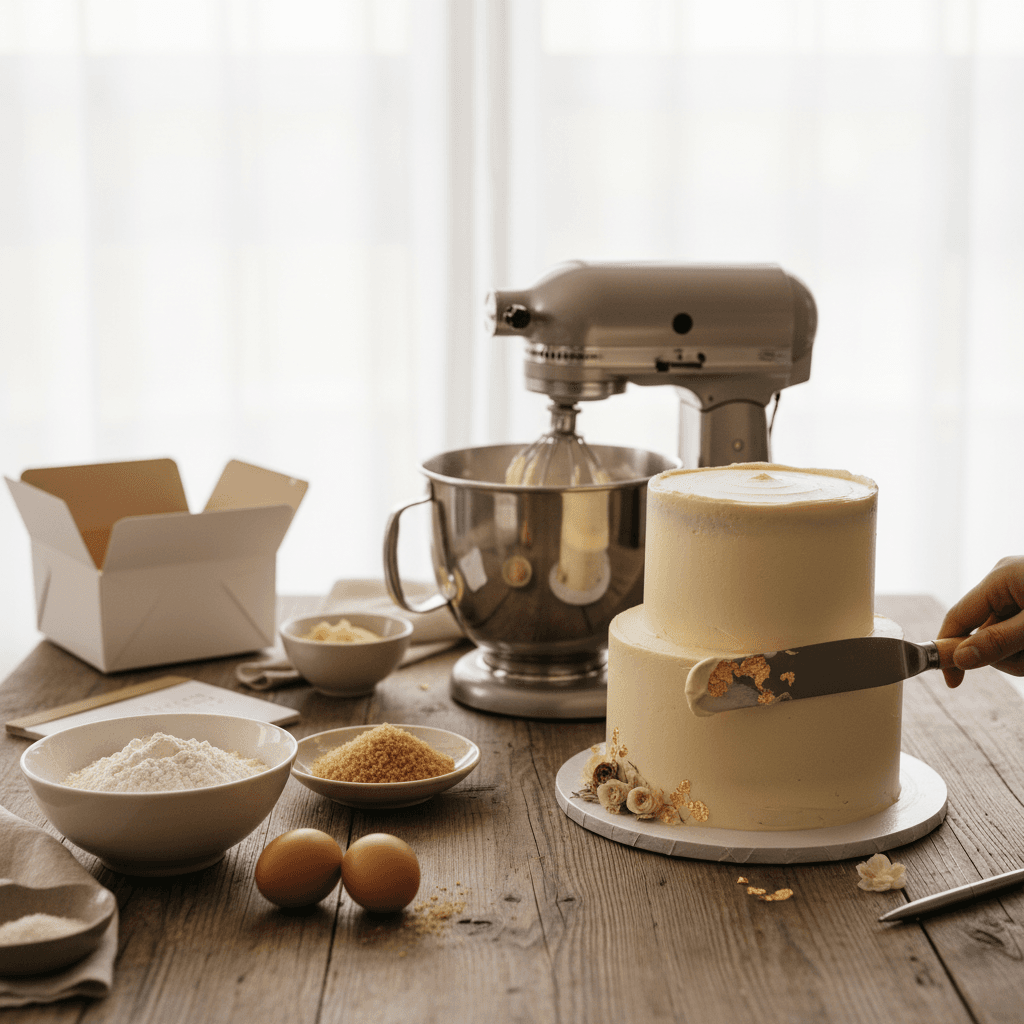
Your first custom cake order probably won't come from Instagram. It'll come from a specific, repeatable action you take in the next 7 days — and it'll pay you real money if you set it up right. Here's exactly how to make that happen.
Key takeaways
- Your first custom cake order most often comes from a warm personal network ask — not from strangers on social media — and the average timeline is 5–14 days when you do it right.
- Pricing your first cake at $75–$150 (not free, not $40) sets the tone for every order after it and filters out problem customers immediately.
- You need exactly 3 things before taking your first order: one signature design you can repeat, a price you've calculated (not guessed), and a simple order form — nothing else.
- The "launch cake" strategy — baking one specific cake, photographing it well, and offering it at full price to 20 people you know — converts at roughly 10–15% for most home bakers.
- Your first order is a business system test, not a popularity contest. The goal is to prove you can take payment, deliver on time, and profit.
Why your first custom cake order matters more than you think
Your first paid custom cake order isn't about the money (though you should absolutely get paid). It's the moment you prove — to yourself and to your local market — that you run a business, not a hobby with an Instagram page. Every decision you make on this order sets a precedent: your pricing floor, your communication style, your turnaround time, your boundaries.
I've watched dozens of home bakers torpedo their businesses before they start by giving away their first cake, underpricing it at $35 for a two-tier buttercream that took 6 hours, or accepting a design they weren't ready for. Maria, a home baker in Phoenix, charged $40 for her first custom cake — a 6-inch round with hand-piped florals that took her 4.5 hours. After ingredients ($12), packaging ($4), and delivery gas ($6), she netted $18. That's $4 per hour. She spent the next 8 months trying to raise prices on customers who expected $40 cakes forever.
Don't be Maria. Set the right foundation from day one.
What you actually need before taking your first order
You need less than you think, but more than "I bake good cakes." Here's the minimum viable setup:
One signature cake you can execute consistently
Not five designs. Not a full menu. One cake in one size that you've baked at least 3 times with consistent results every time. For most new custom cake bakers, this is a 6-inch or 8-inch round layer cake with buttercream finish. You should know exactly how long it takes you — bake time, cooling, crumb coat, final coat, decorating. Write that number down. If your 8-inch two-layer vanilla cake takes you 3 hours and 40 minutes from start to boxed, that's your baseline.
A real price — not a guess
Before you take a single order, you need to know your cost of goods and your hourly rate target. For a custom 8-inch round, here's a realistic cost breakdown:
| Cost category | Typical range |
|---|---|
| Ingredients (cake + buttercream) | $8–$14 |
| Packaging (cake box, board, ribbon) | $3–$6 |
| Specialty decorations (fondant accents, fresh flowers, toppers) | $0–$15 |
| Utilities and overhead estimate | $2–$4 |
| Total cost of goods | $13–$39 |
If your total cost is $18 and you want to pay yourself $25/hour for 3.5 hours of work, your minimum price is $105.50. Round up to $110. That's not expensive — that's the math. Our full custom cake pricing framework walks through every variable, but for your first order, just make sure you're covering costs plus paying yourself at least $20/hour.
A simple order form
This doesn't need to be fancy. A Google Form works. You need: customer name, event date, pickup or delivery preference, cake size, flavor, design description, and a checkbox confirming they've read your policies. That's it. You can add allergen questions and deposit terms later, but having any form at all puts you ahead of 80% of new home bakers who negotiate everything over DMs and lose track of details.
The "launch cake" strategy that actually works
This is the single most effective way I've seen new home bakers land their first order, and it works in every market I've tested it in — suburban, urban, rural, doesn't matter.
Step 1: Bake your signature cake. Not for a customer. For yourself. Make it beautiful. Take your time.
Step 2: Photograph it well. You don't need a DSLR. Natural window light, a clean background (a $3 poster board from the dollar store works), and your phone camera. Take 8–12 shots from different angles. Pick the best 3. If you want to level up, our guide on how to take better photos of your bakes covers the exact setup.
Step 3: Send a personal message to 20 people you know. Not a mass post. Not a story. A direct, personal text or message. Here's a template that converts:
"Hey [Name]! I'm officially taking custom cake orders from my home kitchen. I'm starting with [describe your signature cake — e.g., 'a 6-inch vanilla bean cake with Swiss meringue buttercream and fresh floral styling']. They're $[price] and I can do pickup on weekends. If you or anyone you know has a birthday, shower, or celebration coming up, I'd love to be your baker. Here's a photo!"
Step 4: Wait 48 hours. Then follow up once with anyone who responded positively but didn't commit.
Tanya, a home baker in suburban Atlanta, sent this exact message to 22 people on a Tuesday evening. By Thursday she had 3 inquiries. By Saturday she had her first paid order — an 8-inch lemon cake with lavender buttercream for a bridal shower, priced at $125. Her second order came from the bridal shower guest list two weeks later.
The conversion rate on this approach is consistently 10–15% when the message is personal and includes a photo. That means out of 20 messages, you'll typically get 2–3 serious inquiries and close 1–2 orders. Compare that to posting on Instagram where your reach might be 50 people and your conversion rate is under 1%.
Why you should not give away your first cake for free
This is the most common advice new bakers get, and it's the most damaging. "Just do a few free ones to build your portfolio!" sounds reasonable until you realize what it actually costs you.
A "free" custom cake still costs you $13–$39 in materials, 3–5 hours of labor, and — most importantly — it trains your first customers to expect free or cheap. When you later try to charge $120 for the same cake, those same people will say "but you used to do them for free" or simply disappear.
Here's the contrarian truth that experienced home bakers know: charging full price from order number one actually makes it easier to get orders, not harder. People trust businesses that charge real prices. A $125 cake signals quality. A free cake signals "I'm not sure this is worth anything." If you're worried about not having portfolio photos, that's what the launch cake strategy solves — you bake one for yourself, photograph it, and use those images to sell.
The one exception: if you're genuinely testing a brand-new recipe and need real-world feedback, offer it at cost ($15–$25) to one person and call it a recipe test. Don't call it a custom order. Don't set up the expectation that this is your pricing.
Where your first order will realistically come from
Based on patterns I've seen across hundreds of home bakery launches, here's where first orders actually originate — ranked by likelihood:
| Source | Likelihood of first order | Typical timeline |
|---|---|---|
| Direct personal outreach (texts, DMs to people you know) | High | 5–14 days |
| Word of mouth from someone who tasted your baking | Medium-high | 1–4 weeks |
| Local Facebook community group post | Medium | 1–3 weeks |
| Instagram post or story | Low-medium | 2–8 weeks |
| Google Business Profile | Low (but builds over time) | 4–12 weeks |
Notice that the fastest path is always personal outreach. Social media is a long game. Your Google Business Profile will eventually become your best free lead source, but it takes months to build local search authority. For order number one, go direct.
If you're starting from zero with no local network (you just moved, you're in a new area), local Facebook groups are your best bet. Search for "[your city] moms group," "[your city] events," or "[your neighborhood] community." Post your launch cake photo with a brief intro. Don't spam — one thoughtful post in 2–3 groups is enough. Jess, a baker who relocated to Raleigh, NC, posted in her neighborhood's Facebook group and booked her first order ($95 for a 6-inch birthday cake) within 4 days.
How to handle the consultation for your first order
When that first inquiry comes in, you'll feel a mix of excitement and panic. Here's exactly how to handle it without underselling yourself or over-promising.
Respond within 2 hours during business hours. Speed matters. If someone messages you at 7pm and you reply at 10am the next day, there's a 40% chance they've already found another baker.
Ask these 5 questions before quoting a price:
- What's the event and date?
- How many people does the cake need to serve?
- Do you have a design in mind? (Ask for reference photos.)
- Any flavor preferences or allergies?
- Pickup or delivery?
Quote confidently. Don't say "I think it would be around..." Say "This cake is $[price]. That includes [what's included]. I require a 50% deposit to reserve your date, with the balance due at pickup." If you need help structuring your pricing language, the guide on how to stop undercharging has scripts you can adapt.
If the design is beyond your skill level, say so. "I'm not set up for 3D sculpted cakes yet, but I can do a beautiful semi-naked finish with fresh flowers that would look stunning for your event." Redirecting to what you do well is a sign of professionalism, not weakness. Knowing when to say no to orders is a skill you'll use for the life of your business.
Setting boundaries from order number one
Your first customer will set the template for every customer after. If you let them text you at 11pm, change the design three times, and pick up 2 hours late — congratulations, that's now your standard of service.
Instead, establish these from the start:
- Communication hours: "I respond to messages between 9am and 6pm, Monday through Friday."
- Design changes: "One revision is included after the initial design is agreed upon. Additional changes are $15 each."
- Deposit policy: 50% non-refundable deposit to book. Balance due 48 hours before the event or at pickup.
- Cancellation window: Full cancellation with deposit forfeiture requires at least 7 days notice.
- Minimum lead time: At least 5–7 days for a standard custom cake. Rush orders (under 5 days) carry a $25–$50 surcharge.
Write these down. Put them in your order form. You don't need a lawyer or a fancy contract for your first order — a clear Google Form with these terms and a checkbox that says "I agree to these policies" is legally sufficient in most cottage food states. For a deeper dive, our post on setting boundaries with customers covers the exact language to use.
What to charge for your first custom cake
This is where most new bakers spiral. They Google "custom cake prices" and see everything from $30 to $500. The answer depends on your market, your design complexity, and your costs — but here are real benchmarks for a first custom cake from a home baker:
| Cake type | Realistic first-order price range |
|---|---|
| 6-inch round, 2 layers, simple buttercream | $65–$90 |
| 8-inch round, 2 layers, buttercream with basic piping or fresh flowers | $90–$135 |
| 8-inch round, 3 layers, detailed buttercream design | $120–$165 |
| Two-tier (6" + 8"), buttercream, moderate decoration | $175–$250 |
| Smash cake (4-inch) add-on | $25–$40 |
If your local market seems "cheap," don't race to the bottom. A baker in rural Oklahoma can absolutely charge $110 for an 8-inch custom cake if the product and presentation justify it. The customers who balk at $110 were never going to be profitable customers at any price. For the full math on how to build your pricing from the cost up, check our custom cake pricing framework.
After the first order: turning one into five
Your first order is a system test. Your second through fifth orders are where the business starts. Here's how to turn one into a pipeline:
Photograph the finished cake before it leaves your kitchen. Every single time. This is your portfolio and your marketing content. 3 photos, natural light, clean background. Takes 4 minutes.
Ask for a review. 24 hours after the event, send a simple text: "Hey [Name], how did the cake go over? If you loved it, I'd be so grateful if you could leave a quick review on my Google page or Facebook. It really helps small bakers like me get found!" This feeds your Google Business Profile and builds social proof.
Ask for a referral — specifically. Don't just say "tell your friends." Say "Do you know anyone with a birthday or event coming up in the next month or two? I'd love to bake for them." Direct asks generate 3x more referrals than passive ones. If you want to build a real system around this, our home bakery referral program guide lays out a framework that consistently brings in 3–5 new customers per month.
Post the cake photo on your social media and tag the customer (with permission). Their network sees it. Their friends ask "who made that?" That's organic reach that actually converts.
Rachel, a home baker in Denver, followed this exact sequence after her first order. Her customer shared the tagged photo, which led to 2 DM inquiries. She booked both. One of those customers referred a coworker. Within 6 weeks of her first order, she had completed 7 paid custom cakes averaging $118 each — $826 in revenue from a single launch cake and 22 text messages.
Common first-order mistakes to avoid
These aren't hypothetical. These are patterns from real first-year home bakers:
- Accepting a design you've never attempted. Your first order is not the time to try a 5-tier fondant castle. Stick to what you've practiced.
- Not collecting a deposit. 1 in 5 first orders gets cancelled if there's no deposit. A 50% deposit collected via Venmo, Zelle, or PayPal eliminates this.
- Quoting before knowing the full scope. "Sure, I can do that for $80" before seeing reference photos is how you end up doing $200 worth of work for $80.
- Delivering instead of offering pickup. Delivery adds risk (damage, time, gas) and cost. For your first order, offer pickup. If you must deliver, charge $15–$25 depending on distance.
- Not doing a timeline dry run. If the cake is due Saturday at 2pm, work backwards. When do you need to start decorating? When does the cake need to be baked and cooled? When do you need to shop for ingredients? Build in a 2-hour buffer for your first order. You'll be slower than you think.
Frequently asked questions
How long does it take to get your first custom cake order?
With direct personal outreach to 20 people in your network, most home bakers book their first order within 5–14 days. If you're relying solely on social media posts without personal messages, expect 2–8 weeks. The variable that matters most is whether you're asking specific people directly or broadcasting to no one in particular.
Should I give away my first custom cake for free to build a portfolio?
No. Bake a cake for yourself to photograph for your portfolio, then sell your first order at full price. Free cakes train customers to expect low prices and cost you $13–$39 in materials plus hours of labor with zero return. Charging $90–$130 for your first 8-inch custom cake is reasonable and signals that you're a real business.
What should I charge for my first custom cake as a home baker?
A standard 8-inch, 2-layer buttercream cake with basic decoration should be priced at $90–$135 for most home bakers. Calculate your ingredient cost (typically $8–$14), add packaging ($3–$6), then add your labor at $20–$25/hour. Our custom cake pricing guide walks through the full formula.
Do I need a website or social media following before taking custom cake orders?
Neither is required for your first order. You need 3 good photos of your signature cake, a way to collect order details (a Google Form works), and a way to accept payment (Venmo, Zelle, or PayPal). A Google Business Profile is worth setting up early because it's free and builds local search visibility over time, but it won't drive your first order.
What if someone wants a custom cake design I've never done before?
Be honest and redirect. Say something like "I specialize in [your strength — e.g., buttercream florals and semi-naked finishes]. I'd love to create something beautiful in that style for your event." Accepting a design beyond your skill level for your first order risks a bad result, a bad review, and a bad start to your business. There will be plenty of time to expand your skills after you've built a foundation of successful orders.

Written by
Co-founder, BakingSubs
Co-founder of BakingSubs, where he turns the science of ingredient substitutions into tested, reliable guidance for home bakers.
Related Posts
Bakery Recipe Cost Sheet: How to Cost a Recipe in 6 Steps (With a Table You Can Copy)
Home Bakery Order Form Template: A Copy-Paste Layout That Cuts Mistakes by Half
Cottage Food Label Requirements and Template: What Every State Demands (With a Copy-Paste Layout)
Bake with Confidence
See all
Confident Gluten-Free Baker Toolkit
The science-based system that replaces gluten's seven invisible jobs so your baking turns out soft, fluffy, and foolproof — every time.

Gluten-Free Recipe Vault
Instant access to our complete library of proven gluten-free recipes — no waiting, no guesswork, just results that work tonight.

Fix Your Gluten-Free Bread
Learn the 3-step formula to make bread rise and stay soft, discover why your loaves collapse, and get a tested sandwich bread recipe that actually works.