

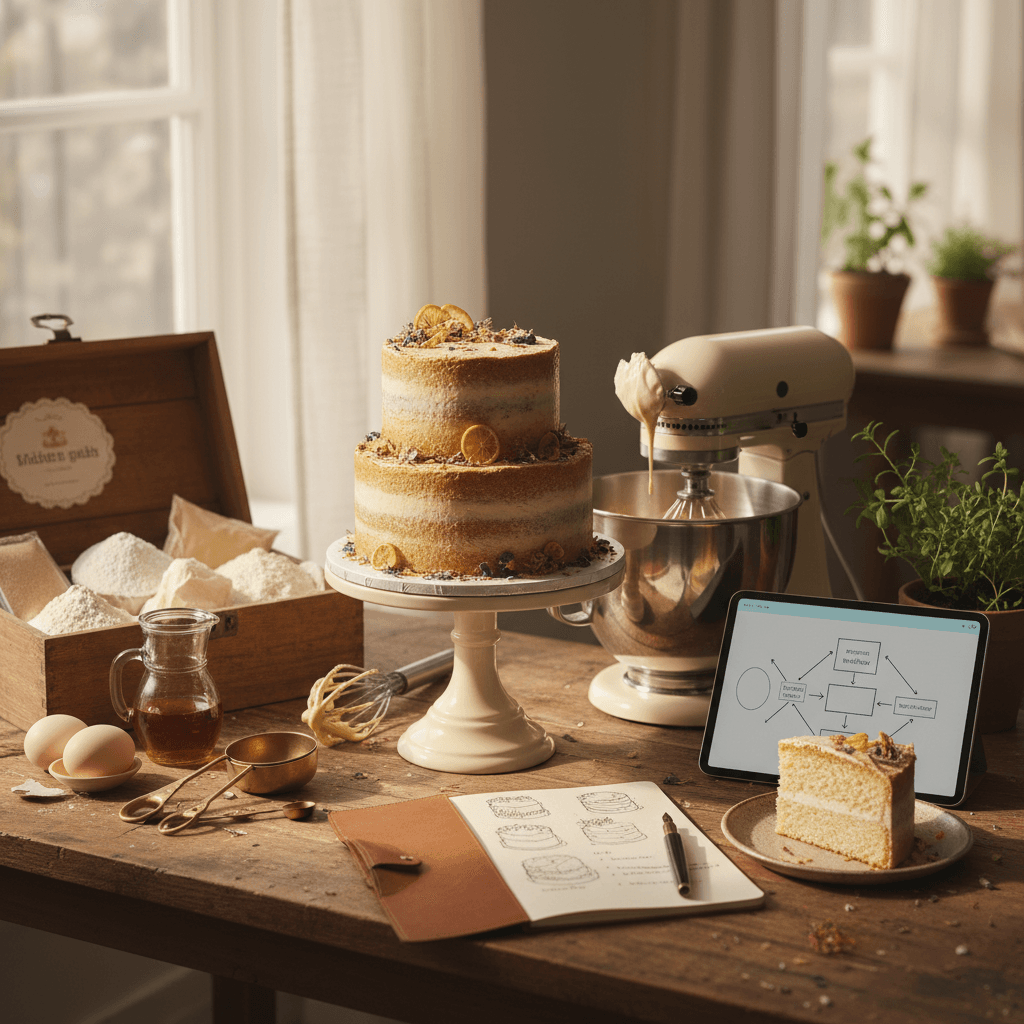
The problem isn't that you have too many orders. The problem is that every order requires a different conversation, a different timeline, and a different set of decisions — and none of it is written down anywhere except scattered DMs. Here's how to build an order intake system that lets you take more custom cake work without losing your weekends or your sanity.
Key takeaways
- A standardized order form that captures 90% of decisions upfront eliminates an average of 4-6 back-and-forth messages per order
- Capping your weekly order slots (not just saying yes to everything) is the single biggest factor in preventing overwhelm
- A tiered menu with 3-5 base options and a clear "custom beyond this" price threshold reduces scope creep dramatically
- Requiring a 50% non-refundable deposit at booking filters out flaky inquiries and protects your materials cost
- Batching your admin time into two 30-minute blocks per week keeps order management from bleeding into every waking hour
- Your order system should make saying no easy — the goal isn't to take every order, it's to take the right ones profitably
Why custom cake orders create overwhelm (and it's not the baking)
I tracked where my time actually went during a busy month — 14 custom cake orders in four weeks. The baking and decorating took about 58% of my total work hours. The other 42% was messaging clients, clarifying details, chasing deposits, adjusting designs, and managing pickup logistics. That admin overhead is what creates the drowning feeling, not the buttercream.
Most home bakers I talk to describe the same pattern: they start saying yes to everything because they need the revenue, then hit a wall around order 8-12 per month where the mental load of tracking who wants what, when, and for how much becomes unsustainable. The fix isn't working harder. It's building a system that handles the repetitive decisions so you only spend brain power on the creative work.
If you're already at the point where you dread your phone buzzing, you might want to read our piece on home baker burnout first. What follows here is the structural fix — the system that prevents you from reaching that point again.
Build an order form that eliminates 80% of back-and-forth
The single most impactful change you can make is replacing free-form DM conversations with a structured order form. This doesn't have to be fancy. A Google Form works. So does a simple page on your website with required fields.
Here's what your custom cake order form needs to capture:
- Event date and pickup/delivery date — with a note that you require a minimum of 14 days' notice (or whatever your real lead time is)
- Cake size — give them options, not an open field. "6-inch (serves 8-10), 8-inch (serves 14-18), 10-inch (serves 24-28), tiered (select sizes)"
- Flavor selections — list your available flavors. If you offer 6 cake flavors and 4 filling options, that's 24 combinations without a single custom recipe
- Design complexity tier — more on this below, but give them 3 visual tiers with example photos and price ranges
- Budget range — yes, ask this directly. Options like "$65-$85," "$85-$125," "$125-$200," "$200+" let you filter immediately
- Inspiration photos — require at least one, cap at three. More than three and you're designing by committee
- Allergy or dietary needs — a simple checklist
- How they found you — this data is gold for knowing where to spend your marketing energy
Rachel, a home baker in Nashville, told me she went from spending 45 minutes per inquiry to 12 minutes after implementing a structured form. That's 33 minutes saved per order. At 10 orders a month, that's 5.5 hours back — almost a full baking day.
The key insight: when you give people a blank canvas ("What kind of cake do you want?"), they either freeze up or write you a novel. When you give them structured choices, they make decisions faster and you get exactly the information you need to quote accurately.
Create a tiered menu with clear pricing boundaries
This is where most home bakers resist because they think "custom" means "anything goes." It doesn't. Even high-end bakeries work from a tiered system. Yours should have three levels at minimum:
| Tier | What's included | 8-inch round price example | Time estimate |
|---|---|---|---|
| Simple elegance | Smooth buttercream, single color palette, basic piping or fresh flowers, custom color match | $75-$95 | 2-2.5 hours total |
| Custom design | 2-3 colors, fondant accents or hand-piped details, themed toppers (purchased), textured finishes | $110-$145 | 3.5-4.5 hours total |
| Specialty/sculpted | Hand-sculpted fondant figures, painted details, 3D elements, complex color work, multiple techniques | $165-$250+ | 5-8+ hours total |
These numbers will vary based on your market and your custom cake pricing framework, but the structure matters more than the exact dollars. The point is that when someone fills out your order form and selects "Custom design" with a budget of "$85-$125," you already know whether the project is viable before you respond.
A contrarian take: I actually recommend not publishing exact prices on your public menu. Instead, list the tiers with "starting at" prices and example photos. The order form captures their budget range, and you quote the specific price in your response. This prevents the race-to-the-bottom comparison shopping that happens when every baker in town has their prices on Instagram, and it gives you room to price based on actual complexity rather than a fixed grid.
The "custom beyond this" boundary
For anything that falls outside your three tiers — a five-tier wedding cake with sugar flowers, a gravity-defying sculpted design, a cake that requires techniques you'd need to learn — you need a clear boundary. Mine is simple: "Designs requiring more than 8 hours of total production time are quoted individually with a minimum of $300 and require a consultation call."
This single sentence has saved me from underpricing complex work more times than I can count. It also signals to the client that they're asking for something premium, which resets their price expectations before you even quote. If you're finding it hard to turn down orders that don't fit, this guide on saying no to money-losing orders walks through the exact language.
Set your weekly order cap (and actually enforce it)
This is the part that separates overwhelmed bakers from profitable ones. You need a hard cap on how many custom cake orders you take per week, and that number should be based on math, not feelings.
Here's how to calculate yours:
- Total available baking/decorating hours per week. Be honest. If you work a full-time job and bake evenings and weekends, maybe that's 15 hours. If you're full-time home bakery, maybe 30-35 hours.
- Average production time per order. Track this for your last 10 orders. Include baking, cooling, decorating, boxing, and cleanup. For most home bakers doing mid-tier custom cakes, this lands between 3.5 and 5 hours per order.
- Subtract admin time. Reserve 3-5 hours per week for responding to inquiries, ordering supplies, social media, and bookkeeping.
- Divide remaining hours by average production time. That's your cap.
Example: Megan bakes part-time around her teaching schedule. She has 18 hours available per week. She reserves 3 hours for admin. That leaves 15 production hours. Her average custom cake takes 4 hours. Her cap is 3 custom cakes per week, with a buffer hour for the inevitable order that runs long.
At 3 cakes per week averaging $115 each, that's $345/week or roughly $1,380/month. If she wants to increase revenue, she doesn't take a fourth cake order and destroy her margins with rush stress — she raises her prices or adds a higher-margin product line like decorated cookies that batch more efficiently.
The hardest part of this system is turning away order number four. But here's what actually happens when you enforce the cap: your quality goes up, your stress goes down, your reviews improve, and you can justify raising prices. I raised my 8-inch custom cake price from $85 to $120 over six months specifically because I had a waitlist from enforcing a cap of 4 orders per week.
Streamline your response workflow
Every custom cake inquiry should follow the same path, every time. No exceptions. Here's the workflow that takes the thinking out of it:
Step 1: Form submission (client does the work)
They fill out your order form. If someone DMs you instead, your response is always the same: "Thanks so much for reaching out! To get you an accurate quote, please fill out my order form here: [link]. I respond to all submissions within 48 hours." Copy-paste this. Every time. No exceptions.
Step 2: Review and quote (your 10-minute window)
Set two specific times per week to review new submissions — say, Tuesday evening and Friday morning. This is your "admin batch." For each submission:
- Does the date work? Check your calendar. If the slot is full, respond with your next available date.
- Does the design fit your tiers? Match it to a tier and pull the price.
- Does the budget match the ask? If they want a Tier 3 design on a Tier 1 budget, you have a templated response for that too.
Your quote response should be a template with blanks you fill in. Something like: "Hi [Name]! I'd love to make your [event type] cake. Based on your selections, here's what I'm quoting: [cake details, size, flavor, tier]. Total: $[X], which includes [what's included]. A 50% deposit of $[Y] is due to secure your date, with the balance due 3 days before pickup. Your pickup window is [date, time range]. Want to move forward? Here's my payment link: [link]."
That template handles 85% of inquiries. You're filling in blanks, not writing custom emails.
Step 3: Deposit secures the slot (no exceptions)
No deposit, no spot on the calendar. Period. A 50% non-refundable deposit protects your materials cost and filters out people who are "just looking." For a $130 cake, that's a $65 deposit. If they ghost after paying, you've covered your flour, butter, and time to prep.
I've had exactly two people push back on the deposit policy in three years. Both times I explained it simply: "The deposit covers the cost of ingredients I'll be purchasing specifically for your order, which I can't resell." Both paid. The people who won't pay a deposit are almost always the same people who would cancel last-minute or be difficult about the final product.
Handle revisions without scope creep
Scope creep is the silent profit killer in custom cake work. The client starts with a simple two-tone design, then asks to add a fondant topper, then wants hand-piped lettering, then sends a new inspiration photo that's completely different from the original. Each change feels small, but collectively they can add 2+ hours of unpaid work.
The fix is built into your quote template: one round of revisions is included, additional changes are $15-$25 each depending on complexity. State this upfront. Most clients won't need revisions at all if your order form captured good information. But having the policy means you're never doing free work out of guilt.
Lisa, a home baker in Denver, tracked her revision requests over three months. Before implementing a revision policy, she averaged 3.2 revision conversations per order. After adding "one revision included, $20 per additional change" to her quote template, revisions dropped to 0.8 per order. Clients made better decisions upfront because they knew changes had a cost.
For more on setting boundaries with customers without damaging the relationship, we have a full breakdown of the language that works.
Batch your baking days (not your admin days)
Most productivity advice says to batch similar tasks together. For custom cakes, this is partially true but needs a caveat: you can't batch-bake custom cakes the way you can batch-bake cookies, because each one has a different flavor, size, and decoration timeline.
What you can batch:
- Baking days vs. decorating days. If you have 3 cakes due Saturday, bake all three on Wednesday, let them chill Thursday, decorate Thursday evening and Friday. Never bake and decorate the same cake on the same day if you can avoid it — the quality difference is noticeable and the stress difference is enormous.
- Buttercream production. Make one large batch of your base buttercream and portion it for coloring. A 10-pound batch takes barely more time than a 5-pound batch and covers 2-3 cakes.
- Fondant work. If multiple orders need fondant elements, do all your rolling, cutting, and shaping in one session.
A realistic weekly schedule for someone taking 3-4 custom cake orders with Saturday pickups looks like this:
| Day | Task | Time |
|---|---|---|
| Monday | Admin batch: respond to inquiries, send quotes, order supplies | 1.5 hours |
| Tuesday | Prep: make buttercream, fondant elements, any advance components | 2-3 hours |
| Wednesday | Bake all cake layers, cool and wrap | 3-4 hours |
| Thursday | Crumb coat all cakes, begin decorating simplest orders first | 3-4 hours |
| Friday | Final decorating, boxing, admin batch #2 (respond to new inquiries) | 4-5 hours |
| Saturday | Pickup window (keep it to 2-3 hours, not all day) | 2-3 hours |
Notice that baking and decorating never happen on the same day. This is intentional. It reduces the feeling of being pulled in twelve directions at once, which is the core of overwhelm. For more on efficient production when orders stack up, see our guide on batch baking for big orders.
When to raise prices instead of taking more orders
If you're consistently hitting your order cap and turning people away, the answer is almost never "take more orders." The answer is raise your prices. This is the leverage point most home bakers miss because they're afraid of losing customers.
Here's the math that convinced me. At 4 orders/week at $100 each, I was making $1,600/month working about 20 production hours per week. I raised prices by 25% across the board. I lost about 15% of my inquiries. But I was now making $125 per order x 3.4 orders/week average = $1,700/month — more money, fewer orders, less stress, better work.
The customers you lose to a price increase are almost always the most price-sensitive, most demanding, most likely to haggle or complain. The customers who stay are the ones who value your work and are easier to serve. This isn't theory — it's a pattern I've seen play out with dozens of home bakers. If you haven't raised prices recently, here's how to do it without losing your best clients.
The tools that actually matter (and the ones that don't)
You don't need a $50/month CRM or a custom-built ordering platform. Here's what actually works for most home bakers doing 8-16 custom cake orders per month:
- Google Forms (free) — for your order intake form. It dumps responses into a spreadsheet automatically.
- Google Sheets (free) — your order tracker. Columns for client name, event date, cake details, price, deposit status, balance status, pickup time. Sort by event date. That's your entire operations dashboard.
- Google Calendar (free) — block your baking days, decorating days, and pickup windows. When a slot is full, you can see it instantly.
- A payment app — Venmo, Zelle, Square, or PayPal. Pick one and stick with it. Square gives you the most professional invoicing if you want to send itemized receipts.
- A text expander or saved replies — on iPhone, go to Settings > General > Keyboard > Text Replacement. Create shortcuts for your most common responses. I have "cakeq" expand to my full quote template and "cakeform" expand to my order form link message.
That's it. Five free or near-free tools. Anyone telling you that you need a $200 website with an integrated ordering system before you can manage custom orders is selling you something. You can add sophistication later when you're doing 20+ orders per month and the spreadsheet genuinely becomes a bottleneck.
What to do when you're already overwhelmed right now
If you're reading this mid-crisis with six orders due this weekend, here's your triage plan:
- Stop accepting new orders for the next 7 days. Put an auto-reply on your DMs and a note on your order form: "Currently booked through [date]. Accepting orders for [date] and beyond." This alone reduces the mental load of incoming requests while you dig out.
- List every current order on paper with its due date, what's left to do, and estimated hours remaining. Seeing it all in one place is less scary than the swirl in your head.
- Identify the one order that's causing the most stress. Is it underpriced? Is the client difficult? Is the design beyond your skill level? If it's not too late, have an honest conversation with that client. "I want to make sure your cake is perfect, and I've realized the design we discussed needs more time than I originally estimated. I'd like to simplify [specific element] to ensure the quality is where I want it." Most clients respect honesty.
- After this week, implement the order cap before you do anything else. The system above can wait. The cap cannot.
If this cycle keeps repeating, it's worth looking at whether your business model is sustainable in its current form, or whether you need structural changes beyond just an order system.
Frequently asked questions
How many custom cake orders per week is realistic for a home baker?
It depends on your available hours and the complexity of your work. A part-time baker with 15 production hours per week can typically handle 3-4 mid-tier custom cakes. A full-time baker with 30+ hours can manage 6-8. The key variable is your average production time per cake — track it for 10 orders and divide your available hours by that number. Don't forget to subtract 3-5 hours for admin work.
Should I require a deposit for custom cake orders?
Yes, always. A 50% non-refundable deposit is standard in the home baking industry and protects you from last-minute cancellations. For a $130 cake, that's $65 upfront, which covers your ingredient costs. Clients who won't pay a deposit are statistically the most likely to cancel, change their order repeatedly, or be difficult at pickup. The deposit filters them out before you've invested any time. Learn more about setting boundaries with customers.
How far in advance should I require custom cake orders?
A minimum of 14 days is the sweet spot for most home bakers. It gives you time to order specialty supplies, plan your baking schedule, and avoid the stress of rush work. For tiered or highly detailed cakes, 3-4 weeks is better. If you do accept rush orders (under 7 days), charge a rush fee — $25-$50 is reasonable and compensates you for the schedule disruption. State the lead time requirement clearly on your order form so clients self-select.
How do I handle clients who want unlimited revisions to their cake design?
Include one round of design revisions in your standard quote and charge $15-$25 for each additional change. State this in your quote template before the client pays the deposit. This isn't about being rigid — it's about making sure your time is valued. Most clients will finalize their design quickly when they know changes have a cost. If a client consistently needs more than two rounds of revisions, that's a signal they may not be clear on what they want, and a 15-minute phone call often resolves more than ten messages back and forth.
What's the best way to manage custom cake orders without expensive software?
Google Forms for intake, Google Sheets for tracking, and Google Calendar for scheduling. These three free tools handle everything a home baker doing up to 15-20 orders per month needs. Your spreadsheet should track client name, event date, cake specs, price, deposit paid (yes/no), balance paid (yes/no), and pickup time. Sort by event date and you have a complete operations view. Add a text expander on your phone for templated responses and you've eliminated most of the repetitive typing that makes order management feel overwhelming.

Written by
Co-founder, BakingSubs
Co-founder of BakingSubs, where he turns the science of ingredient substitutions into tested, reliable guidance for home bakers.
Related Posts
Bakery Recipe Cost Sheet: How to Cost a Recipe in 6 Steps (With a Table You Can Copy)

Home Bakery Order Form Template: A Copy-Paste Layout That Cuts Mistakes by Half
Cottage Food Label Requirements and Template: What Every State Demands (With a Copy-Paste Layout)
Bake with Confidence
See all
Confident Gluten-Free Baker Toolkit
The science-based system that replaces gluten's seven invisible jobs so your baking turns out soft, fluffy, and foolproof — every time.

Gluten-Free Recipe Vault
Instant access to our complete library of proven gluten-free recipes — no waiting, no guesswork, just results that work tonight.

Fix Your Gluten-Free Bread
Learn the 3-step formula to make bread rise and stay soft, discover why your loaves collapse, and get a tested sandwich bread recipe that actually works.