

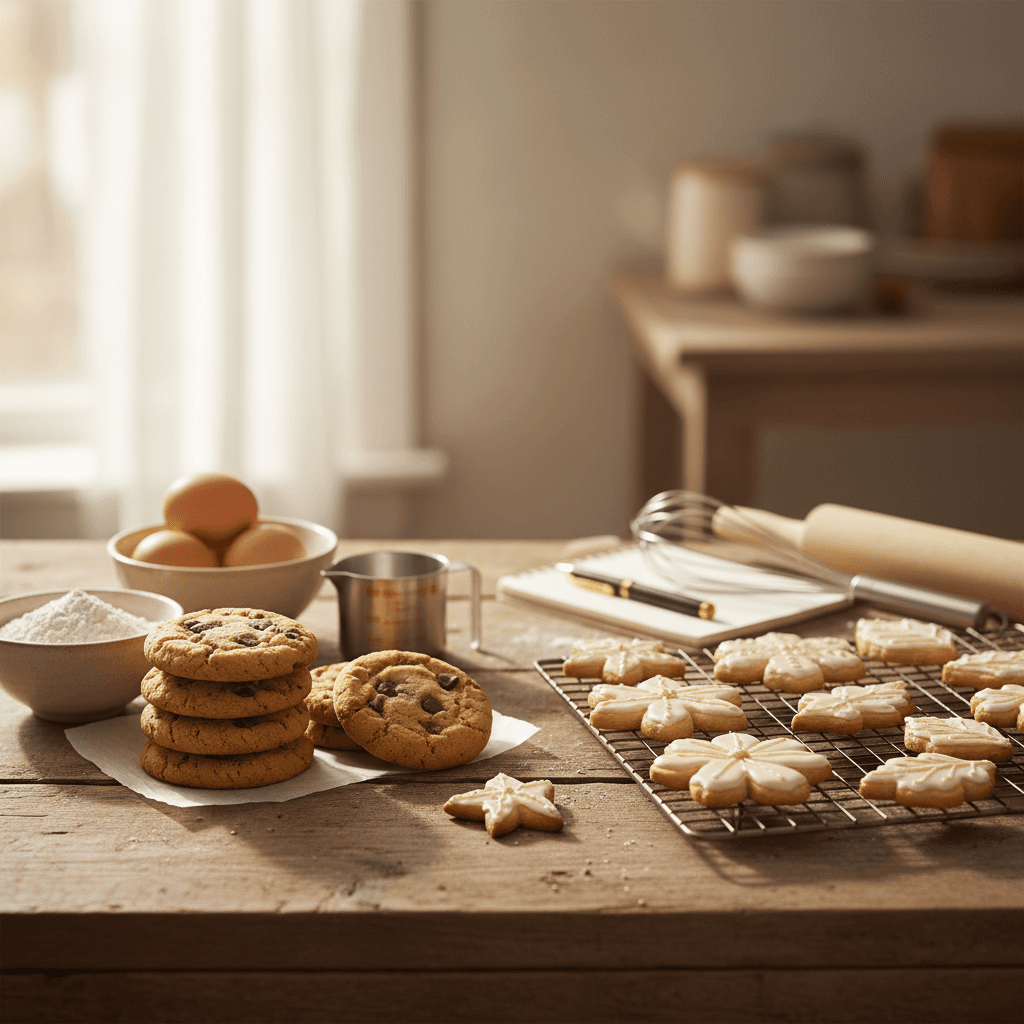
Most home bakers price cookies by looking at what other people charge on Instagram and picking a number that feels "reasonable." That's how you end up working 12-hour days for $6 an hour. Here's how to price cookies using real numbers, real tradeoffs, and a framework you can adapt as your costs and market shift.
Key takeaways
- Your cookie price must cover ingredients, packaging, labor, and overhead — not just what "feels fair" or what the baker down the street charges.
- Most profitable home bakeries price decorated sugar cookies between $4 and $8 each, and drop cookies between $2 and $4 each, depending on complexity and market.
- Labor is the cost most home bakers undercount. If your pricing doesn't include at least $20-$30/hour for your time, you're subsidizing your customers.
- Pricing per cookie works for simple items. Pricing per dozen works for batch items. Pricing per hour of labor works for highly decorated or custom work.
- Raising prices is easier than you think if you've built value first — most bakers lose fewer customers than they expect.
Why most home bakers underprice cookies
The number one reason home bakers underprice is that they don't count their own labor as a real cost. They calculate flour, butter, sugar, and eggs, slap a small markup on top, and call it a price. But that ignores the 45 minutes of mixing, the hour of decorating, the 20 minutes of packaging, and the time spent messaging the customer back and forth.
The second reason is comparison pricing — looking at grocery store cookies or another home baker's prices and anchoring to that number. Grocery stores have industrial equipment, bulk purchasing power, and minimum-wage labor. Another home baker might be losing money and not know it. Neither is a useful benchmark for your business.
If you've been stuck in this cycle, you're not alone. It's one of the most common patterns we see, and we wrote an entire guide on how to stop undercharging that covers the mindset and mechanics behind it.
The cookie pricing formula that actually works
Start with this framework. It's not the only way to price, but it forces you to account for every real cost before you set a number.
Price per cookie = (Ingredient cost + Packaging cost + Labor cost + Overhead) x Profit multiplier
Let's break each piece down with real numbers.
Ingredient cost
Calculate the cost of every ingredient in a single batch, then divide by the number of cookies that batch produces. Be precise — use weight measurements, not volume estimates. A batch of 36 chocolate chip cookies might use:
| Ingredient | Amount | Cost |
|---|---|---|
| Butter | 1 lb | $4.50 |
| Sugar (granulated + brown) | 1.5 cups total | $0.80 |
| Eggs | 2 large | $0.70 |
| Flour | 2.5 cups | $0.60 |
| Chocolate chips | 12 oz | $3.50 |
| Vanilla, salt, leavener | Various | $0.40 |
| Total ingredient cost | $10.50 |
That's about $0.29 per cookie in ingredients. This number will vary based on where you shop and what quality ingredients you use. Premium butter, high-end chocolate, or specialty flours push it higher.
Packaging cost
Bags, boxes, labels, ribbon, tissue paper, stickers — it all adds up. A simple cellophane bag with a label might cost $0.15-$0.25 per cookie. A custom box for a dozen might cost $1.50-$3.00. Don't forget to include the cost of any inserts, thank-you cards, or branded elements.
Labor cost
This is where most pricing falls apart. Decide what your time is worth — $25/hour is a reasonable starting point for skilled baking work, and $30-$40/hour is appropriate if you're doing detailed decorating.
For a batch of 36 chocolate chip cookies, your time might look like:
| Task | Time |
|---|---|
| Prep and mixing | 20 min |
| Portioning and baking (2 batches in oven) | 35 min |
| Cooling and packaging | 15 min |
| Customer communication and order management | 10 min |
| Total | 80 min |
At $25/hour, that's $33.33 in labor for the batch, or about $0.93 per cookie. Already more than triple the ingredient cost — and that's for a simple drop cookie with no decorating.
For decorated sugar cookies, labor jumps dramatically. A single royal icing cookie with multiple colors and detail work can take 10-20 minutes to decorate. At $30/hour, that's $5-$10 in labor alone per cookie before you've counted ingredients or packaging.
Overhead
Overhead covers the costs of running your business that aren't tied to a single batch: electricity, gas, equipment wear, website or ordering platform fees, cottage food license costs, insurance if you carry it, cleaning supplies, and the depreciation on your mixer and oven. A common approach is to add 10-15% on top of your other costs to cover overhead.
Profit multiplier
After covering all costs, you need actual profit — money that stays in the business for reinvestment, savings, or growth. A multiplier of 1.2x to 1.5x on top of your total costs is standard for home food businesses. Without this, you're just paying yourself a wage with nothing left over for the business itself.
If you're finding that this framework is revealing deeper issues with how your business is structured, this diagnostic on whether your home bakery model is sustainable walks through the bigger picture.
If you're a gluten-free baker looking for tools and resources to level up your baking foundations, the Confident Gluten-Free Baker Toolkit can help you build consistency and confidence in your recipes — which directly supports charging premium prices.
Real pricing examples for common cookie types
These ranges reflect what profitable home bakeries across the US are actually charging in 2024-2025. Your local market, ingredient quality, and brand positioning will shift where you land within each range.
| Cookie type | Price per cookie | Price per dozen | Key cost driver |
|---|---|---|---|
| Chocolate chip (standard) | $2.00 - $3.50 | $24 - $42 | Ingredient quality (butter, chocolate) |
| Double chocolate / specialty drop | $2.50 - $4.00 | $30 - $48 | Premium ingredients |
| Sugar cookies (simple icing, 1-2 colors) | $4.00 - $6.00 | $48 - $72 | Decorating labor |
| Sugar cookies (detailed, 3+ colors) | $6.00 - $8.00+ | $72 - $96+ | Decorating labor and skill |
| Macarons | $2.50 - $4.00 | $30 - $48 | Skill, failure rate, filling cost |
| Stuffed cookies (large format) | $4.00 - $6.00 | $48 - $72 | Size, premium fillings |
| Cookie boxes (mixed, gift-ready) | N/A | $35 - $65 per box | Variety, packaging, presentation |
If you're seeing these numbers and thinking "nobody in my area would pay that," you might be in the wrong market segment — or you might be underestimating what people will pay for quality. We'll cover that below.
How to decide between per-cookie and per-dozen pricing
Per-cookie pricing works best for decorated sugar cookies, large-format stuffed cookies, and any item where individual complexity varies. It lets you charge appropriately for a detailed holiday cookie versus a simple round with a single color flood.
Per-dozen pricing works better for drop cookies, bar cookies, and batch items where every unit takes roughly the same effort. It also feels like a better "deal" to customers psychologically, even when the math is identical.
Some bakers use a hybrid: per-dozen for simple items, per-cookie for decorated work, and flat-rate boxes for gift assortments. The key is that every pricing structure traces back to the same formula — you're just presenting it differently to the customer.
The variables that make cookie pricing "it depends"
Honest answer: there's no single correct price for a cookie. Here are the variables that matter most, ranked by impact:
1. Decorating complexity. This is the single biggest variable. A plain chocolate chip cookie and a hand-painted royal icing cookie with gold leaf are completely different products with completely different labor profiles. Price them completely differently.
2. Your local market. A suburb of San Francisco and a small town in Mississippi have different price ceilings. But the floor — the minimum you need to charge to make money — is the same everywhere. If your market won't support your floor price, you need a different product or a different customer base, not a lower price.
3. Order size. Larger orders can justify a small per-unit discount because you gain efficiency in batching. But be careful — a 10% discount on a 100-cookie order can erase your entire profit margin if you're already tight. Run the numbers before offering bulk pricing.
4. Ingredient cost. If you use high-end European butter, high-quality vanilla, and single-origin chocolate, your ingredient costs might be 40-60% higher than someone using store-brand everything. That's a positioning choice, and your price needs to reflect it.
5. Packaging and presentation. A cookie in a cellophane bag and a cookie in a custom box with tissue paper and a ribbon are different products in the customer's mind. Upgrading packaging lets you charge more — but only if the cost of that packaging doesn't eat the margin.
If you're struggling with which variables to optimize, choosing the right niche for your home bakery can help you clarify who you're selling to and what they'll pay for.
How to handle "that's too expensive" pushback
You will get this. Every home baker does. Here's how to think about it:
Not every person is your customer. Someone comparing your hand-decorated sugar cookies to a $5 pack from the grocery store isn't your target market. That's fine. You don't need everyone — you need enough of the right people.
Lead with value, not justification. Instead of explaining your costs (customers don't care about your butter bill), emphasize what they're getting: made from scratch, hand-decorated, custom designs, premium ingredients, made to order. The story matters more than the spreadsheet.
Have a lower-priced option. If someone balks at $7 decorated sugar cookies, offer a simpler design at $4.50. This gives them a path to buy without you discounting your premium work. It also protects your brand — you're not "lowering your prices," you're offering a different tier.
Build social proof. When customers see others happily paying your prices, the objection dissolves. Testimonials, reorder photos, and a full order calendar all signal that your pricing is normal. If you're looking for ways to build that kind of demand, setting up a referral program is one of the most effective approaches.
When and how to raise cookie prices
If you've been selling cookies for a while and realize you're underpriced, you need to raise prices — and sooner is better than later. Every week you wait is another week of working below what you're worth.
Here's the practical approach:
- Run your real numbers first. Use the formula above. Know exactly what your cookies cost to make, including your labor. The gap between your current price and your real cost is the urgency signal.
- Raise prices for new customers immediately. New customers have no anchor. They'll see your price and either buy or not. This is the easiest win.
- Give existing customers notice. A simple message: "Starting [date], my pricing will be updated to reflect current ingredient costs and the care that goes into each order. Here are my new prices." No apology needed.
- Expect to lose some customers. You will. But the customers you lose are almost always the lowest-margin, highest-maintenance ones. The customers who stay are the ones your business should be built around.
We have a full guide on how to raise your home bakery prices without losing customers that walks through the communication templates and timing in detail.
Pricing mistakes that cost home bakers the most money
These are the errors we see repeatedly from bakers who are working hard but barely breaking even:
Not tracking time per order. You think a batch takes 30 minutes because that's the active baking time. But when you add prep, cleanup, decorating, packaging, and customer communication, it's 2-3 hours. Track your time for a full week. The number will surprise you.
Offering too many cookie varieties. Every new variety means a different ingredient list, different prep workflow, and more complexity. Complexity kills margin. The most profitable home cookie businesses offer 4-8 varieties, not 25.
Discounting for friends and family. A 20% discount on a $48 dozen is $9.60 off your revenue. Do that five times a month and you've given away $48 — probably more than your profit on a full order. Set a clear policy and stick to it. Setting boundaries with customers applies to people you know, too.
Accepting custom orders without a custom price. A customer wants a cookie in the shape of their dog with four colors of icing and edible gold? That's not the same price as a round cookie with a simple flood. Custom work gets custom pricing, always. If you struggle with this, here's how to say no to orders that lose you money.
Ignoring seasonal ingredient cost swings. Butter and eggs can fluctuate 30-50% over the course of a year. If you set your prices in January and don't revisit them when butter hits $6/lb in November, your margins evaporate during your busiest season.
A step-by-step pricing exercise you can do right now
Grab a pen and your most popular cookie recipe. Walk through this:
- List every ingredient with the exact amount used. Calculate the cost of each based on what you actually pay (not the cheapest possible price).
- Add up total ingredient cost for one batch. Divide by the number of cookies to get per-cookie ingredient cost.
- Calculate packaging cost per cookie or per order.
- Time yourself making one full batch from start to finish, including cleanup and packaging. Multiply by your target hourly rate ($25-$35). Divide by cookies per batch.
- Add 10-15% for overhead.
- Multiply the total by 1.3 (for a 30% profit margin).
- Compare that number to what you're currently charging.
If there's a gap — and for most home bakers doing this exercise for the first time, there is — that gap is the money you've been leaving on the table with every single order.
Frequently asked questions
How much should I charge for a dozen decorated sugar cookies?
Most profitable home bakeries charge $48 to $96 per dozen for decorated sugar cookies, depending on design complexity, number of colors, and detail level. Simple one-color designs land at the lower end, while multi-color, hand-painted, or intricate designs justify the higher end. Always calculate your actual labor time per cookie — decorating labor is the primary cost driver.
Is it worth selling cookies from home?
Selling cookies from home can be profitable if you price correctly, control your product variety, and build a customer base that values quality over the cheapest option. Many bakers struggle because they underprice and overextend. If you're considering it, validating your home bakery idea before launching will save you months of guesswork.
Should I offer bulk discounts on cookie orders?
Only if the larger order genuinely saves you time per unit. A 100-cookie order of the same design is more efficient than ten separate 10-cookie orders, so a small discount (5-10%) can make sense. But never discount below your cost floor. Run the full pricing formula on the discounted price to make sure you're still profitable after labor and overhead.
How do I price cookies when ingredient costs keep changing?
Review your ingredient costs quarterly and adjust prices accordingly. Build a small buffer (5-10%) into your pricing so minor fluctuations don't require constant changes. For major swings — like butter doubling in price — update your prices immediately and communicate the change to customers. Most customers understand that ingredient costs affect small businesses.
What's the minimum order I should accept for cookie orders?
Set a minimum that ensures the order is worth your time after accounting for all costs including customer communication, setup, and cleanup. For most home bakers, a one-dozen minimum ($30-$50+) is the practical floor. Orders smaller than that rarely generate enough profit to justify the fixed time costs. If you're finding it hard to enforce minimums, knowing when to stop taking every order is an important skill to develop.

Written by
Co-founder, BakingSubs
Co-founder of BakingSubs, where he turns the science of ingredient substitutions into tested, reliable guidance for home bakers.
Related Posts
How to Sell Cookies From Home: Legality, Pricing, and Your First 3 Sales Channels

Christmas Cookie Box Pre-Orders: Week-by-Week Planning Calendar for Home Bakeries (2026)
Bakery Recipe Cost Sheet: How to Cost a Recipe in 6 Steps (With a Table You Can Copy)
Bake with Confidence
See all
Confident Gluten-Free Baker Toolkit
The science-based system that replaces gluten's seven invisible jobs so your baking turns out soft, fluffy, and foolproof — every time.

Gluten-Free Recipe Vault
Instant access to our complete library of proven gluten-free recipes — no waiting, no guesswork, just results that work tonight.

Fix Your Gluten-Free Bread
Learn the 3-step formula to make bread rise and stay soft, discover why your loaves collapse, and get a tested sandwich bread recipe that actually works.