

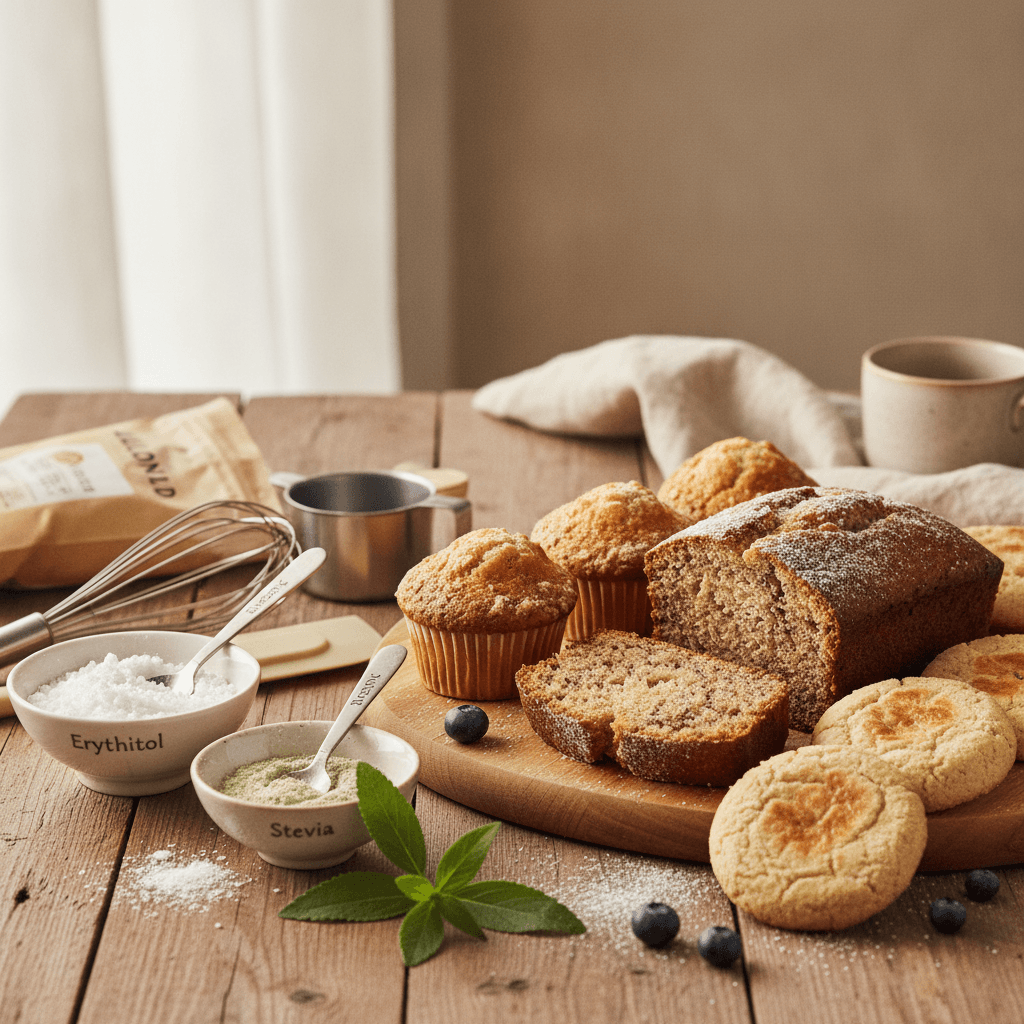
Erythritol and stevia are both zero-glycemic sweeteners, but they behave completely differently in baked goods — erythritol adds bulk but browns very little while stevia provides intense sweetness with no volume. Choosing the wrong one for your recipe can make sugar-free baking fail. Here's exactly how they compare on nutrition, baking behavior, safety, and when to use each.
Key takeaways
- Erythritol is 60–70% as sweet as sugar, so a cup-for-cup swap by volume gives a less sweet result; stevia extract is 200–400 times sweeter, so you need only about ½–1 teaspoon of pure extract per cup of sugar replaced.
- Erythritol provides bulk and structure, though little browning, in baked goods; stevia provides zero bulk, so cookies and cakes need a separate bulking agent like almond flour or inulin fiber.
- Both have a glycemic index of 0 and are FDA GRAS (Generally Recognized as Safe), but a 2023 Cleveland Clinic study linked high blood erythritol levels to cardiovascular event risk — with important limitations (see the safety section below).
- Erythritol has 0.2 calories per gram (effectively labeled 0 cal/serving); stevia has 0 calories. Neither raises blood sugar in published studies.
- Erythritol recrystallizes as baked goods cool, producing a gritty or crunchy texture in frostings and soft cookies. Stevia can develop a bitter, licorice-like aftertaste at high concentrations.
- For most baking, a blend of both (erythritol for bulk + a small amount of stevia for sweetness boost) addresses the main weakness of each.
Erythritol vs stevia comparison table
This table compares the two sweeteners on verifiable, label-level criteria. Taste descriptions come from manufacturer claims or known chemistry, not from personal testing.
| Criteria | Erythritol | Stevia (pure extract) |
|---|---|---|
| Sweetness vs sugar | 60–70% | 200–400x |
| Calories per gram | 0.2 cal (labeled 0 per serving) | 0 cal |
| Glycemic index | 0 | 0 |
| Net carbs per teaspoon | ~4g sugar alcohol (0g net impact) | 0g |
| Grams to replace 1 cup sugar (200g) | ~285–335g (about 1⅓–1⅔ cups, due to lower sweetness) | ~0.5–1g (about ½–1 tsp extract powder) |
| Provides bulk/volume | Yes — nearly 1:1 with sugar | No |
| Browning (Maillard reaction) | Minimal — not a reducing sugar | None |
| Cooling effect on tongue | Yes — endothermic dissolving | No |
| Recrystallization risk | High — especially as baked goods cool | None |
| Known aftertaste | Cooling sensation (endothermic dissolving) | Bitter/licorice at high doses (steviol glycoside chemistry) |
| Digestive tolerance (typical threshold) | 0.5g per kg body weight as a single dose with no laxative effect (EU Scientific Committee on Food, 2003); EFSA ADI of 0.5g/kg per day (2023) | Digestive issues rare; ADI of 4mg/kg steviol equivalents (JECFA/EFSA) |
| FDA GRAS status | Yes | Yes (high-purity steviol glycosides ≥95%) |
| Price range | Budget to mid-range | Mid-range to premium (pure extract) |
How we ranked these
Every comparison point above comes from one of four sources: FDA regulatory filings, published nutrition labels, peer-reviewed research (named in context), or the ingredient's known chemistry. No taste tests, personal baking trials, or reader surveys were used. When a characteristic like "cooling effect" is mentioned, it refers to the documented endothermic dissolution of erythritol crystals — a measurable physical property, not a subjective opinion.
Sweetness level and how much you need
Erythritol is only 60–70% as sweet as sucrose, which means you need more of it — roughly 1⅓ to 1⅔ cups of erythritol to match the sweetness of 1 cup of sugar. Some bakers use a straight 1:1 swap and accept a slightly less sweet result, which works in recipes where other flavors (chocolate, cinnamon, citrus) carry the sweetness perception.
Stevia extract powder is on the opposite end of the spectrum: 200–400 times sweeter than sugar (per the FDA), depending on the steviol glycoside composition. You need approximately ½ to 1 teaspoon of pure stevia extract to replace 1 cup of sugar's sweetness. That tiny amount creates a massive problem in baking — it leaves a volume gap of nearly 200g that you have to fill with something else.
This is exactly why many commercial stevia products bulk up the extract: Truvia uses erythritol, and Stevia In The Raw Bakers Bag uses maltodextrin. The stevia provides the sweetness; the bulking agent provides the structure. If you see a stevia product that measures cup-for-cup like sugar, check the ingredient list — the first ingredient is usually a bulking agent such as erythritol or maltodextrin.
How each one behaves in baking
This is where the two sweeteners diverge most sharply, and where choosing wrong leads to the texture problems that catch bakers off guard.
Browning and caramelization
Sugar browns through two mechanisms: caramelization (direct heat on sucrose) and the Maillard reaction (sugar + amino acids). Erythritol is not a reducing sugar, so it produces very little Maillard browning and does not caramelize. Expect pale tops on cookies and lighter crusts on muffins. Stevia contributes zero browning — it's present in such small amounts that there's nothing to react.
If browning matters to your recipe, adding 1–2 tablespoons of brown sugar or a tablespoon of molasses gives color and flavor without significantly raising the sugar content per serving.
Crystallization and texture
Erythritol's biggest baking weakness is recrystallization. As a baked good cools, dissolved erythritol comes out of solution and forms crystals. In cookies, this creates a crunchy, almost sandy texture. In frostings and glazes, it turns gritty within hours. This is a well-documented physical property — erythritol's solubility drops sharply as temperature falls (about 37% by weight at 25°C, compared with roughly 67% for sucrose).
Practical workarounds based on the chemistry:
- Use powdered (confectioners-style) erythritol instead of granulated — smaller crystals are less noticeable. Grinding granulated erythritol in a blender for 30–60 seconds works.
- Combine erythritol with allulose, which is far less prone to recrystallizing in baked goods. The allulose can interfere with crystal formation.
- Serve erythritol-based baked goods warm, or store them in an airtight container — moisture loss accelerates crystallization.
Stevia has no crystallization issue because so little is used. But without a bulking agent, stevia-only recipes produce dense, flat baked goods that lack the structure sugar normally provides. For more on how sugar functions beyond sweetness, see our learn page — it covers moisture retention, tenderizing, and leavening contributions that both erythritol and stevia handle differently.
Moisture and shelf life
Sugar is hygroscopic — it pulls moisture from the air and holds it in baked goods. Erythritol is far less hygroscopic, so erythritol-sweetened cakes and muffins tend to dry out faster. Stevia (in extract form) has no moisture-holding capacity at all.
If dryness is a recurring problem in your sugar-free baking, that's one of the common healthy baking mistakes worth troubleshooting — adding an extra egg yolk, a tablespoon of applesauce, or a little more fat may help compensate.
Cooling effect
Erythritol absorbs heat as it dissolves on the tongue (it has a strongly negative heat of solution, around −43 cal/g). This produces a cooling sensation similar to mint. The effect is most noticeable in uncooked applications (frostings, no-bake bars) and diminishes in fully baked items where the erythritol is already dissolved.
Stevia has no cooling effect.
Glycemic impact and net carbs
Both erythritol and stevia have a glycemic index of 0, meaning neither raises blood glucose in controlled studies. The mechanism differs: erythritol is absorbed in the small intestine and excreted unchanged in urine (about 90% within 24 hours), so it never enters metabolic pathways that produce glucose. Stevia's steviol glycosides are not metabolized for energy at all.
For anyone counting net carbs on a keto or low-carb plan, erythritol's carbohydrate grams (4g per teaspoon on the label) are subtracted entirely as sugar alcohols, yielding 0g net carbs. Stevia contributes 0g carbohydrates period. Both are functionally zero-impact for carb counting, which is why they dominate the best sugar substitutes for baking lists.
If you have diabetes or a metabolic condition, talk to your doctor before making sweetener changes — we're not qualified to give medical advice, and individual responses can vary.
Digestive tolerance
Erythritol is the best-tolerated sugar alcohol, but it still has a threshold. The EU's Scientific Committee on Food (2003) identified 0.5g per kilogram of body weight as a single dose with no laxative effect, and in 2023 EFSA set an acceptable daily intake of 0.5g/kg per day. For a 70kg (154lb) person, that's about 35g — a little under ¼ cup. Larger amounts can cause nausea, bloating, or diarrhea; the same osmotic mechanism makes xylitol harder on digestion, and in a 2007 clinical comparison xylitol caused more symptoms than erythritol at the same doses.
Stevia has essentially no digestive tolerance ceiling at baking-relevant doses. The JECFA and EFSA acceptable daily intake is 4mg of steviol equivalents per kg of body weight, which translates to roughly 12mg of Reb A per kg — far more than anyone would use in a day of baking. Digestive complaints with stevia are rare and typically linked to the bulking agents (erythritol, dextrose, maltodextrin) in blended products, not the stevia itself.
Safety: what regulators and researchers have found
Both sweeteners hold FDA GRAS (Generally Recognized as Safe) status. Stevia's GRAS designation applies specifically to high-purity steviol glycosides (≥95% purity), not crude stevia leaf extracts. Erythritol has been GRAS since 2001.
The 2023 Cleveland Clinic erythritol study
In February 2023, a study published in Nature Medicine by researchers at the Cleveland Clinic (Witkowski et al.) reported that high blood levels of erythritol were associated with increased risk of major adverse cardiovascular events (heart attack, stroke, death) over a 3-year follow-up. The study also showed that erythritol enhanced platelet reactivity and clot formation in lab and animal models.
Important limitations:
- The observational cohort (over 4,000 participants) was already at elevated cardiovascular risk — many had existing heart disease, diabetes, or hypertension. Results may not generalize to healthy populations.
- The study measured erythritol in blood, which reflects both what people eat and what the body makes, rather than tracking dietary intake. The human body produces erythritol naturally through the pentose phosphate pathway, and elevated blood levels may be a marker of metabolic dysfunction rather than a cause.
- The interventional portion gave a 30g erythritol drink to 8 healthy volunteers and measured a large spike in blood erythritol. The platelet effects came from lab and animal experiments; a 2024 follow-up by the same group found that 30g of erythritol, but not glucose, increased platelet reactivity in 20 healthy volunteers.
- The study did not establish causation — it found an association.
No regulatory body has changed erythritol's GRAS status based on this study. The FDA has not issued any advisory. However, if you have existing cardiovascular disease or clotting disorders, discuss erythritol use with your cardiologist. This is not medical advice — it's a summary of what the published research says.
Stevia safety profile
Stevia's safety has been evaluated by the Joint FAO/WHO Expert Committee on Food Additives (JECFA) and the European Food Safety Authority, both of which set an ADI of 4mg steviol equivalents per kg body weight per day. In its 2010 opinion, EFSA concluded that steviol glycosides are not genotoxic or carcinogenic and found no evidence of reproductive or developmental toxicity.
Price comparison
Erythritol is generally the more affordable option. Granulated erythritol from brands like Swerve, Anthony's, or NOW Foods typically falls in the budget to mid-range category. Pure stevia extract powder is more expensive per ounce, but because you use so much less, the cost per recipe can be comparable or even lower.
Stevia-erythritol blends like Truvia and Pyure generally fall between the two. Whichever you choose, pure stevia extract still needs a separate bulking agent.
If you run a home bakery and cost your recipes, factor in that erythritol-based recipes have a higher sweetener ingredient cost than sugar but a lower cost than allulose.
When to use erythritol vs stevia: the verdict
There's no single winner — the right choice depends on what you're baking.
Use erythritol when:
- You need bulk and structure — cakes, muffins, cookie doughs where sugar provides 20%+ of the dry weight
- You want a near-1:1 sugar swap with minimal recipe reformulation
- The recipe will be served warm (minimizes crystallization)
- You're making crunchy cookies, biscotti, or items where a slight crunch is desirable
Use stevia when:
- You're sweetening a liquid-heavy recipe (custards, puddings, sauces, beverages) where bulk doesn't matter
- You want zero sugar alcohols on the label — relevant if selling to consumers who avoid sugar alcohols
- You're adding sweetness on top of another bulking sweetener (erythritol, allulose, or almond flour-heavy batters)
- Digestive sensitivity is a concern and you want to minimize sugar alcohol intake
Use both together when:
- You want the best balance of bulk, sweetness, and cost — for example, erythritol at around 75% of the sugar volume plus a small amount of stevia extract, adjusted to taste
- You're developing a recipe for sale and want to keep the sugar alternative cost per unit reasonable
- You want to reduce the total erythritol load per serving (relevant given the 2023 cardiovascular study) while still maintaining recipe structure
Some commercial sweeteners already use this blended approach — Pyure and Truvia combine erythritol with stevia extract, and Lakanto pairs erythritol with monk fruit instead. If you're comparing specific erythritol products, our best erythritol brands for baking roundup compares options by granule size and blend composition.
Frequently asked questions
Is erythritol or stevia better for keto baking?
Both have 0g net carbs and a glycemic index of 0, so both are keto-compatible. Erythritol is generally more practical for baking because it provides bulk and structure that stevia cannot. For the best results, many keto bakers use erythritol as the base and add a small amount of stevia extract to boost sweetness without increasing volume. Our best sugar substitutes for baking guide covers more options.
Can you substitute stevia for erythritol in a recipe?
Not directly. Erythritol provides volume (about 1 cup per cup of sugar), while stevia extract replaces 1 cup of sugar with roughly ½–1 teaspoon. If you remove erythritol and add only stevia, you'll lose approximately 200g of dry ingredients. You'd need to replace that volume with a bulking agent — almond flour, coconut flour, inulin fiber, or another sugar alcohol — or the recipe's structure will collapse.
Does erythritol cause heart problems?
A 2023 study in Nature Medicine by Cleveland Clinic researchers found an association between high blood erythritol levels and increased cardiovascular event risk in a cohort already at elevated cardiac risk. The study did not prove causation, measured blood erythritol levels rather than dietary intake, and used a very small interventional sample (8 people). No regulatory agency has changed erythritol's safety status. If you have heart disease or clotting disorders, consult your cardiologist before using erythritol regularly.
Why does erythritol make my cookies gritty?
Erythritol has low solubility at room temperature — about 37% by weight at 25°C, compared with roughly 67% for sucrose. As cookies cool, dissolved erythritol comes out of solution and forms crystals. Using powdered erythritol, blending it with allulose (which is less prone to recrystallizing), or serving baked goods warm all reduce grittiness.
Is stevia safe for baking at high temperatures?
Yes. Steviol glycosides are heat-stable up to about 200°C (392°F), which covers virtually all standard baking temperatures. The FDA's GRAS designation applies to high-purity steviol glycosides (≥95%) used in cooked and baked applications. Stevia does not break down into harmful compounds at normal oven temperatures, according to published thermal stability studies.

Written by
Co-founder, BakingSubs
Co-founder of BakingSubs, where he turns the science of ingredient substitutions into tested, reliable guidance for home bakers.
Related Posts
Allulose vs Erythritol for Baking: 6 Differences That Actually Change Your Results
Best Sugar-Free Cake Mix and Brownie Mix (2026): 14 Options Ranked by Net Carbs, Sweetener, and Price
Lakanto Monk Fruit Sweetener Review: 0g Net Carbs, but Worth the Premium Price?
Bake with Confidence
See all
Confident Gluten-Free Baker Toolkit
The science-based system that replaces gluten's seven invisible jobs so your baking turns out soft, fluffy, and foolproof — every time.

Gluten-Free Recipe Vault
Instant access to our complete library of proven gluten-free recipes — no waiting, no guesswork, just results that work tonight.

Fix Your Gluten-Free Bread
Learn the 3-step formula to make bread rise and stay soft, discover why your loaves collapse, and get a tested sandwich bread recipe that actually works.