

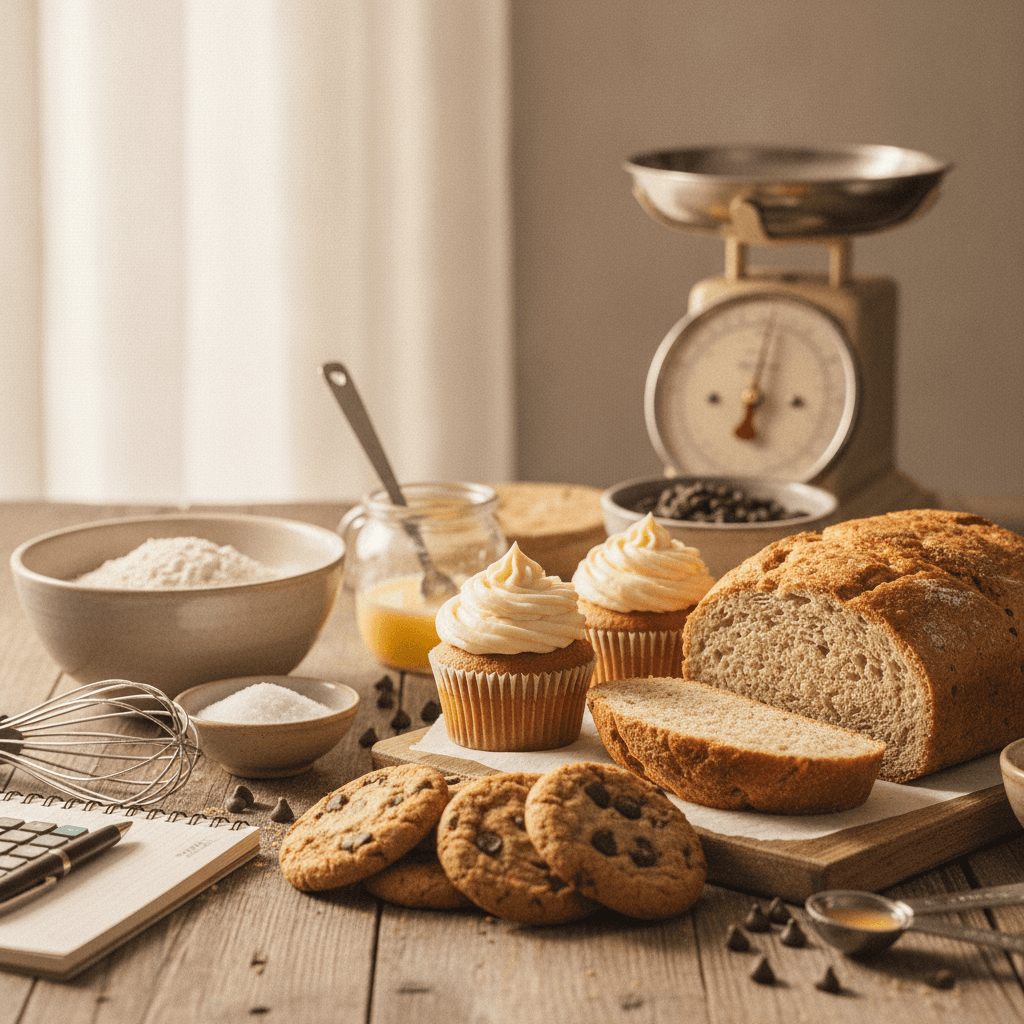
A bakery recipe cost sheet lists every ingredient, its purchase price, the amount used, and the resulting cost per unit so you know your true cost before you set a price. Without one, it's easy to underprice and not realize it until they've already committed to a full weekend of orders. Below is the exact process — and a copy-ready table — to cost any recipe in about 15 minutes.
Key takeaways
- A recipe cost sheet tracks ingredient cost per unit produced, not per batch — this is the number you price from.
- Ingredient cost should land between 25–35% of your retail price. If it's above 40%, your margin is too thin to cover labor and packaging.
- Weigh ingredients in grams instead of cups. A cup of almond flour can range from 96g to 120g depending on how you scoop — that's a $0.30 swing per batch on a $14 bag.
- Recalculate your cost sheet every time a supplier raises prices. A $2 increase on a 5 lb bag of butter changes your per-cookie cost by $0.03–$0.06, which compounds fast at volume.
- The copy-ready table below has every column you need — ingredient, purchase unit, purchase price, recipe quantity, and cost per recipe.
Why most home bakers skip recipe costing (and pay for it later)
Picture a baker who prices lemon bars at $24 a dozen for six months before sitting down with a cost sheet. Ingredient cost alone is $11.40 per dozen — 47.5% of the retail price. After $3.50 in packaging and $0.80 in cottage food label stickers, she is earning $8.30 per dozen before counting a single minute of labor. Raising the price to $32 might cost her two customers and still make her more money per month.
The problem isn't laziness. It's that recipe costing feels tedious until you realize you've been donating your labor. A cost sheet takes 15 minutes to build and saves you from months of underpricing.
What goes on a bakery recipe cost sheet
Every recipe cost sheet needs seven columns. Here's what each one does and why it matters:
- Ingredient name — Be specific. "Butter" isn't enough; write "Kerrygold unsalted butter" because the brand changes the price.
- Purchase unit — The size you actually buy (e.g., 5 lb bag, 32 oz jar, dozen eggs).
- Purchase price — What you paid, including tax if your state charges sales tax on groceries. Round to the cent.
- Cost per gram (or per oz) — Purchase price divided by total grams in the package. This is the conversion factor.
- Recipe quantity — How many grams (or oz) the recipe uses.
- Cost per recipe — Cost per gram multiplied by recipe quantity.
- Notes — Track where you bought it, the date, and any bulk discount.
Copy-ready recipe cost sheet table
This table is built for a chocolate chip cookie recipe that yields 36 cookies. Replace the ingredients and numbers with your own. If you're using specialty ingredients like sugar-free chocolate chips or alternative sweeteners, your per-unit cost will be higher — which is exactly why costing matters more for specialty baking.
| Ingredient | Purchase unit | Purchase price | Cost per gram | Recipe qty (g) | Cost per recipe | Notes |
|---|---|---|---|---|---|---|
| All-purpose flour (King Arthur) | 5 lb / 2,268g | $5.49 | $0.0024 | 360g | $0.87 | Walmart, 6/2026 |
| Unsalted butter (store brand) | 1 lb / 454g | $4.29 | $0.0094 | 227g | $2.14 | Kroger, 6/2026 |
| Granulated sugar | 4 lb / 1,814g | $3.99 | $0.0022 | 200g | $0.44 | Aldi, 6/2026 |
| Brown sugar | 2 lb / 907g | $3.49 | $0.0038 | 220g | $0.84 | Aldi, 6/2026 |
| Eggs (large) | 1 dozen / ~600g edible | $3.89 | $0.0065 | 100g (2 eggs) | $0.65 | Costco, 6/2026 |
| Vanilla extract (pure, store brand) | 8 oz / 237ml | $11.99 | $0.0506 (per ml) | 10ml | $0.51 | Typical price; pure, not imitation |
| Baking soda | 16 oz / 454g | $1.09 | $0.0024 | 6g | $0.01 | Arm & Hammer |
| Salt (Diamond Crystal kosher) | 3 lb / 1,361g | $4.49 | $0.0033 | 6g | $0.02 | Amazon, 6/2026 |
| Chocolate chips (Ghirardelli 60%) | 10 oz / 283g | $4.49 | $0.0159 | 340g | $5.40 | Target, need 1.2 bags |
| Total ingredient cost per batch (36 cookies) | $10.88 | Typical 2026 prices | ||||
| Ingredient cost per cookie | $0.30 | |||||
Notice that chocolate chips are over half the ingredient cost. That's typical — mix-ins and fats are almost always the most expensive lines. If you switch to a bulk 2 lb bag of chips at about $8.99, your per-gram cost drops from $0.0159 to roughly $0.0099, saving about $2 per batch.
How to cost a recipe in 6 steps
Step 1: Write out every ingredient with exact weights
Convert everything to grams using a kitchen scale like the OXO Good Grips 11 lb. Volume measurements introduce too much variance. A "cup" of brown sugar packed firmly weighs about 220g; loosely scooped, it's closer to 180g. That's a $0.15 difference per batch that multiplies across dozens of orders.
Step 2: Record the purchase price and package size for each ingredient
Go through your last receipt or your grocery store's app. Write down exactly what you paid, not the "regular" price. If you used a coupon or bought in bulk, use the price you actually paid. Include sales tax if your state taxes groceries — about a dozen states still do.
Keep a running price log. Egg prices in 2025 swung from roughly $2.49 to $7.99 per dozen depending on the month. Your cost sheet is only accurate if the prices are current.
Step 3: Calculate cost per gram for every ingredient
Divide the purchase price by the total grams in the package. For all-purpose flour: $5.49 / 2,268g = $0.00242 per gram. Do this for every line. It takes about 5 minutes.
For eggs, weigh the edible portion. A large egg without the shell weighs about 50g. A dozen gives you roughly 600g of usable egg. So $3.89 / 600g = $0.00648 per gram.
Step 4: Multiply cost per gram by recipe quantity
This gives you the cost of each ingredient in your recipe. Butter at $0.0094/g times 227g = $2.14. Simple multiplication, but this is the step where most bakers finally see how much butter actually costs them.
Step 5: Add up total ingredient cost and divide by yield
Sum the "cost per recipe" column. Then divide by the number of units the recipe produces. If your batch makes 36 cookies and costs $10.88 in ingredients, each cookie costs $0.30 in ingredients alone.
This is your ingredient cost per unit — the most important number on the sheet.
Step 6: Add packaging, labels, and overhead
Ingredient cost is not your total cost. You also need to account for:
- Packaging — Cellophane bags, boxes, ribbon, stickers. A kraft paper box with a window runs $0.45–$0.85 each depending on quantity. A cottage food label printed on an inkjet costs about $0.08–$0.12 per sticker.
- Indirect ingredients — Parchment paper, cooking spray, cupcake liners. A sheet of parchment costs about $0.12.
- Overhead percentage — Electricity, gas, water, equipment wear. Most home bakers add 5–10% to the ingredient cost as an overhead estimate. If your ingredient cost is $10.88, add $0.54–$1.09.
Your total cost of goods = ingredient cost + packaging + overhead. For our cookie example, that's roughly $10.88 + $2.70 (packaging for 3 dozen bags) + $0.82 (7.5% overhead) = $14.40 per batch, or $0.40 per cookie.
How to set your price from the cost sheet
The standard food-industry target is ingredient cost at 25–35% of retail price. Here's the formula:
Retail price = Total cost of goods / Target food cost percentage
If your total cost per dozen cookies is $4.80 and you want a 30% food cost:
$4.80 / 0.30 = $16.00 per dozen
At 25% food cost: $4.80 / 0.25 = $19.20 per dozen
Those figures are floors, not targets. Most home bakers selling chocolate chip cookies charge $24–$48 per dozen depending on their market, decoration, and ingredient quality. If your cost sheet shows you can't get to $24 without going above 40% food cost, you either need cheaper sourcing or a higher price point. There's no third option.
Common costing mistakes that eat your profit
Forgetting to cost small ingredients
Baking soda, salt, and vanilla seem cheap individually, but across 50 batches a month, vanilla alone can cost $15–$25. Cost everything. A $0.02 ingredient across 200 batches is $4.00.
Using old prices
Butter has swung by close to $2 a pound over the past few years. If your cost sheet still shows the old price, every batch is costing you close to $1 more than you think. Update prices monthly — or at minimum, every time you restock.
Not accounting for waste
Egg whites left over from a yolk-only recipe, batter stuck to the bowl, a batch that burns — these are real costs. Add a 3–5% waste factor to your total. Some bakers round up each ingredient by 5% to cover it.
Costing per batch instead of per unit
A batch cost of $10.88 means nothing for pricing. You need the per-cookie, per-cupcake, or per-slice number. Always divide by yield.
Specialty ingredients change the math
If you bake with almond flour, allulose, or sugar-free chocolate, your ingredient costs can be 2–4 times higher than conventional recipes. A 3 lb bag of almond flour runs about $12–$16 versus $5.49 for 5 lbs of AP flour. That difference has to show up in your retail price.
It helps to cost every recipe twice: once with your specialty ingredients and once with conventional equivalents. The gap tells you exactly how much of a premium you need to charge. For example, if a gluten-free chocolate chip cookie batch costs $16.80 versus $10.88 for the conventional version, that's a 54% increase in ingredient cost to pass through in your price.
A contrarian take: don't cost your labor by the hour
Most pricing advice says to calculate your hourly wage and add it to the cost sheet. We disagree for home bakers. Here's why: if you tack a $25/hour labor line onto a small batch, the resulting price can land well above what your local market will pay. Instead, use the cost sheet to set a floor (your total cost of goods), then price based on what your local market will pay. Your effective hourly rate is whatever's left after costs — and if it's below minimum wage, the cost sheet just told you to either raise prices, increase efficiency, or drop that product.
The cost sheet's job is to prevent you from losing money, not to guarantee a specific wage.
How to track costs over time
Keep a simple spreadsheet or notebook with three columns: ingredient, date, and price paid. Review it quarterly. If any ingredient has increased more than 10% since your last cost sheet update, recalculate that recipe immediately.
Some home bakers build a master ingredient price list and link individual recipe sheets to it. When butter goes up, they update one cell and every recipe recalculates. If you use Google Sheets, this takes about 30 minutes to set up and saves hours over a year.
The first recipe to cost is your bestseller, because that is where an error compounds fastest. Once you know its food cost percentage (ingredient cost divided by retail price), you will know whether the fix is a price increase, a supplier switch, or a reformulation.
Frequently asked questions
What percentage of my selling price should ingredient cost be?
For home bakeries, aim for 25–35% of your retail price. If your total cost per dozen cookies is $4.80, your retail price floor is $13.71 (35% food cost) and ideally $16.00 or higher (30% food cost) — and in practice most home bakers charge $24–$48. Going above 40% leaves almost nothing for labor, packaging, and overhead.
How often should I update my recipe cost sheet?
Update prices every time you restock an ingredient, or at minimum once a month. Staples like butter, eggs, and flour fluctuate seasonally. Egg prices swung from $2.49 to $7.99 per dozen within a single year recently. A cost sheet with stale prices is worse than no cost sheet because it gives you false confidence.
Should I include my time on the recipe cost sheet?
The cost sheet itself should track ingredient cost, packaging, and overhead — not labor. Labor is better handled at the pricing stage. Use the cost sheet to find your cost floor, then set your price based on what the market pays. Back-calculate your effective hourly rate from there. If it's too low, the cost sheet told you something important.
How do I cost recipes that use specialty or gluten-free ingredients?
The same way — weigh everything, record purchase prices, calculate cost per gram. The difference is that specialty ingredients like almond flour or erythritol cost 2–4x more per gram than conventional equivalents. Your cost sheet will show a higher cost per unit, which means your retail price must be higher. Don't absorb the difference — pass it through.
Do I need to cost packaging and labels separately?
Yes. Packaging is a real cost that most home bakers underestimate. A kraft box with a window costs $0.45–$0.85 each. Printed labels run $0.08–$0.12 per sticker on an inkjet. Ribbon, tissue paper, and stickers add another $0.15–$0.30 per unit. Add a "packaging" line to the bottom of your cost sheet and include it in your total cost of goods before calculating your price.

Written by
Co-founder, BakingSubs
Co-founder of BakingSubs, where he turns the science of ingredient substitutions into tested, reliable guidance for home bakers.
Related Posts
Bake with Confidence
See all
Confident Gluten-Free Baker Toolkit
The science-based system that replaces gluten's seven invisible jobs so your baking turns out soft, fluffy, and foolproof — every time.

Gluten-Free Recipe Vault
Instant access to our complete library of proven gluten-free recipes — no waiting, no guesswork, just results that work tonight.

Fix Your Gluten-Free Bread
Learn the 3-step formula to make bread rise and stay soft, discover why your loaves collapse, and get a tested sandwich bread recipe that actually works.