

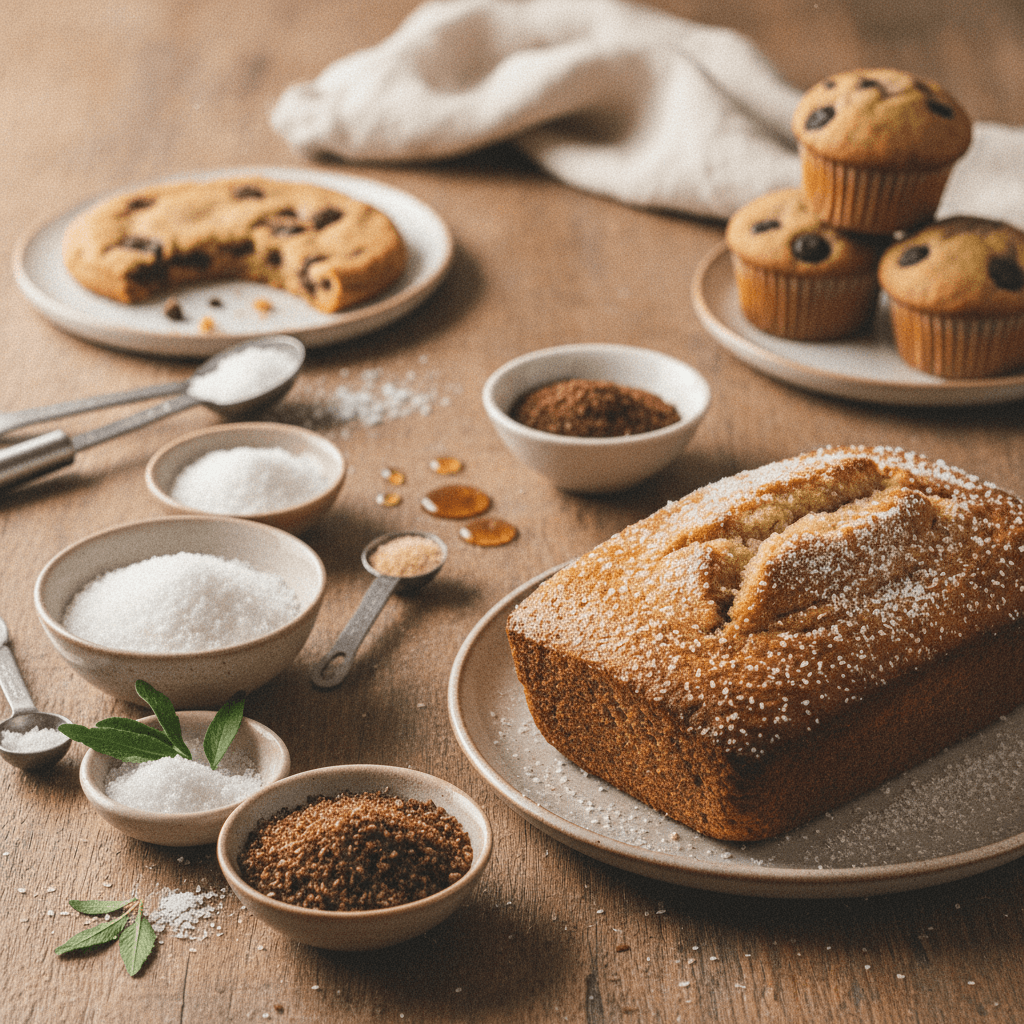
Cutting sugar from baked goods sounds simple until the cookies spread flat, the cake dries out in 24 hours, and the muffins taste like cardboard. Sugar does far more than sweeten — and every substitute handles those jobs differently. Here is what the chemistry actually says about each one and how to choose the right swap for what you are baking.
Key takeaways
Sugar performs at least 6 structural functions in baking beyond sweetness, including moisture retention, browning, tenderizing, and leavening assistance.
Erythritol provides 70% of sugar's sweetness at 0.2 calories per gram but does not caramelize and can produce a cooling aftertaste at amounts above 40g per batch.
Allulose is the closest chemical mimic to sucrose — it browns, retains moisture, and depresses freezing point, but costs roughly $1.10 per ounce compared to sugar's $0.04 per ounce.
Monk fruit extract is 150–200 times sweeter than sugar by weight, so a standard cookie recipe calling for 200g granulated sugar may need only 1–1.3g of pure monk fruit extract — plus a bulking agent.
Every sugar substitute changes at least one of these: spread, rise, browning, shelf life, or crumb tenderness. There is no drop-in replacement that leaves all six unchanged.
Blending two substitutes (such as erythritol + allulose at a 60/40 ratio) often outperforms either one alone by balancing sweetness, bulk, and browning.
What sugar actually does in baking (it is not just about sweet)
Before swapping anything, it helps to understand the jobs sugar performs. Sugar's functions in baking go well beyond flavor. In a standard vanilla cake recipe calling for 200g granulated sugar, that sugar is simultaneously:
Tenderizing the crumb — sugar competes with flour proteins for water, which limits gluten development and keeps the texture soft.
Retaining moisture — sucrose is hygroscopic, pulling water from the air and binding it. This is why sugar-free baked goods often go stale within 12–18 hours while their full-sugar counterparts stay soft for 3–4 days.
Browning the crust — the Maillard reaction and caramelization both depend on sugar. Without it, crusts stay pale even at 375°F for 25 minutes.
Assisting leavening — in creamed butter-sugar methods, granulated sugar crystals create tiny air pockets. Fewer crystals means fewer nucleation sites and a denser crumb.
Controlling spread — in cookies, sugar liquefies during baking, which controls how much the dough spreads. Remove it and the spread pattern changes dramatically — sometimes more, sometimes less, depending on what replaces it.
Depressing the freezing point — relevant for frozen desserts, but also affects the set point of custards and curds.
Any substitute that handles only the sweetness job — and ignores the other five — will produce a noticeably different product. That is why so many low sugar baking attempts disappoint on the first try.
6 sugar substitutes ranked by how many of sugar's jobs they actually do
Not all sweeteners are created equal. Here is a comparison based on published food science data, not marketing claims.
Substitute | Sweetness vs. sugar | Calories per gram | Browns? | Retains moisture? | Provides bulk? | Approximate cost per ounce (USD) |
|---|---|---|---|---|---|---|
Allulose | 70% | 0.2–0.4 | Yes (strongly) | Yes | Yes | $1.10 |
60–70% | 0.2 | No | Minimal | Yes | $0.55 | |
100% | 2.4 | No | Moderate | Yes | $0.45 | |
Monk fruit extract (pure) | 150–200x | 0 | No | No | No | $3.80 |
Stevia extract (pure) | 200–350x | 0 | No | No | No | $2.50 |
100% | 4.0 | Yes | Yes | Yes | $0.22 |
A few things jump out. Allulose wins the most columns, but it costs roughly 27 times more than granulated sugar per ounce. Coconut sugar checks nearly every box but has essentially the same caloric load as regular sugar — it is lower on the glycemic index (GI of about 35 vs. 65 for sucrose), but calling it "low sugar" is a stretch. And the high-intensity sweeteners (monk fruit, stevia) solve sweetness and nothing else, which means you need a separate bulking strategy.
Allulose: the closest chemical match to sucrose
Allulose (D-psicose) is a rare sugar naturally found in figs and raisins. Chemically, it is a monosaccharide with the same molecular formula as fructose (C6H12O6) but with a different arrangement at the C-3 carbon. That small structural difference means the human body absorbs about 70% of ingested allulose but excretes most of it unchanged — resulting in roughly 0.2–0.4 calories per gram depending on the study.
What makes allulose remarkable for baking is that it participates in the Maillard reaction. Research published in the Journal of Food Science (2019) showed allulose-containing cookie doughs browned 15–20% more than sucrose controls at the same oven temperature and time. This means you may need to reduce oven temperature by 15–25°F or shorten bake time by 2–3 minutes to avoid over-browning.
Allulose also retains moisture well. Cakes made with allulose tend to stay soft for 48–72 hours, which is closer to sucrose performance than any other low-calorie substitute. The trade-off: at quantities above 50g in a single serving, allulose can cause digestive discomfort in some people. And the price — roughly $1.10 per ounce retail — makes it expensive for large-batch baking.
Best uses for allulose
Cakes, brownies, and soft cookies where browning and moisture retention matter most. It works well in recipes where sugar is creamed with butter because allulose crystals, while finer than granulated sugar, still create some air incorporation. For bread baking, allulose can feed yeast to a limited degree, though fermentation is slower than with sucrose.
Erythritol: the budget workhorse with real limits
Erythritol is a sugar alcohol produced by fermenting glucose with Moniliella pollinis yeast. At 0.2 calories per gram and about 60–70% the sweetness of sugar, it is one of the most widely used sugar substitutes in commercial low sugar baking. Brands like Swerve blend erythritol with oligosaccharides to improve the taste profile.
The chemistry explains both its strengths and weaknesses. Erythritol does not undergo the Maillard reaction because it is not a reducing sugar. That means no browning. Cookies come out pale. Crusts stay white-ish. If visual appeal matters — and for home bakers selling their products, it absolutely does — you will need to compensate with a small amount of a browning agent. Adding just 10–15g of allulose or 1 tablespoon of molasses per batch can solve this without meaningfully increasing sugar content.
Erythritol also has a pronounced cooling effect on the tongue. This is an endothermic dissolution — erythritol absorbs heat as it dissolves in saliva, creating a minty-cool sensation. In chocolate baked goods, this is barely noticeable. In vanilla sugar cookies, it is very noticeable and often described as "weird" by taste testers. Keeping erythritol below 40g per standard batch (about 24 cookies) minimizes this effect.
The recrystallization problem
Erythritol has a strong tendency to recrystallize as baked goods cool. This can make the surface of muffins or the top of a cake feel gritty or crunchy within 6–8 hours of baking. Powdering erythritol in a blender before use reduces but does not eliminate this. Combining erythritol with a humectant like glycerin (roughly 1 teaspoon per batch) or blending it with allulose helps prevent recrystallization by disrupting crystal lattice formation.
Monk fruit and stevia: high-intensity sweeteners that need a partner
Pure monk fruit extract (mogroside V) is 150–200 times sweeter than sugar. Pure stevia extract (steviol glycosides, specifically rebaudioside A) is 200–350 times sweeter. Both have zero calories and zero glycemic impact.
The problem for bakers is obvious: a recipe calling for 200g of sugar cannot be replaced with 1g of monk fruit extract and nothing else. You have lost 199g of bulk, structure, and moisture-binding capacity. The batter will be a completely different consistency.
This is why most retail "monk fruit sweetener" or "stevia baking blend" products are actually 98–99% erythritol or another bulking agent with a tiny amount of the high-intensity sweetener added. Check the ingredient label — if erythritol is listed first, the product's baking behavior will follow erythritol's rules, not monk fruit's. Understanding how to choose sugar alternatives means reading past the front-of-package marketing.
Stevia can leave a bitter, licorice-like aftertaste, especially at higher concentrations. This bitterness comes from stevioside, a different glycoside than rebaudioside A. Higher-purity reb-A extracts (95%+ purity) have significantly less bitterness, but they cost more. Monk fruit extract generally has a cleaner taste profile, though some people detect a slight fruity aftertaste.
When high-intensity sweeteners make sense
They work best when paired with a bulking agent in recipes where sweetness is the primary role of sugar — think frostings, glazes, whipped cream, and no-bake fillings. For structural baked goods like cakes, cookies, and gluten-free breads, you need a bulking substitute that handles the other five jobs sugar performs.
Xylitol: the middle ground nobody talks about
Xylitol is a sugar alcohol with a sweetness profile nearly identical to sucrose — 1:1 substitution by weight for sweetness. At 2.4 calories per gram (vs. sugar's 4.0), it is not zero-calorie, but it has a glycemic index of about 7 compared to sucrose's 65.
Structurally, xylitol provides bulk comparable to sugar. It dissolves in liquid, incorporates into batters, and creates reasonable air incorporation when creamed with butter. It does not brown through the Maillard reaction, but it caramelizes slightly at high temperatures (above 320°F), giving a faint golden color that erythritol cannot achieve.
The major limitation: xylitol is extremely toxic to dogs. Even small amounts — 0.1g per kilogram of body weight — can cause hypoglycemia and liver failure in dogs within 30–60 minutes of ingestion. For any home baker with dogs in the kitchen, or anyone selling baked goods at farmers markets or to customers with pets, this is a serious liability concern that requires clear labeling.
Xylitol also has a laxative effect at doses above 40–50g per day for most adults, though tolerance builds over time. In a batch of 24 muffins, using 150g of xylitol means each muffin contains about 6.25g — well within the tolerable range for most people.
Blending substitutes: why 60/40 erythritol-allulose outperforms either alone
Food scientists at Purdue University and several commercial R&D labs have found that blending sugar substitutes often produces better results than using any single one. The logic is straightforward: each substitute has different strengths and weaknesses, and blending averages them out.
A 60/40 erythritol-to-allulose blend (by weight) is one combination that shows up repeatedly in reformulated commercial products. Here is why it works:
Erythritol provides bulk and structure at a lower cost ($0.55/oz vs. $1.10/oz for allulose)
Allulose provides browning and moisture retention that erythritol cannot
The allulose disrupts erythritol's crystal lattice, reducing the recrystallization and grittiness problem
The cooling effect of erythritol is diluted because less erythritol is used per batch
For a recipe calling for 200g granulated sugar, a starting point would be 130g erythritol + 85g allulose (total 215g, to account for the lower sweetness of both). Adjustments from there depend on the specific recipe. Cookies may need slightly more allulose for spread control. Cakes may need slightly less total substitute if the batter is too wet.
This blend costs roughly $0.73 per ounce — still 18 times more expensive than granulated sugar, but significantly cheaper than pure allulose. For bakers thinking about profit margins on specialty baked goods, the ingredient cost difference is real and needs to be priced into the final product.
How low sugar substitutes affect specific baked goods
Cookies
Sugar controls cookie spread by liquefying during baking. Erythritol melts at 250°F (vs. sugar's 320°F), which means erythritol-based cookies spread earlier and set differently. The result is often a thinner, crispier cookie. Adding 1–2 tablespoons of applesauce per batch can add back moisture and chewiness without significant sugar content. Allulose-based cookies tend to spread similarly to sugar cookies but brown faster — reduce oven temp by 25°F.
Cakes
The biggest challenge in low sugar cakes is rapid staling. Without sugar's hygroscopic properties, cakes dry out fast. Allulose handles this best among the substitutes. Erythritol-only cakes can become noticeably dry within 18–24 hours. Adding 2 tablespoons of vegetable glycerin per cake recipe helps retain moisture regardless of which substitute you use.
Bread
Most bread recipes use relatively little sugar (2–4% of flour weight), so the structural impact of substitution is smaller. The main role of sugar in bread is feeding yeast during fermentation. Erythritol cannot be metabolized by yeast at all. Allulose is fermented by yeast, but slowly — expect 20–30% longer rise times. Xylitol is partially fermentable. For yeast breads, the simplest approach is often to keep a small amount of real sugar (10–15g) for the yeast and use a substitute for any remaining sweetness.
Frostings and glazes
This is where high-intensity sweeteners like monk fruit and stevia shine. Powdered erythritol makes a passable powdered-sugar-style frosting, though it can have a slight cooling sensation. Blending powdered erythritol with a monk fruit sweetener and cream cheese produces a frosting that is nearly indistinguishable from the original in taste, though the texture is slightly less smooth. Understanding common sugar substitution mistakes can save a lot of wasted frosting batches.
The contrarian take: sometimes a little real sugar outperforms a lot of substitutes
Here is something the sugar-substitute industry does not love to hear: in many recipes, using 25–30% of the original sugar amount plus a small amount of high-intensity sweetener produces better results than using 100% substitute. A cake recipe calling for 200g sugar might perform beautifully with 50g real sugar + 0.5g monk fruit extract + 100g erythritol for bulk. The 50g of real sugar handles browning, some moisture retention, and yeast feeding (in enriched doughs), while the monk fruit covers the sweetness gap and the erythritol provides the remaining bulk.
This "hybrid" approach adds about 8.3g of sugar per serving in a 12-slice cake — compared to 16.7g in the full-sugar version. That is a 50% reduction with dramatically better texture, browning, and shelf life than a fully sugar-free version. For people managing blood sugar rather than eliminating sugar entirely, this is often the more practical path.
Frequently asked questions
What is the best sugar substitute for baking that does not change texture?
Allulose is the closest to sugar in terms of overall baking behavior — it browns, retains moisture, provides bulk, and even depresses freezing point like sucrose. However, it costs roughly $1.10 per ounce compared to sugar's $0.04, and it browns faster than sugar, so oven temperature adjustments of 15–25°F lower are usually needed. No substitute leaves texture completely unchanged, but allulose comes closest. For a deeper look at options, see our guide on choosing sugar alternatives.
Can you use erythritol as a 1:1 sugar replacement in baking?
Not exactly. Erythritol is only 60–70% as sweet as sugar, so a 1:1 swap by weight will taste less sweet. It also does not brown, can recrystallize into a gritty texture, and produces a cooling sensation on the tongue at amounts above 40g per batch. Blending erythritol with allulose at a 60/40 ratio addresses most of these issues while keeping costs lower than using allulose alone.
Why do sugar-free baked goods go stale so fast?
Sugar is hygroscopic — it attracts and binds water molecules, keeping baked goods moist for days. Most sugar substitutes (erythritol, stevia, monk fruit) do not share this property. Without that moisture-binding action, cakes and muffins can dry out within 12–18 hours. Allulose is the exception, retaining moisture similarly to sucrose. Adding humectants like vegetable glycerin (1–2 tablespoons per recipe) also helps. Learn more about why baked goods stale quickly and how to prevent it.
Is monk fruit sweetener good for baking cookies and cakes?
Pure monk fruit extract is 150–200 times sweeter than sugar, so you only need about 1g to replace the sweetness of 200g of sugar. The problem is that you lose 199g of bulk, structure, and moisture. Most "monk fruit baking blends" sold at retail are actually 98–99% erythritol with a small amount of monk fruit added. These blends work reasonably well for cookies and cakes, but their baking behavior follows erythritol's rules — no browning, potential grittiness, and a cooling aftertaste.
Does coconut sugar count as low sugar baking?
Coconut sugar has the same caloric content as regular sugar (4 calories per gram) and contains sucrose, glucose, and fructose. Its glycemic index is lower (about 35 vs. 65 for white sugar), which means a slower blood sugar spike, but the total sugar content is essentially the same. It is a better option for people focused on glycemic impact specifically, but it is not a reduced-sugar or reduced-calorie substitute.

Written by
Co-founder, BakingSubs
Co-founder of BakingSubs, where he turns the science of ingredient substitutions into tested, reliable guidance for home bakers.
Related Posts
Bake with Confidence
See all
Confident Gluten-Free Baker Toolkit
The science-based system that replaces gluten's seven invisible jobs so your baking turns out soft, fluffy, and foolproof — every time.

Gluten-Free Recipe Vault
Instant access to our complete library of proven gluten-free recipes — no waiting, no guesswork, just results that work tonight.

Fix Your Gluten-Free Bread
Learn the 3-step formula to make bread rise and stay soft, discover why your loaves collapse, and get a tested sandwich bread recipe that actually works.