

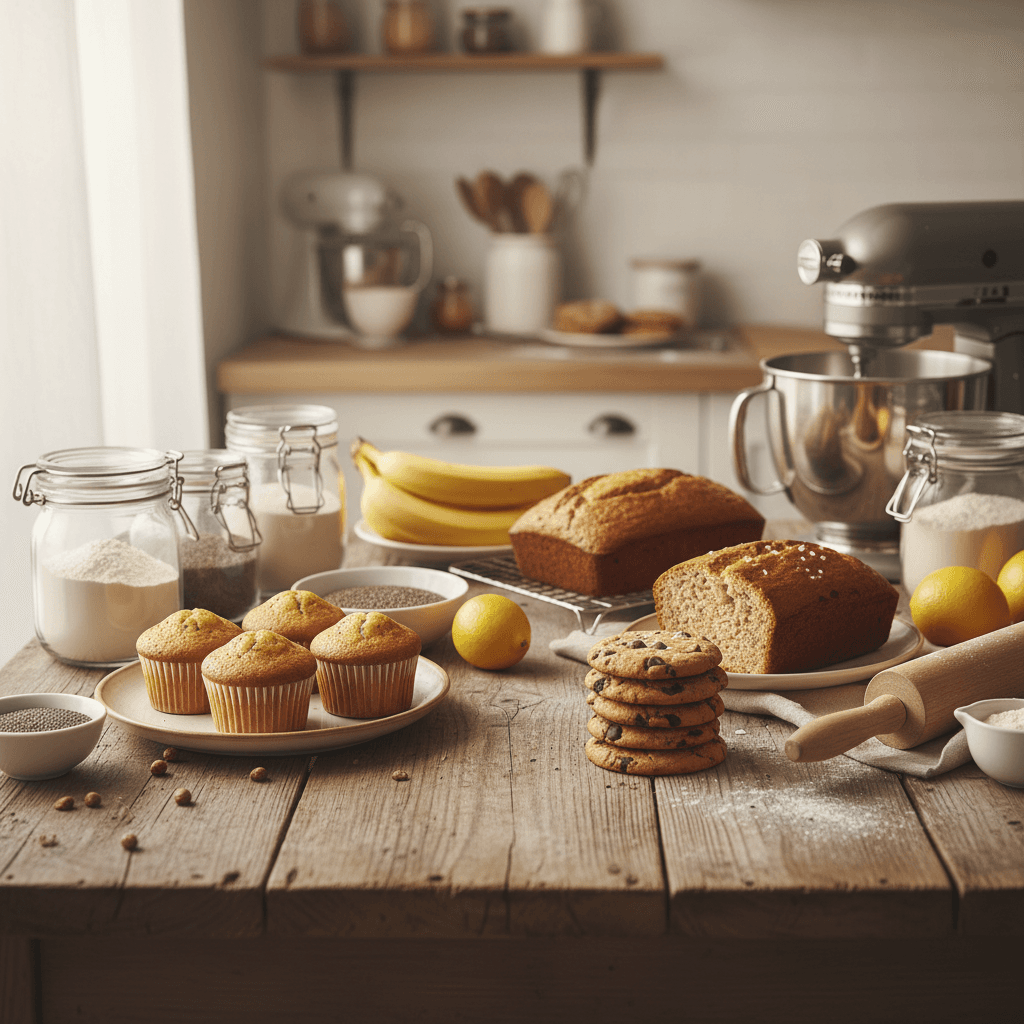
Most "highest margin" lists rank products by ingredient cost alone, which is useless. A $2.10 ingredient cost on a $28 cake sounds amazing until you realize it took you 4.5 hours to decorate — and you just paid yourself $5.76/hour. The real question is: which baked goods put the most profit in your pocket per hour of your actual labor?
I tracked costs, labor, and revenue across seven product categories from my own baking and from conversations with dozens of home bakers running real businesses. Here's what the numbers actually say.
Key takeaways
- Ingredient cost percentage is a misleading metric on its own — labor hours per dollar of revenue is what determines real margin for home bakers.
- Simple loaf cakes and banana bread consistently deliver $35–$55 profit per labor hour, making them the highest effective-margin items for most operators.
- Custom decorated cookies look profitable on paper but often net under $15/hour once you account for design, drying, and packaging time.
- Cinnamon rolls and scones scale beautifully for batch production, hitting $40–$48/hour when you batch 4–6 dozen at once.
- The "best" margin product depends on three variables: your speed, your market's price tolerance, and your production capacity.
- Mixing high-margin staples with one premium "hero" product is the most sustainable menu strategy.
Why ingredient cost percentage lies to you
The standard advice says keep food cost under 30% and you're golden. By that logic, a custom 3-tier cake with $18 in ingredients that sells for $350 has a 5% food cost — incredible, right? Except that cake took Rachel, a home baker in Austin, 11 hours from batter to delivery. After subtracting $18 in ingredients, $12 in packaging and gas, and $8 in overhead allocation, she netted $312 — but divided by 11 hours, that's $28.36/hour.
Meanwhile, her banana bread loaves cost $3.40 in ingredients, sell for $14 each, and she cranks out 8 loaves in 2.5 hours. That's $84.80 in gross profit from a single batch, or $33.92/hour. When she doubled her price to $18 per loaf (her market supported it), she hit $46.72/hour.
The metric that matters is profit per labor hour. That's (Revenue – Ingredients – Packaging – Delivery) ÷ Total Hours. Every product below is ranked by this number, not by food cost percentage.
If you've been undercharging for your baked goods, fixing your prices alone can shift a mediocre-margin product into your most profitable one.
The 7 highest margin baked goods, ranked by profit per labor hour
These numbers assume a moderately experienced home baker (not your first month, not a 20-year pro) working in a standard home kitchen. Your numbers will differ, but the relative ranking holds remarkably consistent across the bakers I've talked to.
| Rank | Product | Typical sell price | Ingredient cost | Batch size | Total labor (hrs) | Profit/hour |
|---|---|---|---|---|---|---|
| 1 | Simple loaf cakes (banana, lemon, pumpkin) | $16–$22 each | $2.80–$4.10 | 6–8 loaves | 2.0–2.5 | $38–$55 |
| 2 | Cinnamon rolls (batch of 3 dozen) | $4.50–$6 each | $0.68–$0.92 | 36 rolls | 3.0 (incl. rise) | $40–$48 |
| 3 | Scones (batch of 4 dozen) | $3.50–$5 each | $0.55–$0.80 | 48 scones | 2.0 | $42–$52 |
| 4 | Brownies/blondies (sheet pan, cut to sell) | $3–$4 each or $24–$32/dozen | $0.45–$0.70 | 24 bars | 1.5 | $34–$46 |
| 5 | Cupcakes (simple flavors, basic frosting) | $3.50–$5 each | $0.60–$0.90 | 24 cupcakes | 2.5 | $26–$38 |
| 6 | Custom cakes (simple 2-layer, buttercream) | $55–$85 | $8–$14 | 1 cake | 2.5–3.5 | $18–$28 |
| 7 | Custom decorated cookies | $5–$8 each | $0.40–$0.65 | 24 cookies | 5–8 (incl. drying) | $12–$22 |
A few things jump out. The simplest products — loaf cakes, scones, brownies — dominate. The fanciest products — decorated cookies, elaborate cakes — sit at the bottom. This isn't because they're bad products. It's because complexity eats labor, and labor is the most expensive ingredient in a home bakery.
Product-by-product breakdown: what the numbers actually mean
Simple loaf cakes: the quiet profit machine
Banana bread, lemon pound cake, pumpkin bread — these are the products that quietly fund successful home bakeries while everyone on Instagram is chasing cake orders. The reason is pure math: a loaf cake requires about 15 minutes of active work per loaf when batched, plus shared oven time. There's no decorating, no fondant, no custom design consultation.
Tanya, a home baker in Columbus, sells 30 banana bread loaves per week at $18 each. Her ingredient cost per loaf is $3.22 (she uses high-quality vanilla and real butter, not the cheapest options). She bakes all 30 in two sessions totaling about 5 hours. After packaging ($0.85/loaf in kraft paper and stickers), she nets roughly $418 from those 5 hours — that's $83.60/hour before overhead. Even after allocating for gas, electricity, and cottage food license fees, she's clearing north of $70/hour.
The catch? You need volume. Selling 3 loaves a week at $16 won't change your life. But if you can build a weekly order list — and email marketing is the best tool for that — loaf cakes become a revenue engine.
Cinnamon rolls: high perceived value, batch-friendly
People will pay $5 for a single cinnamon roll without blinking, but they'll argue about $5 for a cookie. That perception gap is real money. A batch of 36 cinnamon rolls uses about $25–$33 in ingredients (flour, butter, brown sugar, cream cheese for frosting). The sell-through at $5 each is $180. Net after ingredients and packaging: roughly $140 for about 3 hours of work, including rise time where you're free to do other things.
The key insight: rise time is not labor time. If you're standing around watching dough proof, you're misallocating your hours. Experienced bakers use proofing windows to prep packaging, answer customer messages, or start a second product batch. That's how you push profit per hour from $35 up past $45.
Scones: the farmers market winner
Scones are criminally underrated for home bakeries. They're fast (no rise time, no decoration), they freeze beautifully before baking, and they have a "premium bakery" feel that supports $4–$5 pricing. A batch of 48 scones takes about 2 hours from mise en place to cooling rack, with ingredient costs around $26–$38 depending on mix-ins.
The margin jumps when you use seasonal flavors — cranberry orange in fall, lavender blueberry in spring — because seasonal items command 15–20% higher prices with zero additional ingredient cost. A $4 blueberry scone becomes a $4.75 lavender blueberry scone, and nobody questions it.
If you're wondering which products to lead with, this ties directly into choosing the right niche for your home bakery. Scones pair well with a "morning pastry" niche that targets coffee shops and wholesale accounts.
Brownies and blondies: the simplest math in baking
One sheet pan. One recipe. Cut into 24 pieces. Sell for $3–$4 each or $28–$32 per dozen. Ingredient cost for a full sheet: $11–$17 depending on chocolate quality. Active labor: roughly 20 minutes of mixing and 25 minutes of baking, plus cooling and cutting. You're looking at about 1.5 hours total for $55–$79 in profit.
The secret weapon here is variety without complexity. Swirl in peanut butter, add espresso powder, throw in some sea salt — each variation takes 30 seconds of extra work but lets you charge $1 more per piece. Marcus, a home baker in Portland, sells four brownie flavors every weekend: classic, salted caramel, espresso walnut, and a rotating seasonal. His average is $3.75 per brownie, and he moves 8 dozen per week through his Google Business Profile and a simple text list.
Cupcakes: good margin if you keep them simple
Cupcakes sit in the middle because they can go either way. A basic vanilla cupcake with a clean buttercream swirl takes about 4 minutes per cupcake to frost and box. At $4 each and $0.75 in ingredients, the math works. But the moment a customer asks for fondant toppers, custom colors, or individual flavor variations, your labor per cupcake triples and your profit per hour craters.
The move: offer 2–3 set flavors. No custom requests on cupcakes. If someone wants custom, steer them to a cake order where you can price the labor properly. This is one of those situations where saying no to certain orders directly protects your margin.
Custom cakes: profitable only with discipline
Custom cakes are the product most home bakers think is their highest margin item. It's usually not — unless you're ruthlessly efficient and you price correctly. A simple 2-layer 8-inch buttercream cake with minimal decoration can be profitable at $65–$85. But scope creep is the margin killer. "Can you add a few flowers?" turns into 45 extra minutes. "Could you write a message?" adds another 15.
If you're going to sell custom cakes, you need a real pricing framework that charges for every hour of labor, not just ingredients. The bakers I know who make good money on cakes charge $75+ for a basic 8-inch round and $150+ for anything with fondant or detailed piping. Below those numbers, you're probably paying yourself less than you would flipping brownies.
Custom decorated cookies: the margin trap
This is the controversial one. Decorated sugar cookies are everywhere on Instagram, and they look like a goldmine — $5 to $8 per cookie with $0.40 in ingredients? That's an 88% gross margin!
Except. Each cookie takes 8–15 minutes to decorate once you factor in flooding, drying between layers, and detail work. A set of 24 cookies routinely takes 5–8 hours of total labor (baking, cooling, outlining, flooding, drying, detailing, packaging). At $6 per cookie, that's $144 in revenue, minus about $15 in ingredients and $8 in packaging, leaving $121 across let's call it 6.5 hours — or $18.62/hour.
That's not terrible, but it's roughly half what you'd make on loaf cakes or scones in the same time. If you love decorating cookies and your market pays premium prices ($8+ per cookie), it can work. But if you're optimizing for profit, make sure your pricing reflects the real labor.
Looking for a structured approach to building a profitable baking business? The free Home Bakery Pro masterclass walks through getting consistent orders and building a sustainable home bakery — worth watching if you're serious about turning margin into real income.
The three variables that change everything
The table above is a starting point, not gospel. Three things will shift your personal rankings significantly:
Your speed
A baker who's made 500 batches of cinnamon rolls is 40–60% faster than someone on batch 20. If you're new to a product, your profit per hour will be lower. Track your actual time for the first 10 batches, then re-evaluate. I weighed and timed 12 batches of scones over a month, and my per-batch time dropped from 38 minutes to 22 minutes as I dialed in the process — that's a 42% improvement that directly hits profit per hour.
Your market's price tolerance
A loaf of banana bread sells for $22 in parts of Brooklyn and $12 in rural Arkansas. Same recipe, same quality, wildly different margins. Before you commit to a product line, test your local market's ceiling. List the same item at three price points across three weeks and see where demand drops. If your area won't pay $16 for a loaf cake, scones at $4.50 might be a better play.
If you haven't tested your market yet, validating your home bakery idea before going all-in will save you months of wasted effort.
Your production capacity
A home oven fits 2 sheet pans at a time. That's a hard ceiling on batch size. If you can only bake 24 scones per oven load and your oven takes 18 minutes per batch, you max out at about 80 scones in a 2-hour session. At $4 each, that's $320 in revenue — great if you can sell them all, but your kitchen is the bottleneck. Bakers with double ovens or convection ovens can push 30–50% more volume in the same time window, which changes the margin math on batch products dramatically.
The menu strategy that actually works
The highest-margin home bakeries I've studied don't pick one product — they run a deliberate mix:
- 2–3 high-margin staples (loaf cakes, scones, brownies) that generate consistent weekly revenue with minimal labor. These are your bread and butter — literally.
- 1 premium "hero" product (custom cakes, decorated cookies, specialty item) that builds your brand and justifies higher prices across your whole menu.
- 1 seasonal rotating item that creates urgency and lets you charge seasonal premiums.
The staples fund your business. The hero product gets you on Instagram and drives word-of-mouth. The seasonal item keeps your menu fresh and gives customers a reason to order now rather than later.
Dana, a home baker in Nashville, runs exactly this model: banana bread and blueberry scones every week (her staples), custom birthday cakes twice a month (her hero), and a monthly rotating flavor — pumpkin everything in October, peppermint bark brownies in December, strawberry lemon scones in June. She grosses $2,800–$3,400/month working about 20 hours per week. Her effective hourly rate hovers around $42.
That's the kind of sustainable business model that doesn't burn you out. She's not taking every order — she's selective about what she bakes because she knows exactly which products make her money and which ones just make her busy.
The contrarian take: stop chasing "high margin" and chase repeatability
Here's what most margin advice gets wrong: the highest margin product you never sell is worth zero. A $55 profit-per-hour scone is meaningless if you can only sell 12 per week. Meanwhile, a $28/hour cupcake that sells 10 dozen per week is generating $1,344 in weekly profit.
Margin matters, but only multiplied by volume. The real question isn't "what has the highest margin?" — it's "what has the highest margin that I can sell consistently every single week?"
That's why building systems for consistent weekly orders matters more than optimizing any single product's margin by a few percentage points. A baker selling 40 loaves of banana bread every week at $16 each is making more than a baker selling 3 custom cakes at $120 each — and working fewer hours to do it.
Frequently asked questions
What baked goods have the highest profit margin for a home bakery?
Simple loaf cakes (banana bread, lemon pound cake, pumpkin bread) consistently deliver the highest profit per labor hour for home bakers — typically $38–$55/hour when batched properly. Scones and cinnamon rolls are close behind at $40–$52/hour. The key metric is profit per labor hour, not just ingredient cost percentage, because labor is the biggest expense in a home bakery.
Are decorated cookies profitable for a home bakery?
Decorated sugar cookies have high ingredient margins (85–90%) but low profit per labor hour — often $12–$22/hour — because each cookie takes 8–15 minutes to decorate. They're profitable if you charge $8+ per cookie and work efficiently, but they're rarely the most profitable item in a home bakery menu. Many bakers use them as a brand-building "hero product" while relying on simpler items for core revenue. See our full breakdown on how much to charge for custom decorated cookies.
How do I know if a baked good is worth adding to my menu?
Track three numbers for any product: ingredient cost per unit, total labor hours per batch (including prep, baking, decorating, cooling, and packaging), and realistic sell price in your market. Calculate (Total Revenue – Total Costs) ÷ Labor Hours. If the result is below $25/hour, the product is dragging your business down unless it serves a specific strategic purpose like brand building.
Should I sell wholesale or direct to customer for better margins?
Direct-to-customer almost always has higher per-unit margins — typically 40–60% higher than wholesale pricing. But wholesale offers volume and predictability. A coffee shop ordering 4 dozen scones every Tuesday at $2.25 each (versus your $4.50 retail price) still generates reliable income with minimal marketing effort. The best approach for most home bakers is a mix: direct sales for margin, wholesale for baseline volume. Our guide on pricing baked goods for wholesale covers the full framework.
How do I raise prices on my best-selling items without losing customers?
Raise prices 10–15% at a time, not 30% all at once. Give 2 weeks notice to repeat customers, frame it around ingredient quality ("We switched to high-quality European butter"), and add a small visible improvement (better packaging, a new flavor option). Most home bakers lose fewer than 10% of customers on a reasonable price increase — and the ones who leave were usually the most price-sensitive and least profitable anyway. We cover this in depth in our post on raising your home bakery prices without losing customers.

Written by
Co-founder, BakingSubs
Co-founder of BakingSubs, where he turns the science of ingredient substitutions into tested, reliable guidance for home bakers.
Related Posts
Bakery Recipe Cost Sheet: How to Cost a Recipe in 6 Steps (With a Table You Can Copy)
Home Bakery Order Form Template: A Copy-Paste Layout That Cuts Mistakes by Half
Cottage Food Label Requirements and Template: What Every State Demands (With a Copy-Paste Layout)
Bake with Confidence
See all
Confident Gluten-Free Baker Toolkit
The science-based system that replaces gluten's seven invisible jobs so your baking turns out soft, fluffy, and foolproof — every time.

Gluten-Free Recipe Vault
Instant access to our complete library of proven gluten-free recipes — no waiting, no guesswork, just results that work tonight.

Fix Your Gluten-Free Bread
Learn the 3-step formula to make bread rise and stay soft, discover why your loaves collapse, and get a tested sandwich bread recipe that actually works.