

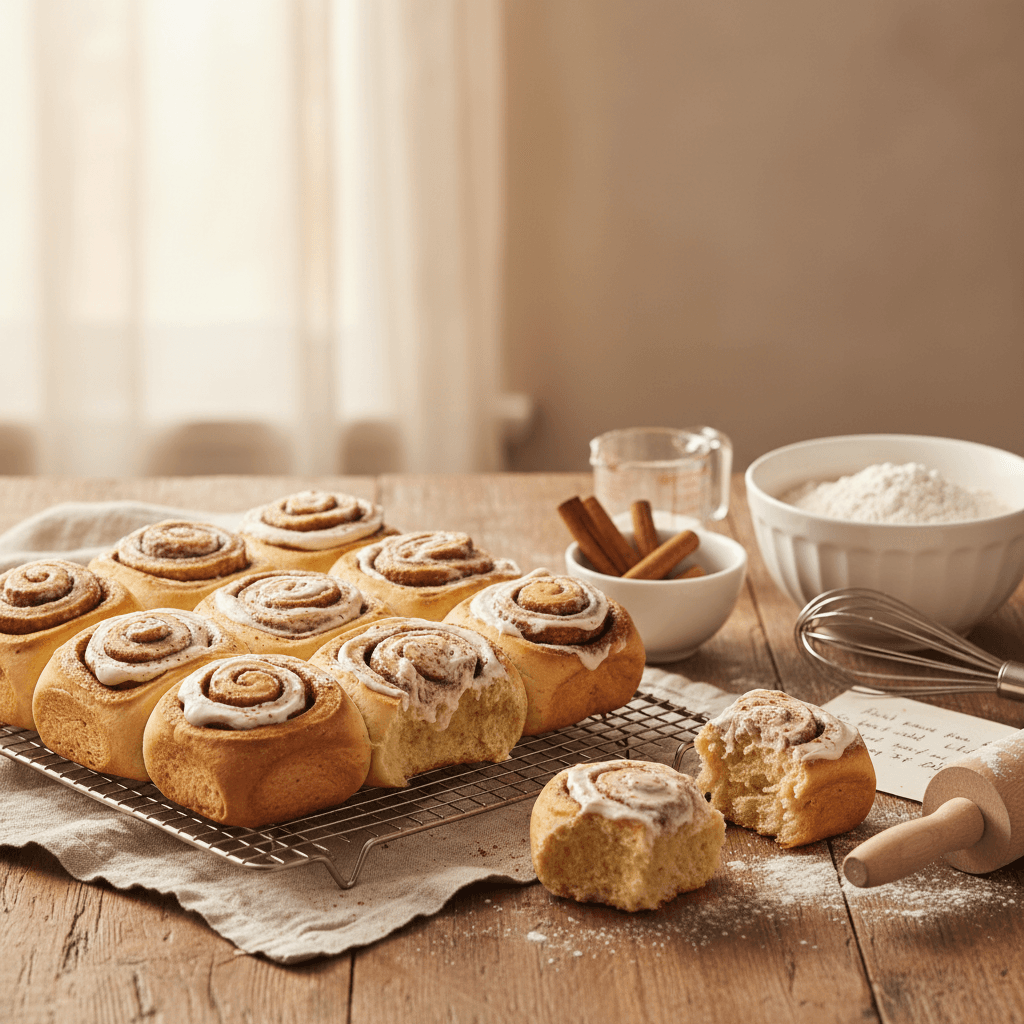
Cinnamon rolls are one of the highest-demand items you can sell from a home bakery, but most bakers underprice them by $1–$3 per roll because they cost out ingredients and forget everything else. Here's how to price cinnamon rolls so you actually keep money after the flour dust settles.
Key takeaways
- A standard 4-oz cinnamon roll costs $1.10–$1.85 in ingredients depending on whether you use real butter and cream cheese frosting — but ingredient cost should only be 25–30% of your price.
- Most profitable home bakers charge $4.50–$6.50 per standard roll and $7–$9 for jumbo (6–8 oz) rolls in 2025, with higher prices in metro areas and at farmers markets.
- Your labor rate matters more than your ingredient cost — if a batch of 12 takes you 3.5 hours from start to packaged, you need to know what you're earning per hour, not just per roll.
- Selling by the half-dozen or dozen at a slight discount per roll increases your average order value and reduces your per-order packaging and transaction time.
- Wholesale pricing for coffee shops typically runs 40–50% of retail, which means your retail price needs to be high enough that wholesale still covers costs plus profit.
What it actually costs to make a cinnamon roll
Before you can price anything, you need a real ingredient cost — not a guess. I've costed out two versions of a standard 12-roll batch to show the range.
| Ingredient | Standard batch (12 rolls) | Premium batch (12 rolls) |
|---|---|---|
| Flour (AP or bread) | $0.85 | $1.20 (King Arthur) |
| Butter | $2.40 (store brand) | $4.10 (Kerrygold) |
| Sugar + brown sugar | $0.65 | $0.65 |
| Eggs | $0.70 | $0.70 |
| Milk/cream | $0.45 | $0.80 (heavy cream) |
| Yeast | $0.30 | $0.30 |
| Cinnamon | $0.55 | $1.10 (Vietnamese) |
| Cream cheese frosting | $1.80 | $2.60 |
| Vanilla | $0.40 | $0.85 (pure extract) |
| Salt, misc | $0.10 | $0.10 |
| Total batch cost | $8.20 | $12.40 |
| Per-roll ingredient cost | $0.68 | $1.03 |
Add packaging — a clamshell container or bakery box runs $0.25–$0.60 per roll depending on whether you're doing individual packaging or boxing a half-dozen. A sticker label adds another $0.08–$0.15. So your true per-roll cost with packaging lands between $0.95 and $1.85.
Here's the mistake: most home bakers stop here, double the ingredient cost, and land at $2–$3 per roll. That's a recipe for burnout, not a business. Your ingredient cost should represent only 25–30% of your selling price, which means a roll that costs $1.50 to make and package should sell for $5–$6, not $3.
The pricing formula that actually accounts for your time
Ingredient-based pricing ignores the most expensive input: you. A batch of 12 cinnamon rolls from dough to packaged product takes 3 to 4 hours when you include mixing, two rises, rolling, filling, cutting, baking, cooling, frosting, and packaging. That's real time you could be doing literally anything else.
Here's the framework we recommend, and it's the same one we use for pricing cookies and pricing custom cakes:
Price per roll = (ingredient cost + packaging cost + overhead allocation + labor) / number of rolls, then add profit margin
Let's run the numbers for a premium batch of 12:
| Cost component | Amount | How to calculate it |
|---|---|---|
| Ingredients | $12.40 | Actual costed recipe |
| Packaging (individual clamshells + labels) | $5.40 | $0.45 per roll |
| Overhead (utilities, insurance, supplies) | $3.00 | ~15% of ingredient + packaging |
| Labor (3.5 hours at $25/hr) | $87.50 | Your target hourly rate |
| Total cost for 12 rolls | $108.30 | |
| Cost per roll | $9.03 |
Wait — $9 per cinnamon roll? That's where the sticker shock hits, and it's exactly where most bakers panic and slash their price. But look at what's happening: at $25/hour for your labor, a single batch of 12 rolls needs to generate $108 for you to hit that rate. If you sell them at $5 each, you gross $60 on a batch — meaning you're paying yourself about $9/hour after costs.
The solution isn't to charge $9 per standard roll (unless you're in a high-income metro area and your product justifies it). The solution is to increase your batch efficiency.
Why batch size changes everything
Here's the contrarian point most pricing guides miss: a single batch of 12 cinnamon rolls is almost never profitable at reasonable retail prices. The labor-to-output ratio is terrible. The magic happens when you scale to 2–3 batches in the same session.
Tara, a home baker in Raleigh, NC, told me she makes 36 rolls in a single 5-hour session by running three batches with staggered rise times. Her ingredient cost triples, but her labor only goes from 3.5 hours to 5 hours because the rises overlap. Here's how her numbers look:
| 1 batch (12 rolls) | 3 batches (36 rolls) | |
|---|---|---|
| Ingredient + packaging | $17.80 | $53.40 |
| Overhead (15%) | $2.67 | $8.01 |
| Labor ($25/hr) | $87.50 | $125.00 |
| Total cost | $107.97 | $186.41 |
| Cost per roll | $9.00 | $5.18 |
At 36 rolls and a selling price of $6 each, Tara grosses $216 and nets $29.59 in pure profit on top of her $25/hour labor rate. At $6.50 each, she nets $47.59. That's the difference between a hobby that costs you money and a business that pays you.
This is why the answer to "how much should I charge for cinnamon rolls" is genuinely "it depends" — on your batch size, your efficiency, your ingredient tier, and your market. But the variables are knowable, and you should calculate them before you post a price.
Real price ranges by channel and format
Where you sell changes what people will pay. Here's what we're seeing from actual home bakers in 2025:
| Sales channel | Standard roll (4 oz) | Jumbo roll (6–8 oz) | Half-dozen box | Dozen box |
|---|---|---|---|---|
| Direct orders (local pickup) | $4.50–$6.00 | $6.50–$8.50 | $24–$33 | $42–$60 |
| Farmers market | $5.00–$7.00 | $7.00–$9.00 | $27–$38 | $48–$65 |
| Wholesale (coffee shops) | $2.25–$3.50 | $3.50–$4.50 | N/A | $24–$36 |
| Holiday/seasonal specials | $6.00–$8.00 | $8.00–$11.00 | $32–$44 | $55–$78 |
Notice the farmers market premium. People expect to pay more at a market because they're buying directly from the person who made it, and the experience of warm cinnamon rolls at a Saturday market is worth more than a Tuesday pickup. If you're selling at markets, our farmers market pricing guide goes deeper on the psychology of market pricing.
For wholesale, the math is brutal unless your retail price is already healthy. If you sell a standard roll for $5 retail, wholesale at 50% is $2.50 — which barely covers your costs on a single batch. You need either high volume from the wholesale account or a retail price of $6+ to make wholesale work. We break this down in detail in our wholesale pricing framework.
The multi-pack strategy that boosts your average order
Individual rolls are your worst margin product because of per-unit packaging cost and transaction time. Every order you process — whether it's one roll or twelve — costs you roughly the same amount of admin time: reading the message, confirming the order, coordinating pickup. That's 5–10 minutes per order regardless of size.
Smart cinnamon roll operators set a minimum order or incentivize multi-packs:
- Individual rolls: $6.00 each (full price, no discount)
- Half-dozen box: $32 ($5.33/roll — a small discount that increases your revenue per transaction by 5x)
- Dozen box: $58 ($4.83/roll — your best margin because packaging per roll drops and you're only processing one order)
Marcus, a home baker in Austin, stopped selling individual rolls entirely after his first three months. He only sells half-dozens and dozens now, and his average order went from $11 to $34 overnight. His weekly revenue jumped from about $180 to $340 on roughly the same number of orders — around 10 per week.
Specialty and seasonal rolls deserve a premium
A basic cinnamon roll with cream cheese frosting is your baseline. The moment you add a specialty element — apple pie filling, pumpkin spice, Nutella, maple bacon — you should charge more. Not because the ingredient cost is dramatically higher (though sometimes it is), but because the perceived value jumps.
Here's what the premium looks like in practice:
- Salted caramel pecan rolls: +$1.50–$2.00 per roll over standard (pecans alone add $0.40–$0.60 per roll in ingredient cost)
- Pumpkin cream cheese (fall seasonal): +$1.00–$1.50 per roll
- Nutella-stuffed rolls: +$1.00 per roll
- Holiday gift boxes (decorated packaging, ribbon): +$3–$5 per box over standard packaging
Seasonal pricing is one of the most under-used levers in home baking. During November and December, Tara charges $8 per jumbo pumpkin cream cheese roll — $1.50 more than her standard jumbo — and sells out every batch. People expect to pay more for seasonal items. Our holiday pricing guide covers how to set and communicate seasonal premiums without pushback.
When to raise your cinnamon roll prices
If you're consistently selling out, that's not a success signal — it's a pricing signal. Selling out means you left money on the table. Here are the triggers that mean it's time to raise prices:
- You sell out more than 3 weeks in a row. Raise by $0.50–$1.00 per roll and see if demand holds.
- Your ingredient costs went up. Butter prices jumped 22% in some regions between 2023 and 2025. If your costs went up $0.30 per roll, your price should go up at least $0.50.
- You're turning down orders. If demand exceeds your capacity, price is too low.
- You calculated your hourly rate and it's under $20. That's a clear sign your prices need to move.
Raising prices is uncomfortable, but it's necessary. We have a full guide on how to raise your home bakery prices without losing customers that covers the exact language to use and when to do it.
The "race to the bottom" trap with cinnamon rolls
Cinnamon rolls are popular, which means you'll have competition — often from other home bakers charging $3 per roll. Do not match them. Here's why:
A baker charging $3 per standard roll with $1.50 in costs is making $1.50 gross profit per roll. On a batch of 12, that's $18 gross. Subtract 3.5 hours of labor and she's earning $5.14 per hour. She either doesn't know her numbers, is subsidizing her business with a day job, or will burn out within 6 months. You don't want to compete with someone who's losing money — you want to outlast them.
Instead, compete on quality, presentation, and reliability. A baker who shows up every Saturday with consistently excellent cinnamon rolls, beautiful packaging, and a friendly face will outsell the $3-roll baker within two months. If you need help with the visual side, our guide on taking photos of baked goods with your phone covers how to make your rolls look as good online as they taste.
Putting it all together: your pricing decision checklist
Before you set your cinnamon roll price, run through this:
- Cost your exact recipe. Weigh every ingredient. Don't estimate — weigh. Include packaging and labels.
- Calculate your batch time honestly. From the moment you pull out flour to the moment the last box is labeled and in the fridge. For most bakers, that's 3–4 hours for a single batch.
- Decide your minimum hourly rate. $20/hour is the floor. $25–$30 is reasonable for skilled baking work.
- Plan your batch size. If you can only do 12 at a time, your per-roll cost will be high. If you can do 24–36 by staggering batches, your numbers improve dramatically.
- Check your local market. Search Instagram and Facebook for home bakers in your area selling cinnamon rolls. Note their prices, sizes, and what's included (frosting on the side? plain? decorated?).
- Set your price at the top of the local range, not the middle. You can always offer a first-time discount to get people in the door, but you can't easily raise prices you set too low.
If you're just starting out and aren't sure whether cinnamon rolls are the right product for your business, our highest-margin baked goods ranking compares cinnamon rolls against cookies, bread, cakes, and other products on actual profit per hour. Spoiler: cinnamon rolls rank well, but only when you batch efficiently.
And if pricing is just one piece of a bigger puzzle — if you're still figuring out your whole business model — the home bakery sustainability diagnostic will help you see whether your numbers work before you get too deep.
Frequently asked questions
How much should I charge for a dozen cinnamon rolls?
For standard 4-oz cinnamon rolls with cream cheese frosting, most home bakers charge $42–$60 per dozen for direct orders in 2025. At farmers markets, $48–$65 is typical. Your exact price depends on ingredient quality, roll size, and your local market, but charging under $36 per dozen usually means you're earning less than $15/hour after costs.
Are cinnamon rolls profitable to sell from home?
Yes, but only if you batch efficiently and price correctly. A single batch of 12 rolls is rarely profitable at standard retail prices because the labor-to-output ratio is poor. Making 24–36 rolls in a single session by staggering rise times is where the profit appears. At 36 rolls sold at $6 each, you can clear $25–$30/hour in labor plus a profit margin on top.
How much do cinnamon rolls cost to make per roll?
Ingredient cost per standard 4-oz roll ranges from $0.68 using store-brand butter to $1.03 using premium ingredients like Kerrygold butter and Vietnamese cinnamon. Add $0.25–$0.60 for packaging and your total material cost per roll is $0.95–$1.85. But material cost is only part of the picture — labor and overhead typically represent 60–70% of your true cost per roll.
Should I sell cinnamon rolls individually or by the box?
Selling by the half-dozen or dozen is almost always more profitable. Each order you process costs roughly the same admin time whether it's 1 roll or 12, so larger orders dramatically improve your revenue per transaction. Many successful home bakers set a minimum of a half-dozen for custom orders and only sell individual rolls at farmers markets where the walk-up format demands it.
How do I price cinnamon rolls for wholesale to coffee shops?
Wholesale pricing for cinnamon rolls typically runs 40–50% of your retail price. If you sell a standard roll for $6 retail, wholesale would be $2.40–$3.00 per roll. This only works if you can produce in volume — at least 2–3 dozen per delivery — and if your retail price is already set high enough that the wholesale price still covers your costs plus a margin. Our wholesale pricing guide walks through the full math.

Written by
Co-founder, BakingSubs
Co-founder of BakingSubs, where he turns the science of ingredient substitutions into tested, reliable guidance for home bakers.
Related Posts
Bakery Recipe Cost Sheet: How to Cost a Recipe in 6 Steps (With a Table You Can Copy)

Home Bakery Order Form Template: A Copy-Paste Layout That Cuts Mistakes by Half
Cottage Food Label Requirements and Template: What Every State Demands (With a Copy-Paste Layout)
Bake with Confidence
See all
Confident Gluten-Free Baker Toolkit
The science-based system that replaces gluten's seven invisible jobs so your baking turns out soft, fluffy, and foolproof — every time.

Gluten-Free Recipe Vault
Instant access to our complete library of proven gluten-free recipes — no waiting, no guesswork, just results that work tonight.

Fix Your Gluten-Free Bread
Learn the 3-step formula to make bread rise and stay soft, discover why your loaves collapse, and get a tested sandwich bread recipe that actually works.