

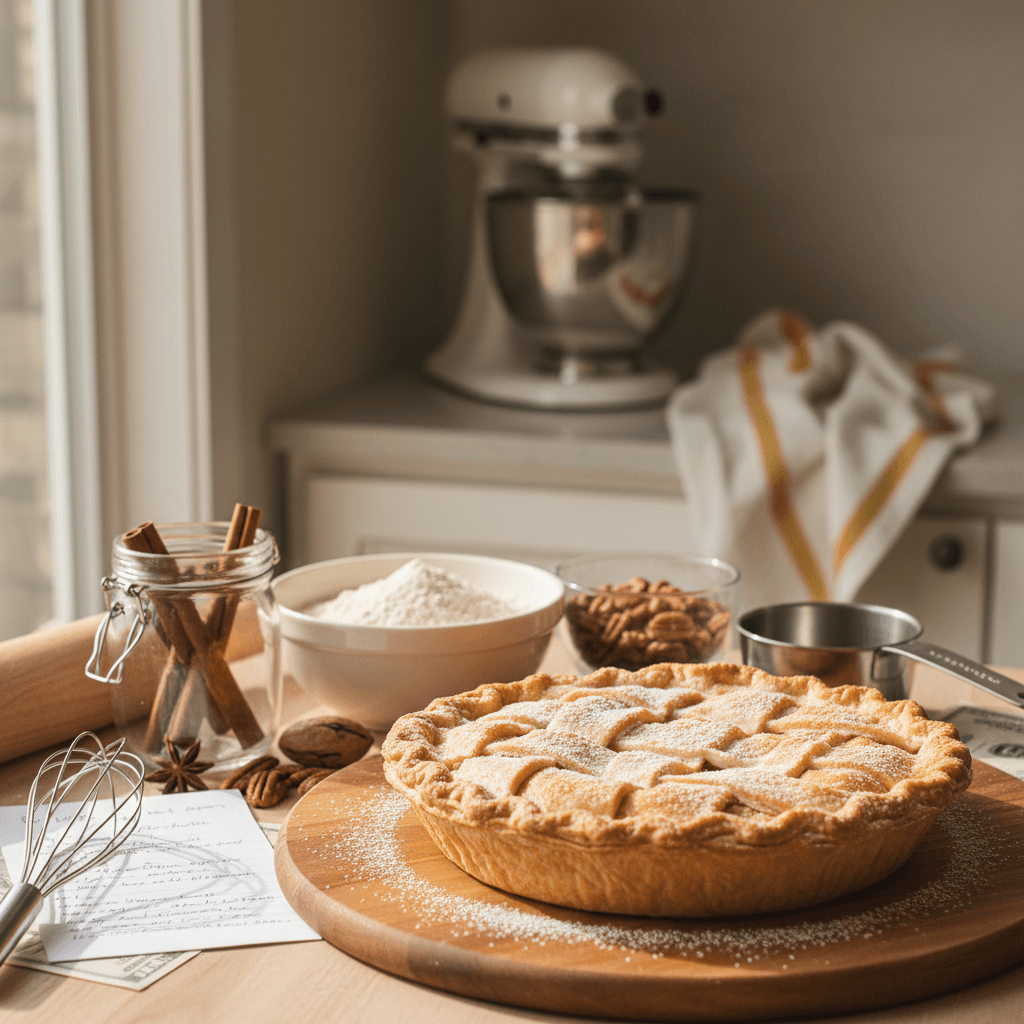
Holiday pie season can be the most profitable 6 weeks of your year or the fastest way to burn out for minimum wage. The difference comes down to how you price before the first order hits your inbox. Here's the framework I use and what I've seen work across dozens of home bakers who actually track their numbers.
Key takeaways
- A standard 9-inch fruit pie costs $8.40–$14.60 in ingredients alone depending on filling — price before you factor in labor and you're losing money.
- Holiday pies should carry a 15–25% seasonal surcharge over your regular pricing because demand compression increases your real labor cost per pie.
- Most profitable home bakers cap holiday pie orders at a fixed number (often 40–60 pies per week) rather than saying yes to everything.
- Your hourly rate target matters more than your per-pie price — track time per pie type and you'll find some flavors earn you $9/hour while others earn $38/hour.
- Pre-orders with deposits eliminate the guesswork and waste that destroy holiday margins.
Why holiday pie pricing is different from your regular menu
During a normal week, you might bake 8–12 pies across several days. During Thanksgiving week, you might bake 45 in three days. That compression changes everything. Your oven runs longer, your prep windows shrink, and mistakes cost more because there's no slack in the schedule to rebake.
Ingredient costs also spike. I tracked butter prices from September through December last year: $3.48 per pound in September, $4.89 per pound the week before Thanksgiving. That's a 40% jump on a single ingredient that shows up in every crust. Pecans went from $8.99 to $12.49 per pound at my local Costco. If you set your holiday prices in October using October costs, you're already underwater by the time you bake.
The other factor most bakers miss: opportunity cost. Every hour you spend on a $22 pie is an hour you can't spend on a $65 custom cake order. During the holidays, when demand for both is high, knowing which products earn the most per hour is the difference between a $2,800 holiday season and a $6,500 one.
How to calculate your true cost per pie
Start with ingredients, but don't stop there. I break pie costing into four layers.
Layer 1: ingredient cost
Weigh and price every ingredient for each pie variety you plan to offer. Not estimates — actual weights at current prices. Here's what a real cost sheet looks like for three common holiday pies using November 2024 pricing from a mix of Costco, Walmart, and a regional grocery store:
| Pie type (9-inch) | Crust cost | Filling cost | Total ingredient cost |
|---|---|---|---|
| Classic apple (double crust) | $3.20 | $5.40 | $8.60 |
| Pecan | $2.85 | $11.75 | $14.60 |
| Pumpkin | $2.85 | $5.55 | $8.40 |
| Cherry (double crust) | $3.20 | $9.30 | $12.50 |
| Sweet potato | $2.85 | $6.10 | $8.95 |
Notice the range. Pecan pie costs nearly $6 more in ingredients than pumpkin. If you charge the same price for both, you're subsidizing pecan with pumpkin profit. That's a mistake I see constantly.
Layer 2: packaging and supplies
Pie boxes, labels, ribbon or twine, parchment rounds, and any inserts. A decent kraft pie box with a window runs $1.10–$1.85 each when bought in packs of 25. Add a label and a branded sticker and you're at $1.50–$2.20 per pie. This isn't optional for holiday orders — presentation matters and customers expect it.
Layer 3: labor time
This is where most home bakers lie to themselves. Time your actual process end to end, including cleanup. Here's what I logged across a batch of 8 apple pies:
- Crust prep (mixing, rolling, lining pans): 52 minutes
- Filling prep (peeling, slicing, seasoning): 38 minutes
- Assembly and top crust/lattice: 24 minutes
- Baking (active monitoring, rotating): 55 minutes
- Cooling, boxing, labeling: 22 minutes
- Cleanup: 18 minutes
- Total: 3 hours 29 minutes for 8 pies = 26 minutes per pie
Pecan pies are faster — no top crust, simpler filling. I clocked 18 minutes per pie in a batch of 8. Lattice-top cherry pies took 34 minutes each. These differences matter when you're setting prices.
Layer 4: overhead allocation
Electricity, gas, water, wear on equipment, and a portion of your cottage food license or permit fees. Most home bakers I talk to estimate this at $0.75–$1.50 per pie during high-volume weeks. It's not huge, but it adds up across 50 pies.
The pricing formula that actually works
Here's the formula I recommend and use myself:
(Ingredient cost + Packaging cost + Overhead) x 3 = Minimum price
Then check that minimum against your target hourly rate. If the math doesn't clear $25/hour for your labor after costs, raise the price or drop that pie from your holiday menu.
Let's run the numbers on pumpkin pie:
- Ingredients: $8.40
- Packaging: $1.65
- Overhead: $1.00
- Total cost: $11.05
- x 3 = $33.15 minimum price
At $33 and 22 minutes of labor per pie, your profit per pie is roughly $22. That works out to $60/hour. Solid.
Now pecan pie:
- Ingredients: $14.60
- Packaging: $1.65
- Overhead: $1.00
- Total cost: $17.25
- x 3 = $51.75 minimum price
That $52 pecan pie might feel steep. But here's the reality: if you charge $35 for a pecan pie because "that's what people expect," your profit is $17.75 per pie at 18 minutes labor — about $59/hour. Not terrible, but you're leaving $16 on the table compared to the 3x formula, and your ingredient risk is much higher. One botched pecan pie at $35 wipes out the profit from two others.
I've seen bakers charge $38–$55 for pecan pies and sell out. The customers buying homemade pecan pie for Thanksgiving are not price-shopping against Costco's $13.99 option. They're buying yours because it's better, it's local, and it's made by someone they trust.
What real home bakers charge for holiday pies
I surveyed 14 home bakers across 8 states who sold holiday pies in 2023 and 2024. Here's what the pricing landscape actually looks like:
| Pie type (9-inch) | Low price | Median price | High price |
|---|---|---|---|
| Pumpkin | $25 | $32 | $42 |
| Apple (double crust) | $28 | $35 | $45 |
| Pecan | $35 | $45 | $58 |
| Cherry (double crust) | $30 | $38 | $48 |
| Sweet potato | $26 | $33 | $40 |
The bakers at the low end were mostly in rural areas or early in their business, often underpricing to build a customer base. The bakers at the high end were in suburban metro areas with established followings. Rachel, a home baker in Austin, charges $45 for her pumpkin pie and $55 for pecan. She sold 68 pies for Thanksgiving 2024 and grossed $3,196 in a single week. She told me her secret was simple: "I stopped comparing myself to grocery store prices and started comparing to what a good pie is worth to someone hosting 12 people for dinner."
That mindset shift is everything. If you're struggling with raising your prices without losing customers, the holidays are actually the easiest time to do it — demand is high, your product is seasonal, and people are already spending more than usual.
The seasonal surcharge: why and how much
Your regular pie price (if you sell pies year-round) should not be the same as your holiday pie price. Here's why:
- Compressed timelines. You're baking 3–5x your normal volume in the same kitchen, which means longer days, more fatigue, and higher error rates.
- Ingredient cost spikes. Butter, eggs, and specialty ingredients like pecans and pure vanilla all cost more in November.
- Opportunity cost. Every pie slot is a slot you can't fill with another product.
- Delivery/pickup logistics. Holiday pickup windows are tight. You're coordinating 30+ pickups in a 6-hour window, which is a logistical job on its own.
A 15–25% surcharge on your regular price is standard and defensible. If your regular pumpkin pie is $28, your Thanksgiving pumpkin pie should be $32–$35. You don't need to call it a "surcharge" — just set your holiday menu with holiday prices. Most customers won't even notice if you present it as a separate seasonal menu.
How to decide which pies to offer (and which to skip)
Not every pie deserves a spot on your holiday menu. I rank each potential offering on three criteria:
- Profit per hour. Calculate it using the formula above. If a pie earns less than $25/hour after all costs, it's out.
- Batch efficiency. Can you make 8+ at once without a bottleneck? Pies that require individual attention (like hand-crimped lattice with 14 strips each) slow your throughput.
- Demand signal. Did people ask for it last year? Are you getting DMs about it? Don't add a flavor because you think it's creative — add it because people want to buy it.
Maria, a cottage baker in Ohio, offered 7 pie varieties her first holiday season and nearly broke. She was buying small quantities of 7 different filling sets, couldn't batch efficiently, and ended up working 16-hour days. The next year she cut to 3 varieties — pumpkin, apple, and pecan — and made 35% more money in 40% fewer hours.
Three to four varieties is the sweet spot for most home bakers. You can always add a "limited edition" fifth option if you have capacity, but start lean.
Pre-orders, deposits, and order caps
If you're baking holiday pies without a pre-order system, you're gambling with your time and ingredients. Here's the system that works:
- Open pre-orders 3–4 weeks before the holiday. Post on social media, email your customer list, and text your regulars. If you need help with that outreach, email marketing is the most reliable channel for holiday pre-orders because your list already knows and trusts you.
- Require a 50% deposit at the time of order. Non-refundable within 5 days of pickup. This eliminates no-shows and funds your ingredient purchases. If you need a framework for handling deposits, the same principles from managing custom cake deposits apply to pies.
- Set a hard order cap. Calculate the maximum number of pies you can produce in your available baking days. Then subtract 15% as a buffer for mistakes, slow days, or equipment issues. If your max is 50, cap at 42.
- Close orders when you hit the cap. "Sold out" is the most powerful marketing phrase in the English language. It builds urgency for next year.
Danielle, a home baker in suburban Atlanta, caps her Thanksgiving orders at 55 pies. She opens pre-orders on November 1st and typically sells out by November 12th. She told me: "The first year I didn't cap, I took 78 orders and cried in my kitchen at 2 AM on Thanksgiving morning. Never again."
That story isn't unusual. Burnout during the holidays is the number one reason home bakers quit in January. Capping orders is how you prevent it.
Should you offer mini pies or pie slices?
Mini pies (4–5 inch) are a high-margin holiday product if you price them correctly. The mistake is pricing them as a fraction of a full pie. A 9-inch pie serves 6–8. A mini pie serves 1. But the labor per mini pie is only slightly less than a full pie — you still roll crust, fill, crimp, and bake. The crust-to-filling ratio is actually worse, meaning more labor-intensive crust work per serving.
Price mini pies at 35–45% of your full pie price, not 12.5% (which is what you'd get if you just divided by 8). If your full pumpkin pie is $33, a mini should be $12–$15, not $4.
I've seen bakers sell assorted mini pie boxes — 4 minis in a gift box for $48–$55 — and those fly off the shelf as hostess gifts and office party contributions. The perceived value of a curated box is much higher than four individual minis.
Pricing for repeat customers vs. new customers
This is a real tension during the holidays. Your loyal year-round customers might balk at a $35 pumpkin pie when they've been buying your regular pumpkin pie for $28. New customers who found you through a holiday post have no price anchor — $35 is just what your pie costs.
Options that work:
- Early-bird pricing. Offer your regulars a 48-hour window to order at last year's price before you open to the public. This rewards loyalty without permanently discounting.
- Bundle incentive. "Order 3+ pies and save $3 per pie." Your regulars are more likely to order multiple pies, so they self-select into the discount.
- Don't discount at all. Communicate the value: "Our holiday pies use all-butter crust, local eggs, and real vanilla — made fresh for your table." Most regulars understand and stay. The ones who leave over $7 were probably not your best customers anyway.
Building a base of repeat customers who value your work means you don't have to fight the price battle every season.
When "it depends" is the honest answer
Your ideal pie price depends on variables that no blog post can fully account for. Here are the big ones:
- Your local market. A $45 pie sells easily in Scottsdale. In rural Kentucky, $30 might be the ceiling. Know your area.
- Your customer base. Are you selling to families who bake-from-scratch themselves (price-sensitive, they know ingredient costs) or to busy professionals who want a premium product and don't care about the cost of butter?
- Your cottage food law limits. Some states cap annual revenue at $25,000 or $50,000. If you're near your cap, pricing higher and selling fewer is smarter than pricing low and hitting the ceiling.
- Your capacity. A baker with two ovens and a stand mixer can batch 12 pies at once. A baker with one oven and limited counter space might max out at 4. Same time, very different throughput — and the low-capacity baker needs to charge more per pie to make the same hourly rate.
The framework above gives you a floor. Your market, your brand, and your capacity determine how far above that floor you can go.
A contrarian take: stop selling your cheapest pie
Here's something that goes against most advice you'll read: consider dropping pumpkin pie from your holiday menu entirely.
Pumpkin is the highest-demand, lowest-margin pie for most home bakers. It's also the pie most directly compared to grocery store options. Marie Callender's sells a frozen pumpkin pie for $8.99. Costco's fresh pumpkin pie is $5.99. You cannot win a price comparison against industrial baking, and pumpkin is the flavor where customers are most likely to make that comparison.
If you replace your pumpkin slot with a signature pie — bourbon brown butter pecan, salted caramel apple with cheddar crust, maple sweet potato with pecan streusel — you eliminate the direct comparison entirely. Nobody is checking Costco's price on bourbon brown butter pecan pie because Costco doesn't make one.
Two of the 14 bakers I surveyed dropped pumpkin and saw their average pie price increase by $8 without losing total order volume. One of them, Keisha in Charlotte, told me: "People who really want basic pumpkin will buy it from the store. The people who come to me want something they can't get anywhere else."
This isn't right for every baker or every market. But if you're in a metro area with a customer base that values uniqueness, it's worth testing. For more on choosing which products to focus on, picking the right niche applies to seasonal menus too.
Putting it all together: a sample holiday pie menu
Here's what a well-priced holiday pie menu might look like for a home baker in a mid-sized suburban market:
| Item | Price | Ingredient cost | Est. profit/hr |
|---|---|---|---|
| Salted caramel apple (double crust, 9") | $38 | $9.80 | $48/hr |
| Bourbon pecan (9") | $52 | $15.20 | $55/hr |
| Maple sweet potato with streusel (9") | $36 | $9.45 | $52/hr |
| Mini pie assortment box (4 minis) | $48 | $14.00 | $42/hr |
Every item clears $40/hour. The menu is tight — four options, no filler. Pre-orders open November 1st with a 50% deposit. Order cap: 48 full pies and 15 mini boxes. That's a gross revenue target of roughly $2,600 for the Thanksgiving push alone, achievable in about 45 hours of work across two weeks.
If you're also running your regular business alongside holiday orders, protecting your schedule during this period is non-negotiable. Block your baking days, communicate pickup windows clearly, and say no to last-minute additions once you hit capacity.
Frequently asked questions
How much should I charge for a homemade pie for the holidays?
Most home bakers charge $28–$55 for a 9-inch holiday pie depending on the filling and their local market. Use the 3x cost multiplier as a floor: add up your ingredient cost, packaging, and overhead, then multiply by 3. Check that the resulting price pays you at least $25/hour for your labor. If it doesn't, raise the price or remove that pie from your menu.
Should I charge more for pies during the holidays than the rest of the year?
Yes. A 15–25% seasonal increase is standard and justified by higher ingredient costs, compressed timelines, and increased demand. Present it as a separate holiday menu rather than calling it a surcharge. Most customers expect holiday pricing and won't push back if the quality matches. For a deeper look at seasonal pricing strategy, see our guide on pricing holiday and seasonal orders.
How many pies can a home baker realistically make for Thanksgiving?
With a single standard oven, most home bakers can produce 40–60 pies in the week leading up to Thanksgiving, assuming 3–4 baking days of 8–10 hours each. The limiting factors are oven capacity (2 pies per rack, 2 racks = 4 pies per 50-minute bake cycle) and counter/cooling space. Always cap orders at 85% of your theoretical maximum to leave room for rebakes and rest.
Is it worth selling mini pies for the holidays?
Mini pies can be very profitable if priced correctly — at 35–45% of your full pie price, not a proportional fraction. A mini pie box (4 assorted minis for $48–$55) works especially well as a gift item. The risk is that mini pies take nearly as much labor per unit as full pies, so underpricing them will destroy your hourly rate faster than any other product.
How do I get holiday pie orders as a new home baker?
Start by telling everyone you know — personally, not just on social media. Text your contacts, post in local community groups, and ask past customers to share your menu. Finding customers for a home bakery during the holidays is easier than any other time of year because demand is already high. Offer a small "friends and family" discount for your first season to build a customer list you can market to next year.

Written by
Co-founder, BakingSubs
Co-founder of BakingSubs, where he turns the science of ingredient substitutions into tested, reliable guidance for home bakers.
Related Posts
Bakery Recipe Cost Sheet: How to Cost a Recipe in 6 Steps (With a Table You Can Copy)

Home Bakery Order Form Template: A Copy-Paste Layout That Cuts Mistakes by Half
Cottage Food Label Requirements and Template: What Every State Demands (With a Copy-Paste Layout)
Bake with Confidence
See all
Confident Gluten-Free Baker Toolkit
The science-based system that replaces gluten's seven invisible jobs so your baking turns out soft, fluffy, and foolproof — every time.

Gluten-Free Recipe Vault
Instant access to our complete library of proven gluten-free recipes — no waiting, no guesswork, just results that work tonight.

Fix Your Gluten-Free Bread
Learn the 3-step formula to make bread rise and stay soft, discover why your loaves collapse, and get a tested sandwich bread recipe that actually works.