

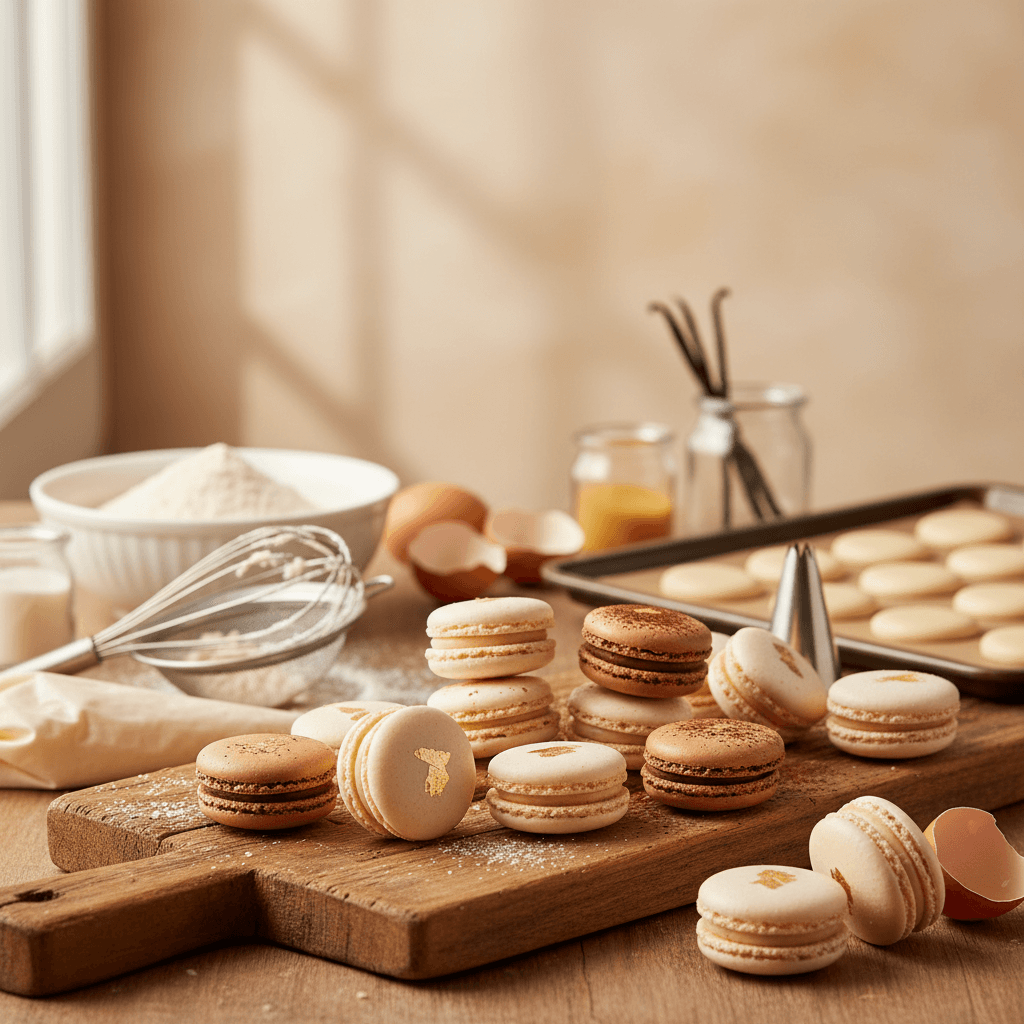
Macarons are one of the most labor-intensive products you can sell from a home kitchen, and most bakers underprice them by 30-50% because they treat them like cookies. They are not cookies. The pricing math is completely different, and if you get it wrong, you will work harder for less money than almost any other baked good you could sell.
Here is a real framework for pricing macarons that accounts for your actual costs, your actual time, and what the market will actually bear.
Key takeaways
- A single French macaron costs $0.55-$0.85 in ingredients alone, before labor, packaging, or overhead — most home bakers forget at least one of those line items.
- At minimum, you should charge $2.50-$4.00 per macaron for standard flavors, and $4.00-$6.00 for specialty or custom-decorated shells.
- Your hourly labor rate matters more than your ingredient cost — a batch of 48 macarons takes 2.5-3.5 hours including cleanup, which means your labor cost per mac is $0.42-$0.73 at a $20/hour rate.
- Pricing by the dozen ($30-$48 standard, $48-$72 custom) is more profitable than selling singles because you batch your production time.
- Your local market ceiling matters, but underpricing to "stay competitive" with grocery store macarons is a trap that leads to burnout, not growth.
Why macarons are different from every other home bakery product
Macarons have a failure rate built into the product. Even experienced bakers lose 10-15% of shells per batch to cracked tops, hollow centers, or lopsided feet. That loss has to be priced in — you cannot eat it and stay profitable.
They also require aging. A macaron needs 12-24 hours in the refrigerator after filling to develop the right texture. That means you are producing a full day before delivery, which ties up your fridge space and limits how many orders you can take per week. Compare that to cookies, which you can bake and deliver same-day. If you are also selling cookies, you might find the cookie pricing framework useful for comparison.
The shelf life is also short — 3-5 days refrigerated, 7 days frozen. You cannot overbake and sell leftovers at a market the next weekend the way you can with brownies or bread. Every macaron you make needs a buyer already lined up.
The real cost of one macaron (with actual numbers)
I priced out a standard vanilla bean macaron using retail ingredient costs in the Midwest in early 2025. Here is the breakdown for a batch of 48 assembled macarons (96 shells):
| Ingredient | Amount per batch | Cost per batch |
|---|---|---|
| Almond flour (blanched, fine) | 300g | $7.20 |
| Powdered sugar | 300g | $1.80 |
| Egg whites (aged) | 220g (~6 large eggs) | $2.10 |
| Granulated sugar | 150g | $0.45 |
| Cream of tartar | 2g | $0.08 |
| Vanilla bean paste | 8g | $1.60 |
| Butter (for ganache/filling) | 170g | $2.40 |
| White chocolate (for filling) | 115g | $2.80 |
| Heavy cream | 120ml | $0.90 |
| Gel food coloring | ~1ml | $0.30 |
| Parchment/silicone mat wear | — | $0.25 |
| Subtotal ingredients | $19.88 | |
| 10% waste/failure buffer | $1.99 | |
| Total ingredient cost | $21.87 |
That is $0.46 per macaron in ingredients alone for a basic vanilla. But we are not done.
Add labor
Timing a full macaron batch from mise en place through cleanup, I consistently land at 3 hours. That includes sifting and weighing (15 min), making the meringue and macaronage (25 min), piping (20 min), resting trays until skin forms (30-45 min of waiting but you are still in the kitchen monitoring), baking in two rounds (35 min), cooling (20 min), making filling (15 min), filling and assembling (20 min), and cleanup (15 min).
At a $20/hour labor rate — which is modest for skilled pastry work — that is $60 in labor for 48 macarons, or $1.25 per mac.
Add packaging and overhead
A clear macaron insert box that holds 6 costs $1.20-$1.80 each. A box of 12 runs $2.00-$3.50. Tissue paper, stickers, ribbon — call it $0.50-$1.00 per box. Per macaron, packaging adds $0.25-$0.40.
Overhead includes electricity (oven running 35+ minutes at 300-325F), parchment or silicone mats, piping bags and tips, and your cottage food license or commercial kitchen rental if applicable. A reasonable overhead allocation is $0.10-$0.15 per macaron.
Your true cost per macaron
| Cost category | Per macaron |
|---|---|
| Ingredients (with waste buffer) | $0.46 |
| Labor ($20/hr) | $1.25 |
| Packaging | $0.30 |
| Overhead | $0.12 |
| Total cost | $2.13 |
If you are selling macarons at $2.00 each — which I see constantly on Instagram — you are losing $0.13 on every single one. You are literally paying your customers to take your macarons.
What to actually charge (and the variables that shift the number)
The honest answer is "it depends," but here are the variables that actually matter and the ranges they produce.
Standard flavors (vanilla, chocolate, raspberry, lemon, pistachio)
These are your workhorse flavors with ingredients you buy in bulk. Target a 50-60% margin minimum, which means:
- Per macaron: $3.00-$3.50
- Per dozen: $33-$42
- Box of 6: $18-$22
Rachel, a home baker in Austin, sells her standard dozen at $36 and moves 15-20 dozen per week through Instagram DMs and a local coffee shop. Her ingredient costs run slightly higher because she uses Valrhona chocolate, but her volume keeps her profitable at roughly $22/hour after all costs.
Specialty and seasonal flavors
Flavors that require more expensive ingredients (matcha, saffron, Earl Grey with real bergamot, bourbon caramel) or more prep time (homemade fruit curds, toasted meringue filling) should be priced 25-40% higher:
- Per macaron: $3.75-$5.00
- Per dozen: $42-$60
This is not gouging. Matcha powder alone adds $0.80-$1.20 per batch depending on grade, and a passion fruit curd filling takes an extra 20 minutes of active cooking time.
Custom decorated macarons
Hand-painted shells, printed images (edible ink), gold leaf, themed designs for weddings or baby showers — this is where the real money is, but also where scope creep destroys your margins if you do not price correctly.
- Per macaron: $4.50-$7.00
- Per dozen: $54-$84
The wide range depends on complexity. A simple two-tone shell with a drizzle is $4.50. Hand-painted florals or character faces are $6.00-$7.00 each. If you are doing holiday and seasonal orders, custom macarons are a high-margin add-on that customers expect to pay premium for.
The pricing framework: cost-plus vs. market-rate (and which one to use when)
There are two schools of thought, and most profitable home macaron bakers use a blend of both.
Cost-plus pricing
Calculate your total cost per macaron (ingredients + labor + packaging + overhead), then multiply by your target markup. A 2.5x markup on a $2.13 cost gives you $5.33 per macaron. A 2x markup gives you $4.26.
Use cost-plus when: You are doing custom work, specialty flavors, or any order where your costs vary significantly from your standard menu. It protects you from accidentally underpricing a labor-heavy order.
Market-rate pricing
Research what other home bakers and local bakeries charge in your area, then position yourself based on quality and presentation. In most US metro areas in 2025, the range is:
- Grocery store (Trader Joe's, Costco): $1.00-$1.50 per mac
- Local bakery: $2.50-$4.00
- Specialty macaron shop (like a Ladurée-style boutique): $3.50-$5.00
- Home bakers on Instagram: $2.00-$4.50 (wildly inconsistent)
Use market-rate when: You are setting your standard menu prices and need to make sure you are not pricing yourself out of your local market. But — and this is critical — never let market rate pull you below your cost-plus floor. If your market will not support $3.00 per macaron and your costs are $2.13, macarons are not a viable product for your business in that market.
This is the same principle behind pricing custom cakes — you need a floor that pays you, and a ceiling set by what your specific customer base values.
Why you should not compete with grocery store macarons
This is the contrarian take that will save your business: grocery store macarons are not your competition, and pricing as if they are will bankrupt you.
Costco sells a 36-count box of frozen macarons for $16.99. That is $0.47 per macaron. They can do this because they are produced in a factory in France, flash-frozen, shipped in bulk containers, and sold as a loss leader to get people into the store.
You cannot compete with $0.47. You should not try. Your customer is not the person buying frozen macarons at Costco. Your customer is the person planning a baby shower who wants 4 dozen macarons in specific colors that match the nursery theme, boxed beautifully, delivered fresh. That person will pay $4.00-$5.00 per macaron without blinking, because what they are buying is not just a cookie — it is a centerpiece.
If you find yourself losing sales to grocery store prices, you have a marketing problem, not a pricing problem. You need to position your product differently on Instagram and target customers who value custom work.
Minimum order sizes protect your hourly rate
Here is a math problem most home macaron bakers ignore: a batch of 48 takes 3 hours whether you sell all 48 to one customer or split them into eight 6-packs for eight different customers. But eight customers means eight conversations, eight payment transactions, eight delivery/pickup windows, and eight sets of packaging.
That administrative time adds 15-25 minutes per customer. Eight customers at 20 minutes each is 2.7 additional hours of work — nearly doubling your total time for the same 48 macarons.
Smart minimums:
- Standard flavors: 1 dozen minimum ($33-$42)
- Custom/decorated: 2 dozen minimum ($108-$168)
- Wedding/event orders: 4 dozen minimum ($180-$336)
Jen, a home baker in Portland, switched from a 6-mac minimum to a 12-mac minimum and saw her effective hourly rate jump from $18 to $27 — same product, same prices, just fewer customers ordering more each. She wrote about this in a local baker Facebook group and the pushback was immediate ("But you will lose customers!"). She lost 3 low-value customers and gained 2 high-value ones within a month. Net revenue went up 22%.
If you are worried about losing small orders, consider whether those small orders are actually profitable after you account for the communication and logistics time. Often they are not. For more on this kind of boundary-setting, see when to stop taking every order.
How to price macaron towers and event packages
Event orders are where macarons become genuinely high-margin. A macaron tower for a wedding or corporate event is essentially the same product, displayed on a rented or purchased tower stand, with a presentation upcharge.
Real pricing from home bakers I have talked to:
| Package | Quantity | Price range | Per-mac effective price |
|---|---|---|---|
| Small tower (baby shower, bridal) | 50-75 macarons | $225-$375 | $4.50-$5.00 |
| Medium tower (wedding, corporate) | 100-150 macarons | $425-$675 | $4.25-$4.50 |
| Large tower (wedding, gala) | 200-300 macarons | $800-$1,350 | $4.00-$4.50 |
| Favor boxes (wedding, 2-pack) | 100+ guests | $5.50-$8.00 per box | $2.75-$4.00 |
Notice the per-macaron price actually stays flat or drops slightly on large orders. The efficiency gain from batching production offsets the small per-unit discount. You are making 6-8 batches in a focused 2-day production window instead of spreading them across a week.
Add a delivery fee of $25-$50 for event orders. Setup (building the tower on-site) is an additional $50-$75. These are standard in the industry and customers expect them for event-level service.
If you are also doing wedding cakes, bundling macarons with cake orders is a powerful upsell. The wedding cake pricing framework covers how to structure those packages.
When to raise your macaron prices
You should raise prices when any of these are true:
- You are booked out more than 2 weeks consistently — demand exceeds your capacity, and price is the lever that fixes that
- Your ingredient costs have increased more than 10% since you last priced (almond flour went from $8.99 to $11.49 per pound in many areas between 2023 and 2025)
- You have improved your skill level — your shells are more consistent, your flavor range has expanded, your presentation is better
- You are turning down orders because you are at capacity — that is the clearest signal that your prices are too low
Raise prices 10-15% at a time. Announce it 2-3 weeks in advance. Do not apologize for it. The full playbook is in how to raise your home bakery prices without losing customers.
A quick sanity check: is your macaron business actually worth it?
Macarons look glamorous on Instagram but they are one of the most time-intensive products per dollar of revenue. Before you commit to macarons as your primary product, run this check:
Take your average weekly macaron revenue. Subtract all costs (ingredients, packaging, overhead). Divide by total hours spent (production, admin, delivery, marketing). That is your true hourly rate.
If it is under $15/hour, you are either underpricing, over-customizing, or taking too many small orders. If it is under $10/hour, macarons may not be the right product for your business model — at least not as your primary offering.
For comparison, the highest-margin baked goods tend to be products with lower skill barriers and faster production times. Macarons can be highly profitable, but only if you price them correctly and enforce minimums.
Frequently asked questions
How much should I charge for a dozen macarons from home?
For standard flavors like vanilla, chocolate, or raspberry, charge $33-$42 per dozen. For specialty flavors or custom-decorated shells, charge $48-$72 per dozen. These ranges assume you are paying yourself at least $20/hour for labor and accounting for a 10-15% shell failure rate in your ingredient costs.
Why are homemade macarons so expensive compared to store-bought?
Homemade macarons use fresh, high-quality ingredients (especially blanched almond flour at $9-$12/lb), require 3+ hours of skilled labor per batch, and have a built-in failure rate of 10-15% that has to be absorbed into pricing. Store-bought macarons are factory-produced overseas, flash-frozen, and sold as loss leaders. They are fundamentally different products targeting different customers.
What is the profit margin on macarons sold from home?
A healthy macaron business should target 50-60% gross margin on standard flavors and 55-65% on custom work. On a $3.50 macaron with a total cost of $2.13, your margin is 39% — which means you need to be closer to $4.00 to hit a sustainable 47% margin, or reduce costs through bulk ingredient purchasing.
Should I charge per macaron or per dozen?
Price per dozen for most orders. It simplifies your menu, encourages larger orders, and reduces the per-unit administrative cost. List a per-macaron price only for custom event work where quantities vary. A dozen at $36 sounds more approachable than "$3.00 each" even though the math is the same — customers perceive better value in the bundled price.
How do I price macarons for a farmers market?
At farmers markets, sell in boxes of 6 ($18-$22) or 12 ($33-$42). Singles at $3.00-$3.50 work as impulse buys but should not be your primary unit. Pre-box everything before the market to speed up transactions. For broader market pricing strategy, the farmers market pricing guide covers how to set prices that move product without leaving money on the table.

Written by
Co-founder, BakingSubs
Co-founder of BakingSubs, where he turns the science of ingredient substitutions into tested, reliable guidance for home bakers.
Related Posts
Bakery Recipe Cost Sheet: How to Cost a Recipe in 6 Steps (With a Table You Can Copy)
Home Bakery Order Form Template: A Copy-Paste Layout That Cuts Mistakes by Half
Cottage Food Label Requirements and Template: What Every State Demands (With a Copy-Paste Layout)
Bake with Confidence
See all
Confident Gluten-Free Baker Toolkit
The science-based system that replaces gluten's seven invisible jobs so your baking turns out soft, fluffy, and foolproof — every time.

Gluten-Free Recipe Vault
Instant access to our complete library of proven gluten-free recipes — no waiting, no guesswork, just results that work tonight.

Fix Your Gluten-Free Bread
Learn the 3-step formula to make bread rise and stay soft, discover why your loaves collapse, and get a tested sandwich bread recipe that actually works.