

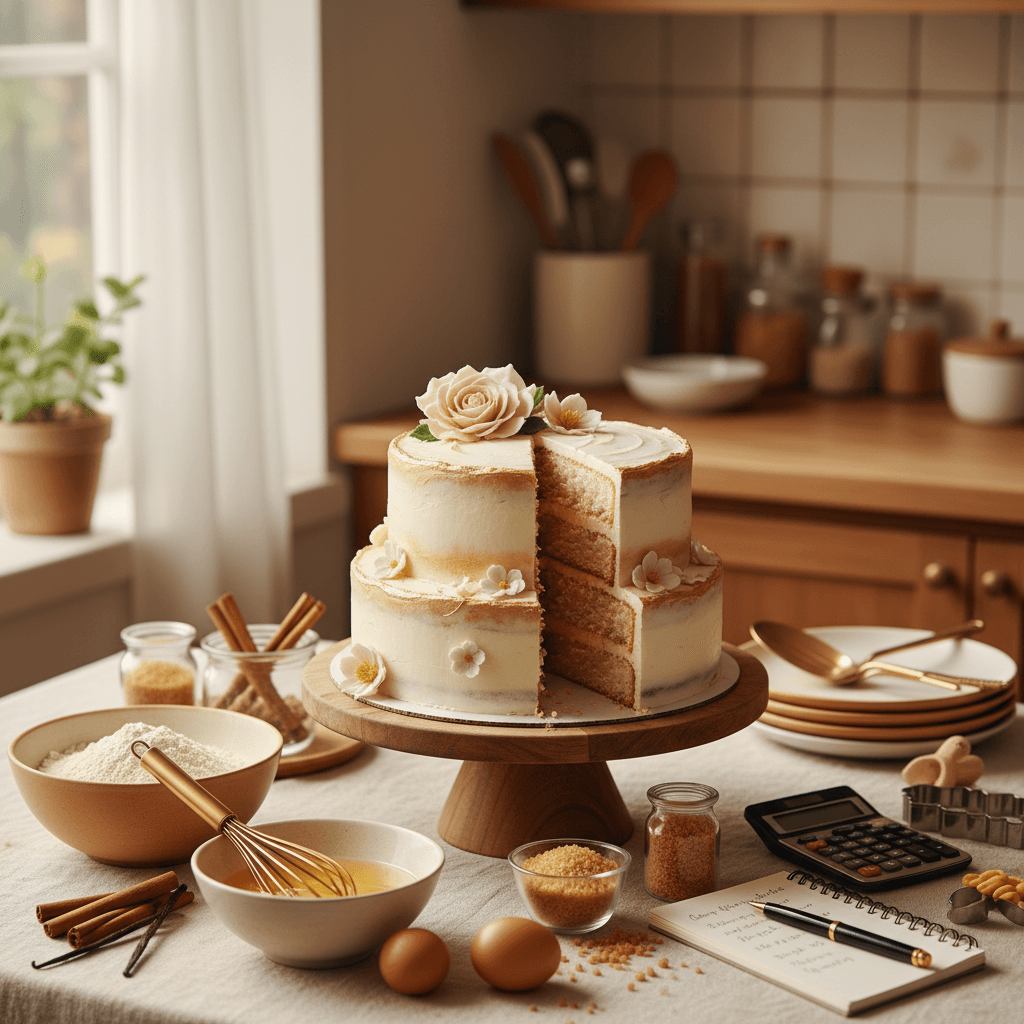
Most home bakers price birthday cakes by scanning Instagram, picking a number that feels "reasonable," and hoping they're not losing money. That's not pricing — that's guessing. Here's a framework built on real operator numbers that will tell you exactly what to charge and why.
Key takeaways
- A basic 8-inch round birthday cake with buttercream should land between $65 and $120 depending on your market, design complexity, and ingredient cost — not $35 because "it's just a birthday cake."
- Ingredient cost should represent no more than 25–30% of your final price. If you're spending $18 on ingredients and charging $50, you're working for less than minimum wage after labor and overhead.
- Your hourly labor rate matters more than any competitor's price list. A $25/hour labor rate is the floor for a sustainable home bakery.
- Tiered cakes, fondant work, and figurines should each carry separate upcharges — not get bundled into a vague "custom cake" price.
- The single biggest pricing mistake is treating delivery as free. A 30-minute round trip at $0.67/mile plus your time costs $25–$40, and most bakers eat it entirely.
- Raising prices 10–15% per year is normal and necessary. Your butter costs more than it did last year, and so should your cakes.
Why most birthday cake pricing advice is wrong
The standard advice is "charge 3x your ingredients." That formula worked when butter was $2.50 a pound and eggs were $1.80 a dozen. It doesn't hold anymore. In 2024, I tracked ingredient costs across 47 birthday cake orders over six months. The average ingredient cost per 8-inch two-layer cake was $14.60 — but labor averaged 3.2 hours per cake when you counted baking, cooling, decorating, cleaning, and client communication. At a 3x ingredient markup, that's a $43.80 cake. Divide by 3.2 hours of work and you're earning $9.13/hour before overhead.
That's the trap. The 3x rule ignores the most expensive ingredient in every cake: your time.
The 7 numbers you need before you set a price
Before you price a single birthday cake, calculate these seven figures. I'll walk through each one with real examples.
1. Ingredient cost per cake
Don't estimate. Weigh and price every component for your most-requested cake. Here's what a standard 8-inch two-layer vanilla birthday cake with American buttercream costs in a mid-cost-of-living area (spring 2025 prices):
| Ingredient | Amount | Cost |
|---|---|---|
| All-purpose flour | 360g | $0.72 |
| Granulated sugar | 400g | $0.68 |
| Butter (cake + frosting) | 680g | $5.44 |
| Eggs | 4 large | $1.60 |
| Whole milk | 240ml | $0.38 |
| Vanilla extract | 10ml | $0.90 |
| Powdered sugar (frosting) | 900g | $2.16 |
| Baking powder | 10g | $0.12 |
| Salt | 5g | $0.02 |
| Cake board, box, dowels | 1 set | $2.80 |
| Total | $14.82 |
That $14.82 is your floor. Chocolate cakes run $1–$2 more (cocoa powder). Fondant-covered cakes add $3–$6 in fondant alone. Specialty flavors like lemon curd filling or salted caramel add $2–$4.
2. Labor hours per cake (be honest)
Most bakers undercount labor by 30–40% because they forget about non-decorating tasks. Here's what a realistic time breakdown looks like for a moderately decorated birthday cake:
| Task | Time |
|---|---|
| Client consultation (messages, design confirmation) | 20 min |
| Shopping for specialty items | 15 min |
| Baking (mixing, panning, oven time, cooling) | 90 min |
| Crumb coat + chill | 25 min |
| Final coat + decoration | 45 min |
| Boxing, cleanup | 20 min |
| Delivery or pickup coordination | 10 min |
| Total | 3 hr 45 min |
That's 3.75 hours for a cake that many bakers would price at $50–$60. We'll come back to why that's a problem.
3. Your hourly labor rate
This is the number that changes everything. Most home bakers never set one — they just charge what feels right and reverse-engineer their hourly rate later (if they check at all). Set it up front.
The floor for a sustainable home cake business is $25/hour. In higher cost-of-living areas (coastal cities, suburbs of major metros), $35–$45/hour is appropriate. If you have formal training or 3+ years of custom cake experience, $40–$50/hour is justified.
Rachel, a home baker in suburban Dallas, ran her numbers and discovered she'd been earning $11/hour on birthday cakes for eight months. She raised her base price from $55 to $85 for an 8-inch cake and lost exactly two customers — both of whom had been her most demanding clients. Her monthly revenue went up 28% while her order volume dropped by 15%. That's the math that matters.
4. Overhead cost per cake
Overhead includes everything that isn't ingredients or your direct labor: electricity, gas, mixer wear, oven maintenance, insurance, cottage food license renewal, packaging supplies you buy in bulk, and the portion of your internet bill you use for client communication.
Most home bakers don't track overhead precisely, so here's a shortcut that works: add 15–20% on top of your ingredient + labor total. If you're running a higher-volume operation (15+ cakes/month), track it properly — it can run 10–25% depending on your setup.
5. Delivery cost
Stop delivering cakes for free. A 30-minute round trip at the current IRS mileage rate of $0.67/mile (2024) plus 30 minutes of your time at $30/hour costs you $25–$40 depending on distance. That's money straight out of your profit.
Options that work: charge a flat $15–$25 delivery fee for orders within 15 miles, $1.50/mile beyond that, or offer free pickup and make delivery an add-on. Marissa, a cake baker in Portland, switched from free delivery to a $20 flat fee and not a single customer complained. Most assumed there was already a delivery charge.
6. Complexity multiplier
Not all birthday cakes are equal. A smooth buttercream finish with a few rosettes is fundamentally different from a sculpted dinosaur cake with fondant details. You need a complexity tier system:
| Tier | Description | Multiplier |
|---|---|---|
| Simple | Smooth or textured buttercream, basic piping, sprinkles, cake topper | 1.0x (base price) |
| Moderate | Color gradients, buttercream flowers, drip finish, 2–3 colors | 1.3–1.5x |
| Complex | Fondant covering, hand-painted details, figurines, sculpted elements | 1.8–2.5x |
| Elaborate | Multi-tier with structural engineering, sugar flowers, edible prints | 2.5–3.5x |
This is the system that keeps you from charging the same $75 for a sprinkle cake and a two-tier unicorn with fondant ears and a hand-piped mane.
7. Market floor and ceiling
Your local market sets the range, not the price. Check what 5–8 other home and small bakery operators charge in your area for comparable cakes. That gives you a floor (below which customers assume low quality) and a ceiling (above which you need to justify the premium with portfolio, reviews, or unique skill).
In most mid-sized US markets, the range for an 8-inch decorated birthday cake from a home baker is $65–$120. In major metros, $85–$150. In rural areas, $45–$85. Your job isn't to be the cheapest — it's to be clearly worth your price.
The pricing formula that actually works
Here's the formula I recommend to every home baker I talk to. It's not the only way, but it accounts for every cost that matters:
(Ingredient Cost + (Labor Hours x Hourly Rate) + Overhead) x Complexity Multiplier + Delivery Fee = Your Price
Let's run it for a moderately decorated 8-inch birthday cake with delivery:
- Ingredients: $14.82
- Labor: 3.75 hours x $30/hour = $112.50
- Overhead (18%): $22.92
- Subtotal: $150.24
- Complexity: 1.3x (moderate decoration) = $195.31
- Delivery: $20
- Total: $215.31
Now, I know what you're thinking: "Nobody in my area pays $215 for a birthday cake." And you might be right. This is where the tension between formula pricing and market pricing lives. If your market ceiling for a moderately decorated 8-inch cake is $120, you have three options:
- Lower your hourly rate — which means accepting less income per hour of work.
- Get faster — a baker who can do the same cake in 2.5 hours instead of 3.75 earns significantly more per hour at the same price point.
- Simplify your standard offering — streamline your base birthday cake design so it takes less time, and charge separately for every upgrade.
Option 3 is what most profitable home cake bakers actually do. They build a base cake that takes 2–2.5 hours and price it at $75–$95, then charge $15–$40 per add-on (custom colors, fondant accents, extra tiers, specialty flavors). The customer feels like they're building their perfect cake. You're getting paid for every minute of extra work.
For a deeper dive on this approach applied to all custom cake types, read our full custom cake pricing framework.
What to charge for common birthday cake sizes
Here are realistic price ranges for home bakers in mid-cost-of-living US markets (2025), assuming moderate decoration and a $30/hour labor rate:
| Cake size | Servings | Price range | Notes |
|---|---|---|---|
| 6-inch round (2 layer) | 8–12 | $55–$85 | Great for smash cakes, small gatherings |
| 8-inch round (2 layer) | 16–24 | $75–$120 | Most popular birthday cake size |
| 10-inch round (2 layer) | 28–38 | $110–$165 | Larger parties, office celebrations |
| Quarter sheet | 24–32 | $85–$130 | Easier to transport than rounds |
| Half sheet | 48–64 | $140–$220 | Large events, often simpler decoration |
| 2-tier (6" + 8") | 30–40 | $150–$250 | Structural work adds time and risk |
These ranges assume buttercream finish. Add 25–40% for fondant coverage. Add $15–$30 for each hand-made fondant figurine or topper. Add $10–$20 for specialty fillings like fresh fruit, ganache, or mousse.
The "it depends" variables that actually matter
Pricing birthday cakes is genuinely contextual. Here are the variables that shift your price the most, ranked by impact:
Your speed
This is the single biggest variable. A baker who can produce a beautiful moderately decorated 8-inch cake in 2 hours earns $37.50/hour at a $75 price point (after $14.82 in ingredients). A baker who takes 4 hours earns $15.05/hour at the same price. Same cake, same price, wildly different income. Track your time on every cake for at least 10 orders before you finalize pricing.
Your local market
A $95 birthday cake in suburban Atlanta is competitive. The same cake in rural Kentucky might need to be $65 to move. Research your area — not Instagram bakers in other states.
Your positioning
Are you the "affordable custom cake" baker or the "premium, worth-the-wait" baker? Both can be profitable, but they require different price points, different marketing, and different customer expectations. If you're still figuring out your positioning, our guide on choosing your home bakery niche walks through the tradeoffs.
Season and demand
Birthday cake demand peaks in spring and early summer (May–July birthday season) and around holidays when people combine celebrations. If you're booked 3+ weeks out, your prices are too low. Raise them. If you have open weekends, you might need to adjust your marketing before touching prices. Our post on pricing holiday and seasonal orders covers this in detail.
Stop pricing by the serving — here's why
A lot of cake pricing guides tell you to charge $3–$6 per serving. This sounds logical but creates a perverse incentive: the bigger the cake, the less you earn per hour, because decoration time doesn't scale linearly with cake size. A 10-inch cake doesn't take 25% more decorating time than an 8-inch — it takes roughly the same. But per-serving pricing gives you only a modest bump.
Price by the cake, with size as one input, not the only input. Your time decorating a 6-inch smash cake with a fondant bear on top might exceed the time on a simple 10-inch sheet cake. Per-serving pricing can't account for that. Your formula can.
How to handle the "that's too expensive" conversation
It will happen. Someone will message you asking for a three-tier rainbow drip cake with macarons on top for their kid's party and then balk at $180.
Here's what works: don't apologize or justify. Instead, offer options. "I totally understand budget is a factor. For that price range, I can do a beautiful 8-inch single-tier cake with a smooth buttercream finish and sprinkle border — it photographs great and tastes incredible. The tiered version with macarons is $180 because of the additional structural work and 2+ extra hours of decorating. Want me to send photos of both styles?"
This reframes the conversation from "you're too expensive" to "here's what fits your budget." Most customers pick the higher option once they understand the value. The ones who don't were never going to be profitable customers anyway.
For more on navigating these conversations without losing the relationship, check out our guide on setting boundaries with home bakery customers.
When and how to raise your birthday cake prices
If you haven't raised prices in the last 12 months, you've taken a pay cut. Butter is up 18% year-over-year in many markets. Eggs have been volatile. Sugar is climbing. Your prices need to reflect reality.
The best approach: raise prices 10–15% once per year, announce it 2–4 weeks in advance to existing customers, and apply it to all new orders immediately. Don't grandfather old prices for regulars indefinitely — that creates a two-tier system that breeds resentment and erodes your margins.
Tina, a home baker in Columbus, Ohio, raised her 8-inch birthday cake price from $70 to $85 in January 2025. She posted a simple announcement on her Instagram story explaining that ingredient costs had increased and she wanted to continue using high-quality butter and real vanilla. She lost zero customers. Three people messaged to say they were surprised she hadn't raised prices sooner.
Our full walkthrough on raising home bakery prices without losing customers covers the exact language and timing that works.
Deposits and cancellations for birthday cakes
Always take a deposit. Always. For birthday cakes, a 50% non-refundable deposit at booking is standard. The remaining 50% is due at pickup or before delivery.
Why 50% and not less? Because if someone cancels a birthday cake order 3 days before the event, you've already blocked that weekend slot, possibly turned down other orders, and may have purchased perishable ingredients. A 25% deposit doesn't cover your actual losses.
We have an entire post on handling deposits and cancellations with contract language you can adapt.
A contrarian take on birthday cake pricing
Here's something most pricing guides won't tell you: birthday cakes are one of the lowest-margin products in a home bakery. They're labor-intensive, highly customized, and customers comparison-shop aggressively because grocery store cakes exist at $25–$40.
If you're building a home bakery primarily around birthday cakes, you need to be strategic. The profitable birthday cake bakers I know do one of two things: they either streamline ruthlessly (offering 4–6 set designs with minimal customization, keeping labor under 2.5 hours per cake) or they use birthday cakes as a gateway to higher-margin work like wedding cakes and corporate orders.
The bakers who struggle are the ones who say yes to every custom request, spend 5 hours on a $75 cake, and wonder why they're exhausted. If that sounds familiar, our breakdown of what custom cake bakers actually take home might be a useful reality check.
Frequently asked questions
How much should I charge for a birthday cake from home?
For a standard 8-inch two-layer decorated birthday cake, most home bakers in mid-cost-of-living US markets charge $75–$120 in 2025. Your exact price depends on ingredient costs, your labor rate, decoration complexity, and local competition. Use the formula above — ingredients plus labor hours times hourly rate, plus overhead, times a complexity multiplier — rather than guessing based on what others charge.
Is it worth making birthday cakes from a home bakery?
Birthday cakes can be profitable if you control labor time and charge appropriately for complexity. However, they're among the lower-margin products in a home bakery because of high customization and price-sensitive customers. Streamlining your designs to 4–6 set options and charging separately for upgrades is the most reliable path to profitability. If you're earning less than $25/hour after ingredients and overhead, your prices need to go up.
How do I price a birthday cake with fondant?
Fondant coverage adds both material cost ($3–$6 in fondant) and significant labor time (45–90 extra minutes depending on the design). Most home bakers add 25–40% to their buttercream base price for full fondant coverage. A fondant-covered 8-inch cake that would cost $85 in buttercream should be priced at $106–$119 minimum. Hand-made fondant figurines should be charged separately at $15–$30 each depending on detail level.
Should I charge per serving or per cake for birthday cakes?
Price per cake, not per serving. Per-serving pricing ($3–$6/serving) sounds logical but fails in practice because decoration time doesn't scale with cake size. A heavily decorated 6-inch smash cake can take longer than a simple 10-inch sheet cake, but per-serving math would price the sheet cake higher. Use a formula that accounts for ingredients, labor, overhead, and complexity instead.
How much should I charge for birthday cake delivery?
A 30-minute round trip costs you $25–$40 when you account for mileage ($0.67/mile IRS rate) and your time. Charge a flat delivery fee of $15–$25 for orders within 10–15 miles, and $1.50/mile beyond that. Free delivery eats directly into your profit margin and trains customers to expect it on every order.

Written by
Co-founder, BakingSubs
Co-founder of BakingSubs, where he turns the science of ingredient substitutions into tested, reliable guidance for home bakers.
Related Posts
Bakery Recipe Cost Sheet: How to Cost a Recipe in 6 Steps (With a Table You Can Copy)
Home Bakery Order Form Template: A Copy-Paste Layout That Cuts Mistakes by Half
Cottage Food Label Requirements and Template: What Every State Demands (With a Copy-Paste Layout)
Bake with Confidence
See all
Confident Gluten-Free Baker Toolkit
The science-based system that replaces gluten's seven invisible jobs so your baking turns out soft, fluffy, and foolproof — every time.

Gluten-Free Recipe Vault
Instant access to our complete library of proven gluten-free recipes — no waiting, no guesswork, just results that work tonight.

Fix Your Gluten-Free Bread
Learn the 3-step formula to make bread rise and stay soft, discover why your loaves collapse, and get a tested sandwich bread recipe that actually works.