

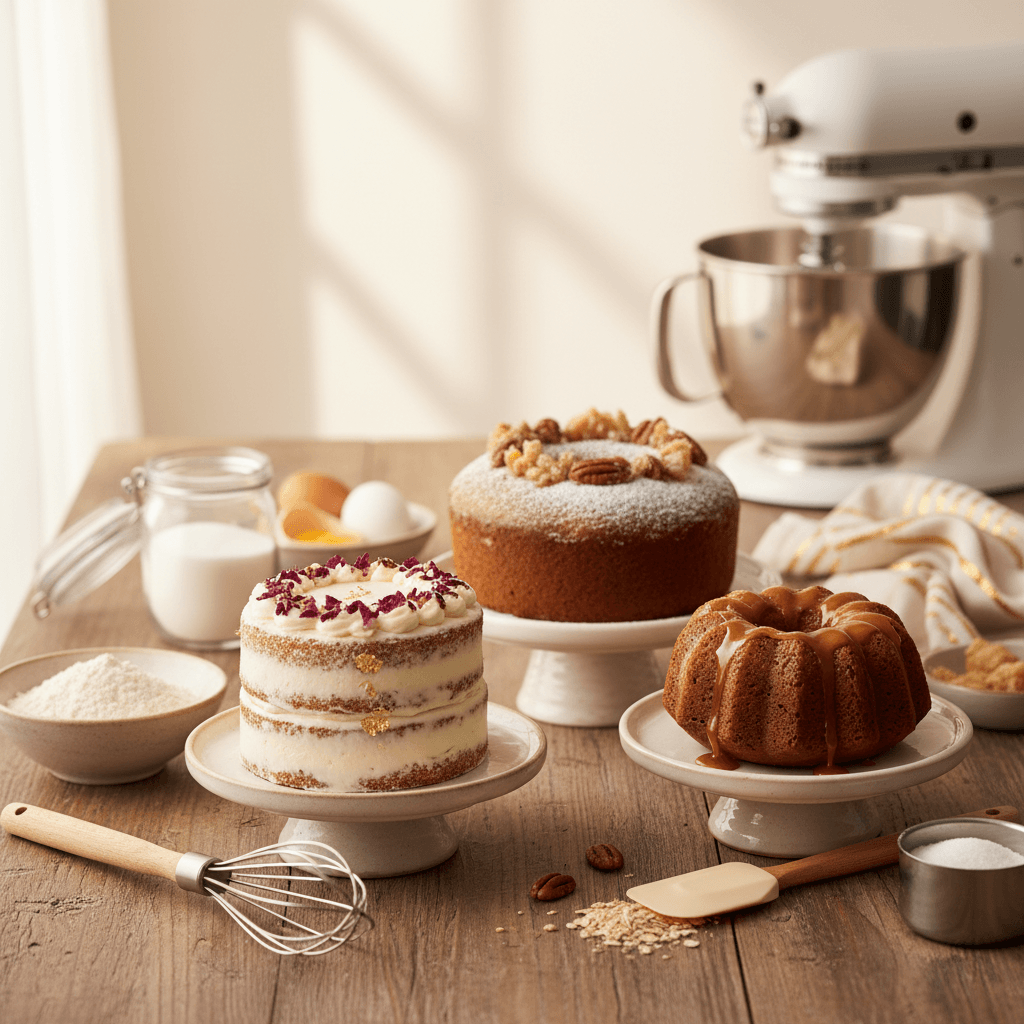
Most custom cake income posts throw out numbers like "$1,000–$5,000 a month" without showing you where that money actually goes. That's useless if you're trying to figure out whether your cake business is paying you fairly or just keeping you busy. Here's a real breakdown — with actual dollar figures, profit margins, and the variables that determine whether you're building income or subsidizing a hobby.
Key takeaways
- A custom cake home baker doing 6–8 cakes per week can gross $3,200–$5,600/month, but net income after costs typically lands between $1,400 and $3,100.
- Ingredient costs should run 18–28% of your cake price — if you're above 30%, your pricing is broken or your recipes are inefficient.
- Time is the hidden profit killer: a 3-tier fondant cake that takes 11 hours at $175 pays you $9.50/hour after materials.
- The highest-earning home cake bakers don't necessarily make the fanciest cakes — they've built systems around a focused menu with repeatable designs.
- Your income ceiling is set by your weekly order capacity, not your per-cake price alone.
Three real custom cake income breakdowns
I tracked numbers from three home bakers at different stages. These aren't hypothetical — they're based on real order logs and expense tracking. Names are changed, numbers aren't.
Marcy: part-time, 3–4 cakes per week (Austin, TX)
Marcy bakes Thursday through Sunday around her day job. She focuses on buttercream birthday cakes in the $65–$110 range. Her average order is $82.
| Category | Monthly amount | % of gross |
|---|---|---|
| Gross revenue (avg 14 cakes/month) | $1,148 | 100% |
| Ingredients | $264 | 23% |
| Packaging (boxes, boards, dowels) | $58 | 5% |
| Delivery gas/mileage | $42 | 3.7% |
| Cottage food license + insurance | $28 | 2.4% |
| Net take-home | $756 | 65.8% |
Marcy's hourly rate works out to about $16.80 when she tracks her time honestly (including consultations, grocery runs, and cleanup). She's comfortable with that as side income but knows she'd need to restructure to go full-time.
Devon: full-time, 6–8 cakes per week (Charlotte, NC)
Devon left her office job 18 months ago. She does custom buttercream and semi-fondant cakes priced between $125 and $325. Her average order is $195.
| Category | Monthly amount | % of gross |
|---|---|---|
| Gross revenue (avg 28 cakes/month) | $5,460 | 100% |
| Ingredients | $1,147 | 21% |
| Packaging + supplies | $196 | 3.6% |
| Delivery costs | $168 | 3.1% |
| Insurance + license | $67 | 1.2% |
| Marketing (Instagram ads, Google) | $150 | 2.7% |
| Software (invoicing, scheduling) | $39 | 0.7% |
| Self-employment tax set-aside (25%) | $1,365 | 25% |
| Net take-home | $2,328 | 42.6% |
Notice that Devon's gross looks great, but after she sets aside for taxes — which most income breakdowns conveniently skip — her take-home is $2,328. That's real. If you're not setting aside 20–30% for self-employment tax, you're not calculating income, you're calculating a future problem.
Devon's effective hourly rate is about $22.40 based on 26 hours of active baking/decorating per week, plus roughly 8 hours of admin, consultations, and social media.
Tina: full-time, premium niche, 4–6 cakes per week (Denver, CO)
Tina only does wedding cakes and luxury event cakes. Her minimum order is $350 and her average is $485. She takes fewer orders but charges significantly more.
| Category | Monthly amount | % of gross |
|---|---|---|
| Gross revenue (avg 20 cakes/month) | $9,700 | 100% |
| Ingredients (premium: real vanilla, European butter) | $2,716 | 28% |
| Packaging, rentals, display items | $485 | 5% |
| Delivery + setup (she does all setups personally) | $340 | 3.5% |
| Insurance + license | $92 | 0.9% |
| Marketing (styled shoots, vendor networking) | $275 | 2.8% |
| Software + website | $65 | 0.7% |
| Self-employment tax set-aside (25%) | $2,425 | 25% |
| Net take-home | $3,302 | 34% |
Tina's net percentage is actually the lowest of the three because her ingredient costs are higher (she uses Plugra butter at $5.49/lb and real vanilla bean paste at $38 per 4oz bottle) and her delivery/setup time is substantial. But her dollar take-home is the highest because her price floor eliminates low-margin work.
If you're still figuring out where your pricing sits relative to these numbers, the custom cake pricing framework walks through the math step by step.
Where the money actually goes (and where it leaks)
Looking at all three bakers, the cost categories break into predictable ranges. Here's what healthy looks like versus what signals a problem:
| Expense category | Healthy range | Red flag |
|---|---|---|
| Ingredients | 18–25% | Above 30% |
| Packaging + supplies | 3–6% | Above 8% |
| Delivery | 2–5% | Above 7% (means your delivery radius is too wide) |
| Marketing | 2–5% | Above 8% without clear ROI tracking |
| Tax set-aside | 20–30% | 0% (you will owe a painful lump sum in April) |
The biggest leak I see consistently isn't in any of those categories. It's untracked time. Devon told me she originally thought she spent 4 hours per cake. When she actually timed herself for two weeks — including the consultation call, the grocery run, baking, decorating, cleanup, and delivery — her average was 6.8 hours. That difference alone meant her real hourly rate was 40% lower than she thought.
If your ingredient costs are creeping above 28%, you have two options: raise prices or simplify your designs. A cake with 4 fondant figurines and hand-painted details uses $18–$24 more in materials than the same size cake with textured buttercream and fresh flowers. That's not a small difference when you're doing 20+ cakes a month.
For a deeper look at why pricing problems compound into business-killing patterns, read why most home bakeries fail.
The income ceiling problem most cake bakers hit
Here's the math that nobody wants to hear: your income is capped by how many cakes you can physically produce in a week.
Most home bakers with a single standard oven can produce 6–8 custom cakes per week if they're baking 4–5 days. That's your ceiling. If your average order is $85, your gross monthly cap is roughly $2,720. If your average order is $200, that same capacity produces $6,400.
This is why raising your prices is the single most effective income lever for a custom cake baker. You can't bake more hours into the day, but you can charge more per hour of work.
The bakers I've seen break through the ceiling do one of three things:
- Raise the average order value. Moving from $85 average to $150 average on the same volume is a 76% income increase with zero additional hours.
- Add high-margin repeating products. Devon added a weekly "cake slice box" — 6 slices of her bestselling flavors for $28 — and sells 15–20 per week through her email list. That's $420–$560/week in revenue with about 4 hours of batch work.
- Specialize and go premium. Tina's wedding-only focus means she can charge $485 average because she's not competing with the baker down the street doing $60 birthday cakes. Her niche is her moat.
What doesn't work: trying to take every order that comes in. If you're saying yes to a $45 smash cake that takes 3 hours, you're blocking a time slot that could hold a $175 order. Learning when to say no is a direct income decision.
Contrarian take: the "passion pricing" trap
Here's something that goes against most advice you'll read: charging what you're worth is not a pricing strategy. It's a feeling. And feelings don't pay your self-employment tax.
I've seen bakers who are genuinely talented — competition-level decorators — earning less per hour than the baker two towns over who does simple two-tier buttercream cakes with a focused menu and efficient systems. Skill does not automatically translate to income. Systems and pricing discipline do.
The baker earning more isn't necessarily better. She just knows her numbers: $14.20 in ingredients per cake, 3.5 hours of labor, $145 minimum price, 7 cakes per week, $4,060/month gross. She can tell you her profit margin to the decimal because she tracks it.
If you're not tracking your numbers this tightly, the business model sustainability diagnostic can help you figure out where you stand.
If you're looking for structured guidance on building a bakery that actually pays you, check out the free Home Bakery Pro masterclass — it covers getting consistent orders and building a sustainable home bakery from the ground up.
What determines where you land on the income spectrum
The honest answer to "how much can I make with a custom cake business" is: it depends. But it depends on specific, measurable variables — not vague notions of talent or luck.
Variable 1: your average order value
This is the single biggest predictor of income. A baker doing 24 cakes/month at $80 average grosses $1,920. The same 24 cakes at $180 average grosses $4,320. Same hours, same oven, $2,400 difference.
Variable 2: your production efficiency
How long does it actually take you — including everything — to complete an order? If you can get a standard 2-tier buttercream cake from start to delivery in 4.5 hours instead of 7, you've just created capacity for more orders or more rest. Both matter.
Batch baking systems help here. Baking all your cake layers on one day and decorating on another is measurably faster than doing each cake start-to-finish.
Variable 3: your order consistency
Feast-or-famine ordering is an income killer. A baker who does 8 cakes one week and 2 the next averages the same as 5 per week, but the inconsistency makes it impossible to plan expenses or set aside for taxes reliably. Building consistent weekly orders smooths your income curve.
Variable 4: your cost discipline
Every dollar you overspend on ingredients is a dollar off your take-home. Tina's 28% ingredient cost is justified by her premium positioning and $485 average order. If your average order is $90 and your ingredient cost is also 28%, you're taking home $15.12 less per cake than you would at 20%. Over 24 cakes a month, that's $363 in lost income.
Variable 5: whether you actually pay yourself
This sounds obvious, but a shocking number of home cake bakers reinvest every dollar back into the business — new tools, more supplies, a better mixer — and never actually take a paycheck. Revenue is not income. If you grossed $4,000 last month and your bank account looks the same, you have a revenue problem disguised as a business.
A realistic income ladder for custom cake bakers
Based on the data I've collected and the patterns across dozens of home bakers, here's what each stage typically looks like:
| Stage | Orders/month | Avg order | Monthly gross | Est. net (after costs + tax) |
|---|---|---|---|---|
| Side hustle (year 1) | 8–12 | $70–$100 | $560–$1,200 | $350–$780 |
| Serious side income (year 1–2) | 14–20 | $100–$150 | $1,400–$3,000 | $770–$1,650 |
| Full-time viable (year 2–3) | 20–30 | $150–$250 | $3,000–$7,500 | $1,500–$3,750 |
| Premium/specialty (year 3+) | 16–24 | $300–$500+ | $4,800–$12,000 | $2,400–$5,400 |
Notice the premium tier actually has fewer orders. That's intentional. Higher prices with fewer orders means less physical labor, less burnout risk, and often better net margins because you're not racing through cakes at volume.
If you're in the early stages and trying to figure out whether this can become real income, the transition roadmap lays out what the shift actually requires.
The one number that matters more than gross revenue
Your effective hourly rate. Calculate it like this:
(Monthly gross - all expenses - tax set-aside) / total hours worked
Total hours means everything: baking, decorating, consulting, shopping, cleaning, posting on social media, answering DMs, doing delivery. All of it.
If that number is below $15/hour, your pricing needs work — period. If it's below $10/hour, you're subsidizing your customers' celebrations with your labor. That's generous, but it's not a business.
Devon's $22.40/hour is solid for a home-based business with no commute and flexible scheduling. Tina's works out to about $28.60/hour. Marcy's $16.80 is reasonable for side income but wouldn't sustain full-time.
The path from $16 to $28/hour isn't about working harder. It's about charging accurately, building efficient systems, and being deliberate about which orders you accept.
Frequently asked questions
How much do custom cake bakers actually make per month?
It ranges widely based on volume, pricing, and efficiency. A part-time home baker doing 12–14 cakes per month at $80 average typically nets $700–$800 after expenses. A full-time baker doing 24–30 cakes at $150–$250 average can net $1,500–$3,750 per month after expenses and tax set-aside. The biggest variable is average order value, not the number of cakes.
What percentage of custom cake revenue is profit?
After all expenses including a 25% self-employment tax set-aside, most home cake bakers keep 35–55% of gross revenue as take-home pay. Bakers with ingredient costs above 30% or those who don't track time accurately often end up below 30%. Keeping ingredients at 20–25% of your cake price is the single biggest lever for improving that margin.
Is a custom cake business worth it financially?
It depends on your pricing discipline and how you value your time. A well-run custom cake business can pay $20–$30/hour with flexible scheduling and no commute, which compares favorably to many part-time jobs. But a poorly priced one can pay below minimum wage when you account for all hours worked. Track your effective hourly rate honestly before deciding. The sustainability diagnostic can help you evaluate where you stand.
How many custom cakes can one person make per week from home?
With a single standard home oven and baking 4–5 days per week, most bakers max out at 6–8 custom cakes. This assumes standard 2–3 tier designs with buttercream or semi-fondant finishes. Highly detailed sculpted cakes or large wedding cakes drop that to 3–4 per week. Your weekly capacity times your average price equals your income ceiling, which is why raising prices matters more than adding orders.
Should I specialize in one type of cake or offer everything?
Specializing almost always leads to higher income per hour. Bakers who focus on a specific niche — wedding cakes, character birthday cakes, minimalist modern designs — can charge more because they're known for something specific. Offering everything means competing on price with every other generalist baker in your area. Tina's wedding-only focus lets her charge $485 average versus the $82 average of a generalist doing all birthday cake styles. Read more about choosing a profitable niche.

Written by
Co-founder, BakingSubs
Co-founder of BakingSubs, where he turns the science of ingredient substitutions into tested, reliable guidance for home bakers.
Related Posts
Bakery Recipe Cost Sheet: How to Cost a Recipe in 6 Steps (With a Table You Can Copy)

Home Bakery Order Form Template: A Copy-Paste Layout That Cuts Mistakes by Half
Cottage Food Label Requirements and Template: What Every State Demands (With a Copy-Paste Layout)
Bake with Confidence
See all
Confident Gluten-Free Baker Toolkit
The science-based system that replaces gluten's seven invisible jobs so your baking turns out soft, fluffy, and foolproof — every time.

Gluten-Free Recipe Vault
Instant access to our complete library of proven gluten-free recipes — no waiting, no guesswork, just results that work tonight.

Fix Your Gluten-Free Bread
Learn the 3-step formula to make bread rise and stay soft, discover why your loaves collapse, and get a tested sandwich bread recipe that actually works.