

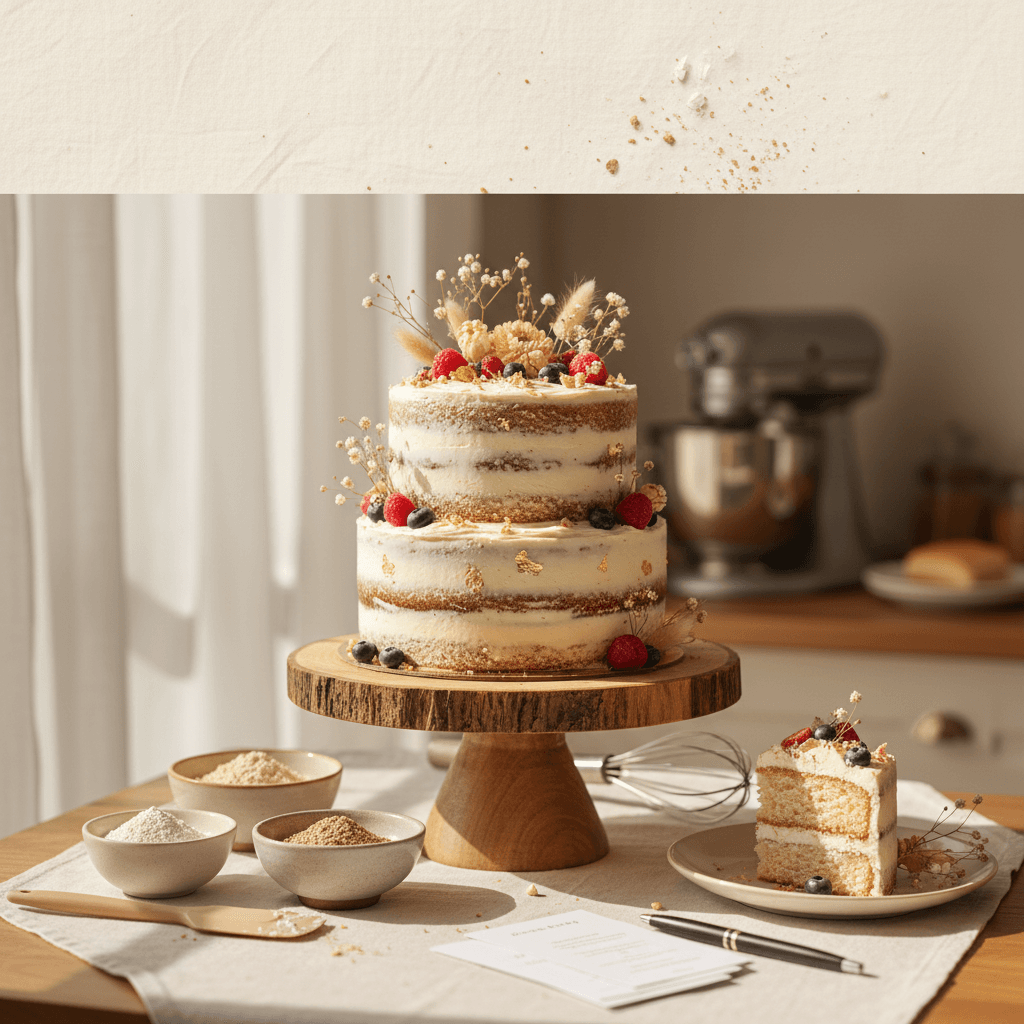
A clear deposit and cancellation policy is the single biggest thing standing between you and a $200 loss on a cake nobody picks up. Here's exactly how to set yours up, what to charge, and how to handle the awkward conversations when someone cancels.
Key takeaways
- A 50% non-refundable deposit is the industry standard for custom cakes, but the right number depends on your ingredient costs and lead time.
- Written policies sent before you accept payment prevent 90% of cancellation disputes.
- Cancellations within 48 hours of the event should almost never receive a refund — your labor and ingredients are already committed.
- Tiered refund schedules (e.g., 75% back at 14+ days, 0% back under 48 hours) protect you while keeping customers comfortable booking.
- The way you communicate the policy matters more than the policy itself — frame it as protecting their spot on your calendar.
Why you need a deposit policy before your next order
If you've been taking custom cake orders on a handshake and a DM, you're one ghost customer away from eating a $180 loss. I tracked my first year of cake orders and found that 3 out of 22 customers either cancelled late or simply didn't show up for pickup. That's $475 in ingredients, labor, and lost weekend slots I never recovered.
A deposit policy isn't about being rigid. It's about making sure both you and the customer have skin in the game. When someone puts down $75 on a $150 cake, they show up. When they don't put down anything, roughly 1 in 7 orders evaporates in my experience — and other home bakers I've talked to report similar numbers.
If you haven't already nailed down your base pricing, start there first. Your deposit amount only makes sense when you know your actual costs. Our custom cake pricing framework walks through the math.
How much to charge as a custom cake deposit
The short answer: 50% of the total order price, non-refundable. That's the most common number among working home bakers, and it's what I recommend as a starting point. But here's when you should adjust it.
When 50% is the right call
For most standard custom cakes in the $80–$300 range, 50% works well. It's enough to cover your ingredient costs and a portion of your labor if the order falls through, but it's not so high that it scares off customers. A customer ordering a $160 birthday cake pays $80 upfront. If they cancel, you've covered your $35–$45 in ingredients and have something toward your time.
When to go higher than 50%
Wedding cakes and large event cakes over $400 often justify a different structure. Megan, a home baker in Austin, charges a flat $200 non-refundable booking fee plus 50% of the remaining balance due 30 days before the event. Her reasoning: wedding cakes require a tasting session, a design consultation, and she blocks an entire weekend for one order. That $200 covers her consultation time even if the wedding gets called off.
For specialty cakes requiring expensive imported ingredients — say, a $65 bottle of high-quality vanilla paste or $28 worth of fondant — you may want to collect enough upfront to cover those specific costs. I've seen bakers go as high as 75% for orders requiring non-returnable specialty supplies.
When to go lower
If you're just starting out and building your customer base, a 30–40% deposit with a clear cancellation policy can lower the barrier to booking. You'll take on slightly more risk, but you'll also convert more inquiries into orders. Once you're consistently booked 2–3 weeks out, move to 50%.
| Order size | Recommended deposit | Reasoning |
|---|---|---|
| Under $100 | 50% ($40–$50) | Covers ingredients; keeps it simple |
| $100–$300 | 50% | Standard for most custom cakes |
| $300–$600 | 50% or flat $200 + 50% of remainder | Protects consultation and design time |
| Over $600 (wedding/event) | $200–$300 booking fee + 50% | Covers tasting, design, blocked calendar slot |
Building a cancellation policy that actually protects you
A deposit alone isn't a cancellation policy. You need a tiered refund schedule that accounts for when the cancellation happens relative to the event date. Here's the framework I use and recommend:
The tiered refund schedule
| Cancellation timing | Refund amount | Why |
|---|---|---|
| 14+ days before event | Deposit minus $25 admin fee | You haven't bought ingredients or blocked significant time |
| 7–13 days before event | 50% of deposit | You may have purchased specialty items and turned away other orders |
| 3–6 days before event | No refund on deposit | Ingredients purchased, prep likely started |
| Under 48 hours / no-show | No refund; balance still owed | Cake is made or in progress |
That last row is the one most home bakers skip, and it's the one that costs them the most. If you've already baked a three-tier cake and the customer ghosts, you deserve to be paid. The balance-still-owed clause gives you legal standing to pursue payment through small claims if needed, though in practice, most people pay when they see it in writing.
Why the $25 admin fee matters
Even a cancellation at 14+ days costs you something. You spent time on the consultation, possibly sketched a design, and you turned away or delayed other inquiries to hold that date. A $25 fee acknowledges that your time has value. Lisa, a home baker in Ohio, told me she added this fee after calculating she spent an average of 47 minutes per custom cake consultation — and she was losing 3–4 consultations per month to cancellations with zero compensation.
How to communicate your policy without scaring people off
The biggest mistake I see home bakers make isn't having a bad policy — it's presenting a good policy badly. If your first message to a new customer reads like a legal document, you'll lose bookings. Here's how to frame it.
Frame it as protecting their spot
Instead of: "A 50% non-refundable deposit is required. Cancellations within 7 days receive no refund."
Try: "To lock in your date, I collect a 50% deposit. This guarantees I won't book anyone else for that slot and I can start planning your design. If plans change, here's how my cancellation schedule works..."
Same policy. Completely different feeling. The first sounds like a warning. The second sounds like a service.
Put it in writing every single time
A verbal agreement over Instagram DM is worth nothing if someone disputes a charge. Send your policy as a PDF, a Google Doc, or even a clearly formatted text message that the customer confirms with a "yes" or a signature. The minimum you need:
- Total order price
- Deposit amount and due date
- Balance due date (I recommend 48 hours before the event)
- Cancellation/refund schedule
- What happens if they don't pick up
If you're handling more than 4–5 custom orders per month, a simple contract template saves you 15–20 minutes per order and eliminates ambiguity. You don't need a lawyer for this — a one-page agreement with the five items above, signed by both parties, holds up in small claims court in most states.
Clear communication is part of a larger skill set around setting boundaries with customers that every working baker needs to develop.
Handling the actual cancellation conversation
Knowing your policy is one thing. Enforcing it when a crying bride calls you three days before her wedding to say it's off — that's another. Here's how to handle the most common scenarios.
Scenario 1: the "something came up" cancellation (7+ days out)
This is the most common and the easiest. The customer's kid got sick, plans changed, whatever. Stick to your tiered schedule. A response like this works:
"I totally understand — life happens. Since we're [X] days out, I can refund [amount] per my cancellation policy. I'd love to rebook you for another date if that works. Just let me know."
Offering to rebook is a smart move. You keep the deposit, keep the customer, and often end up with a bigger order the second time around.
Scenario 2: the last-minute cancellation (under 48 hours)
This is where it gets uncomfortable. You've already bought $38 in ingredients, spent 4 hours baking and decorating, and the customer texts "we don't need the cake anymore." Your policy says no refund and balance owed. Enforce it.
"I'm sorry to hear that. Since the cake is already completed, the remaining balance of [$X] is still due per our agreement. I'm happy to arrange pickup at your convenience or deliver as planned."
Most people will pay. For the rare person who refuses, you have a signed agreement and can decide whether pursuing it is worth your time. For orders under $150, I generally write it off and add that person to my do-not-book list. For orders over $300, small claims court costs $30–$75 in most jurisdictions and is worth considering.
Scenario 3: the customer who wants to change everything
This isn't technically a cancellation, but it causes the same problems. Someone booked a $120 two-tier cake and now wants to downgrade to a $60 single tier — after you've already bought supplies for the original order. Your policy should address this: design changes that reduce the order total are treated as partial cancellations, and the deposit applies to the original order amount.
This is closely related to knowing when and how to say no to orders that lose you money.
What to do with cancelled cakes you've already made
A cancelled cake that's already baked is sunk cost — but it doesn't have to be a total loss. Here are the recovery strategies that actually work:
- Flash sale on social media. Post the cake at 60–70% of retail price with a "ready today" tag. I've recovered $85–$110 on cakes this way multiple times. Speed matters — post within an hour of the cancellation.
- Slice and sell. Cut the cake into individual servings and sell them at $4–$6 each at a local farmers market or through your regular order channels. A cake that would have sold for $140 whole can bring in $90–$100 in slices.
- Donate and document. Donate to a local shelter or food bank, photograph it, and post about it. You take the tax write-off (document the retail value) and get genuine goodwill marketing. This works especially well for building your brand reputation.
- Freeze components. Unfrosted cake layers freeze well for 2–3 months. Strip the decoration, wrap tightly, and use them for future orders where the timeline is tight.
Special considerations for wedding cake deposits
Wedding cakes deserve their own section because the stakes are higher, the timelines are longer, and the emotional complexity of cancellations is on another level.
For wedding cakes, I recommend a three-payment structure:
- Booking fee: $200–$300 non-refundable, due at signing. This covers your tasting, consultation, and design time.
- 50% of remaining balance: Due 60 days before the wedding.
- Final balance: Due 14 days before the wedding.
This structure means that by the time you're buying ingredients and blocking your weekend, you've already collected 70–80% of the total. If a $500 wedding cake cancels 10 days out, you've collected $400+ and your policy says no refund. You're covered.
For detailed pricing math on wedding cakes specifically, see our wedding cake pricing framework.
The cancelled wedding scenario
Weddings get cancelled for all kinds of reasons, and some of them are genuinely heartbreaking. You can show compassion while still protecting your business. One approach that works well: offer to convert the non-refundable deposit into a credit for a future order within 12 months. You don't lose money (you've already been compensated for your time), and the customer feels like you care — because you do.
Common deposit mistakes that cost home bakers money
After talking to dozens of home bakers about their deposit policies, these are the patterns that consistently lead to losses:
- Making deposits refundable "as a courtesy." The whole point of a deposit is that it's non-refundable. If you refund every time someone asks nicely, you don't have a policy — you have a suggestion.
- Not collecting the balance before delivery. Collect the remaining balance 24–48 hours before the event, not at pickup. Customers who owe you money at pickup have all the leverage.
- Accepting Venmo/Zelle with no paper trail. These platforms have limited dispute resolution. If you use them (and most home bakers do), pair every payment with a written confirmation of what was paid and what it covers.
- Having different policies for different customers. The moment you make an exception for your neighbor's cousin, word gets around. One policy, applied consistently, for everyone.
- Not accounting for your time in the deposit amount. If your $150 cake costs $40 in ingredients but 5 hours of labor, a $40 deposit only covers materials. You need the deposit to cover enough that a cancellation doesn't leave you working for free.
Many of these overlap with the most common mistakes new home bakers make in their first year of business.
When to make exceptions (and when not to)
Rigid policies applied without judgment will lose you good customers. But bending your policy every time someone has a story will bankrupt you. Here's my decision framework:
Consider an exception when:
- The customer is a repeat buyer with 3+ previous orders and has never caused issues
- There's a genuine emergency (death in the family, hospitalization) — not just "we changed our minds"
- You haven't purchased ingredients or started any work yet
- Offering a credit instead of a refund keeps the relationship intact
Hold firm when:
- Work has already begun or ingredients are purchased
- This is a first-time customer with no relationship history
- The cancellation reason is vague or the customer is being hostile
- You've already made an exception for this person before
The credit-instead-of-refund approach is almost always the right middle ground. You keep the revenue, the customer feels heard, and they usually come back. Rachel, a baker in Denver, told me that 6 out of 8 customers who received credits used them within 4 months — and 3 of those became regular repeat customers.
Setting up your policy: a step-by-step checklist
- Calculate your true cost per cake. Include ingredients, labor (pay yourself at least $20/hour), packaging, and overhead. Your deposit must cover at minimum your hard costs. Use a real pricing system to make sure you're not guessing.
- Choose your deposit percentage. 50% for standard orders, higher for weddings and large events.
- Write your tiered cancellation schedule. Use the table above as a template and adjust the timeframes for your typical lead times.
- Create a one-page order agreement. Include order details, deposit terms, cancellation terms, and a signature line.
- Build the language into your inquiry process. Mention the deposit requirement in your first response to every inquiry so there are no surprises.
- Practice the cancellation conversation. Write out your responses to the three scenarios above and save them as templates. When a cancellation happens at 10pm on a Friday, you won't have to think — just send.
Frequently asked questions
Frequently asked questions
What percentage should a cake deposit be?
For most custom cake orders in the $80–$300 range, 50% of the total price is the standard deposit. For wedding cakes and large event orders over $400, many bakers use a flat booking fee of $200–$300 plus 50% of the remaining balance. The deposit should at minimum cover your ingredient costs and a portion of your labor so a cancellation doesn't leave you in the red.
Should cake deposits be refundable or non-refundable?
Non-refundable. A refundable deposit defeats the purpose — it doesn't actually commit the customer to the order. However, offering a credit toward a future order (instead of a cash refund) is a smart compromise that protects your revenue while maintaining the relationship. Most working home bakers use non-refundable deposits with a tiered schedule that returns partial amounts only for cancellations made 14+ days in advance.
How do I handle a customer who refuses to pay the balance after cancelling?
If the cake is already made and the customer refuses to pay, your signed order agreement is your protection. For balances under $150, most bakers write it off and add the customer to a do-not-book list. For larger amounts, small claims court costs $30–$75 in most states and doesn't require a lawyer. Having a written, signed agreement with clear cancellation terms is what makes this enforceable. Without one, you have very little recourse.
Do I need a contract for custom cake orders?
You don't need a lawyer-drafted contract, but you absolutely need a written order agreement that both parties confirm. A one-page document covering the order details, deposit amount, payment schedule, cancellation policy, and pickup/delivery terms is sufficient. Even a clearly formatted text or email that the customer replies "agreed" to creates a record. The key is having something in writing — verbal agreements are nearly impossible to enforce. For more on handling difficult customer situations, we have a full guide.
What should I do with a custom cake if the customer cancels last minute?
Post it immediately on social media as a flash sale at 60–70% of retail price. If it doesn't sell whole within a few hours, slice it into individual portions at $4–$6 each. Unfrosted layers can be frozen for 2–3 months and used in future orders. Donating to a local food bank is also an option — document the retail value for a potential tax write-off and share the story on your social channels for goodwill marketing.

Written by
Co-founder, BakingSubs
Co-founder of BakingSubs, where he turns the science of ingredient substitutions into tested, reliable guidance for home bakers.
Related Posts
Bakery Recipe Cost Sheet: How to Cost a Recipe in 6 Steps (With a Table You Can Copy)

Home Bakery Order Form Template: A Copy-Paste Layout That Cuts Mistakes by Half
Cottage Food Label Requirements and Template: What Every State Demands (With a Copy-Paste Layout)
Bake with Confidence
See all
Confident Gluten-Free Baker Toolkit
The science-based system that replaces gluten's seven invisible jobs so your baking turns out soft, fluffy, and foolproof — every time.

Gluten-Free Recipe Vault
Instant access to our complete library of proven gluten-free recipes — no waiting, no guesswork, just results that work tonight.

Fix Your Gluten-Free Bread
Learn the 3-step formula to make bread rise and stay soft, discover why your loaves collapse, and get a tested sandwich bread recipe that actually works.