

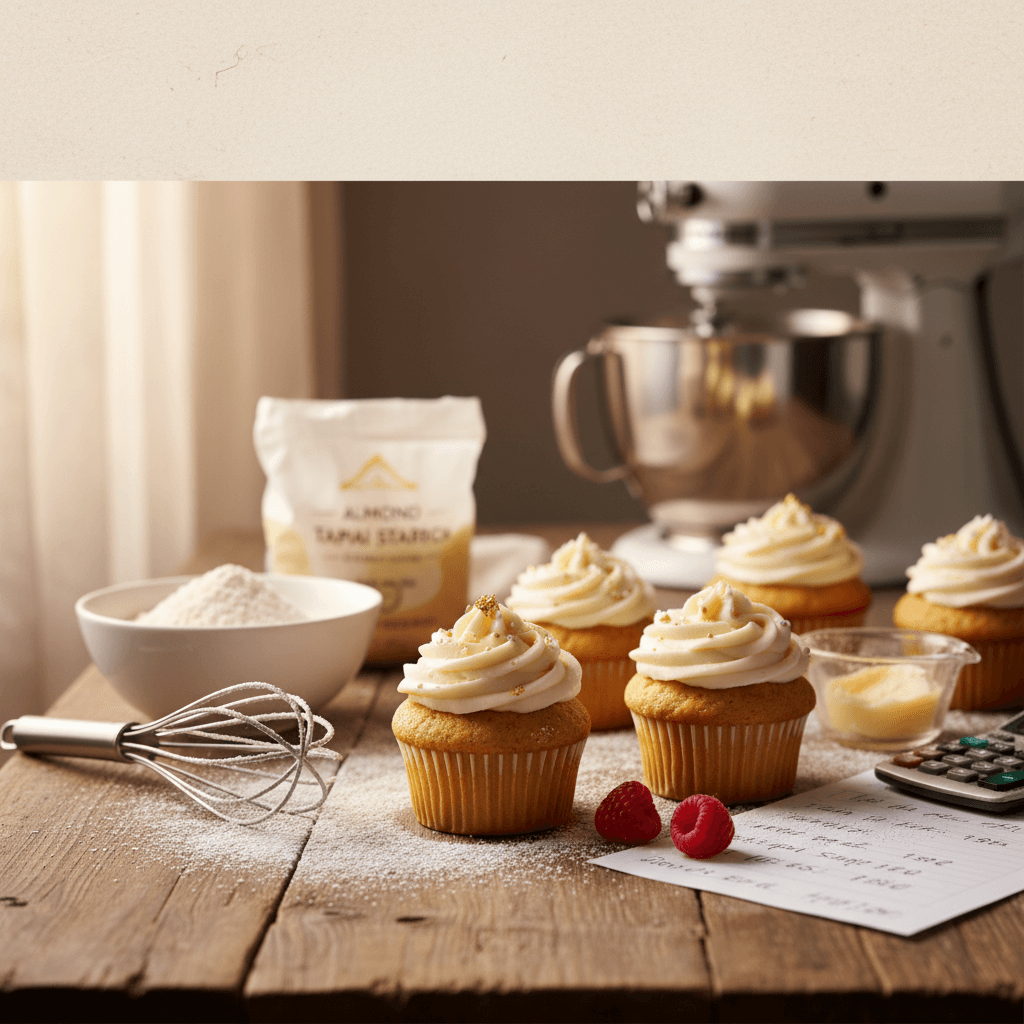
Most home bakers price cupcakes by looking at what other bakers charge on Instagram and picking a number in the middle. That is how you end up making $4.80 an hour after ingredients, packaging, and the three hours you spent piping rosettes at midnight. Here are the actual numbers you need to set cupcake prices that pay you fairly — and keep customers coming back.
Key takeaways
- A standard vanilla cupcake costs $0.78–$1.35 in ingredients depending on whether you use butter or oil, and $0.30–$0.75 in packaging — most bakers forget the packaging line.
- Your labor is the biggest cost. A dozen cupcakes takes 90–120 minutes of active work when you count mixing, baking, cooling, frosting, packaging, and cleanup. Price accordingly.
- The minimum viable price for a basic frosted cupcake from a home bakery is $3.50 each — anything less and you are subsidizing your customers' parties with your free time.
- Custom-decorated cupcakes (fondant toppers, hand-piped details, themed sets) should start at $5.50–$7.00 each, with complex designs running $8.00–$12.00.
- Pricing per dozen is more profitable than pricing per cupcake because it locks in a minimum order size and reduces your per-unit labor cost by 15–25%.
- Your local market ceiling matters, but it is higher than you think — most home bakers underprice by 30–40% relative to what customers will actually pay.
The real cost of a cupcake (not just ingredients)
Ingredient cost is the number every baker calculates first, and it is the least important number in your pricing formula. Here is why: ingredients are typically only 25–35% of what a cupcake should sell for. The rest is labor, overhead, packaging, and profit.
I tracked costs across 14 batches of cupcakes — seven vanilla, four chocolate, three specialty flavors — and here is what the numbers looked like:
| Cost category | Vanilla (per dozen) | Chocolate (per dozen) | Specialty/filled (per dozen) |
|---|---|---|---|
| Ingredients | $4.85 | $5.40 | $7.20–$9.60 |
| Packaging (box, insert, sticker) | $2.10 | $2.10 | $2.50 |
| Labor (90–120 min at $20/hr) | $30.00–$40.00 | $30.00–$40.00 | $40.00–$50.00 |
| Overhead (utilities, gas, supplies) | $2.50 | $2.50 | $3.00 |
| Total cost per dozen | $39.45–$49.45 | $40.00–$50.00 | $52.70–$65.10 |
That labor line is the one that shocks people. But think about it: you are not just piping frosting. You are measuring, mixing, preheating, baking, cooling (that alone is 30–45 minutes you cannot skip), frosting, decorating, packaging, cleaning up, and communicating with the customer. If you would not do all of that for $6 an hour at someone else's bakery, do not accept that rate from yourself.
The overhead line covers things like the extra electricity for running your oven, the parchment paper, the piping bags, the cupcake liners, and the wear on your mixer. It is small per batch but it adds up. I estimate $2.50 per dozen as a floor — some bakers calculate higher depending on their setup.
The pricing formula that actually works
There are multiple frameworks floating around, but after talking to dozens of home bakers and running numbers from cookie pricing and custom cake pricing, this is the one that consistently produces prices people can live with — both the baker and the customer.
Price = (Ingredients + Packaging + Overhead) x 3, then add a labor charge based on your hourly rate.
For a dozen vanilla cupcakes with buttercream:
- Ingredients: $4.85
- Packaging: $2.10
- Overhead: $2.50
- Subtotal: $9.45 x 3 = $28.35
- Labor: 100 minutes at $25/hr = $41.67
- Total: $70.02 per dozen, or $5.84 per cupcake
That might feel high if you have been charging $36 a dozen. It is not high. It is what the work is worth. And here is the contrarian take that most pricing advice will not tell you: the 3x multiplier on materials is not profit — it is your margin of safety for waste, mistakes, and the batches where something goes wrong and you have to rebake. Every experienced baker I know loses 5–10% of their output to cracked domes, sunken centers, or frosting that does not set. That cost has to live somewhere in your price.
What home bakers actually charge (real numbers)
Here is what I have seen from real operators, not what pricing guides wish people charged:
| Cupcake type | Low end (per dozen) | Mid range (per dozen) | Premium (per dozen) |
|---|---|---|---|
| Basic frosted (vanilla, chocolate) | $36 | $42–$48 | $54–$60 |
| Gourmet flavors (salted caramel, lemon lavender) | $42 | $48–$60 | $66–$78 |
| Filled cupcakes | $48 | $54–$66 | $72–$84 |
| Custom decorated (themed toppers, piped details) | $54 | $66–$84 | $90–$120 |
| Mini cupcakes (per two dozen) | $30 | $36–$48 | $54–$60 |
Megan, a cottage baker in Austin, told me she charged $30 a dozen for her first six months and was drowning in orders. She raised her price to $48 a dozen and lost exactly two customers. Her revenue went up 40% and her order volume dropped by 15%, which meant she was working less and making more. That is the pattern I see over and over — raising prices rarely costs you as many customers as you fear.
Your specific number depends on variables that no blog post can decide for you: your city's cost of living, your customer base, your skill level, and whether you are selling at farmers markets, through Instagram, or to repeat clients. A baker in rural Oklahoma and a baker in Brooklyn are operating in completely different economies. But the formula above gives you a defensible floor — do not go below it.
When to price per cupcake vs. per dozen
Price per dozen whenever possible. Here is why: when you quote $4.50 per cupcake, people order four. When you quote $48 per dozen, they order twelve. Your setup time, cleanup time, and communication time are nearly identical whether you bake 4 or 12 cupcakes. The marginal cost of those extra 8 cupcakes is almost entirely ingredients — maybe $3.20 more. But you just collected $30+ more in revenue for an extra 15 minutes of piping.
Set a minimum order of one dozen for standard flavors. If someone wants fewer, charge a small-order fee — I have seen bakers add $8–$12 for orders under a dozen, which effectively prices a half-dozen at $3.50–$4.50 each instead of the per-dozen rate of $4.00. This protects your time without turning away the customer who genuinely just needs six cupcakes for a small birthday.
The exception is farmers markets, where individual cupcake sales are the norm. At a market, price each cupcake at $4.00–$5.50 for standard and $5.50–$7.00 for premium. You will sell more volume at a market than through custom orders, and the per-unit price can be slightly lower because you are batching production and eliminating the back-and-forth communication cost. For more on market-specific pricing, see our farmers market pricing guide.
The 5 variables that change your cupcake price
Pricing is not one number forever. These are the levers that move it up or down, and you should revisit them every quarter.
1. Ingredient quality and cost
Using European-style butter ($5.49/lb) instead of store-brand ($3.29/lb) adds roughly $0.55 per dozen cupcakes to your ingredient cost. Real vanilla extract vs. imitation adds another $0.40–$0.80 per dozen. These are real costs, and they should be reflected in your price. If you are using premium ingredients, say so in your marketing — customers will pay more when they understand why.
2. Decoration complexity
This is where the biggest pricing gaps happen. A simple buttercream swirl takes 20–30 seconds per cupcake. A hand-piped floral design takes 3–5 minutes. Fondant toppers can take 8–12 minutes each if they are custom-shaped and painted. That is the difference between 6 minutes of decorating time per dozen and 2+ hours. Price the time, not just the look.
I recommend tiering your offerings:
- Tier 1 — Simple swirl: base price
- Tier 2 — Piped details, sprinkle designs, two-tone frosting: base + $1.50–$2.50 per cupcake
- Tier 3 — Custom fondant toppers, hand-painted details, themed sets: base + $3.00–$6.00 per cupcake
3. Order size
Larger orders should cost less per cupcake — but not dramatically less. A 2-dozen order might get a 5–8% discount. A 4-dozen order might get 10–12%. Never discount more than 15% even on large orders, because your labor does not scale linearly. Baking 48 cupcakes takes significantly more than 4x the time of baking 12 — you are running multiple oven loads, managing cooling racks, and piping for over an hour straight.
4. Delivery vs. pickup
If you deliver, add a delivery fee. Period. I have seen bakers charge $10–$25 depending on distance, and some charge a flat $15 within a 10-mile radius. The gas, the time, the risk of cupcakes shifting in transit — it all costs money. Do not absorb it. If delivery feels like a hard sell, consider that most customers already pay $5–$10 for DoorDash delivery on a $15 meal. They understand delivery costs.
5. Seasonal and holiday demand
Valentine's Day, Mother's Day, Halloween, and December holidays are peak cupcake season. Your prices should reflect the demand. A 15–20% seasonal surcharge is standard and expected. You are giving up personal time during holidays to bake for other people's celebrations — that has a premium. We cover this in detail in our holiday and seasonal pricing guide.
Why underpricing hurts your business more than losing a customer
Here is the math that changed my perspective on pricing. Let's say you charge $36 a dozen and you are booked solid with 10 orders per week. That is $360 in revenue. Your ingredient and packaging cost is roughly $70. Your labor at those 10 orders is about 20 hours of work. That leaves $290 for 20 hours — $14.50 an hour before you account for overhead, taxes, or the cost of your own equipment.
Now raise your price to $54 a dozen. You lose 3 of those 10 customers. You now have 7 orders, $378 in revenue, $49 in ingredient and packaging costs, and 14 hours of work. That is $329 for 14 hours — $23.50 an hour. You are making more money in less time.
This is the pattern described in our analysis of high-margin baked goods: the most profitable home bakers are not the busiest ones. They are the ones who price correctly and protect their time. If you are already feeling the strain of too many orders, that is a pricing problem, not a capacity problem. Our post on home baker burnout digs into why this matters for your long-term sustainability.
How to present your prices so customers say yes
Pricing is partly math and partly psychology. Here are three tactics that work:
Anchor with your premium option first. When you list your cupcake menu, put the custom-decorated tier at the top. When a customer sees $84/dozen first, $48/dozen for a standard flavor feels reasonable. If you lead with $48, it feels expensive because there is no frame of reference.
Use per-dozen pricing, not per-cupcake. $48 per dozen sounds better than $4.00 each, even though it is the same price. The larger number feels like more value. And it nudges people toward ordering a full dozen instead of asking for six.
Show your work when it matters. For custom orders, a brief explanation goes a long way: "Each of these cupcakes has a hand-piped succulent on top — those take about 4 minutes each to create, which is why the decorated dozen is $72 instead of $48." Most customers respect craftsmanship when you frame it as time and skill, not just cost. Good product photos help enormously here — our guide on photographing baked goods with your phone covers how to make your cupcakes look worth every penny.
A real pricing example: themed cupcakes for a kid's birthday
Let's walk through a real scenario. A customer messages you asking for 24 dinosaur-themed cupcakes for her son's 5th birthday party.
Ingredients (24 cupcakes): Chocolate cupcakes with vanilla buttercream — $10.80
Packaging: Two cupcake boxes with inserts — $5.40
Overhead: $5.00
Decoration: Fondant dinosaur toppers, 7 minutes each = 168 minutes of decorating alone. Plus 90 minutes for baking, cooling, frosting. Total labor: 258 minutes, or 4.3 hours.
Labor at $25/hr: $107.50
Material subtotal x 3: ($10.80 + $5.40 + $5.00) x 3 = $63.60
Total: $63.60 + $107.50 = $171.10
Price quoted: $174 for 24 ($7.25 each)
That is a fair price. If the customer balks, you can offer a simpler decoration tier — buttercream dino prints instead of fondant toppers — which drops the decorating time to about 45 minutes total and brings the price down to roughly $108 for 24 ($4.50 each). Giving the customer two options at different price points almost always results in a sale.
When "it depends" is the honest answer
I want to be direct about this: there is no single correct price for a cupcake. The right price depends on your cost of living, your ingredient sourcing, your speed, your skill level, your customer base, and your business goals. A baker doing 5 orders a week as a side hustle has different needs than a baker doing 25 orders a week as her primary income.
What I can tell you is the floor. Do not sell a basic frosted cupcake for less than $3.50 each. Do not sell a custom-decorated cupcake for less than $5.50 each. Do not accept an hourly rate below $20 for your labor. If your current prices fall below those numbers, it is time to recalculate — and our guide to raising prices can help you do it without losing your customer base.
If you are also selling other products alongside cupcakes, understanding your profit margins across different product lines helps you decide where to focus your energy. Cupcakes are a solid middle-of-the-road product — not the highest margin per hour (that tends to be bread or simple cookies), but they command strong prices and have broad appeal.
Frequently asked questions
How much should I charge for a dozen cupcakes from home?
For basic frosted cupcakes, $42–$54 per dozen is a reasonable range for most home bakers in 2025. Gourmet flavors and filled cupcakes should be $54–$78, and custom-decorated cupcakes with fondant or detailed piping should start at $66 and can go well above $100 per dozen depending on complexity. Your specific price depends on your ingredient costs, local market, and how long decoration takes.
How do I calculate the cost of making cupcakes to sell?
Add up your ingredient cost per batch, packaging cost (boxes, inserts, labels, stickers), a $2–$3 overhead charge for utilities and supplies, and your labor at $20–$30 per hour for all active time including cleanup and customer communication. Most bakers undercount labor — a dozen cupcakes typically takes 90–120 minutes of total work, not the 30 minutes they imagine.
Is selling cupcakes from home profitable?
Yes, if you price correctly. At $48 per dozen with $9.50 in materials and 100 minutes of labor, you are making about $23 per hour. At $36 per dozen with the same costs, you are making about $16 per hour. The difference between a profitable cupcake business and a hobby that costs you money is almost always pricing, not volume. See our business model sustainability diagnostic for a deeper look.
Should I charge more for mini cupcakes?
Per unit, mini cupcakes should cost less than standard — typically $1.75–$3.00 each. But per dozen, they should not be dramatically cheaper because your labor per mini cupcake is nearly the same as a standard one. Frosting 24 minis takes just as long as frosting 24 regulars. Price two dozen minis at 70–80% of what you charge for two dozen standard cupcakes.
How do I handle customers who say my cupcake prices are too high?
First, recognize that price objections usually come from people who are not your target customer. A customer who wants $24 cupcakes from a grocery store is not the same person who values handmade, custom-decorated cupcakes from a home baker. When someone pushes back, offer a simpler decoration tier at a lower price point rather than discounting your existing prices. If you consistently hear objections, it may be a marketing problem — you are attracting the wrong audience. Our post on finding the right customers covers how to reach people who value what you make.

Written by
Co-founder, BakingSubs
Co-founder of BakingSubs, where he turns the science of ingredient substitutions into tested, reliable guidance for home bakers.
Related Posts
Bakery Recipe Cost Sheet: How to Cost a Recipe in 6 Steps (With a Table You Can Copy)
Home Bakery Order Form Template: A Copy-Paste Layout That Cuts Mistakes by Half
Cottage Food Label Requirements and Template: What Every State Demands (With a Copy-Paste Layout)
Bake with Confidence
See all
Confident Gluten-Free Baker Toolkit
The science-based system that replaces gluten's seven invisible jobs so your baking turns out soft, fluffy, and foolproof — every time.

Gluten-Free Recipe Vault
Instant access to our complete library of proven gluten-free recipes — no waiting, no guesswork, just results that work tonight.

Fix Your Gluten-Free Bread
Learn the 3-step formula to make bread rise and stay soft, discover why your loaves collapse, and get a tested sandwich bread recipe that actually works.