

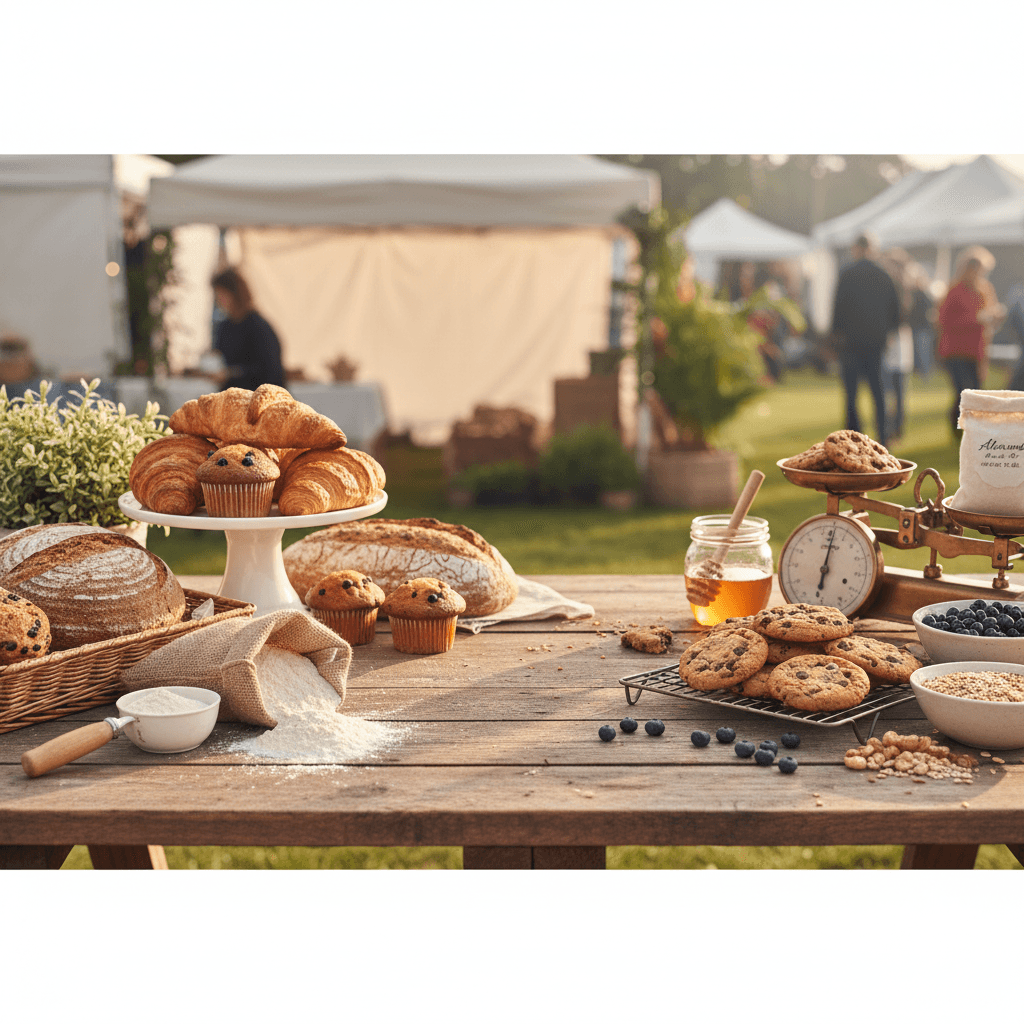
Your first farmers market booth will either become your most profitable weekly sales channel or a money pit that eats your Saturday mornings. The difference comes down to decisions you make before you ever load the car. Here's the operator-level breakdown of what actually matters, what costs what, and where most home bakers get it wrong.
Key takeaways
- A basic farmers market booth setup runs $340–$780 upfront depending on whether you buy new or secondhand, plus $25–$75 per week in booth fees.
- Your product mix matters more than your display — bakers who sell 3–5 items with clear price points outsell those with 12+ scattered options.
- You need to hit roughly $350–$500 in weekly sales to make a Saturday market worth your time after costs.
- Packaging and signage account for roughly 8–12% of your per-item cost, and skimping here kills perceived value.
- The first 3 markets are a loss leader — treat them as paid market research, not profit centers.
What it actually costs to set up a farmers market booth
The biggest mistake I see home bakers make is underestimating startup costs and then feeling underwater by week three. Here's what a real booth setup costs in 2025, broken into tiers.
| Item | Budget option | Mid-range option |
|---|---|---|
| 10x10 canopy tent | $89 (basic pop-up) | $189 (commercial-grade) |
| Folding table (6ft) | $42 (used) | $65 (new) |
| Tablecloth + risers | $25 | $55 |
| Signage (banner + price cards) | $35 (DIY printed) | $120 (vinyl banner + stands) |
| Packaging (first 2 weeks' supply) | $40 | $85 |
| Cash box + card reader | $18 (Square reader is free; cash box $18) | $45 (with tip jar setup) |
| Weights/sandbags for tent | $20 | $40 |
| Cooler (if needed) | $30 | $65 |
| Total | $299–$340 | $664–$780 |
Then add recurring costs: booth fees range from $25 per week at a small neighborhood market to $75+ at a high-traffic urban market. Some markets charge a flat seasonal fee — I've seen $400–$600 for a 20-week season, which works out cheaper per week but requires commitment upfront.
Marissa, a home baker in Portland, told me she spent $520 on her initial setup and made $187 her first Saturday. She didn't break even on her booth investment until week five. That's normal. If you're expecting profit on day one, you're setting yourself up for disappointment.
How to choose the right farmers market (not all markets are equal)
Picking the wrong market is the single fastest way to waste an entire season. The variables that actually matter:
Foot traffic vs. vendor count. A market with 2,000 weekly visitors and 80 vendors gives you a worse ratio than one with 800 visitors and 25 vendors. Ask the market manager for average attendance numbers — good ones track this.
Existing baked goods vendors. Visit the market as a customer first. Count how many bakers are already there. Two other bread vendors at a 40-vendor market is fine. Two other bread vendors at a 15-vendor market means you need a differentiated product or you'll split sales three ways.
Customer demographics. A market in a college neighborhood sells $3 cookies and $5 muffins. A market in an affluent suburb sells $8 scone boxes and $28 specialty loaves. Your niche and product line need to match the crowd that actually shows up.
Time slot and day. Saturday morning markets (8am–1pm) generally pull the highest traffic. Wednesday evening markets can work but tend to attract grab-and-go buyers spending less per transaction. If you're running your bakery while working full time, a weekday evening or Sunday market might be your only option — just set revenue expectations accordingly.
The application process
Most markets require an application 2–6 months before the season starts. Many have waitlists. Here's what you'll typically need:
- Cottage food license or home bakery permit (requirements vary by state)
- Proof of liability insurance ($200–$400/year for a basic policy — some markets require $1M coverage)
- Product list with ingredients
- Photos of your products and setup
- A food handler's certificate (often $15–$25 online)
Apply to 2–3 markets even if you only plan to do one. Waitlists are real, and having options gives you leverage.
What to sell at a farmers market (the product mix that actually moves)
Here's a contrarian take: selling more variety almost always hurts you at markets. I've watched bakers with 15 items on their table get outsold by the person next to them offering 4 things.
Why? Decision fatigue. A customer standing at your table for 8 seconds needs to understand what you sell and what it costs. The baker with "Sourdough Loaf — $9 / Cinnamon Rolls (4-pack) — $14 / Chocolate Chip Cookies (6-pack) — $12" closes faster than the baker with a cluttered table of 14 items at 9 different price points.
The sweet spot is 3–5 core items with one rotating seasonal special. Structure your pricing around these tiers:
- Impulse buy: $3–$5 (single cookie, muffin, brownie). This is your traffic driver — people buy one to try, then come back next week for more.
- Anchor item: $8–$14 (bread loaf, 4-pack of rolls, cookie box). This is where your volume revenue comes from.
- Premium item: $18–$28 (specialty cake, large cookie platter, gift box). You won't sell many, but the margin is strong and it elevates your perceived quality.
Marcus, a home baker in Austin, stripped his market menu from 11 items down to 5 after his fourth week. His weekly revenue went from $290 to $410 — same market, same spot, same hours. Fewer choices meant faster transactions and less leftover inventory.
If you're still figuring out how to price your cookies or struggling with undercharging, sort that out before your first market. Farmers market customers are more price-tolerant than you think — they're already paying $6 for a jar of honey and $8 for a pint of berries.
Booth layout and display that drives sales
Your booth is a 10x10-foot retail store. Treat it like one. The layout decisions that matter most:
Height variation. A flat table with everything at the same level looks like a garage sale. Use wooden crates, cake stands, or tiered risers to create 3 levels of display. Your eye-level items sell best — put your anchor product there.
Signage you can read from 15 feet away. Most bakers make signs that are readable from 3 feet. By then, the customer has already walked past. Your main banner should communicate three things at a glance: your name, what you sell ("Artisan Bread" or "Handmade Cookies"), and that it's homemade/local. Price cards should use 48pt+ font minimum.
Samples convert. If your market and local regulations allow it, offering bite-sized samples increases sales by roughly 25–40% in my experience. Cut a cookie into sixths, put them on a tray with toothpicks, and watch people buy the full-size version. The cost of one sacrificed cookie ($0.45 in ingredients) pays for itself many times over.
Flow matters. Stand to one side of your table, not behind the center. This opens up the space and makes your booth feel approachable rather than like a counter with a gatekeeper. Keep your cash box and card reader at one end so there's a natural checkout flow.
The packaging question
Packaging is where a lot of bakers either overspend or underspend. Here's the framework:
Your packaging cost should run 8–12% of the item's selling price. For a $12 cookie box, that's $0.96–$1.44 on the box, sticker, and any tissue paper. For a $9 bread loaf, that's $0.72–$1.08 on the bag and label.
Kraft paper bags with a branded sticker are the sweet spot for most market bakers. A roll of 100 kraft bags runs about $12, and 100 branded stickers from an online printer cost $18–$30. That's $0.30–$0.42 per unit — well within budget for items priced $5+.
Clear cellophane bags work well for cookies because customers can see the product. Bread does better in paper bags because it signals artisan quality and prevents condensation.
How much you need to sell to make a farmers market worth it
This is the math most bakers skip. Here's a real example:
Say your booth fee is $40/week. You spend 3 hours at the market, plus 1 hour loading and unloading, plus 5 hours of baking and prep the day before. That's 9 hours of your time. Add $65 in ingredient costs for what you bring.
Your total cost for that Saturday: $40 (booth) + $65 (ingredients) + $12 (packaging) + $8 (gas) = $125 in hard costs.
If you want to pay yourself $25/hour for 9 hours, that's $225 in labor. So you need to gross at least $350 to break even, and $500+ to feel like it's actually worth it.
At an average transaction of $11 (which is realistic for a mix of impulse buys and anchor items), $350 means 32 transactions. $500 means 46 transactions. Over a 4–5 hour market, that's 6–12 sales per hour — very doable at a decent market, but a stretch at a slow one.
If the math doesn't work, the market isn't the right one — or your price points are too low. This is the same sustainability diagnostic that applies to every sales channel in your business.
What to do the night before and morning of market day
Your prep timeline determines whether market day is smooth or chaotic. Here's what works:
Two days before: Confirm your product quantities. Bake anything that holds well (cookies, brownies, bars). Print any new price signs. Check your change — you want at least $40 in small bills and coins.
Night before: Bake anything that needs to be fresh (bread, pastries). Package everything. Load the car with non-perishables (tent, table, signage, cash box). Set out your clothes and an alarm.
Morning of: Load perishables. Arrive 45–60 minutes before the market opens. Set up your tent first (get help — a 10x10 canopy in wind is a two-person job), then table, then display, then products last.
Bring more product than you think you'll sell for the first 3 weeks. Running out at 11am when the market runs until 1pm means you're leaving money on the table. After 3 weeks, you'll have data to calibrate quantities.
If you're batch baking for volume, your market prep fits naturally into your weekly production schedule. The key is treating it as a production run, not a one-off scramble.
How to turn market customers into repeat buyers
The farmers market is a customer acquisition channel, not just a point of sale. The real money is in what happens after someone buys from you the first time.
Collect emails or phone numbers. A simple clipboard with "Join our weekly menu list" converts surprisingly well. Offer a small incentive — "Sign up and get $1 off today" works. Even 5 signups per market gives you 100+ contacts over a season. Then use email marketing to turn those contacts into weekly custom orders.
Hand out business cards or flyers with every purchase. Include your Instagram handle, website, and how to place custom orders. A $0.05 business card that converts one $45 custom cake order has an absurd ROI.
Create a "market regular" incentive. A simple punch card (buy 5 loaves, get the 6th half off) brings people back. It doesn't need to be fancy — a hand-stamped card works fine. This is a low-tech version of the same referral and retention strategy that works for all home bakery channels.
Talk to people. This sounds obvious, but many bakers hide behind their table. The person who asks about your sourdough process and gets a 30-second genuine answer becomes a loyal customer. The person who gets a nod and a "thanks" might not come back.
Common farmers market mistakes that cost you money
After watching dozens of home bakers at markets over the years, these are the patterns that separate the ones who thrive from the ones who quit after one season:
Bringing too much variety and not enough volume of your best sellers. You don't need 12 items. You need 60 units of the 4 things people actually want.
Pricing too low because "it's just a market." Farmers market customers expect to pay more than grocery store prices. That's the whole point. If your sourdough is $6 and the grocery store charges $5.49, you've undercut yourself. Charge $9–$11 and own the quality difference.
No shade or weather plan. Your frosted items will melt at 85 degrees. Your tent will blow away in 20mph gusts without sandbag weights. Bring a backup tarp, extra weights, and keep chocolate/cream items in a cooler until displayed.
Ignoring the slow first weeks. Your first 3 markets will be your worst. People don't know you yet. They need to see you consistently before they trust you enough to buy. Bakers who quit after 2 slow weeks miss the payoff that starts around week 5–6.
Not tracking numbers. After every market, write down: total revenue, number of transactions, what sold out first, what you brought home, and weather/foot traffic notes. After 6 weeks, this data tells you exactly what to bake, how much to bring, and whether this market is worth continuing. If your orders aren't consistent, this data is how you diagnose why.
When a farmers market isn't worth it (and what to do instead)
Farmers markets aren't universally the right move. They're a bad fit if:
- Your products require refrigeration and your market doesn't allow coolers or has strict temp rules
- The only available market has fewer than 300 weekly visitors
- You can't commit to at least 8 consecutive weeks (consistency is everything at markets)
- Your product line is entirely custom/made-to-order with no grab-and-go options
- The booth fee exceeds 15% of your realistic weekly revenue
If the market math doesn't pencil out, consider alternatives: corporate orders, a Google Business Profile that drives local pickup orders, or diversifying beyond social media into channels that don't require you to stand outside for 5 hours every Saturday.
But if the numbers work and you enjoy the face-to-face selling, a farmers market can become a $400–$800/week revenue stream that also feeds your custom order pipeline. The bakers who treat it as a real sales channel — not a hobby outing — are the ones who make it work.
Frequently asked questions
How much does a farmers market booth cost per week?
Booth fees typically range from $25 to $75 per week depending on the market's size and location. Some markets offer seasonal rates of $400–$600 for a full 20-week season, which works out to $20–$30 per week. Urban markets with high foot traffic charge more, while smaller neighborhood markets are on the lower end.
How much money can you make selling baked goods at a farmers market?
Most established home bakers gross $300–$800 per market day, with $400–$500 being a common range at mid-sized markets after the first few weeks. Your net profit depends on ingredient costs (typically 25–35% of revenue), booth fees, packaging, and how you value your time. A baker selling $11 average transactions needs about 32–46 sales to hit $350–$500.
What sells best at a farmers market bakery booth?
Bread (especially sourdough), cookies in multi-packs, cinnamon rolls, and seasonal items like pumpkin bread or berry scones consistently perform well. Single-serve impulse items in the $3–$5 range drive foot traffic to your booth, while $8–$14 multi-packs generate the bulk of your revenue. Keep your menu to 3–5 core items rather than spreading across a dozen options.
Do I need a license to sell baked goods at a farmers market?
In most U.S. states, yes — you'll need at minimum a cottage food license or home bakery permit. Requirements vary significantly by state and sometimes by county. Many markets also require proof of liability insurance ($1M coverage is common), a food handler's certificate, and a complete ingredient list for every product. Check your state's cottage food laws and the specific market's vendor requirements before applying.
How do I get customers to come back to my farmers market booth every week?
Collect email addresses or phone numbers at every market using a simple signup sheet with a small incentive like $1 off their purchase. Hand out business cards with every sale. Use a punch card loyalty program to reward repeat visits. Most importantly, show up consistently — customers need to see you 3–4 weeks in a row before they build the habit of stopping at your booth. Then use your email list to notify them about seasonal specials and pre-orders.

Written by
Co-founder, BakingSubs
Co-founder of BakingSubs, where he turns the science of ingredient substitutions into tested, reliable guidance for home bakers.
Related Posts
Bakery Recipe Cost Sheet: How to Cost a Recipe in 6 Steps (With a Table You Can Copy)
Home Bakery Order Form Template: A Copy-Paste Layout That Cuts Mistakes by Half
Cottage Food Label Requirements and Template: What Every State Demands (With a Copy-Paste Layout)
Bake with Confidence
See all
Confident Gluten-Free Baker Toolkit
The science-based system that replaces gluten's seven invisible jobs so your baking turns out soft, fluffy, and foolproof — every time.

Gluten-Free Recipe Vault
Instant access to our complete library of proven gluten-free recipes — no waiting, no guesswork, just results that work tonight.

Fix Your Gluten-Free Bread
Learn the 3-step formula to make bread rise and stay soft, discover why your loaves collapse, and get a tested sandwich bread recipe that actually works.