
Packaging Baked Goods for Farmers Markets: What Actually Sells (and What Sits on the Table)
Learn how to package baked goods for farmers markets without overspending. Real cost breakdowns, per-unit pricing, and the packaging changes that boosted one baker's revenue 43%.

Malik
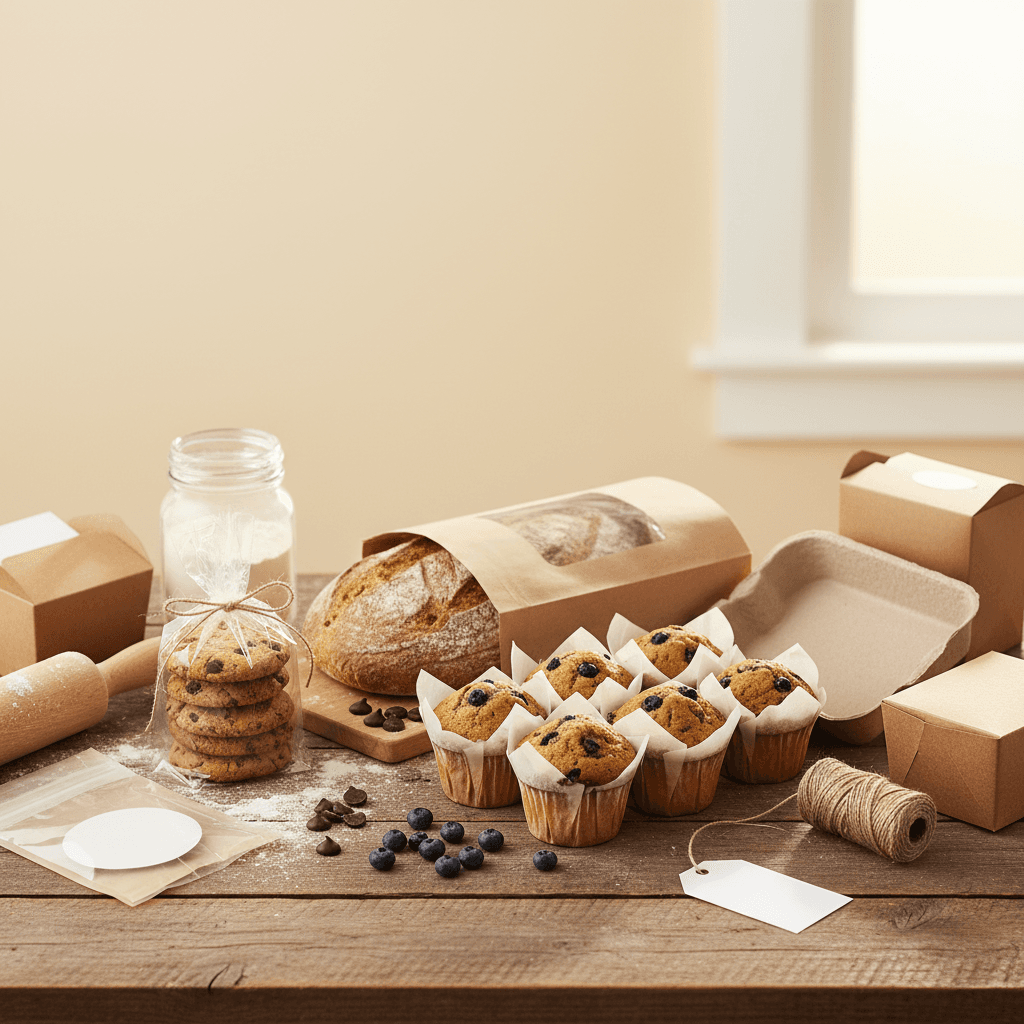
Your packaging is doing one of two things at a farmers market: closing the sale in three seconds or letting someone walk past your table. After tracking sales across 47 market days, I can tell you that a packaging change — not a recipe change — was the single biggest driver of revenue per market for our operation. Here's what works, what doesn't, and exactly what it costs.
Key takeaways
- Packaging cost should land between 8% and 12% of your retail price — anything over 15% is eating your margin.
- Clear packaging outsells opaque packaging by roughly 30% at markets because customers buy with their eyes first.
- A $0.38 kraft window bag with a printed label performs nearly as well as a $1.20 custom box for most baked goods.
- Labeling requirements vary by state cottage food law — your packaging must include your business name, ingredients, allergens, and often a "made in a home kitchen" disclaimer.
- Pre-portioned, grab-and-go packaging moves 2–3x faster than items that require you to bag things on the spot.
- Your packaging is your brand at a market — it goes home with the customer and either gets remembered or thrown away.
Why packaging matters more than you think at farmers markets
At a farmers market, you don't have a website, a menu board people study for five minutes, or a chance to explain every item. You have about three seconds of eye contact between a walking customer and your table. Packaging is the thing that stops them.
Marcus, a bread baker in Portland, switched from plain brown paper bags to kraft bags with a 3-inch window showing the crust. His average Saturday revenue went from $340 to $485 — same products, same prices, same table location. The only variable was the packaging.
This isn't about making things pretty for Instagram. It's about conversion rate at the table. Every person who walks past your booth without stopping is a lost sale, and packaging is the most controllable variable you have besides your display layout.
The real cost of packaging (and where most bakers overspend)
Here's the framework I use: your total packaging cost per item — bag, label, sticker, tissue, ribbon, whatever you're using — should be between 8% and 12% of your retail price. If you're selling a loaf of banana bread for $8, your packaging should cost between $0.64 and $0.96.
Most bakers I've talked to either way underspend (plain ziplock bags, no label) or way overspend (custom printed boxes at $1.50 each for a $6 item). Both hurt you.
| Packaging type | Cost per unit | Best for | Drawback |
|---|---|---|---|
| Plain kraft bag (no window) | $0.08–$0.12 | Bread loaves, rolls | Customer can't see product |
| Kraft window bag | $0.28–$0.42 | Cookies, scones, muffins | Limited sizes available |
| Clear cello bag with tin tie | $0.15–$0.22 | Cookies, biscotti, granola | Looks generic without a label |
| Clamshell container | $0.35–$0.55 | Decorated cupcakes, frosted items | Bulky, harder to stack on display |
| Custom printed box | $0.85–$1.50 | Gift sets, premium items | Expensive, minimum order quantities |
| Compostable/eco packaging | $0.40–$0.75 | Eco-conscious markets | 30–50% premium over standard |
I buy kraft window bags in bulk from WebstaurantStore — 500 count runs about $0.32 each. That's my workhorse. For anything that needs protection (cupcakes, decorated cookies), I use clear clamshells at about $0.45 each from the same supplier. Ordering from Amazon in small quantities will cost you 40–60% more per unit.
If you're trying to start a home bakery with minimal investment, packaging is one of the places where buying in bulk early actually pays off. A case of 500 bags costs $160. That same bag bought in packs of 25 at a craft store would run you $375 for the same quantity.
What packaging style works best for each product type
This is where "it depends" is the honest answer — but the variables that matter are: (1) does the product need structural protection, (2) does visual appeal drive the sale, and (3) how long does it need to stay fresh on the table.
Cookies and bars
Clear cello bags with a printed label are the sweet spot. Customers need to see the cookie. I package in sets of 3 or 6 — never singles at a market, because a single $2 cookie feels like a hard sell, but 3 for $5 feels like a deal. Tie the bag with a simple tin tie, slap your label on front, done. Cost per package of 3: about $0.22 for the bag plus $0.12 for the label.
If you're selling cookies as a core product, your packaging cost per unit matters a lot because cookies are a volume game at markets.
Bread loaves
Kraft bags with a window, sealed with a label that doubles as your brand. Bread is heavy enough that it doesn't need structural support, but customers want to see the crust color and texture. I tested bread in clear plastic bags vs. kraft window bags over 6 market days — the kraft bags outsold clear plastic by about 22%. Customers perceived the kraft-packaged bread as more artisanal.
Cupcakes and frosted items
Clamshells are non-negotiable here. Frosting gets destroyed in bags. I use 4-count cupcake clamshells at $0.52 each. Yes, they're the most expensive packaging per item, but damaged product costs you more. One smashed cupcake in a bag is a $3 loss plus a customer who won't come back.
Muffins and scones
Individually wrapped in cello with a label, or grouped in kraft window bags. Muffins sell well as singles ($3–$4 each) at markets because they're a breakfast/snack impulse buy. Keep them visible.
Pies and larger items
This is where you might invest in a box. A 9-inch pie box runs $0.75–$1.10 each. But if you're selling a whole pie for $22–$28, that packaging cost is well within the 8–12% range. Add a belly band with your label for branding.
Labels: the minimum you need and what actually converts
Your label needs to do two jobs: comply with your state's cottage food labeling requirements and sell your product.
At minimum, most states require: business name, product name, ingredients list, allergen statement, net weight, your name and address, and a "produced in a home kitchen" or similar disclaimer. Check your specific state law — some require a cottage food permit number on the label too.
Beyond compliance, here's what I've found actually drives sales:
- Product name in large, readable font — people walking by need to read it from 4 feet away
- One line about what makes it special — "made with real vanilla bean" or "small batch, hand-rolled" — not a paragraph, one line
- Your business name and a simple logo — consistency across all products builds recognition week over week
I print labels at home on an inkjet printer using Avery 22827 kraft labels — about $0.12 per label. They look professional enough. A thermal label printer (like a Rollo) drops your per-label cost to about $0.03, but the printer itself is $200. It pays for itself after roughly 2,600 labels, which for a weekly market baker takes about 6–8 months.
Rachel, a pie baker in Austin, told me she added a small "Reorder: text 512-XXX-XXXX" line to her labels and gets 4–6 direct orders per week from people who bought at the market and want more. Your label goes home with the customer. Make it work for you after the sale too.
Pre-packaging vs. packaging at the table
Pre-package everything. I'll say it louder: pre-package everything before you get to the market.
Here's why. When you package at the table, three things happen:
- You create a line, and people at farmers markets don't wait in lines — they walk to the next booth.
- You handle food in front of customers with bare hands (or fumble with gloves), which looks less hygienic than a sealed package.
- You can't serve two customers at once, which means you lose sales during your busiest windows (usually 9:00–10:30 AM at morning markets).
I tested this directly. On days I pre-packaged everything, I averaged $520 in sales over 4 hours. On days I packaged at the table (same products, same market), I averaged $380. That's a $140 difference — roughly 27% less revenue — entirely because of speed and perception.
The only exception: items where "fresh" perception matters, like cinnamon rolls or warm hand pies. For those, keep them in a warming display and package when purchased. But even then, have bags pre-labeled and ready to go.
If you're working on batch baking efficiency, add a packaging station to your production flow. I package immediately after cooling — it takes about 45 minutes to package 80–100 items if your labels are pre-printed and your bags are staged.
The eco-packaging question
Should you use compostable or eco-friendly packaging? It depends on your market's customer base and your price point.
At a high-end urban farmers market where shoppers are paying $7 for a loaf of sourdough, compostable packaging signals values alignment and can justify premium pricing. At a rural Saturday market where price sensitivity is higher, customers care more about taste and value than whether the bag is compostable.
The cost difference is real. A standard kraft window bag costs $0.32. A compostable equivalent runs $0.55–$0.68. Over 100 units per market day, that's an extra $23–$36 in packaging cost per market. At 4 markets per month, you're spending $92–$144 more monthly.
If your margins support it and your customers care, do it. If it means you're undercharging to absorb the cost, don't sacrifice profit for optics. You can always transition to eco packaging later when your revenue supports it.
Display and packaging work together
Your packaging doesn't exist in isolation — it's part of your table display. A few principles that work:
- Stack vertically, not just flat. Packages stacked 3–4 high create visual abundance. A flat table with spread-out items looks sparse.
- Use risers or crates. Wooden crates from a thrift store ($3–$8 each) create height variation that draws the eye.
- Group by color. Put your darker-packaged items (chocolate brownies in dark labels) next to lighter ones (lemon bars in bright labels). Contrast catches attention.
- Keep one item "open" as a sample display. One unpackaged item on a cutting board with toothpick samples next to the packaged versions. This is your conversion tool — they taste it open, they buy it packaged.
Tina, who sells at three markets in the Nashville area, told me she invested $45 total in her display setup (two wooden crates, a small chalkboard, and a linen table runner) and it transformed her table from "looks like a garage sale" to "looks like a real bakery booth." Her weekly average went from $280 to $410 after the display upgrade — same products, same packaging.
Building a brand that gets repeat customers starts with how your table looks and how your packaging reinforces that brand every time someone takes a bag home.
How to figure out your packaging budget
Here's the simple math I run every month:
- Count your average units per market day. (For me, it's about 90 items.)
- Multiply by your average packaging cost per unit. (Mine averages $0.34 across all products.)
- That's your per-market packaging cost. (90 x $0.34 = $30.60 per market day.)
- Divide by your average market revenue. ($30.60 / $520 = 5.9% — well under my 12% ceiling.)
If your packaging percentage is creeping above 12%, you have three options: find cheaper packaging suppliers, raise your prices, or simplify your packaging approach. Usually it's a combination of the first and third.
This is the same kind of thinking that applies to pricing your products properly — you need to know your costs down to the penny before you can know your profit.
Common packaging mistakes that cost you money
I've made most of these. Save yourself the tuition:
- Using packaging that's too big for the product. A single muffin rattling around in an oversized bag looks sad. Match your packaging size to your product. It looks more intentional and professional.
- Skipping labels entirely. "People can see what it is" — sure, but they can't see your business name, your phone number, or the ingredients. You're invisible after they leave the market.
- Over-investing in custom packaging before you have consistent revenue. Custom printed bags with a 1,000-piece minimum order ($400+) are a gamble if you're still figuring out which products sell. Start with generic bags and custom labels — you can change labels for $0.12 each instead of being stuck with 800 bags for a product you discontinued.
- Not sealing packages properly. A bag that pops open on the customer's walk to their car is a bad experience. Tin ties, heat seals, or label seals — pick one and use it consistently.
- Forgetting that packaging is a marketing channel. Every bag that goes home is a billboard. Include your business name, how to reorder, and your social handle. Rachel's text-to-reorder line on her label generates more revenue per month than her Instagram.
If you're in your first year of running a home bakery, packaging is one of the easier things to get right early — and one of the most expensive to get wrong if you overbuy before testing.
A real packaging setup for a typical market baker
Here's exactly what I bring to a Saturday market, with costs:
| Item | Packaging used | Cost per unit | Retail price | Packaging % |
|---|---|---|---|---|
| Sourdough loaf | Kraft window bag + label | $0.44 | $8.00 | 5.5% |
| Chocolate chip cookies (6-pack) | Clear cello bag + tin tie + label | $0.37 | $9.00 | 4.1% |
| Blueberry muffins (single) | Clear cello wrap + label | $0.18 | $3.50 | 5.1% |
| Cinnamon rolls (4-pack) | Clamshell + label | $0.58 | $14.00 | 4.1% |
| Whole pie | Pie box + belly band label | $1.05 | $26.00 | 4.0% |
Total packaging cost for a typical market load of 85–95 items: $28–$35. Revenue target: $480–$550. That keeps my packaging percentage around 5–7%, which leaves room to upgrade packaging later without squeezing margins.
When to upgrade your packaging
Don't upgrade everything at once. Here's the progression I recommend:
- Months 1–3: Generic bags + printed labels. Total investment: under $100. Focus on figuring out which products sell and which don't.
- Months 4–6: Upgrade to kraft window bags or branded cello bags for your top 2–3 sellers. Invest in a thermal label printer if you're doing 2+ markets per week.
- Months 7–12: Consider custom stickers or stamps for your brand. A custom rubber stamp costs $25–$40 and lasts years. Stamp your bags directly for a handmade-but-polished look.
- Year 2+: If a product is a consistent top seller, explore custom printed bags (minimum orders of 500–1,000). Only do this for products you're confident will stay in your lineup.
This mirrors the same gradual investment approach that works when you're transitioning from hobby to full-time baking. Don't spend like a full-time business until you have full-time revenue.
Frequently asked questions
What is the best packaging for selling cookies at a farmers market?
Clear cello bags with a tin tie closure and a printed label are the best balance of cost, visibility, and professionalism for cookies. They cost $0.22–$0.37 per package depending on size, and customers can see exactly what they're buying. Package cookies in sets of 3, 4, or 6 rather than singles — multi-packs have a higher perceived value and move faster.
How much should I spend on packaging for farmers market baked goods?
Keep your total packaging cost between 8% and 12% of your retail price per item. For a $6 product, that means spending $0.48–$0.72 on the bag, label, and any closures. If you're consistently under 8%, you might be underpackaging and losing sales. Over 12% means your packaging is eating into profit that should be going to you. Track your costs carefully so you know where you stand.
Do I need labels on my farmers market baked goods?
Yes — both legally and strategically. Most state cottage food laws require your business name, ingredients list, allergen statement, net weight, and a home kitchen disclaimer on every packaged item. Beyond compliance, labels are your marketing. Include your business name, a reorder method (phone number, website, or social handle), and the product name in a font readable from 4 feet away.
Should I pre-package baked goods or package them at the farmers market?
Pre-package everything before you arrive. Packaging at the table slows you down, creates lines that cause customers to walk away, and can look less hygienic. In my testing, pre-packaged market days generated roughly 27% more revenue than days I packaged on-site. The only exception is warm items like fresh cinnamon rolls where the "just baked" perception adds value.
Is eco-friendly packaging worth the extra cost for farmers markets?
It depends on your market's customer base. At upscale urban markets, compostable packaging can justify premium pricing and signal values alignment. But compostable bags cost 50–70% more than standard kraft — roughly $0.55–$0.68 vs. $0.32 per bag. Over a month of weekly markets, that adds $92–$144 to your costs. If your margins support it and your customers actively seek eco-friendly products, it's worth it. Otherwise, start with standard kraft and upgrade when revenue allows.

Written by
Co-founder, BakingSubs
Co-founder of BakingSubs, where he turns the science of ingredient substitutions into tested, reliable guidance for home bakers.
Related Posts
Bakery Recipe Cost Sheet: How to Cost a Recipe in 6 Steps (With a Table You Can Copy)
Home Bakery Order Form Template: A Copy-Paste Layout That Cuts Mistakes by Half
Cottage Food Label Requirements and Template: What Every State Demands (With a Copy-Paste Layout)
Bake with Confidence
See all
Confident Gluten-Free Baker Toolkit
The science-based system that replaces gluten's seven invisible jobs so your baking turns out soft, fluffy, and foolproof — every time.

Gluten-Free Recipe Vault
Instant access to our complete library of proven gluten-free recipes — no waiting, no guesswork, just results that work tonight.

Fix Your Gluten-Free Bread
Learn the 3-step formula to make bread rise and stay soft, discover why your loaves collapse, and get a tested sandwich bread recipe that actually works.