

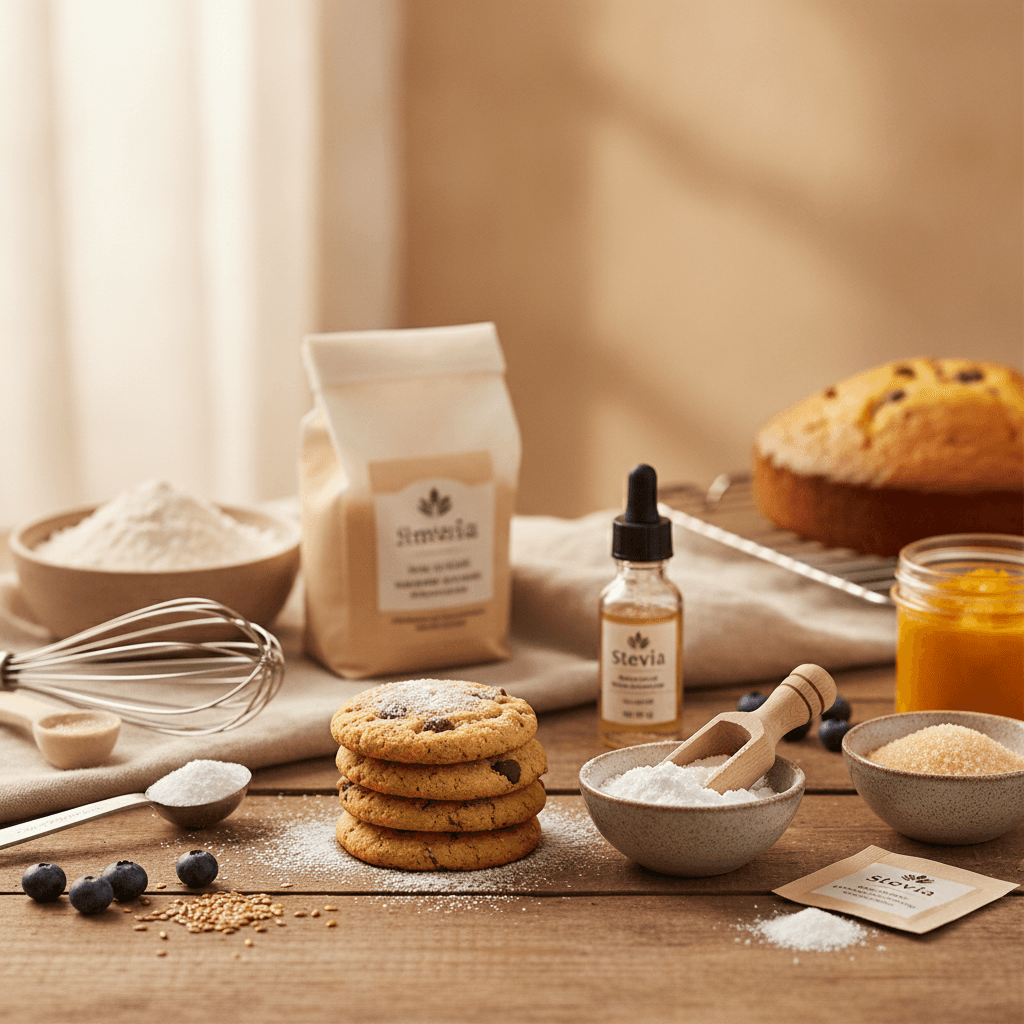
Stevia is roughly 200–300 times sweeter than granulated sugar, which means a tiny miscalculation can turn a cake into something inedibly bitter or leave it flat and dense because you just removed most of the dry bulk. Below are the conversion ratios, the texture traps, and the substitute options that actually keep baked goods intact.
Key takeaways
- Pure stevia extract replaces sugar's sweetness at roughly 1 teaspoon per 1 cup of sugar, but it cannot replace sugar's structural roles — browning, moisture retention, and bulk.
- Stevia-based baking blends (like Truvia Cane Sugar Blend or SweetLeaf SugarLeaf) are formulated to measure closer to 1:1 with sugar, making them far easier to work with than pure extract.
- Removing a full cup of sugar from a recipe without adding a bulking agent back can reduce batter volume by 30–40%, causing dense, dry results.
- Erythritol, monk fruit blends, and allulose are the three most common stevia alternatives for baking, each with different moisture and browning behavior.
- Gluten-free batters are especially sensitive to sweetener swaps because they already lack the structural network that gluten provides.
Why stevia baking conversions are tricky
Sugar does far more in baking than make things sweet. It feeds yeast, creates tenderness by interfering with gluten or starch networks, retains moisture, and drives Maillard browning. Stevia does exactly one of those things: it adds sweetness. That gap is the source of nearly every failed stevia bake. For a deeper look at what sugar actually does in a recipe, the sugar functions guide breaks it down role by role.
The other complication is concentration. A single cup of granulated sugar weighs about 200g. The equivalent sweetness from pure stevia extract might weigh under 1g. That means your recipe just lost almost a full cup of dry volume with nothing to replace it. The batter changes, the rise changes, and the final crumb changes — sometimes dramatically.
Stevia baking conversion chart by form
Stevia comes in several forms, and each one converts differently. This is where most bakers get confused, because "stevia" on a label can mean pure extract, a blend with erythritol, or a liquid concentrate.
| Stevia form | Approximate equivalent to 1 cup granulated sugar | Notes |
|---|---|---|
| Pure stevia extract powder | 1 teaspoon | Extremely concentrated; bitter if over-measured by even a fraction |
| Liquid stevia concentrate | 1 teaspoon (roughly 40 drops, varies by brand) | No bulk; best for custards, sauces, and drinks rather than structured bakes |
| Stevia + erythritol blend (e.g., Truvia) | ~1/3 cup (check brand label) | Provides some bulk but still less than sugar; may crystallize on cooling |
| Stevia baking blend (e.g., Truvia Cane Sugar Blend) | 1/2 cup | Designed for baking; contains real sugar to help with browning and structure |
| Stevia + sugar 1:1 packets (e.g., SweetLeaf SugarLeaf) | 1 cup | Easiest swap but still contains significant sugar/filler calories |
A critical detail: these ratios are approximate because brand formulations differ. Truvia's stevia-erythritol blend and Pyure's stevia-erythritol blend do not measure identically cup-for-cup. Always check the specific conversion on the package you're holding.
How to replace sugar's bulk when using pure stevia
If you're using pure stevia extract — the kind where 1 teaspoon replaces a full cup of sugar — you need a bulking agent to fill that missing volume. Without it, the batter will be too wet relative to its dry ingredients, or too thin, or both. Here are the most common approaches:
Erythritol as a bulking agent
Erythritol is a sugar alcohol that measures roughly 1:1 with sugar by volume, has about 70% of sugar's sweetness, and contributes almost zero net calories. Combined with stevia for the sweetness gap, it's one of the most popular pairings. The catch: erythritol doesn't caramelize, so you won't get the same golden-brown crust on cookies or the deep color on a banana bread top. It also has a cooling sensation on the tongue that some people notice in frostings and thin batters more than in dense bakes.
Allulose as a bulking agent
Allulose behaves more like real sugar than any other low-calorie sweetener. It browns via Maillard reactions, retains moisture well, and doesn't crystallize the way erythritol does. It's about 70% as sweet as sugar, so pairing it with stevia covers the sweetness gap neatly. The downside is cost — allulose typically runs $0.80–$1.20 per ounce compared to about $0.03–$0.05 per ounce for granulated sugar. For a home baker doing a single batch of muffins, that might mean $4–$6 extra in sweetener cost.
Applesauce or mashed banana for partial bulk
In quick breads and muffins, applesauce can replace some of the lost bulk and moisture. A common approach is to use about 1/3 cup unsweetened applesauce per cup of sugar removed, alongside stevia for sweetness. This adds fruit flavor and extra moisture, so you may need to reduce other liquids slightly or add an extra minute or two of bake time. It works well in spice cakes and carrot muffins where the fruit flavor is welcome, less well in vanilla cakes where you want a clean flavor profile.
5 stevia substitutes for baking (when stevia itself isn't working)
Sometimes the answer isn't a better stevia conversion — it's a different sweetener entirely. Stevia has a characteristic aftertaste that some people describe as licorice-like or metallic, and in certain recipes it's impossible to mask. Here are five alternatives worth considering, along with what each one does well and where it falls short.
1. Monk fruit sweetener
Monk fruit extract is about 150–200 times sweeter than sugar, similar to stevia in concentration. Most commercial monk fruit sweeteners (like Lakanto) are blended with erythritol to create a 1:1 sugar substitute by volume. The flavor profile is generally considered cleaner than stevia, with less aftertaste. It's a strong option for cookies, cakes, and frostings where stevia's aftertaste becomes distracting. The choosing sugar alternatives guide covers how to pick between these based on your specific recipe type.
2. Erythritol (standalone)
Without stevia, erythritol provides about 70% of sugar's sweetness at roughly 1:1 volume. Many bakers simply use a bit more erythritol (about 1-1/3 cups per cup of sugar) and skip the stevia entirely. The trade-off is the cooling effect and the lack of browning. For sugar cookies where appearance matters, this is a real limitation. For a chocolate cake where cocoa dominates the flavor and the crumb is dark anyway, it matters less.
3. Allulose (standalone)
As mentioned above, allulose is the closest functional match to sugar. At 70% sweetness, you can use about 1-1/3 cups per cup of sugar, or use a full cup and accept a slightly less sweet result. It's particularly good in recipes where moisture retention matters — think brown sugar applications like chewy cookies or sticky toffee puddings. The cost is the main barrier.
4. Xylitol
Xylitol measures 1:1 with sugar and has a similar sweetness level. It browns slightly better than erythritol, though still not as well as real sugar. Two important warnings: xylitol is extremely toxic to dogs (even small amounts can be fatal), and it can cause digestive upset in large quantities for some people. If you have dogs in the house, this may not be worth the risk.
5. A sugar-stevia hybrid approach
Rather than replacing all the sugar, many bakers find the best results by cutting sugar by 25–50% and using stevia to cover the remaining sweetness. For example, in a recipe calling for 1 cup of sugar, you might use 1/2 cup of sugar plus 1/2 teaspoon of pure stevia extract. This preserves much of sugar's structural contribution while meaningfully reducing the total sugar content. The low-sugar baking substitutes guide goes deeper on why partial replacement often outperforms full replacement.
Stevia conversion in gluten-free baking: extra considerations
Gluten-free batters are already working without the elastic protein network that holds conventional bakes together. When you also remove sugar — which tenderizes, retains moisture, and stabilizes structure — you're asking a lot of your remaining ingredients. Here's what to watch for:
Dryness and crumbling. Gluten-free flours like almond flour and brown rice flour absorb moisture differently than wheat flour. Sugar helps keep that moisture locked in during and after baking. Remove it and replace with stevia alone (no bulking agent), and you'll often get a crumb that's dry within hours of cooling. The dry and crumbly troubleshooting page covers fixes for this specific problem.
Faster staling. Sugar is hygroscopic — it pulls moisture from the air and holds onto it. That's one reason a sugar-rich cake stays soft for days while a low-sugar version goes stale overnight. In gluten-free baking, where quick staling is already a common issue, removing sugar compounds the problem. Allulose is the best stevia alternative here because it shares sugar's hygroscopic properties.
Aftertaste amplification. Some gluten-free flours — particularly buckwheat flour and sorghum flour — have their own earthy or slightly bitter flavor notes. Stevia's aftertaste can layer on top of those and become more noticeable than it would in a wheat-based recipe. If you're getting a strange aftertaste in your gluten-free stevia bakes, the flour blend may be part of the issue, not just the stevia.
Common stevia baking mistakes and how to avoid them
Measuring pure extract like a blend. This is the most common mistake. A baker reads "stevia" on the conversion chart, doesn't check whether it means pure extract or a blend, and adds 1/2 cup of pure stevia extract to a cake. The result is inedibly bitter. Always identify which form of stevia you're working with before measuring.
Expecting the same browning. Stevia doesn't participate in Maillard browning or caramelization. If your recipe relies on a golden crust — think snickerdoodles, creme brulee tops, or caramel sauces — stevia alone won't get you there. You'll need either a browning-capable sweetener (allulose, a small amount of real sugar, or a touch of molasses) or acceptance that the color will be paler.
Ignoring the moisture balance. Removing sugar and adding only stevia changes the wet-to-dry ratio of your batter. If the recipe called for 1 cup of sugar and you replaced it with 1 teaspoon of stevia extract and nothing else, you've removed a significant portion of the dry ingredients. The batter will be wetter, which can lead to gummy centers — a problem the gummy centers troubleshooting page addresses in detail.
Overbaking to compensate. When a stevia cake looks pale and underdone (because it can't brown), the instinct is to leave it in longer. But the internal temperature may already be correct. Use a thermometer — most cakes are done at an internal temperature of around 200–210°F (93–99°C). Judging doneness by color alone leads to overbaking and dryness.
Which stevia form works best for which bake
| Baked good | Best stevia form | Why |
|---|---|---|
| Muffins and quick breads | Stevia baking blend or stevia + applesauce | Needs bulk and moisture; blends provide both |
| Cookies (crisp) | Stevia + erythritol blend | Erythritol crystallizes on cooling, mimicking sugar's snap |
| Cookies (chewy) | Stevia + allulose | Allulose retains moisture for chewiness |
| Layer cakes | Stevia baking blend (half-sugar type) | Needs browning and structural integrity; pure stevia can't deliver |
| Custards and puddings | Liquid stevia | No bulk needed; liquid integrates cleanly |
| Frostings | Powdered stevia + powdered erythritol | Dissolves smoothly; avoids graininess |
A note on cost for home bakers selling stevia-sweetened goods
If you're running a home bakery and considering a stevia or low-sugar line, the ingredient cost math changes significantly. A 5-pound bag of granulated sugar costs roughly $3–$4. The equivalent sweetening power from a stevia-erythritol blend might run $15–$20, and from allulose even more. That cost difference has to show up in your pricing. The sugar substitution mistakes page covers some of the most common errors bakers make when switching sweeteners, including underpricing specialty items.
Frequently asked questions
Can you substitute stevia for sugar in any baking recipe?
Technically yes, but the results vary enormously depending on the recipe. Recipes where sugar plays a primarily structural role — like meringues, caramel, or angel food cake — will fail with a straight stevia swap because stevia can't provide bulk, browning, or the crystalline structure those recipes depend on. Recipes where sugar mainly adds sweetness, like puddings or fruit crisps, convert much more successfully.
How much stevia equals 1 cup of sugar?
It depends on the form. Pure stevia extract powder: about 1 teaspoon. Stevia-erythritol blend (like Truvia): about 1/3 cup. Stevia baking blend with real sugar (like Truvia Cane Sugar Blend): about 1/2 cup. Always check the specific brand's conversion chart, because formulations vary.
Why do my stevia baked goods taste bitter?
Stevia contains steviol glycosides, some of which (particularly stevioside) have a bitter, licorice-like aftertaste. Higher-quality stevia products are refined to contain mostly rebaudioside A (Reb A), which is less bitter. Over-measuring stevia — even slightly — amplifies the bitterness. If you're noticing it, try reducing the stevia by 10–15% and see if the sweetness level is still acceptable.
Does stevia affect how long baked goods stay fresh?
Yes. Sugar is hygroscopic, meaning it attracts and holds moisture, which keeps baked goods soft and extends shelf life. Stevia doesn't have this property. Baked goods made with stevia alone (no sugar, no hygroscopic bulking agent like allulose) tend to stale faster — sometimes within a day. Adding a hygroscopic ingredient back into the recipe helps counteract this.
Is stevia safe for baking at high temperatures?
Stevia is heat-stable and doesn't break down at normal baking temperatures (up to about 400°F / 200°C). Unlike some artificial sweeteners that can degrade or develop off-flavors when heated, stevia maintains its sweetness through the baking process. This makes it suitable for any standard baking application from a stability standpoint — though the texture and browning limitations discussed above still apply.

Written by
Co-founder, BakingSubs
Co-founder of BakingSubs, where he turns the science of ingredient substitutions into tested, reliable guidance for home bakers.
Related Posts
Bake with Confidence
See all
Confident Gluten-Free Baker Toolkit
The science-based system that replaces gluten's seven invisible jobs so your baking turns out soft, fluffy, and foolproof — every time.

Gluten-Free Recipe Vault
Instant access to our complete library of proven gluten-free recipes — no waiting, no guesswork, just results that work tonight.

Fix Your Gluten-Free Bread
Learn the 3-step formula to make bread rise and stay soft, discover why your loaves collapse, and get a tested sandwich bread recipe that actually works.