

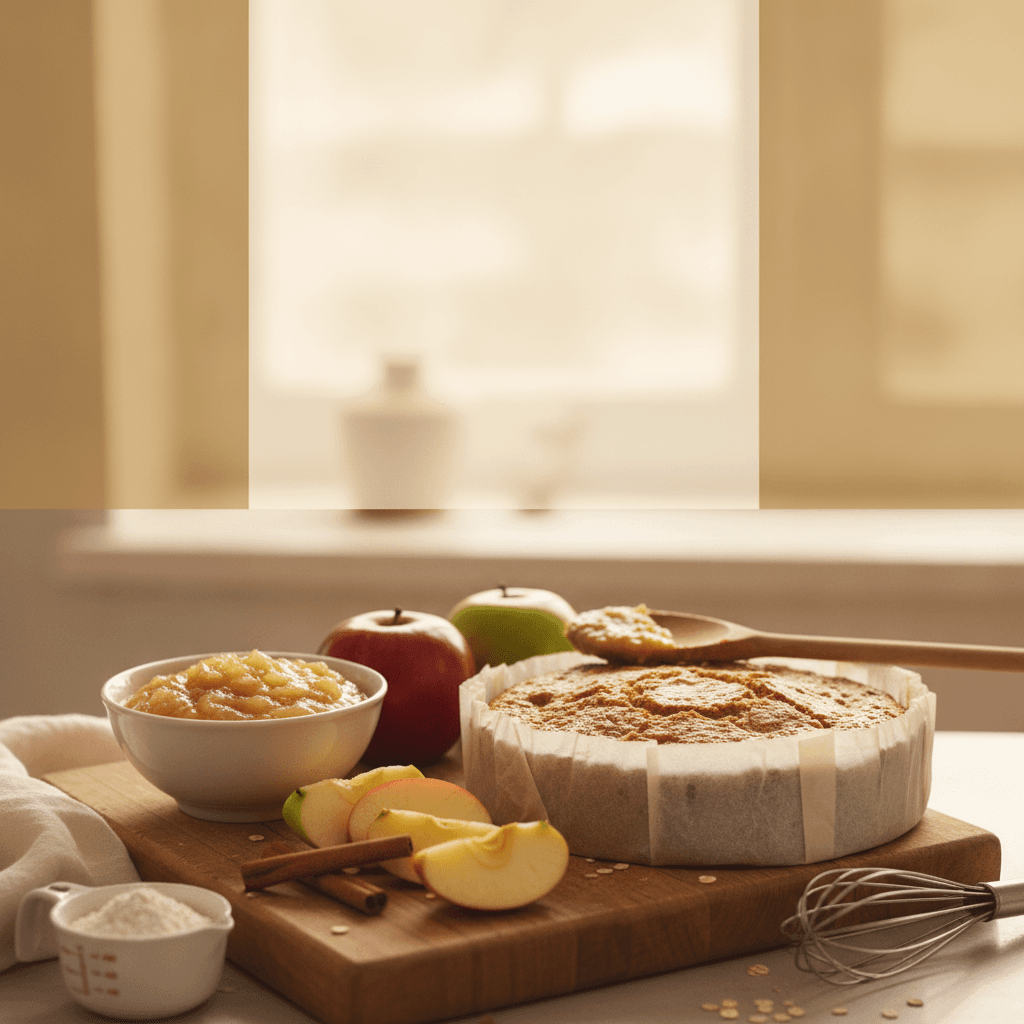
Swapping applesauce for sugar sounds simple — less sugar, fewer calories, healthier baking. But sugar does far more than sweeten, and applesauce behaves nothing like it in a batter. Here's what actually happens when you make the switch, what ratios hold up, and where the substitution falls apart.
Key takeaways
- Applesauce can replace a portion of sugar in most baked goods, but replacing all of it changes texture, browning, and shelf life significantly.
- A common starting point is replacing up to half the sugar with applesauce, using roughly three-quarters the volume of applesauce for the sugar removed.
- Because applesauce adds moisture, you typically need to reduce another liquid in the recipe — or accept a denser, softer crumb.
- Cookies and crispy baked goods suffer the most from this swap because sugar is responsible for their structure and snap.
- Applesauce works best in muffins, quick breads, and cakes where a moist, tender crumb is already the goal.
- This is not a zero-sugar swap — applesauce contains natural sugars (fructose and glucose), so it still contributes sweetness and calories, just less than granulated sugar.
What sugar actually does in baking (beyond sweetness)
Before pulling sugar out of a recipe, it helps to understand why it's there in the first place. Sugar plays at least five structural roles in baked goods, and sweetness is arguably the least important one from a texture standpoint.
Moisture retention. Sugar is hygroscopic — it attracts and holds water. This keeps cakes and muffins soft for days. Remove it, and baked goods stale faster.
Browning. The Maillard reaction and caramelization both depend on sugar. Without enough sugar, crusts stay pale and flavors stay flat.
Tenderizing. Sugar interferes with gluten development (or starch structure in gluten-free baking). It keeps crumbs tender rather than tough.
Creaming and aeration. When you cream butter and sugar together, the sharp sugar crystals create tiny air pockets. Those pockets expand during baking and give cakes their lift. Applesauce can't do this.
Spread and crispness in cookies. Sugar melts during baking, which is why cookies spread and develop crisp edges. Replace sugar with applesauce in a cookie recipe and you'll get something closer to a soft, cakey mound than a thin, snappy cookie.
This is the core tension: applesauce can contribute sweetness and moisture, but it cannot replicate sugar's structural work. Every substitution involves a tradeoff.
How much applesauce to use in place of sugar
The most commonly cited ratio is to use three-quarters of a cup of unsweetened applesauce for every cup of granulated sugar you remove. So if a recipe calls for 1 cup (200g) of sugar, you'd use about 3/4 cup (roughly 180–190g) of unsweetened applesauce.
But here's the part most substitution charts leave out: replacing 100% of the sugar rarely works well. The results tend to be too wet, too pale, and structurally weak. A safer approach is to replace only half the sugar with applesauce and leave the rest. This preserves enough of sugar's structural contributions while still cutting the total sugar content meaningfully.
For a recipe calling for 1 cup of sugar, that means:
| Ingredient | Original amount | Modified amount |
|---|---|---|
| Granulated sugar | 1 cup (200g) | 1/2 cup (100g) |
| Unsweetened applesauce | 0 | ~6 tablespoons (about 90g) |
| Other liquid (milk, water, etc.) | Per recipe | Reduce by 2–3 tablespoons |
That liquid reduction matters. Applesauce is roughly 88% water, so every tablespoon you add is mostly liquid entering the batter. Skip the adjustment and you'll end up with a soggy center or a bake that takes much longer in the oven.
Where this substitution works well
Applesauce as a sugar replacement performs best in baked goods that are already supposed to be moist and soft. Think:
- Muffins — especially fruit-based muffins where apple flavor complements the other ingredients.
- Quick breads — banana bread, zucchini bread, and pumpkin bread all tolerate the extra moisture well.
- Sheet cakes and snack cakes — these are meant to be tender and don't rely on a crisp crust.
- Pancakes and waffles — the batter is already liquid-heavy, so the extra moisture is less disruptive.
In these categories, replacing half the sugar with applesauce is a reliable approach. The crumb will be slightly denser and the flavor will lean toward fruit, but neither change is necessarily a problem.
Where it falls apart
Some baked goods depend on sugar so heavily for structure that applesauce simply can't fill the gap.
Cookies. Drop cookies need sugar to spread, crisp, and set. Replace it with applesauce and you get a puffy, soft blob that doesn't hold its shape. Rolled and cut-out cookies are even worse — the dough becomes too wet to roll.
Meringues and macarons. These are essentially whipped sugar and egg whites. There's no version of this that works with applesauce.
Caramels and candy. Sugar is the entire structural medium. Applesauce has no role here.
Pie crusts. The small amount of sugar in pie dough aids browning and tenderness. Swapping it for applesauce would add unwanted moisture to a dough that needs to stay dry and flaky.
Yeasted breads and rolls. Sugar feeds yeast and aids browning. While you can reduce sugar in bread recipes, replacing it with applesauce changes the fermentation dynamics and adds moisture that alters the crumb structure. If you're baking gluten-free bread, where gummy centers are already a risk, adding more liquid via applesauce makes the problem worse.
The flavor factor most people underestimate
Unsweetened applesauce isn't flavor-neutral. It tastes like apples. In a spiced muffin or banana bread, that's fine — even welcome. In a vanilla cake or a lemon bar, it introduces a fruity undertone that clashes with the intended flavor profile.
This is a bigger issue than most substitution guides acknowledge. A good rule is to limit applesauce swaps to recipes where warm spices — cinnamon, nutmeg, allspice — are already present. For chocolate and citrus items, use other strategies to cut sugar (like reducing the total amount by 25% without any replacement), because the apple flavor doesn't belong.
If you're baking gluten-free and already dealing with off-flavors from alternative flours, adding applesauce on top can compound the issue. Rice flour's mild flavor handles it better than bean-based flours, which already carry their own distinct taste.
Applesauce as a sugar replacement in gluten-free baking
Gluten-free batters behave differently from wheat-based ones, and that changes how applesauce performs as a sugar substitute.
In wheat baking, gluten provides structure that can compensate somewhat when sugar is reduced. In gluten-free baking, you don't have that safety net. Sugar is doing even more structural work — helping starches set, aiding browning in the absence of gluten's Maillard-boosting proteins, and keeping the crumb from going dry and crumbly within hours.
That means gluten-free bakers should be more conservative with this substitution. Replacing a quarter to a third of the sugar with applesauce is a safer starting range for gluten-free muffins and quick breads. Going higher risks a bake that's too wet in the center and stales rapidly once it cools.
One thing that does help: if your gluten-free recipe already uses xanthan gum or psyllium husk as a binder, those ingredients can absorb some of the extra moisture from applesauce. Psyllium husk in particular — at a rate of about 5–6g per 100g of flour blend — gels and holds water effectively, which partially offsets the liquid applesauce introduces.
Unsweetened vs. sweetened applesauce
Always use unsweetened applesauce when substituting for sugar. Sweetened applesauce contains added sugar (sometimes high-fructose corn syrup), which defeats the purpose of the swap and makes it nearly impossible to control the sweetness level.
Unsweetened applesauce still contains natural sugars — roughly 9–11g per 100g serving, depending on the apple variety. So this is not a sugar-free substitution. It's a reduced-sugar approach. A cup of granulated sugar contains about 200g of sucrose. Three-quarters of a cup of unsweetened applesauce contains roughly 17–20g of natural sugars. The reduction is significant, but it's not zero.
Store brands and name brands like Mott's and Tree Top all make unsweetened versions. There's no meaningful performance difference between them for baking purposes — the key variable is making sure the label says "no sugar added" or "unsweetened."
Adjustments you'll probably need to make
Beyond reducing other liquids, a few other tweaks help when using applesauce as a sugar replacement:
Lower the oven temperature slightly
With less sugar, browning happens more slowly. But applesauce's natural sugars can still burn on the surface before the center sets if the oven runs hot. Dropping the temperature by about 25°F (roughly 15°C) and extending the bake time by a few minutes often produces better results.
Expect less rise
If the original recipe relies on creaming butter and sugar for aeration, replacing sugar with applesauce removes that leavening mechanism. You may want to add an extra half teaspoon of baking powder to compensate — but don't overdo it, or you'll get a bitter, metallic taste.
Watch the bake time
The extra moisture from applesauce means the center takes longer to set. A toothpick test is more reliable than the timer. Pull the baked good when the toothpick comes out with just a few moist crumbs, not wet batter.
Consider the color
Less sugar means less browning. If appearance matters — say, for items you're selling at a farmers market — you might brush the top with a thin egg wash or a light honey glaze before baking to compensate.
Applesauce vs. other sugar alternatives
Applesauce isn't the only way to reduce sugar in baking. Here's how it compares to a few other common options:
| Alternative | Sweetness relative to sugar | Adds moisture? | Best for | Biggest drawback |
|---|---|---|---|---|
| Applesauce (unsweetened) | Much less sweet | Yes, significantly | Muffins, quick breads | Apple flavor, wet texture |
| Honey | Sweeter than sugar | Yes, moderately | Cakes, quick breads | Distinct flavor, browns fast |
| Maple syrup | Similar to sugar | Yes, moderately | Pancakes, muffins, glazes | Strong flavor, expensive |
| Mashed banana | Less sweet | Yes, significantly | Quick breads, muffins | Banana flavor dominates |
| Stevia | Much sweeter (concentrated) | No | Where only sweetness is needed | No bulk, bitter aftertaste for some |
The right choice depends on what you're baking and why you're reducing sugar. If it's purely about cutting calories, stevia or monk fruit sweetener handles sweetness without adding moisture or volume. If you want a whole-food approach and you're making something where apple flavor works, applesauce is a solid option. For a deeper look at all the alternatives, our guide to choosing sugar alternatives breaks down the tradeoffs in more detail.
A contrarian take: sometimes just using less sugar works better
Here's something that gets overlooked in most substitution advice: many baking recipes are oversweetened to begin with. American baking in particular tends to use more sugar than is structurally necessary. Before reaching for applesauce, try simply reducing the sugar by 25% without replacing it with anything.
In many muffin and quick bread recipes, cutting a quarter of the sugar produces a baked good that's less sweet but otherwise structurally identical. No moisture adjustments needed. No apple flavor to manage. No changes to bake time. The crumb is slightly less tender and the crust browns a touch less, but both changes are subtle.
This approach is especially relevant for home bakers who sell reduced-sugar items. If you're marketing "lower sugar" muffins and your ingredient cost on applesauce is $0.08–$0.12 per muffin batch, that's a real line item. Simply using less sugar costs nothing extra and avoids the common mistakes that come with substitution.
The point isn't that applesauce is bad — it's that it's one tool, and not always the simplest one for the job.
Frequently asked questions
Can I replace all the sugar with applesauce in a cake recipe?
You can, but the results are usually disappointing. The cake will be denser, paler, and significantly less sweet. It will also stale faster because sugar is what keeps cakes moist over time. Replacing half the sugar is a more reliable approach that preserves the cake's structure while still reducing total sugar content.
Does applesauce work as a sugar replacement in cookies?
Poorly, in most cases. Cookies rely on sugar for spread, crispness, and structure. Replacing sugar with applesauce produces soft, puffy cookies that don't hold their shape. If you want lower-sugar cookies, reducing the sugar by 25% without a replacement tends to work better than swapping in applesauce.
How much applesauce equals one cup of sugar?
A commonly used ratio is 3/4 cup of unsweetened applesauce for every 1 cup of granulated sugar. However, applesauce is much less sweet than sugar, so the result will taste noticeably less sweet. You'll also need to reduce other liquids in the recipe by 2–3 tablespoons to account for the moisture applesauce adds.
Is baking with applesauce instead of sugar actually healthier?
It reduces total sugar and calories, but applesauce still contains natural sugars — roughly 9–11g per 100g. It's not a sugar-free swap. The health benefit depends on how much sugar you're replacing and what your dietary goals are. For people managing blood sugar, the reduction may be meaningful; for others, the difference might be marginal.
Can I use applesauce as a sugar replacement in gluten-free baking?
Yes, but be more conservative — replace only a quarter to a third of the sugar rather than half. Gluten-free baked goods already lack the structural support that gluten provides, and sugar plays a bigger compensating role. Adding too much applesauce can lead to gummy centers and rapid staling. Binders like psyllium husk can help absorb some of the extra moisture.

Written by
Co-founder, BakingSubs
Co-founder of BakingSubs, where he turns the science of ingredient substitutions into tested, reliable guidance for home bakers.
Related Posts

Bake with Confidence
See all
Confident Gluten-Free Baker Toolkit
The science-based system that replaces gluten's seven invisible jobs so your baking turns out soft, fluffy, and foolproof — every time.

Gluten-Free Recipe Vault
Instant access to our complete library of proven gluten-free recipes — no waiting, no guesswork, just results that work tonight.

Fix Your Gluten-Free Bread
Learn the 3-step formula to make bread rise and stay soft, discover why your loaves collapse, and get a tested sandwich bread recipe that actually works.