

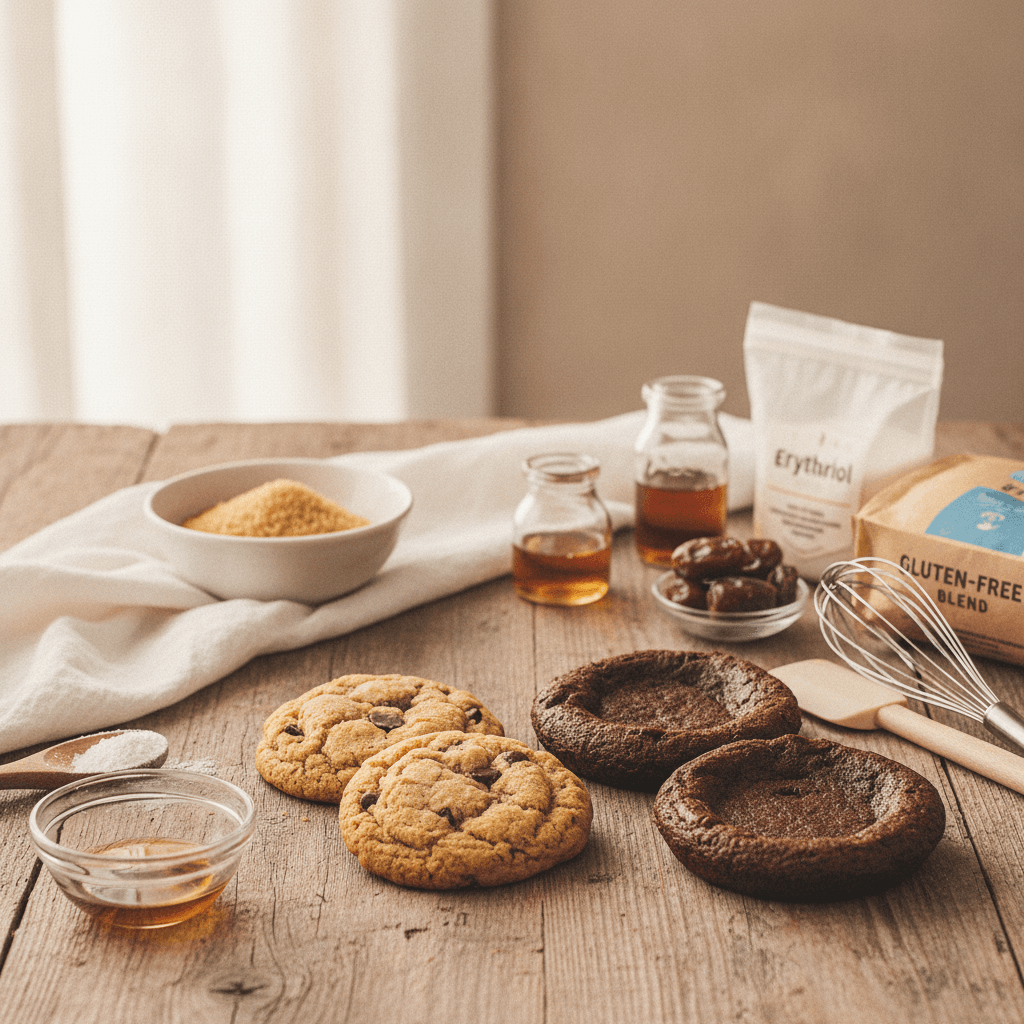
Cutting sugar from baked goods sounds simple until your cookies come out flat, your cake tastes metallic, and your muffins dry out by hour three. Natural sweeteners behave differently from granulated sugar in ways that go beyond sweetness, and choosing the wrong one for the wrong application is the fastest way to ruin a batch.
This post breaks down which natural sweeteners for low sugar baking actually perform well, which ones cause the most problems, and how to think about swapping them into your favorite baked goods.
Key takeaways
- Sugar does far more than sweeten — it affects moisture, browning, spread, and texture, so any substitute has to address those functions too.
- Honey and maple syrup are liquid sweeteners that add moisture, meaning you need to reduce other liquids in the recipe or risk a gummy center.
- Date sugar is the only whole-fruit sweetener that behaves somewhat like granulated sugar in terms of bulk, but it does not dissolve the same way.
- Monk fruit and stevia are intensely sweet with zero calories, but they provide no bulk, no browning, and no moisture — you need a carrier ingredient to compensate.
- Agave nectar and coconut sugar are marketed as healthier alternatives, but they behave more like regular sugar than most people realize.
- The best approach for low sugar baking is often a blend of sweeteners rather than a single 1:1 swap.
Why sugar is harder to replace than you think
Sugar is not just a flavor ingredient. In baking, granulated sugar plays at least four structural roles: it holds moisture (hygroscopy), it helps creamed butter trap air for leavening, it promotes Maillard browning on crusts and surfaces, and it interferes with gluten development to keep textures tender. When you remove sugar, you remove all of those functions at once. For a deeper look at exactly how sugar works in baked goods, our sugar functions guide covers each role in detail.
This is why people who simply halve the sugar in a recipe often end up with pale, dense, tough results. The sweetness might be fine, but the structure falls apart. Natural sweeteners each address some of these functions but rarely all of them, which is why understanding what each one brings to the table matters more than just knowing how sweet it is.
5 natural sweeteners that work well in low sugar baking
1. Honey
Honey is roughly 25–50% sweeter than granulated sugar by weight, depending on the variety, which means you can use less of it to achieve a similar perceived sweetness. It is a liquid sweetener, so it adds moisture to batters and doughs. That extra moisture can be a benefit in quick breads and muffins — it keeps them soft longer — but it can also cause problems if you do not account for it.
The general guideline most baking references cite is to reduce other liquids in the recipe by about 2 tablespoons for every cup of honey used. Honey also promotes faster browning due to its fructose content, so lowering oven temperature by about 25°F helps prevent over-darkening.
Where honey works best: muffins, banana bread, granola, soft cookies, glazes. Where it struggles: anything that needs a crisp, dry texture like biscotti or shortbread.
2. Maple syrup
Pure maple syrup — not pancake syrup, which is mostly corn syrup — brings a complex caramel-like flavor along with its sweetness. It is roughly as sweet as sugar by volume, though slightly less sweet by weight. Like honey, it is a liquid sweetener that requires reducing other liquids in the recipe.
Maple syrup works particularly well in recipes where its flavor complements the other ingredients: spice cakes, oatmeal cookies, pecan-based baked goods, and pumpkin bread. It is less ideal when you want a neutral sweetness that stays in the background. Grade A Dark or Very Dark maple syrup provides the strongest flavor, which means you can sometimes use a bit less and still get a noticeable maple presence. Our agave nectar page covers another liquid sweetener option if you want a more neutral flavor profile.
3. Date sugar
Date sugar is simply dried dates ground into a granular form. It is not actually sugar in the refined sense — it is a whole fruit product that retains the fiber, potassium, and other nutrients from the dates. This makes it one of the more nutritionally interesting options, but it also means it behaves differently from granulated sugar in important ways.
The biggest issue: date sugar does not dissolve. Drop it into a liquid and it stays grainy. This means it will not cream smoothly with butter, and it can leave visible specks in light-colored batters. It works well in recipes where a slightly rustic texture is acceptable — think oatmeal cookies, crumble toppings, and dark quick breads.
Blending date sugar in a spice grinder for about 30 seconds before adding it to cookie dough helps it incorporate more evenly, which gives a smoother final texture.
4. Monk fruit sweetener (with erythritol)
Pure monk fruit extract is roughly 150–200 times sweeter than sugar, so it is almost always sold blended with a bulking agent like erythritol or allulose. The blended versions are typically designed to measure cup-for-cup like sugar, which makes them convenient for baking.
The main trade-off is texture. Erythritol-based monk fruit blends can produce a cooling sensation on the tongue, and they do not caramelize or brown the way sugar does. Cookies made with 100% monk fruit sweetener tend to come out paler and sometimes have a slightly dry, crumbly texture because erythritol does not hold moisture the way sugar does. If you are baking gluten-free and already fighting dry, crumbly results, adding a non-hygroscopic sweetener can make the problem worse.
Monk fruit blends work best when used for 50–75% of the sugar in a recipe, with the remaining sweetness coming from a small amount of regular sugar or a liquid sweetener like honey. This hybrid approach gives you reduced sugar content while preserving enough structure and browning to keep the baked goods recognizable.
5. Coconut sugar
Coconut sugar is made from the sap of coconut palm flowers, and it behaves more like brown sugar than any other alternative sweetener. It has a similar granular texture, it dissolves reasonably well, and it produces comparable browning. Its glycemic index is often cited as lower than white sugar's, though the actual difference varies by source and is debated among nutritionists.
The flavor is distinctly caramel-forward with a slight butterscotch note. It works well in chocolate chip cookies, banana bread, and spice cakes. For recipes where you want a clean, neutral sweetness, coconut sugar's strong flavor can be distracting.
Price is the main barrier for many home bakers. Coconut sugar typically costs $0.40–$0.70 per ounce at retail, compared to roughly $0.03–$0.05 per ounce for granulated white sugar. That is a 10–15x price difference, which matters significantly if you are running a home bakery and tracking your ingredient costs.
2 natural sweeteners that cause more problems than they solve
Stevia (in baking specifically)
Stevia is an excellent zero-calorie sweetener for beverages and no-bake applications. In baking, it is a different story. Pure stevia extract is 200–300 times sweeter than sugar, so you need a tiny amount — and that tiny amount provides zero bulk, zero moisture, and zero browning capability. You are essentially removing all of sugar's structural contributions and replacing them with nothing but sweetness.
Some brands sell stevia baking blends that add bulking agents, but many bakers report a bitter or licorice-like aftertaste that intensifies with heat. This aftertaste varies by brand and by individual sensitivity — some people detect it strongly, others barely notice it. But in baking, where the sweetener is distributed throughout the entire product, even a mild off-taste becomes more noticeable than it would be in a cup of tea.
Agave nectar (for the wrong reasons)
Agave nectar is not a bad sweetener. It works fine as a liquid sweetener in baking, similar to honey but with a more neutral flavor. The problem is why people choose it. Agave is often marketed as a healthier, low-glycemic alternative to sugar, but it is predominantly fructose — often 70–90% fructose depending on the brand and processing method. For comparison, high-fructose corn syrup is about 55% fructose. If your goal in low sugar baking is to reduce fructose intake specifically, agave moves you in the wrong direction.
If you simply want a neutral liquid sweetener and you are not concerned about fructose content, agave works fine. But choosing it because you think it is significantly healthier than other options is a common misconception. Our guide to choosing sugar alternatives breaks down the differences in more detail.
How to compare natural sweeteners for baking
| Sweetener | Form | Relative sweetness vs. sugar | Provides bulk? | Browns well? | Best used in |
|---|---|---|---|---|---|
| Honey | Liquid | 1.25–1.5x | No | Yes (fast) | Muffins, quick breads, soft cookies |
| Maple syrup | Liquid | ~1x | No | Yes | Spice cakes, oatmeal cookies |
| Date sugar | Granular | ~0.7x | Yes | Moderate | Crumbles, dark cookies, quick breads |
| Monk fruit blend | Granular | 1x (as blended) | Yes (with erythritol) | No | Partial sugar replacement in any recipe |
| Coconut sugar | Granular | ~1x | Yes | Yes | Chocolate chip cookies, banana bread |
| Stevia extract | Powder/liquid | 200–300x | No | No | Beverages, no-bake items |
| Agave nectar | Liquid | ~1.5x | No | Yes | Where neutral liquid sweetness is needed |
The blending approach: why one sweetener is rarely enough
Here is the contrarian take most low sugar baking advice skips: trying to replace 100% of the sugar with a single alternative sweetener almost always produces inferior results. The best outcomes usually come from a blend — typically keeping 25–40% of the original sugar and replacing the rest with one or two natural alternatives.
For example, a cookie recipe calling for 1 cup of granulated sugar might work well with 1/3 cup granulated sugar, 1/4 cup honey, and 2 tablespoons of monk fruit blend. You get enough real sugar to maintain browning and spread, enough honey for moisture retention, and enough monk fruit to round out the sweetness without adding more sugar. The total sugar content drops meaningfully, but the cookie still looks and tastes like a cookie.
This blending strategy is especially important in gluten-free baking, where you are already working without the structural support of wheat gluten. Removing sugar's structural contributions on top of that can push a recipe past the point of recovery. If your gluten-free muffins are already coming out with gummy centers, switching to a liquid sweetener without adjusting the rest of the formula will make the problem worse.
Common mistakes when switching to natural sweeteners
Most of the failures people experience with natural sweeteners in baking come from a handful of predictable errors. Our sugar substitution mistakes guide covers the full list, but here are the ones that come up most often with low sugar baking specifically:
- Swapping liquid for dry (or vice versa) without adjusting the recipe. Replacing 1 cup of granulated sugar with 1 cup of honey adds roughly 1/4 cup of extra liquid to your batter. That moisture has to go somewhere — usually into a dense, undercooked center.
- Expecting identical browning. Monk fruit blends and stevia do not caramelize. Your baked goods will look underdone even when they are fully cooked, which leads people to overbake them.
- Ignoring flavor impact. Coconut sugar, maple syrup, and honey all have strong flavors. Using them in a delicate vanilla cake changes the entire flavor profile, not just the sweetness level.
- Using date sugar in recipes that require dissolved sugar. Meringues, angel food cake, and any recipe where sugar needs to dissolve completely will fail with date sugar.
- Going 100% sugar-free on the first attempt. Reducing sugar by 25–30% is barely noticeable in most recipes. Jumping straight to 100% replacement with an alternative sweetener is where most people get discouraged and give up.
What about low sugar baking for a home bakery?
If you are selling baked goods and considering a low sugar or naturally sweetened line, ingredient costs are a real factor. Monk fruit blend runs about $1.00–$1.50 per ounce at retail. Pure maple syrup costs roughly $0.50–$0.80 per fluid ounce. Compare that to granulated sugar at $0.03–$0.05 per ounce, and you can see how quickly ingredient costs climb.
A batch of 24 muffins sweetened with maple syrup instead of sugar might cost an extra $4–$6 in sweetener alone. If you are already underpricing your baked goods, absorbing that cost will eat directly into your margins. You need to price these items as a premium product line, not as a variation of your standard menu.
Customers who specifically seek out low sugar or naturally sweetened baked goods tend to be willing to pay more — but only if you communicate the value clearly. Labeling something as "sweetened with honey and monk fruit" is more compelling than "reduced sugar," because it tells the customer exactly what they are getting.
Frequently asked questions
What is the best natural sweetener for baking cookies with less sugar?
For cookies, a blend of coconut sugar and a small amount of monk fruit sweetener tends to produce the best results. Coconut sugar provides the bulk, browning, and caramelization that cookies need, while monk fruit rounds out the sweetness so you can use less total sweetener. Honey works too but changes the texture toward softer, chewier cookies that may spread more.
Can you replace all the sugar in a cake recipe with honey or maple syrup?
You can, but the results will be noticeably different — denser, moister, and darker than the original. A better approach is to replace 50–75% of the sugar with honey or maple syrup and keep the remainder as granulated sugar. This preserves enough of sugar's structural role to keep the cake's crumb and rise closer to what you expect. Check our choosing sugar alternatives guide for more on partial replacement strategies.
Is coconut sugar actually healthier than regular sugar?
Coconut sugar contains small amounts of minerals like potassium and zinc, and it retains some inulin fiber from the coconut palm sap. However, it is still primarily sucrose and has a similar calorie content to regular sugar. The glycemic index difference is debated and varies by study. It is a reasonable swap for flavor and marginal nutritional benefits, but it should not be treated as a health food.
Why do my baked goods taste bitter when I use stevia?
Stevia contains compounds called steviol glycosides, some of which activate bitter taste receptors in addition to sweet ones. Sensitivity to this bitterness varies genetically — some people taste it strongly, others do not notice it at all. Baking at high temperatures can intensify the bitter notes. If you experience this, try a monk fruit blend instead, which generally has a cleaner sweet taste without the bitter aftertaste.
How do natural sweeteners affect the shelf life of baked goods?
Honey and maple syrup are hygroscopic, meaning they attract and hold moisture. Baked goods made with these sweeteners tend to stay soft longer than those made with granulated sugar. Conversely, monk fruit blends with erythritol can dry out faster because erythritol is less hygroscopic than sucrose. Date sugar and coconut sugar have shelf-life characteristics similar to regular sugar. If shelf life matters — for example, if you are shipping baked goods — honey-sweetened items tend to hold up better in transit.

Written by
Co-founder, BakingSubs
Co-founder of BakingSubs, where he turns the science of ingredient substitutions into tested, reliable guidance for home bakers.
Related Posts
Bake with Confidence
See all
Confident Gluten-Free Baker Toolkit
The science-based system that replaces gluten's seven invisible jobs so your baking turns out soft, fluffy, and foolproof — every time.

Gluten-Free Recipe Vault
Instant access to our complete library of proven gluten-free recipes — no waiting, no guesswork, just results that work tonight.

Fix Your Gluten-Free Bread
Learn the 3-step formula to make bread rise and stay soft, discover why your loaves collapse, and get a tested sandwich bread recipe that actually works.