

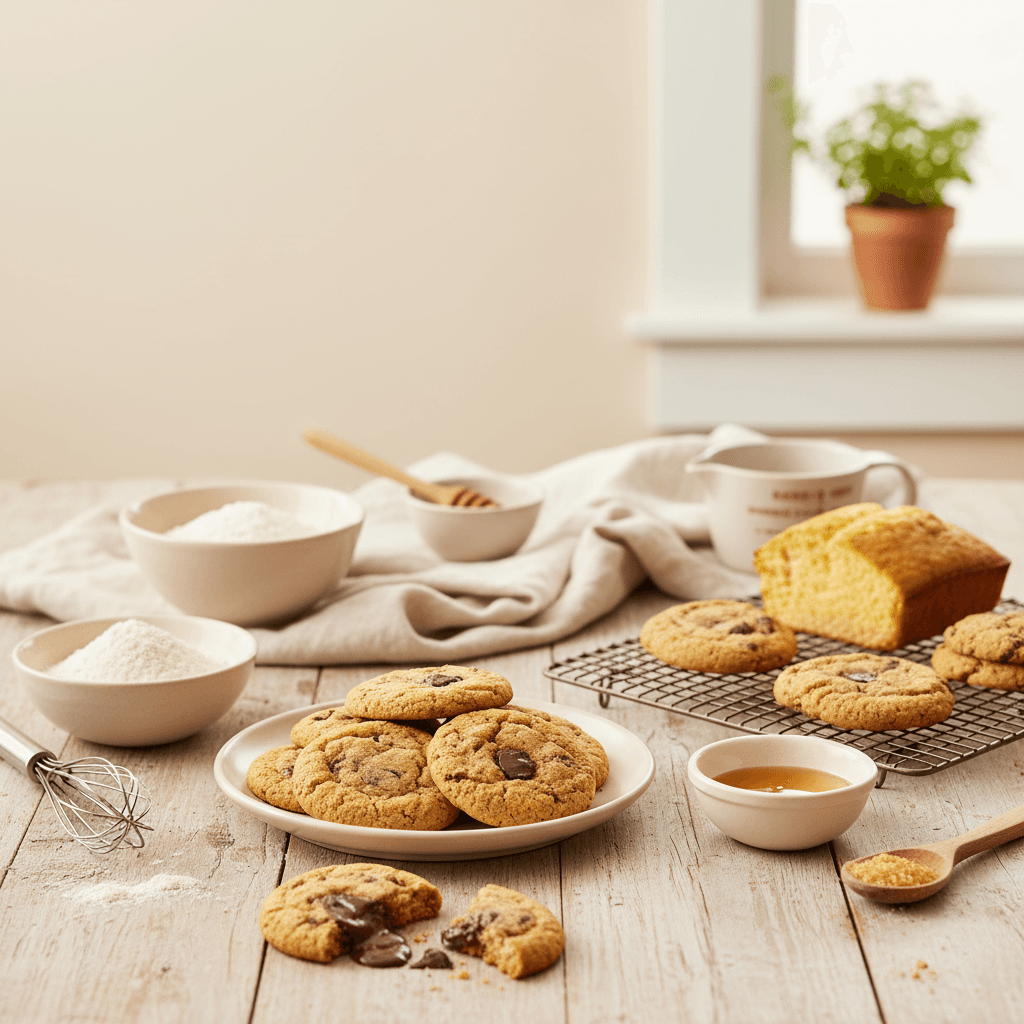
Most home bakers know exactly how much they made last month. Very few know how much they kept. If you've ever deposited $1,800 from a busy weekend and still couldn't explain where the money went by Tuesday, this post is the diagnostic you need.
Key takeaways
- Revenue is not profit — a home baker doing $3,200/month in sales can easily net under $900 after real costs are counted.
- Your labor rate per hour is the single most revealing number, and most bakers have never calculated it.
- Ingredient cost should land between 25–35% of your selling price — above 40%, you're subsidizing your customers' desserts.
- Tracking 7 specific numbers monthly takes about 20 minutes and can reveal $200–$500 in hidden losses.
- Profitability isn't one answer — it depends on your product mix, order volume, and whether you count your own time as a cost.
- A baker doing 12 orders per week at $38 average can be more profitable than one doing 25 orders at $22 average.
Why "I'm making money" is not the same as profitable
Here's the trap: money comes in, you buy more supplies, money goes out, and you feel busy enough that it seems like a real business. But busy and profitable are different animals. I've talked to dozens of home bakers who discovered — after actually running the numbers — that they were earning $6–$9/hour once they accounted for prep, baking, decorating, packaging, delivery, and customer communication.
That's not a business. That's an expensive hobby that also makes you tired.
The fix isn't complicated. It's seven numbers, checked once a month. Let's walk through each one.
Number 1: your true ingredient cost percentage
Take your total ingredient spending for the month and divide it by your total revenue. Multiply by 100. That's your ingredient cost percentage.
| Ingredient cost % | What it means |
|---|---|
| Under 25% | Strong margins — you're pricing well or using efficient recipes |
| 25–35% | Healthy range for most home bakeries |
| 36–45% | Tight — you're likely underpricing or over-portioning |
| Over 45% | You're losing money on most items before labor is even counted |
Megan, a cookie baker in Austin, tracked her ingredient costs for three months and found she was at 43%. The culprit? She was using $14/lb high-end chocolate in cookies she sold for $3.50 each. Switching to a $9/lb chocolate that tasted nearly identical dropped her to 31% — a difference of roughly $340/month on the same order volume.
If you're not sure where to start with pricing, our cookie pricing framework walks through the math step by step.
Number 2: your effective hourly rate
This is the number most bakers avoid because they're afraid of what it'll say. Here's how to calculate it:
- Pick a recent order you remember well.
- Add up every minute you spent on it — shopping, prep, baking, cooling, decorating, packaging, messaging the customer, delivery or pickup coordination.
- Subtract your ingredient cost and any packaging/delivery cost from what you charged.
- Divide the remaining dollars by your total hours.
Example: Rachel in Denver made a two-tier custom cake. She charged $185. Her ingredients cost $38, packaging and board cost $12, and she drove 25 minutes round trip for delivery. Total time from first message to handoff: 7.5 hours. Her effective rate: ($185 − $38 − $12) / 7.5 = $18/hour.
Is $18/hour good? It depends on your market and goals. But if Rachel could earn $22/hour at her day job without the stress of a collapsing fondant tier, she needs to know that. Our custom cake pricing framework helps you build labor into every quote so you're not guessing.
A contrarian take: many pricing guides tell you to set a target hourly rate of $25–$50 and price backward from there. I think that's wrong for most home bakers starting out. Your market sets the ceiling. If custom cakes in your area top out at $200 for a two-tier, you can't just decide you're worth $45/hour and price at $300. You need to either find a higher-value niche, get faster at production, or accept the rate and build volume. Pretending the math doesn't apply is how bakers end up with zero orders and blame the market.
Number 3: your monthly fixed costs (yes, you have them)
Home bakers love to say "I have no overhead." You do. It's just hiding.
- Cottage food license or permit renewal — varies by state, often $50–$250/year, so $4–$21/month
- Insurance — if you carry product liability, typically $25–$50/month
- Website or ordering platform — $0 if you use Instagram DMs, $15–$39/month if you use a proper ordering system
- Packaging supplies on hand — boxes, bags, labels, ribbon, stickers — easily $40–$80/month for a busy baker
- Extra utilities — running your oven 15+ hours a week adds $30–$60/month to your electric or gas bill depending on your region
- Phone/internet portion — if you're running a business from your phone, a portion of that $85/month plan is a business cost
Add these up. For most home bakers doing 10–20 orders per month, fixed costs land between $120 and $280/month. That's money that comes out of your revenue before you've earned a dime of profit.
Number 4: revenue per order
Your average revenue per order tells you whether you're building a business or running a charity bake sale. Divide your monthly revenue by your total number of orders.
If you did $2,400 across 68 orders, your average is $35.29 per order. Now ask: how long does each order take you, start to finish? If it's 90 minutes average, you're at roughly $23/order in gross margin (assuming 35% ingredient cost), which works out to about $15/hour before fixed costs.
The lever here is raising your average order value. That might mean:
- Adding a $6 add-on (extra frosting, a half-dozen mini cookies) to every order
- Setting a minimum order of $30 or $40
- Shifting your product mix toward higher-margin items
- Bundling (a cookie box + a loaf for $48 instead of selling each separately for $22 and $18)
Number 5: your order capacity and utilization
How many orders can you physically produce in a week given your kitchen, your schedule, and your sanity? Be honest. If you're baking around a full-time job and kids, maybe it's 8 orders per week. If you're full-time baking, maybe 20–25.
Now: how many are you actually filling? If your capacity is 12 and you're filling 5, you have a demand problem. If your capacity is 12 and you're filling 14, you have a burnout problem — and probably a quality problem too.
Utilization below 60% means you're paying fixed costs on idle capacity. Above 90% means you have no margin for error, cancellations, or rest. The sweet spot for most home bakers is 65–85% utilization.
If you're struggling to fill your capacity, this breakdown of 9 customer acquisition channels ranks them by what actually converts for home bakers, not what looks good on a marketing blog.
Number 6: your customer return rate
Pull up your last 3 months of orders. How many customers ordered more than once? Divide repeat customers by total unique customers.
A return rate below 20% means you're on a treadmill — constantly chasing new buyers, which is expensive in time and energy even if you're not paying for ads. Above 35% and you're building something sustainable. Above 50% and you likely have a real local following.
Low return rate usually points to one of three things: your product is a one-time novelty (like a birthday cake people only need once a year), your ordering process is too hard, or you're not staying in touch between orders. Our guide on getting repeat customers covers all three.
If you sell custom cakes, a lower return rate is normal — people don't buy cakes every month. But you can still drive referrals. A simple referral program can bring in 3–5 new customers monthly without any ad spend.
Number 7: your actual monthly take-home (net profit)
Here's the formula that matters:
Net profit = Total revenue − Ingredient costs − Packaging costs − Delivery costs − Fixed costs − (Your hours x your target hourly rate)
That last part is where most bakers flinch. If you don't subtract your own labor, you're not measuring profit — you're measuring how much you paid yourself in baked goods and stress.
Let's run a real example:
| Line item | Amount |
|---|---|
| Monthly revenue | $3,200 |
| Ingredient costs (32%) | −$1,024 |
| Packaging and delivery | −$185 |
| Fixed costs | −$210 |
| Gross profit (before labor) | $1,781 |
| Hours worked (62 hrs x $20/hr target) | −$1,240 |
| True net profit | $541 |
That $541 is your actual business profit — the return on your risk, your recipes, your brand. If that number is negative, your bakery is paying you less than a part-time job would, and the "business" is really just self-employment at a discount.
And here's the thing: $541/month profit on $3,200 revenue is a 17% net margin. That's not terrible for a food business. Commercial bakeries often run 5–12%. But you need to know the number exists, and you need to decide if it's enough.
The monthly 20-minute profitability check
You don't need accounting software to do this (though it helps). A simple spreadsheet or even a notebook works. On the last day of each month, spend 20 minutes filling in these seven numbers:
- Total revenue
- Total ingredient spend → calculate ingredient cost %
- Total hours worked → calculate effective hourly rate
- Fixed costs total
- Number of orders → calculate revenue per order
- Orders filled vs. capacity → calculate utilization %
- Repeat customers vs. total unique customers → calculate return rate
Then calculate your net profit using the formula above. Track it month over month. After three months, you'll see patterns that no amount of guessing can reveal.
When the answer is "it depends" — and the variables that matter
Profitability isn't a yes/no question. It depends on variables that are specific to your situation:
- Your product mix. Custom decorated cookies at $48/dozen have very different margins than sourdough loaves at $9 each. A baker selling both needs to know which one is actually making money. Sometimes the answer is surprising — the "cheaper" product with faster production time wins on profit per hour. Check our cookie business margin breakdown for specifics.
- Your market's price ceiling. In Brooklyn, a dozen macarons can sell for $42. In rural Arkansas, $24 might be the max. Your costs don't care where you live, but your revenue does.
- Your speed. A baker who can produce 6 dozen decorated sugar cookies in 4 hours is in a fundamentally different business than one who takes 8 hours for the same output. Speed comes from repetition, better systems, and sometimes just accepting that "good enough" decoration is fine for a $36 box.
- Whether you deliver. Free delivery within 15 miles sounds generous until you realize a 40-minute round trip on a $45 order just cost you $12 in gas and time. Pickup-only or delivery fees change your math significantly.
- Your life structure. A baker with a partner's income covering the mortgage has a different profitability threshold than a single parent who needs the bakery to cover rent. Neither is wrong, but the numbers you need to hit are different. Our post on whether your business model is sustainable digs into this.
What to do if the numbers look bad
Finding out you're not profitable isn't a failure — it's a diagnosis. Here are the highest-leverage fixes, in order:
- Raise prices. This is almost always the first move. If you haven't raised prices in the last 12 months, you're effectively taking a pay cut every quarter due to ingredient inflation. Our guide on raising prices without losing customers walks through exactly how to communicate it.
- Cut your lowest-margin product. If you make 8 things and one of them earns you $7/hour while the rest earn $16–$22/hour, drop it. You'll free up time for the profitable work.
- Set minimums. A $25 minimum order eliminates the $12 single-item orders that eat your time and packaging supplies.
- Batch your baking days. Producing 5 different items across 5 days is wildly less efficient than producing 2 items on 2 focused days. Consolidation alone can save 3–5 hours per week.
- Stop offering free delivery. Charge $8–$15 or make pickup the default. Most customers will adjust.
Frequently asked questions
How much profit should a home bakery make per month?
It varies enormously by product type and volume, but a healthy home bakery doing $2,000–$4,000/month in revenue should aim for 15–25% net profit after accounting for labor. That works out to $300–$1,000/month in true profit. If you're below 10% net, you're likely underpricing or overworking on low-margin items. Our custom cake income breakdown shows what three real bakers actually take home.
What is a good profit margin for a home bakery?
Gross margins (revenue minus ingredient costs) should be 60–75%. Net margins (after all costs including your labor) should be 12–25% for a well-run home bakery. Commercial bakeries often run lower because of rent and staff costs, so home bakers have a structural advantage — but only if they price correctly and track their numbers.
How do I know if I'm charging enough for my baked goods?
Calculate your effective hourly rate on your three most common orders. If it's below $15/hour in your area, you're almost certainly undercharging. Your ingredient cost percentage should be 25–35% of your selling price. If it's above 40%, either your recipes are too expensive for your price point or your prices need to come up. Start with our farmers market pricing guide or custom cake pricing framework depending on what you sell.
Should I count my own labor as a business expense?
Yes — always. If you don't, you'll think your bakery is profitable when it's actually paying you $8/hour and calling it "profit." Set a target hourly rate (even $15–$20/hour is a starting point) and subtract it from your revenue alongside other costs. The remaining number is your true business profit, separate from your wages.
How often should I check my home bakery's profitability?
Monthly is the minimum. It takes about 20 minutes if you've been saving receipts and tracking orders. Quarterly is too slow — by the time you spot a problem, you've lost 8–12 weeks of potential income. Monthly tracking also reveals seasonal patterns so you can plan for slow months instead of panicking when orders drop in January.

Written by
Co-founder, BakingSubs
Co-founder of BakingSubs, where he turns the science of ingredient substitutions into tested, reliable guidance for home bakers.
Related Posts
Bakery Recipe Cost Sheet: How to Cost a Recipe in 6 Steps (With a Table You Can Copy)

Home Bakery Order Form Template: A Copy-Paste Layout That Cuts Mistakes by Half
Cottage Food Label Requirements and Template: What Every State Demands (With a Copy-Paste Layout)
Bake with Confidence
See all
Confident Gluten-Free Baker Toolkit
The science-based system that replaces gluten's seven invisible jobs so your baking turns out soft, fluffy, and foolproof — every time.

Gluten-Free Recipe Vault
Instant access to our complete library of proven gluten-free recipes — no waiting, no guesswork, just results that work tonight.

Fix Your Gluten-Free Bread
Learn the 3-step formula to make bread rise and stay soft, discover why your loaves collapse, and get a tested sandwich bread recipe that actually works.