

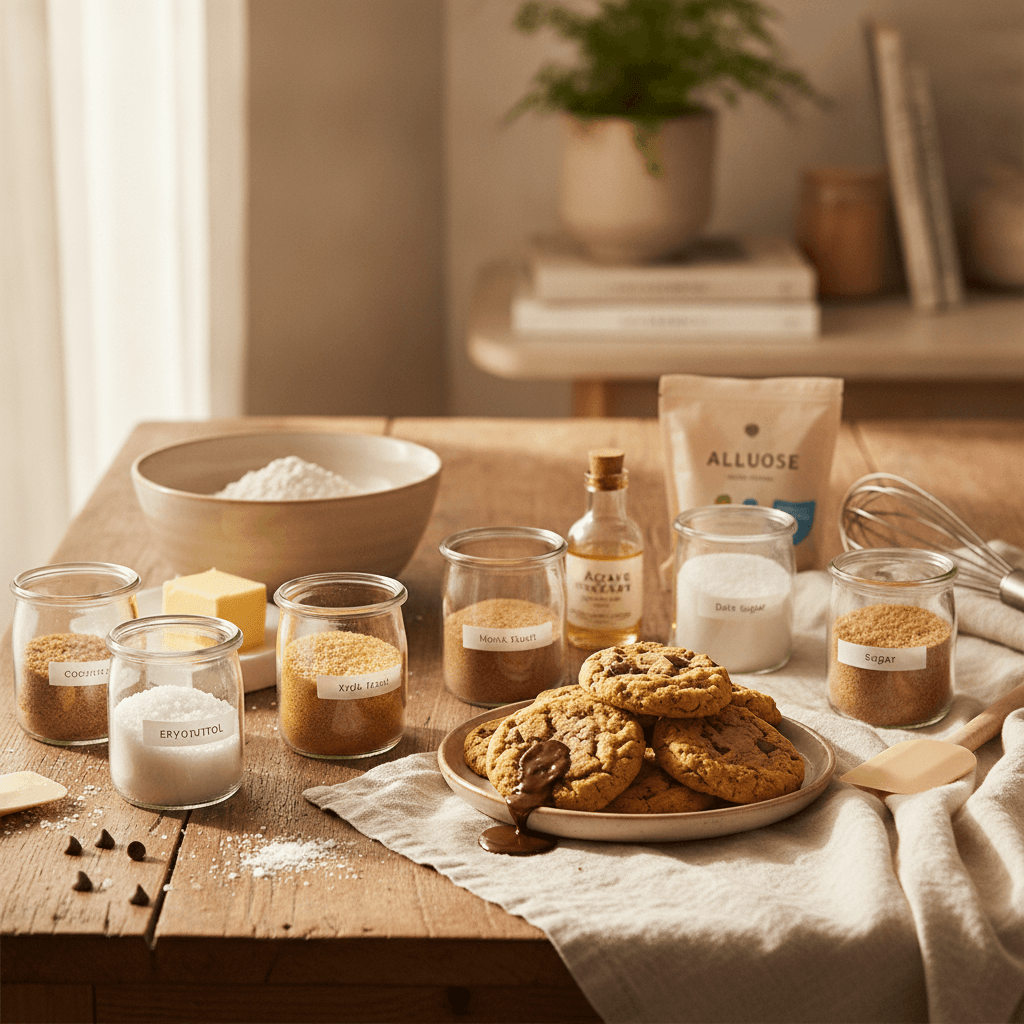
Swapping sugar in cookies is never a straight 1:1 trade. Sugar does more than sweeten — it controls spread, moisture, browning, and texture, so every substitute shifts the outcome in a different direction. Here's how seven common alternatives actually perform in cookie dough, and what to adjust so the batch still works.
Key takeaways
- Honey and maple syrup add moisture, which means you need to reduce another liquid or increase flour to prevent flat, greasy cookies.
- Coconut sugar is the closest drop-in replacement for granulated sugar in most cookie recipes because it behaves similarly in terms of structure and browning.
- Erythritol and monk fruit sweetener don't caramelize the way sugar does, so cookies made with them tend to look pale and feel drier.
- Applesauce can replace some sugar for moisture and mild sweetness, but it won't create the crisp edges sugar provides.
- Date sugar holds moisture well but doesn't dissolve, which changes the texture of the dough and the final cookie.
- Understanding what sugar actually does in baking is the single most useful thing you can learn before making any swap.
Why replacing sugar in cookies is harder than it sounds
Sugar isn't just a sweetener. In cookies, granulated sugar and brown sugar each play specific structural roles. Granulated sugar dissolves during creaming and re-crystallizes as the cookie cools, creating crispness. Brown sugar's molasses content holds moisture, producing chewier results. When you remove either one, you're not just removing sweetness — you're removing the mechanism that creates the texture you expect.
That's why the "best" sugar substitute for cookies depends entirely on what kind of cookie you're making. A chewy chocolate chip cookie can tolerate a liquid sweetener better than a crisp shortbread. A drop cookie handles applesauce more gracefully than a rolled sugar cookie. Before you pick a substitute, think about whether your cookie needs to be crisp, chewy, or cakey — and read up on choosing sugar alternatives to match the right swap to the right job.
7 sugar substitutes for baking cookies, compared
| Substitute | Sweetness vs. sugar | Form | Best cookie types | Biggest tradeoff |
|---|---|---|---|---|
| Honey | Sweeter than sugar | Liquid | Chewy, soft cookies | Adds moisture; cookies spread more and brown faster |
| Maple syrup | Slightly less sweet | Liquid | Oatmeal, spice cookies | Distinct flavor; adds liquid that must be offset |
| Coconut sugar | Roughly equal | Granular | Most cookie types | Darker color; mild caramel/toffee flavor |
| Date sugar | Less sweet | Granular (doesn't dissolve) | Oatmeal, chunky drop cookies | Gritty texture; doesn't cream like sugar |
| Applesauce | Much less sweet | Puree | Soft, cakey cookies | No crispness; significant moisture addition |
| Erythritol | About 70% as sweet | Granular | Low-sugar versions of any style | Cooling aftertaste; no caramelization; can re-crystallize |
| Monk fruit sweetener (with erythritol blend) | Varies by brand | Granular | Low-sugar versions of any style | Pale color; some brands have a lingering aftertaste |
Honey as a cookie sugar substitute
Honey is sweeter than granulated sugar, so you generally need less of it. A common starting point is about 3/4 cup of honey for every 1 cup of sugar, though this varies by the cookie and the honey. Because honey is liquid, it adds moisture to the dough. That extra moisture means cookies tend to spread more during baking and can come out flat if you don't compensate.
The practical fix: reduce another liquid in the recipe (if there is one) or add a small amount of extra flour. Honey also causes faster browning due to its fructose content, so dropping the oven temperature by about 25°F (roughly 15°C) helps prevent over-browning before the center sets.
Flavor-wise, honey is not neutral. Clover honey is mild enough for most cookies, but buckwheat or wildflower honey will assert themselves. If you're making something with strong flavors — ginger cookies, molasses cookies, peanut butter cookies — the honey flavor blends in. In a delicate vanilla shortbread, it takes over. For more detail on how honey behaves as a baking substitute, check the ingredient page.
Maple syrup in cookie dough
Maple syrup is slightly less sweet than granulated sugar and adds a noticeable maple flavor that works well in oatmeal cookies, pecan cookies, and anything with warm spices. Like honey, it's a liquid sweetener, so it introduces moisture that needs to be offset.
A typical substitution ratio is about 3/4 cup of maple syrup per 1 cup of sugar, with a reduction in other liquids. Grade A Dark or Grade B (now called "Grade A Very Dark") syrups have a stronger maple flavor that holds up better after baking than lighter grades.
One thing to watch: maple syrup contains more water than honey, so it can make doughs even stickier. Chilling the dough for at least 30 minutes before scooping helps with handling. You can explore how maple syrup performs across different baking applications on its ingredient page.
Coconut sugar: the closest 1:1 swap
Coconut sugar is the easiest sugar substitute for cookies because it's granular, measures cup-for-cup like regular sugar, and behaves similarly during creaming. It dissolves, it caramelizes, and it creates browning — all things that matter for cookie texture and appearance.
The tradeoffs are cosmetic and flavor-related. Coconut sugar is brown, so every cookie comes out darker than it would with white sugar. It also has a mild caramel or toffee-like flavor that's pleasant in chocolate chip cookies or snickerdoodles but noticeable in a plain sugar cookie where you want a clean, buttery taste.
Nutritionally, coconut sugar is still sugar. It contains roughly the same calories as granulated sugar. People choose it because it's less processed and has a slightly lower glycemic index, but it's not a "healthy" option in any meaningful caloric sense. If your goal is to reduce sugar's impact on blood glucose, coconut sugar alone won't get you there.
If you sell cookies, coconut sugar can also double as a selling point — listing it on your labels signals a less-processed ingredient. If you're thinking about ingredient-driven pricing, this pricing framework is worth reading.
Date sugar: the one that doesn't dissolve
Date sugar is just dehydrated dates ground into a powder. It tastes great — rich, caramelly, naturally sweet — but it doesn't dissolve in liquid or melt during baking. That means it can't cream with butter the way granulated sugar does, and it leaves a slightly gritty texture in the finished cookie.
This works fine in cookies where texture variation is welcome: oatmeal cookies, cookies with nuts or dried fruit, thick drop cookies. It does not work well in smooth, thin, or crispy cookies where undissolved particles would be obvious.
Date sugar also absorbs moisture from the dough, which can make cookies drier than expected. Adding a tablespoon or two of extra fat (butter or oil) per cup of date sugar used can help compensate. Because date sugar is less sweet than granulated sugar, you may want to increase the amount slightly — but go slowly, because more date sugar also means more fiber and more moisture absorption.
Applesauce as a partial sugar replacement
Applesauce is best used as a partial sugar replacement rather than a full one. Replacing half the sugar with unsweetened applesauce reduces overall sweetness and adds moisture, which pushes cookies toward a softer, cakier texture. Replacing all the sugar with applesauce produces something that barely resembles a cookie — more like a muffin top.
The reason is structural. Sugar creates air pockets during creaming, contributes to spread, and provides the crispness that defines many cookie styles. Applesauce does none of those things. What it does do is add pectin and moisture, which can be useful if you're already making a soft cookie and want to reduce sugar content without switching to an artificial sweetener.
A reasonable starting point: replace about half the sugar with an equal volume of unsweetened applesauce, and reduce butter or oil by a tablespoon or two to account for the added liquid. Expect a softer, less sweet cookie that stales faster because applesauce doesn't preserve the way sugar does.
Erythritol and monk fruit sweetener in cookies
Erythritol is a sugar alcohol that provides about 70% of sugar's sweetness with minimal calories. Monk fruit sweetener is typically sold blended with erythritol to make it measure closer to sugar. Both are popular in low-carb and keto baking.
The biggest issue with erythritol in cookies is that it doesn't caramelize. Cookies come out pale — sometimes almost white — even when fully baked. There's no Maillard browning, no golden edges, no caramel notes. The texture is also different: erythritol tends to re-crystallize as cookies cool, creating a slightly crunchy, almost sandy mouthfeel that some people enjoy and others find off-putting. Many people also detect a cooling sensation on the tongue, similar to mint but without the flavor.
Monk fruit blends mitigate some of these issues because manufacturers often add other ingredients (like allulose or inulin) to improve browning and texture. If you're choosing between pure erythritol and a monk fruit blend for cookies, the blend usually produces a more conventional result.
Here's a contrarian take: for many home bakers, erythritol cookies aren't worth the effort. The texture and appearance differences are significant enough that the cookies can be a hard sell at markets and may not satisfy non-dieters. If you're baking for yourself or for someone with specific dietary needs, they're a viable option. If you're selling, the visual and textural gap compared to sugar cookies is hard to overcome at a price point that makes sense. Check the common sugar substitution mistakes page to avoid the pitfalls that trip up most bakers trying these swaps.
What about stevia, allulose, and agave?
Stevia
Stevia is intensely sweet in tiny amounts, which means it doesn't provide the bulk that sugar does. In cookies, bulk matters — sugar makes up a significant percentage of the dough's dry weight. You can't replace a cup of sugar with a teaspoon of stevia and expect the dough to hold together. Stevia works best as a minor sweetness booster alongside another substitute that provides structure, like coconut sugar or a partial amount of regular sugar.
Allulose
Allulose is a rare sugar that tastes remarkably close to regular sugar but has minimal caloric impact. It browns, it dissolves, and it doesn't have the cooling aftertaste of erythritol. The downsides: it's about 70% as sweet as sugar, it's more expensive (often $0.50–$1.00 per ounce depending on the brand), and it can make cookies softer than expected because it holds moisture differently. Allulose is arguably the most promising low-calorie sugar substitute for cookies, but the cost makes it impractical for high-volume baking.
Agave nectar
Agave nectar behaves similarly to honey — it's a liquid sweetener that adds moisture and promotes browning. It's sweeter than sugar, so you need less. The flavor is more neutral than honey, which some bakers prefer. The same adjustments apply: reduce other liquids, lower oven temperature slightly, and expect a chewier cookie.
How to decide which substitute to use
The right choice depends on your goal. Here's a simple decision framework:
- If you want the easiest swap with the least recipe adjustment: coconut sugar. It measures the same, creams the same, and browns the same.
- If you want to reduce calories or carbs significantly: a monk fruit–erythritol blend or allulose. Accept that the texture and appearance will change.
- If you want a more natural, less-processed sweetener: honey, maple syrup, or date sugar. Each adds its own flavor and requires moisture adjustments.
- If you want to reduce sugar without eliminating it: replace half the sugar with unsweetened applesauce. This is the most forgiving approach for beginners.
No substitute does everything sugar does. That's the honest reality. The best results come from picking one substitute, learning how it behaves in your specific cookie recipe, and adjusting from there — rather than chasing a magic swap that doesn't exist.
If you're running a home bakery and debating whether to specialize in sugar-free or low-sugar cookies, keep in mind that specialty ingredients like allulose and monk fruit blends cost significantly more per batch. A dozen cookies made with allulose can cost $2–$4 more in ingredients alone compared to the same batch with granulated sugar. That cost has to go somewhere — either into your price or out of your margin. The cookie business profit margins breakdown covers how to think about ingredient costs in context.
Quick reference: adjustments for each substitute
| Substitute | Reduce other liquid? | Adjust oven temp? | Chill dough first? | Expect different color? |
|---|---|---|---|---|
| Honey | Yes | Lower by ~25°F | Recommended | Darker, more golden |
| Maple syrup | Yes | Lower by ~25°F | Recommended | Slightly darker |
| Coconut sugar | No | No | Not necessary | Noticeably darker |
| Date sugar | No (may need to add fat) | No | Helpful | Darker with visible specks |
| Applesauce (partial) | Reduce fat slightly | No | Helpful | Paler, more matte |
| Erythritol | No | No | Not necessary | Much paler — almost white |
| Monk fruit blend | Depends on blend | No | Not necessary | Paler than sugar |
Frequently asked questions
What is the best sugar substitute for baking chocolate chip cookies?
Coconut sugar is the most straightforward substitute for chocolate chip cookies because it measures cup-for-cup like granulated sugar and still caramelizes during baking. The cookies will be darker and have a slight toffee flavor, but the texture stays close to the original. If you want a low-calorie option, a monk fruit–erythritol blend works but produces paler cookies with a different mouthfeel. Learn more about how each option affects your bake on the choosing sugar alternatives guide.
Can you replace sugar with honey in cookie recipes?
Yes, but it's not a straight swap. Honey is sweeter and adds liquid, so you typically use about 3/4 cup per cup of sugar and reduce other liquids in the recipe. Lower the oven temperature by roughly 25°F to prevent over-browning. The resulting cookies will be chewier and softer than those made with granulated sugar. Check the honey ingredient page for more substitution details.
Why do cookies made with erythritol taste different?
Erythritol is a sugar alcohol that doesn't caramelize or undergo Maillard browning, which means cookies lack the golden color and complex flavor that sugar creates during baking. Many people also notice a cooling sensation on the tongue. As the cookie cools, erythritol can re-crystallize, creating a sandy or crunchy texture that differs from the chewiness or crispness sugar provides.
Is coconut sugar actually healthier than regular sugar in cookies?
Coconut sugar has a slightly lower glycemic index than white sugar and is less refined, but it contains roughly the same number of calories per gram. Swapping to coconut sugar doesn't meaningfully reduce the caloric content of your cookies. If your goal is to cut calories or manage blood sugar more aggressively, you'd need a non-caloric sweetener like erythritol, monk fruit, or allulose instead.
How do sugar substitutes affect cookie texture and spread?
Granulated sugar dissolves during creaming, creates air pockets, and re-crystallizes as cookies cool — all of which contribute to spread and crispness. Liquid sweeteners like honey and maple syrup increase spread because they add moisture. Non-dissolving substitutes like date sugar reduce spread and can make cookies denser. Sugar alcohols like erythritol produce less spread and a drier texture because they don't interact with gluten and fat the same way. The sugar functions page explains these mechanics in depth.

Written by
Co-founder, BakingSubs
Co-founder of BakingSubs, where he turns the science of ingredient substitutions into tested, reliable guidance for home bakers.
Related Posts
Bake with Confidence
See all
Confident Gluten-Free Baker Toolkit
The science-based system that replaces gluten's seven invisible jobs so your baking turns out soft, fluffy, and foolproof — every time.

Gluten-Free Recipe Vault
Instant access to our complete library of proven gluten-free recipes — no waiting, no guesswork, just results that work tonight.

Fix Your Gluten-Free Bread
Learn the 3-step formula to make bread rise and stay soft, discover why your loaves collapse, and get a tested sandwich bread recipe that actually works.