

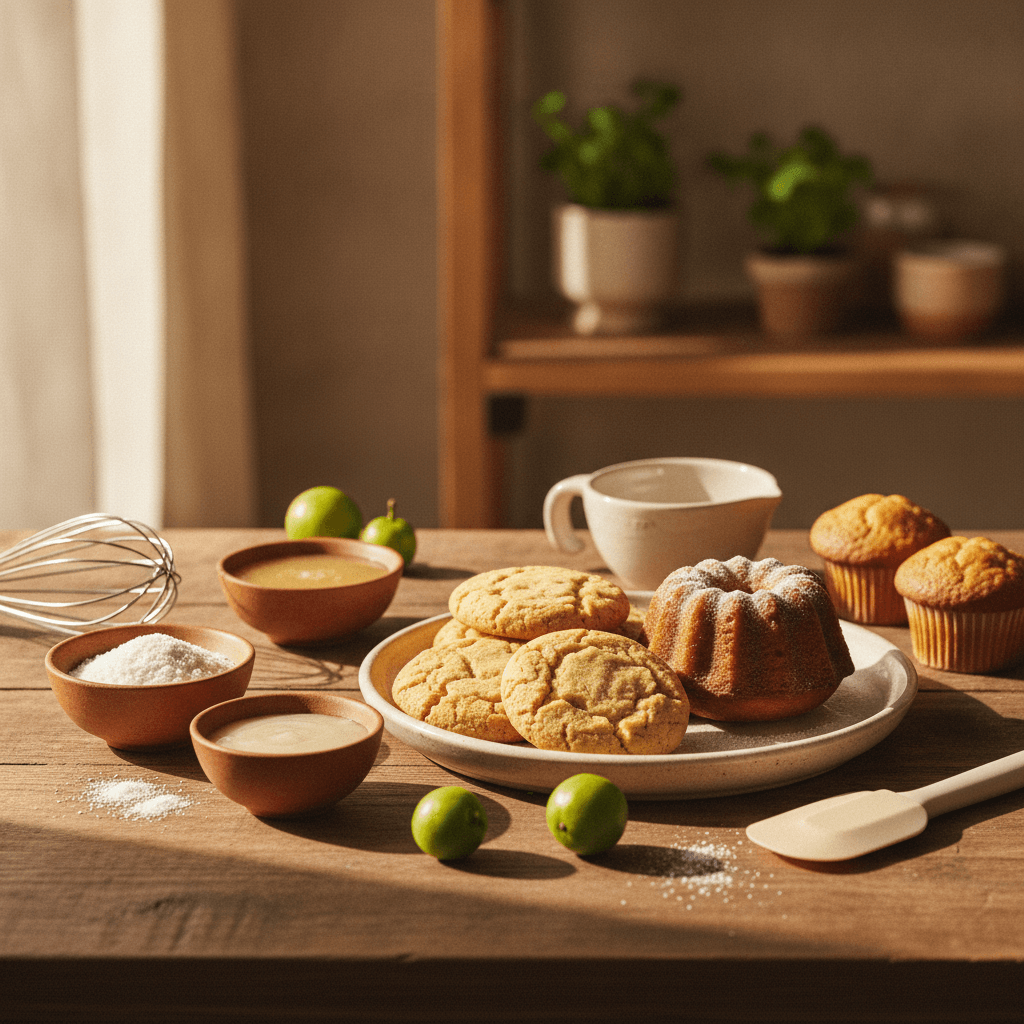
Monk fruit sweetener promises zero-calorie sweetness with no blood sugar spike, but swap it into a cookie or cake recipe cup-for-cup and you'll likely end up with something dry, flat, or oddly crunchy. The problem isn't the sweetener itself — it's that sugar does far more in baking than add sweetness, and monk fruit handles almost none of those other jobs.
Here's what actually matters when you bake with monk fruit, and how to avoid the five failures that trip up most people.
Key takeaways
- Monk fruit extract is roughly 150–250 times sweeter than granulated sugar, so commercial baking blends dilute it with erythritol, allulose, or other bulking agents — and the bulking agent determines your results more than the monk fruit itself.
- Sugar provides moisture retention, browning, spread, and structural bulk in baked goods. Monk fruit blends only replace sweetness and partial bulk, so you need to compensate for the rest.
- Erythritol-based monk fruit blends tend to crystallize as baked goods cool, creating a gritty or crunchy texture that worsens overnight.
- Allulose-based monk fruit blends behave more like sugar in terms of moisture and browning, but allulose holds onto moisture more strongly than sugar, so baked goods can turn out softer, moister, or stickier than expected if you don't reduce liquid.
- Monk fruit works best in recipes where sugar's structural role is minimal — think custards, puddings, frostings, and quick breads — and struggles most in crisp cookies and caramelized pastries.
Why monk fruit sweetener doesn't behave like sugar in baking
Pure monk fruit extract (mogrosides) is a zero-calorie, intensely sweet compound extracted from the Siraitia grosvenorii fruit. Because it's so concentrated, you'd need a nearly invisible pinch to sweeten an entire cake. That's a problem: sugar is often one of the largest ingredients by weight in a standard cake batter, contributing volume, structure, tenderness, and moisture retention — not just sweetness.
To solve the bulk issue, manufacturers blend monk fruit extract with a carrier. The three most common carriers are erythritol, allulose, and inulin fiber. Each one behaves differently in heat, moisture, and crystallization, which means two bags labeled "monk fruit sweetener" on the shelf can produce wildly different baking results. Understanding what sugar actually does in baked goods is the first step toward making any alternative sweetener work.
The 5 most common monk fruit baking mistakes
1. Treating all monk fruit blends as interchangeable
Muffins can turn out perfectly with one monk fruit brand and gritty and dry with another — even when both labels say "1:1 sugar replacement." The difference is usually the carrier: one might use allulose, the other erythritol.
Erythritol is a sugar alcohol that doesn't dissolve as readily as sucrose and tends to recrystallize as baked goods cool. Allulose is a rare sugar that caramelizes, retains moisture, and stays dissolved — behaving much closer to table sugar. Inulin-based blends add fiber bulk but can create a gummy or dense crumb if used in large amounts.
Before you blame monk fruit for a failed batch, check the ingredients panel. The carrier is doing most of the work.
| Carrier ingredient | Browning | Moisture retention | Crystallization risk | Best for |
|---|---|---|---|---|
| Erythritol | Minimal | Low | High (gritty texture after cooling) | Frostings, beverages, no-bake treats |
| Allulose | Good (caramelizes) | Moderate to high | Low | Cookies, cakes, quick breads |
| Inulin fiber | Slight | Moderate | Low | Muffins, dense loaves |
2. Ignoring the moisture gap
Granulated sugar is hygroscopic — it pulls water from the air and from other ingredients, then holds onto it. This is a big reason why sugar-based cakes stay moist for days. Most monk fruit blends, especially erythritol-based ones, don't hold moisture the same way. The result: baked goods that seem fine out of the oven but turn dry and crumbly within hours.
If your monk fruit baked goods go stale fast, that's the moisture gap at work. You can partially close it by adding a tablespoon or two of a humectant ingredient — honey, molasses, applesauce, or a small amount of glycerin. Yes, adding a touch of honey to a "sugar-free" recipe seems contradictory, but even 1–2 tablespoons in a full batch adds minimal sugar per serving while dramatically improving shelf life. For more on this exact problem, see our guide on low-sugar baking substitutes that actually fix texture.
3. Expecting browning that never comes
Maillard browning and caramelization are chemical reactions that require reducing sugars. Erythritol is not a reducing sugar, so baked goods made with erythritol-based monk fruit blends come out pale — sometimes almost white on top — even when fully baked. This isn't just cosmetic. Browning reactions also contribute flavor complexity, and without them, baked goods can taste flat or one-dimensional.
Allulose-based monk fruit blends do brown, and they can actually brown faster than sugar. If you're using an allulose blend, drop your oven temperature by about 25°F (roughly 15°C) and check doneness a few minutes early. A pale top on an erythritol-based cookie, on the other hand, doesn't mean it's underdone — use an internal thermometer or the touch test instead of relying on color.
4. Using monk fruit in recipes that depend on sugar's structure
Crisp sugar cookies, caramel, brittle, meringue — these recipes lean heavily on sugar's ability to melt, resolidify, and create specific textures at precise temperatures. Monk fruit blends can't replicate those phase changes. Erythritol melts at a much higher temperature than sucrose and resolidifies into a hard, grainy mass. Allulose gets sticky rather than crisp.
A better approach: save monk fruit for recipes where sugar plays a supporting role rather than a structural one. Banana bread, pumpkin muffins, custard pies, cream cheese frostings, and puddings are all strong candidates. For something like a snickerdoodle or a crème brûlée, you're fighting the chemistry.
5. Not adjusting liquid ratios
This one catches people off guard with allulose-based blends specifically. Allulose is more hygroscopic than granulated sugar — it attracts and holds onto water — so finished baked goods can come out softer, moister, or stickier than expected. If you're converting a recipe to use an allulose-monk fruit blend, try reducing other liquids (milk, water, juice) by about 10–15% on your first attempt, then adjust from there.
Erythritol-based blends have the opposite tendency — they can make batters slightly drier because erythritol doesn't dissolve as completely. If your dough seems crumbly or dry, add liquid a tablespoon at a time until you reach the consistency the original recipe describes.
Which baked goods work best with monk fruit sweetener
Not every recipe is a good candidate. Here's a realistic breakdown based on how much structural work sugar does in each category:
| Baked good | Sugar's structural role | Monk fruit compatibility | Notes |
|---|---|---|---|
| Quick breads and muffins | Low to moderate | High | Moisture-rich batters mask texture differences |
| Cakes (butter/oil-based) | Moderate | Moderate | May need added fat or humectant for moisture |
| Brownies | Moderate | Moderate | Fudgy styles work better than cakey ones |
| Cookies (soft/chewy) | Moderate to high | Low to moderate | Spread and chew are hard to replicate |
| Cookies (crisp/thin) | High | Low | Sugar's melt-and-resolidify cycle can't be mimicked |
| Pie fillings and custards | Low | High | Sweetness is the main job; structure comes from eggs/starch |
| Frostings and glazes | Low | High | Powdered monk fruit blends dissolve well in fat-based frostings |
| Yeast breads | Low (in most recipes) | Moderate | Yeast can't feed on monk fruit — keep a small amount of real sugar for fermentation |
If you're baking gluten-free, the challenge compounds because gluten-free flours already struggle with dry, crumbly textures and quick staling. Removing sugar's moisture-holding power on top of that can push results from "slightly off" to "inedible." In gluten-free baking, allulose-based monk fruit blends are generally the safer choice because they at least partially compensate for moisture loss.
Monk fruit vs. other alternative sweeteners for baking
Monk fruit isn't the only option, and depending on what you're making, it might not be the best one. Here's how it stacks up against the alternatives bakers most often compare it to:
| Sweetener | Calories (approx. per tsp equivalent sweetness) | Browning | Aftertaste | Best baking use |
|---|---|---|---|---|
| Monk fruit + erythritol blend | 0 | None | Cooling sensation possible | Frostings, no-bake desserts |
| Monk fruit + allulose blend | ~1–2 | Good | Minimal | Cakes, muffins, cookies |
| Stevia (baking blend) | 0 | None (erythritol-based) or slight (dextrose-based) | Bitter at high concentrations | Beverages, light-flavored bakes |
| Coconut sugar | ~15 | Excellent | Caramel-like flavor | Anything calling for brown sugar |
| Honey | ~21 | Good | Distinct floral flavor | Quick breads, glazes |
One thing worth noting: some bakers report a cooling or "minty" aftertaste with erythritol-heavy monk fruit blends, especially in recipes where the sweetener isn't masked by strong flavors like chocolate or spices. If you've noticed this, it's the erythritol, not the monk fruit. Switching to an allulose-based blend or using the sweetener in chocolate or spiced recipes typically eliminates the issue. For a deeper look at how different sugar alternatives affect texture, our guide to choosing sugar alternatives covers the tradeoffs in detail.
A contrarian take: partial substitution beats full substitution
Most monk fruit baking advice assumes you want to replace 100% of the sugar. That's the hardest path and the one most likely to produce disappointing results. A more practical approach is to replace only half to two-thirds of the sugar with a monk fruit blend and keep the rest as real sugar.
Why? Because even a reduced amount of real sugar still provides meaningful browning, moisture retention, and structural support. The monk fruit handles the rest of the sweetness. The result is a baked good with noticeably less sugar per serving but none of the texture problems that come with full replacement. This matters especially if you're baking for others — a birthday cake that's 50% reduced sugar and tastes great is more useful than a 100% sugar-free cake that nobody finishes.
If you're running a home bakery and pricing specialty items, "reduced sugar" baked goods made with partial monk fruit substitution can command a premium without the quality compromises that make customers not reorder. For example, a reduced-sugar muffin line made with a 60/40 split of monk fruit blend to cane sugar could sell for $4.50 per muffin, $1.50 more than standard muffins.
Practical tips for your first monk fruit baking attempt
If you're trying monk fruit sweetener for the first time, these adjustments will save you a failed batch:
- Start with a forgiving recipe. Banana bread, carrot muffins, or a chocolate loaf cake — something with enough moisture and flavor to mask any texture differences.
- Choose your blend deliberately. For anything going into an oven, allulose-based blends like Lakanto's Allulose Monk Fruit Sweetener generally outperform erythritol-based options. For frostings and no-bake treats, erythritol blends work fine.
- Weigh, don't scoop. Monk fruit blends vary in density. A cup of one brand might weigh 180g while another weighs 220g. A kitchen scale removes the guesswork.
- Add a moisture buffer. Include an extra egg yolk, a tablespoon of applesauce, or a tablespoon of oil beyond what the recipe calls for. This compensates for the moisture that sugar would have held.
- Lower your expectations for color. Unless you're using an allulose blend, your baked goods will be paler. That's normal, not a sign of underbaking.
- Store airtight and eat sooner. Monk fruit baked goods stale faster than their sugar counterparts. Wrap tightly and plan to eat within 2–3 days, or freeze portions immediately.
A note on monk fruit and yeast breads
Yeast needs fermentable sugars to produce CO2 and rise. Monk fruit is not fermentable — yeast can't metabolize it. If your bread recipe calls for sugar primarily to feed the yeast (most lean bread doughs use just 1–2 tablespoons), you still need that real sugar. The monk fruit can't do that job.
In enriched breads where sugar plays a larger flavor and tenderness role — think brioche, challah, or cinnamon raisin bread — you can replace some of the sugar with a monk fruit blend for sweetness, but keep enough real sugar (or honey) to feed the yeast and maintain structure. A common approach is to keep about 1 tablespoon of real sugar per packet of yeast and substitute the rest. For more on how leaveners interact with sweeteners, see our page on active dry yeast.
What about cost?
Monk fruit sweetener is significantly more expensive than granulated sugar. A 16-ounce bag of a popular 1:1 monk fruit baking blend typically runs $8–$12, compared to roughly $1 for the same weight of granulated sugar (the U.S. average retail price was about $1.02 per pound in August 2026, according to the Bureau of Labor Statistics). That's roughly 8–12 times the price on the sweetener alone.
For home baking, this is manageable. For a home bakery selling sugar-free or reduced-sugar items, it's a real line item. If you're pricing specialty baked goods, factor in that your sweetener cost per batch could be $2–$5 higher than standard recipes. That needs to show up in your pricing — our home bakery profitability guide walks through how to track ingredient costs against actual revenue.
Frequently asked questions
Can you substitute monk fruit sweetener for sugar cup for cup?
Most monk fruit baking blends are formulated as 1:1 sugar replacements by volume, meaning you use the same amount. However, "same amount" only replaces the sweetness and bulk — not the moisture retention, browning, or structural properties of sugar. You'll likely need to add extra moisture and adjust expectations for color and texture. Check whether your blend uses erythritol or allulose as the carrier, because that changes how it performs in heat.
Does monk fruit sweetener leave an aftertaste in baked goods?
Pure monk fruit extract has a mild, lingering sweetness that some people describe as slightly fruity. The more common complaint is a cooling or "minty" sensation, which comes from erythritol in the blend, not the monk fruit itself. Using an allulose-based blend or pairing the sweetener with strong flavors like chocolate, cinnamon, or citrus typically eliminates any noticeable aftertaste.
Is monk fruit sweetener safe for people with diabetes?
Monk fruit extract has a glycemic index of zero and does not raise blood glucose levels. It's generally recognized as safe (GRAS) by the FDA. However, the carrier ingredients matter — erythritol and allulose also have negligible glycemic impact, but some blends include dextrose or maltodextrin as fillers, which do affect blood sugar. Always read the full ingredients list, not just the front label. Consult a healthcare provider for personalized dietary advice.
Why did my monk fruit cookies turn out gritty?
Grittiness almost always comes from erythritol recrystallizing as the cookies cool. Erythritol doesn't stay dissolved as easily as sucrose, and it forms noticeable crystals — especially in thin, crisp cookies with low moisture. Switching to an allulose-based monk fruit blend, or dissolving the erythritol blend in warm liquid before adding it to the dough, can reduce grittiness. Recipes with higher fat content also help mask the texture. For more on common sugar substitution mistakes, check our troubleshooting guide.
Can you use monk fruit sweetener in gluten-free baking?
Yes, but proceed carefully. Gluten-free baked goods already tend toward dryness and crumbliness because they lack gluten's elastic network. Removing sugar's moisture-holding ability on top of that amplifies those problems. If you're baking gluten-free with monk fruit, prioritize allulose-based blends, add extra moisture (an additional egg yolk or a tablespoon of oil), and consider partial substitution — replacing only 50–60% of the sugar — to keep texture acceptable. Our gluten-free baking guide covers the broader challenges of working without wheat flour.

Written by
Co-founder, BakingSubs
Co-founder of BakingSubs, where he turns the science of ingredient substitutions into tested, reliable guidance for home bakers.
Related Posts
Bake with Confidence
See all
Confident Gluten-Free Baker Toolkit
The science-based system that replaces gluten's seven invisible jobs so your baking turns out soft, fluffy, and foolproof — every time.

Gluten-Free Recipe Vault
Instant access to our complete library of proven gluten-free recipes — no waiting, no guesswork, just results that work tonight.

Fix Your Gluten-Free Bread
Learn the 3-step formula to make bread rise and stay soft, discover why your loaves collapse, and get a tested sandwich bread recipe that actually works.