
Bran as Flour Supplement for High Fiber Baking: 5 Types Compared (and How Much You Can Actually Add)
Learn which bran types work best as flour supplements for high fiber baking, how much to add before texture suffers, and the soaking trick that fixes grittiness.

Malik
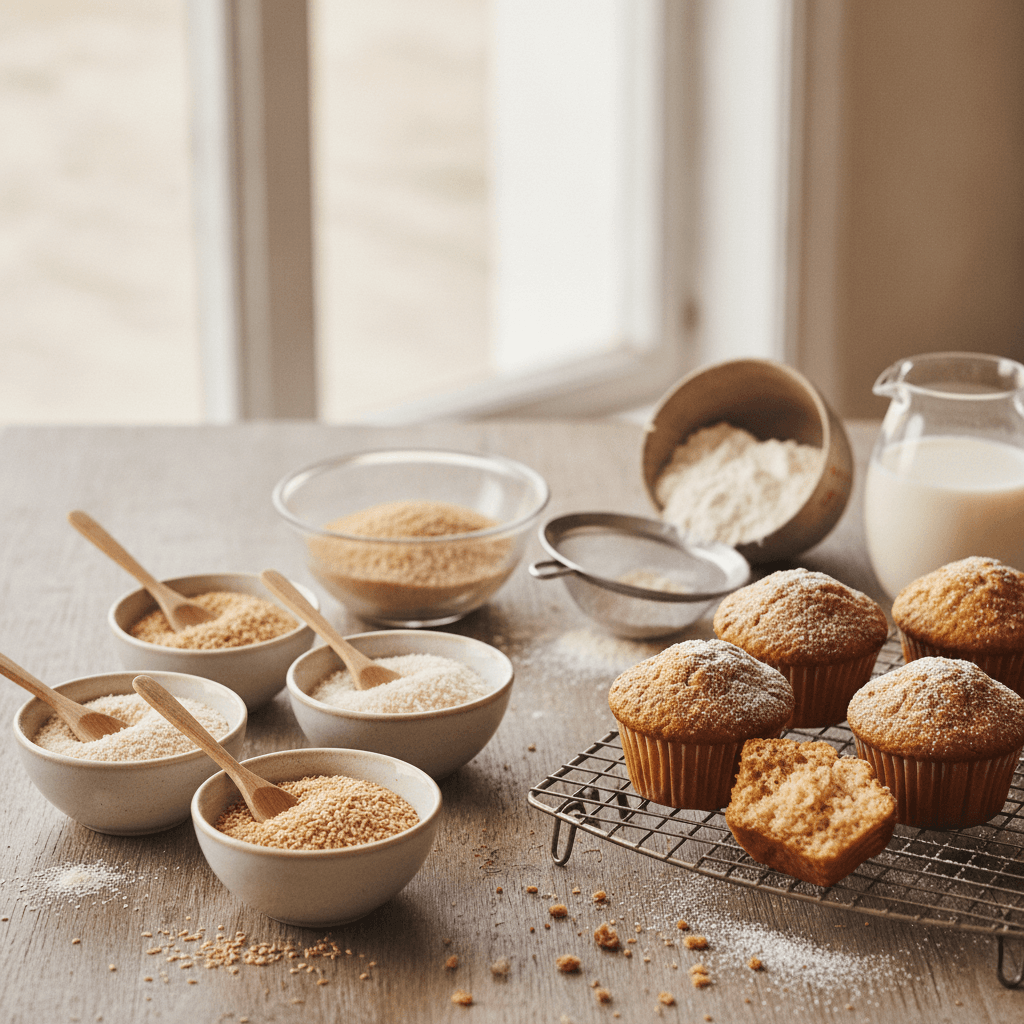
Adding bran to your baking is one of the simplest ways to boost fiber without overhauling an entire recipe — but the type of bran, the amount, and the application all matter more than most resources let on. Here's what actually works, what doesn't, and the ratios that keep your baked goods from turning into cardboard.
Key takeaways
- Bran is not a flour replacement — it's a supplement. Swapping more than about 25% of your total flour weight with bran typically produces dense, crumbly results.
- Wheat bran, oat bran, and rice bran each behave differently in dough and batter. They absorb different amounts of liquid and contribute different textures.
- Oat bran is the most forgiving option for beginners because it absorbs moisture more evenly and produces a softer crumb than wheat bran.
- Soaking or hydrating bran before mixing it into batter reduces grittiness and helps it integrate without stealing moisture from the rest of the recipe.
- Bran additions work best in muffins, quick breads, and pancakes. Delicate items like sponge cakes and pastry doughs are the hardest to adapt.
What bran actually is (and why it's not flour)
Bran is the hard outer layer of a cereal grain — the part that gets stripped away when whole grains are refined into white flour. It's rich in insoluble fiber, and depending on the grain, it also contains B vitamins, minerals, and some protein. But it has almost no starch and zero gluten-forming proteins, which means it can't do what flour does structurally.
When you add bran to a recipe, you're essentially adding a non-structural ingredient that competes for moisture. That's the core tension in high-fiber baking: more fiber means more water absorption, less gluten development (in wheat-based recipes), and a heavier crumb. Understanding this trade-off is the difference between a pleasantly hearty muffin and a dry brick.
If you're exploring other ways to increase fiber in baked goods, our guide to high fiber flour alternatives for baking covers full flour swaps rather than supplemental additions.
5 types of bran compared for baking
Not all bran behaves the same way in a mixing bowl. Here's how the five most common types stack up.
| Bran type | Fiber per 1/4 cup (approx.) | Texture impact | Best used in | Gluten-free? |
|---|---|---|---|---|
| Wheat bran | ~6g | Coarse, slightly gritty | Muffins, quick breads | No |
| Oat bran | ~4g | Softer, slightly chewy | Muffins, pancakes, cookies | Only if certified GF |
| Rice bran | ~3g | Fine, mild | Cakes, cookies, pancakes | Yes |
| Corn bran | ~8g | Very coarse, crunchy | Cornbread, rustic muffins | Yes |
| Flax bran (ground flaxseed meal) | ~4g | Slightly gummy when hydrated | Quick breads, muffins | Yes |
A few things stand out. Corn bran packs the most fiber per serving, but it's also the most texturally aggressive — it stays crunchy even after baking, which limits where you can use it. Rice bran is the mildest and finest, making it the easiest to hide in a recipe, but it contributes less fiber per gram. Wheat bran sits in the middle and is the most widely available, which is why most high-fiber baking guides default to it.
A note on oat bran and gluten-free baking
Oats are naturally gluten-free, but they're frequently cross-contaminated with wheat during processing. If you're baking for someone with celiac disease, only use oat bran that carries a certified gluten-free label. Brands like Bob's Red Mill sell certified gluten-free oat bran specifically for this reason. For more on handling cross-contamination and texture issues in gluten-free baking, our gluten-free learn page covers the basics.
How much bran can you actually add before things fall apart?
This is the question that matters most, and the answer depends on what you're baking.
The general guideline across most baking references: replace no more than 25% of the flour weight with bran. Beyond that threshold, the structural problems become hard to fix without significant recipe reformulation.
But that 25% ceiling isn't universal. Here's how it breaks down by application:
Muffins and quick breads: up to 25%
These are the most forgiving category. Muffins already tolerate a dense, moist crumb, so adding bran at 20-25% of the flour weight generally works without major adjustments. A recipe calling for 240g of all-purpose flour can handle about 50-60g of wheat or oat bran swapped in for an equal weight of flour. You'll likely need to add an extra tablespoon or two of liquid (milk, buttermilk, or yogurt) to compensate for the bran's moisture absorption.
Cookies: 10-15%
Cookies are more sensitive because their structure relies on a delicate balance of fat, sugar, and flour. Adding too much bran makes cookies sandy and crumbly rather than chewy. Oat bran works better than wheat bran here because its finer texture integrates more smoothly. At 10-15% substitution, most drop cookie recipes still hold together.
Yeast breads: 10-20%
Bran interferes with gluten development in yeast-risen doughs. The sharp edges of bran particles can physically cut gluten strands, which is why bran-heavy bread doughs often produce loaves with poor rise and a dense, heavy crumb. Keeping bran at 10-15% of total flour weight is safer for sandwich-style loaves. Heartier, denser breads (like whole wheat boules) can tolerate up to 20%. If you're already working with whole wheat flour substitutes, be aware that adding bran on top of an already fiber-rich flour can push you past the point of diminishing returns.
Cakes and delicate pastries: 5-10% at most
Sponge cakes, chiffon cakes, and laminated pastries are the hardest to adapt. These depend on a light, airy crumb that bran actively works against. If you want to add fiber to a cake, rice bran is the best option because of its fine particle size, and even then, keep it under 10% of the flour weight. Anything more and the crumb becomes noticeably heavier.
The soaking trick that fixes most texture problems
One of the most effective techniques for baking with bran is pre-soaking — and it's underused. Here's why it matters.
Dry bran dropped into a batter will absorb moisture from the surrounding dough during mixing and baking. This creates two problems: the bran particles stay gritty because they don't fully hydrate, and the rest of the batter gets drier because the bran is pulling liquid away from the starch and gluten.
Pre-soaking solves both issues. Mix the bran with an equal weight of liquid (the milk, buttermilk, or water from your recipe) and let it sit for 15-30 minutes before combining it with the other ingredients. The bran softens, the liquid gets absorbed in a controlled way, and the final texture is noticeably smoother.
This technique works especially well with wheat bran, which is the coarsest of the common options. Oat bran benefits from soaking too, though it hydrates faster — even 10 minutes makes a difference. Rice bran, being much finer, doesn't need soaking in most applications.
If you sell high-fiber muffins, this step is worth building into your routine: pre-soaking wheat bran in buttermilk for about 20 minutes before mixing gives a noticeably more tender crumb, and listing the fiber content on your labels can be a selling point.

Written by
Co-founder, BakingSubs
Co-founder of BakingSubs, where he turns the science of ingredient substitutions into tested, reliable guidance for home bakers.
Related Posts
7 Common Healthy Baking Mistakes That Ruin Texture (and How to Fix Each One)
7 Texture Changes With Health Swaps That Catch Bakers Off Guard (and How to Handle Each One)
Gluten-Free Flour Weight Chart: Grams per Cup for 9 Major Brands (and Why the Spread Is Over 20%)
Bake with Confidence
See all
Confident Gluten-Free Baker Toolkit
The science-based system that replaces gluten's seven invisible jobs so your baking turns out soft, fluffy, and foolproof — every time.

Gluten-Free Recipe Vault
Instant access to our complete library of proven gluten-free recipes — no waiting, no guesswork, just results that work tonight.

Fix Your Gluten-Free Bread
Learn the 3-step formula to make bread rise and stay soft, discover why your loaves collapse, and get a tested sandwich bread recipe that actually works.