

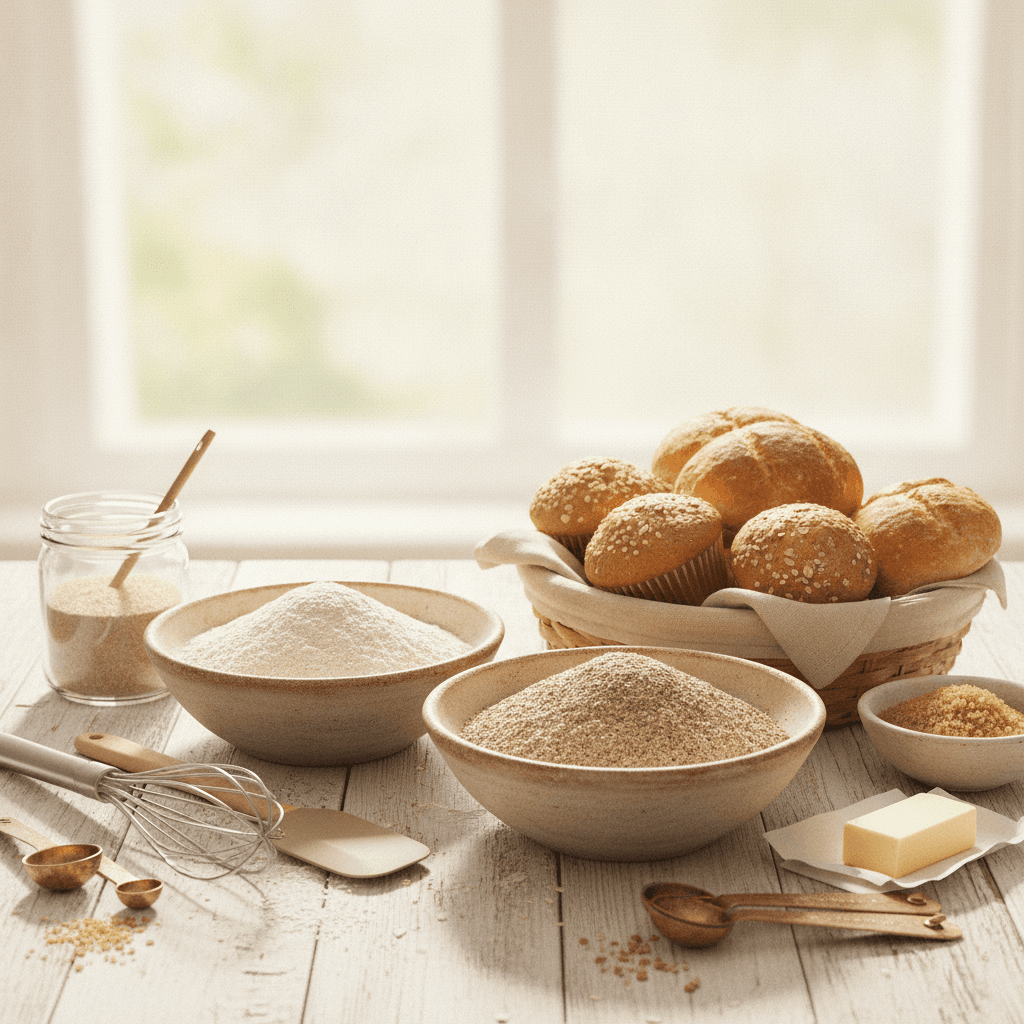
Swapping whole wheat flour for white flour sounds straightforward until you pull a dense, gummy loaf out of the oven. The two flours behave differently in almost every way that matters — protein content, absorption, flavor, and how they interact with leaveners. Here are seven substitutes that actually work, with the specific ratios and adjustments each one needs.
Key takeaways
- You can replace white flour with whole wheat flour at a 1:1 ratio by weight, but you will likely need to add 1–2 extra tablespoons of liquid per cup of whole wheat flour to compensate for higher absorption.
- White whole wheat flour is the closest drop-in substitute — same nutrition as red whole wheat, milder flavor, lighter color.
- Spelt flour substitutes at a 1:1 ratio but has weaker gluten, so reduce mixing time by roughly 25% to avoid a crumbly result.
- For gluten-free baking, a blend of brown rice flour, tapioca starch, and potato starch mimics white flour's behavior better than any single flour alone.
- Oat flour works well in cookies and quick breads but produces a noticeably denser crumb in yeast-risen bread.
- Almond flour and coconut flour are not 1:1 swaps — they require significant recipe restructuring, especially with eggs and liquid.
Why whole wheat and white flour behave so differently
White flour (also called all-purpose or refined flour) is milled from just the starchy endosperm of the wheat kernel. Whole wheat flour includes the bran, germ, and endosperm — all three parts. That bran is the troublemaker. It absorbs more water, physically cuts through gluten strands during kneading, and adds a stronger, sometimes bitter flavor.
The protein content differs too. Most all-purpose flour runs around 10–12% protein. Whole wheat flour typically lands at 13–14%. Higher protein means more gluten development potential, but the bran interference often offsets that advantage, leaving you with a denser, heavier bake.
Understanding this is the key to making any substitute work: you are not just swapping flavor. You are changing absorption, structure, and rise.
The 7 best whole wheat flour substitutes for white flour
1. White whole wheat flour — the closest swap
White whole wheat flour is milled from hard white wheat berries instead of the hard red wheat berries used in traditional whole wheat flour. It has the same nutritional profile — bran, germ, endosperm all included — but a noticeably milder, sweeter flavor and lighter color.
Use it at a straight 1:1 ratio by weight. You may still need a small bump in liquid (about 1 tablespoon per cup of flour) since it still contains bran. It is a popular choice for muffins because most people find it hard to tell apart from refined flour versions. If you are selling baked goods and want to market a "whole grain" option without alienating anyone, white whole wheat flour is the path of least resistance.
King Arthur Baking's white whole wheat flour and Bob's Red Mill white whole wheat flour are both widely available. King Arthur's version tends to have a slightly finer grind, which can produce a less gritty texture in delicate bakes like pancakes.
2. Spelt flour — lighter texture, nuttier flavor
Spelt flour is an ancient wheat variety with a protein content similar to all-purpose flour (around 11–13%) but a weaker gluten structure. It substitutes at 1:1 by weight, and the resulting baked goods tend to be lighter and more tender than those made with standard whole wheat flour.
The catch: spelt's gluten breaks down faster with mixing. If you knead spelt bread dough for the same 10–12 minutes you would use for regular wheat bread, you will likely end up with a crumbly loaf. Cut your mixing or kneading time by roughly 25%. Spelt also absorbs slightly less liquid than whole wheat flour, so start with about 1 tablespoon less liquid per cup and adjust from there.
Spelt is not gluten-free. People with celiac disease or non-celiac gluten sensitivity should avoid it entirely.
3. Oat flour — great for cookies, tricky for bread
Oat flour is simply ground rolled oats. You can buy it or make it by pulsing rolled oats in a blender for about 30 seconds until fine. It adds a mild, slightly sweet flavor and works beautifully in cookies, muffins, pancakes, and quick breads.
For cookies and quick breads, substitute at 1:1 by weight (or use about 1 1/3 cups oat flour for every 1 cup of white flour by volume, since oat flour is lighter). The texture will be slightly more tender and crumbly because oat flour contains no gluten.
For yeast breads, oat flour alone will not give you the structure you need. You would need to blend it with a gluten-containing flour — something like 25% oat flour and 75% bread flour — to get a reasonable rise.
If you need oat flour to be gluten-free, look for oats specifically labeled "certified gluten-free." Standard oats are frequently cross-contaminated with wheat during processing. Our gluten-free baking guide covers cross-contamination risks in more detail.
4. Brown rice flour — a solid gluten-free base
Brown rice flour is one of the most common gluten-free alternatives to white flour. It has a mild flavor, decent protein content for a GF flour, and a slightly gritty texture that works well in heartier baked goods.
Brown rice flour does not substitute at a simple 1:1 for white flour on its own. Used alone, it produces a dry, crumbly, and often gritty result. The standard approach in gluten-free baking is to blend it with starches:
| Ingredient | Proportion (by weight) | Role |
|---|---|---|
| Brown rice flour | 40% | Structure, protein |
| Tapioca starch | 30% | Chewiness, binding |
| Potato starch | 30% | Moisture, lightness |
This blend can then be used roughly 1:1 by weight in place of white flour, though most gluten-free bakers also add a binder like xanthan gum (about 1/2 teaspoon per cup of flour blend for cookies and cakes, 1 teaspoon for bread). Without a binder, gluten-free baked goods tend to crumble apart. If you are troubleshooting texture issues, our guide on dry and crumbly gluten-free bakes walks through the most common causes.
5. Almond flour — high fat, no gluten, different rules
Almond flour is ground blanched almonds. It is naturally gluten-free, grain-free, and high in fat. That fat content (roughly 50% by weight) is what makes almond flour baked goods moist and rich — but it also means you cannot treat it like a grain flour at all.
Almond flour is not a 1:1 substitute for white flour. It does not absorb liquid the same way, it does not form structure, and it does not rise predictably with standard leavener amounts. As a general starting point, you can try replacing up to 25% of white flour with almond flour in a conventional recipe without major restructuring. Beyond that, you are essentially working with a different recipe.
For fully almond-flour-based baking (like French macarons or flourless cakes), the recipe needs to be designed around almond flour from the start, typically relying on eggs for structure rather than gluten. This is one of those substitutions where following a purpose-built recipe matters more than trying to convert an existing one.
6. Coconut flour — the most absorbent option
Coconut flour absorbs roughly 3–4 times more liquid than white flour. That single fact makes it the trickiest substitute on this list. If you try to use it at 1:1, you will end up with something closer to a brick than a baked good.
The general guideline is to use about 1/4 to 1/3 cup of coconut flour for every 1 cup of white flour, and then add a significant amount of extra liquid and eggs. Most coconut flour recipes call for 1 egg per roughly 28g (1 ounce) of coconut flour to provide both moisture and structure.
Coconut flour also imparts a mild coconut flavor that works in some applications (banana bread, tropical muffins) and clashes in others (savory bread, plain dinner rolls). Like almond flour, it is best used in recipes specifically developed for it rather than as a drop-in swap.
7. Cassava flour — the grain-free, nut-free option
Cassava flour is made from the whole cassava root, dried and ground fine. Unlike tapioca starch (which is extracted from cassava), cassava flour contains fiber and behaves more like a grain flour. It is grain-free, nut-free, and gluten-free.
Cassava flour can often be substituted at close to 1:1 by weight for white flour, which makes it one of the easier gluten-free swaps. The texture it produces is slightly chewier and denser than white flour, and it can become gummy if overmixed. It works well in tortillas, flatbreads, and simple cakes.
One contrarian point worth making: cassava flour gets recommended constantly as a "perfect" 1:1 swap, but in practice, it behaves noticeably differently from wheat flour in anything with a delicate crumb — think angel food cake or chiffon. For those applications, a rice flour and starch blend (option 4 above) typically performs better despite requiring more components.
Otto's Naturals is a well-known brand with a consistent grind. Anthony's is a more budget-friendly option.
Quick comparison: all 7 substitutes at a glance
| Substitute | Gluten-free? | Swap ratio (for white flour) | Best for | Watch out for |
|---|---|---|---|---|
| White whole wheat flour | No | 1:1 (add 1 Tbsp liquid/cup) | Everything — closest match | Still contains bran; slightly denser |
| Spelt flour | No | 1:1 (reduce liquid slightly) | Bread, muffins, pancakes | Weak gluten; reduce mixing time |
| Oat flour | Only if certified GF | 1:1 by weight | Cookies, quick breads, pancakes | No gluten; poor for yeast bread alone |
| Brown rice flour blend | Yes | 1:1 (as blend with starches) | Most baked goods with binder | Gritty alone; needs starch partners |
| Almond flour | Yes | Not 1:1; up to 25% partial swap | Macarons, flourless cakes, cookies | High fat; needs recipe redesign |
| Coconut flour | Yes | 1/4 to 1/3 cup per 1 cup white | Quick breads, muffins | Extremely absorbent; needs extra eggs |
| Cassava flour | Yes | Close to 1:1 by weight | Tortillas, flatbreads, simple cakes | Can turn gummy; not great for delicate crumb |
How to adjust your recipe when substituting flour
No matter which substitute you choose, these four adjustments apply broadly:
Weigh your flour. Volume measurements (cups) are unreliable across flour types because they have different densities. A cup of coconut flour weighs about 112g. A cup of all-purpose flour weighs about 120–130g. A cup of almond flour weighs about 96g. Using a kitchen scale eliminates the guesswork entirely.
Adjust liquid gradually. Whole grain and high-fiber flours absorb more water. Rather than dumping in extra liquid all at once, add 1 tablespoon at a time and check the dough or batter consistency before adding more. You are looking for the same consistency the original recipe produces with white flour.
Let the batter rest. This is especially important with whole wheat, oat, and brown rice flour. A 20–30 minute rest after mixing allows the bran and fiber to fully hydrate, which improves texture and reduces grittiness. Skip this step and you will often get a drier, coarser crumb. Our guide on gritty texture in gluten-free baking explains why hydration time matters so much.
Expect a color and flavor shift. Whole wheat flour produces a darker crumb and a nuttier, sometimes slightly bitter taste. Oat flour adds sweetness. Coconut flour adds coconut notes. None of these are problems, but they are worth anticipating — especially if you are baking for customers who ordered something specific. If you run a home bakery and are considering offering whole wheat or alternative flour options, think about how that fits your product lineup strategy.
When to use a partial swap instead of going all-in
Here is a piece of advice that goes against most substitution guides: for many baked goods, a 50/50 blend of whole wheat (or alternative flour) and white flour produces a better result than a full swap. You get some of the nutritional and flavor benefits without the structural downsides.
This is particularly true for:
- Yeast breads — 50% whole wheat, 50% bread flour gives you a wheaty flavor with a much better rise than 100% whole wheat.
- Cakes — 50% white whole wheat, 50% cake flour keeps the crumb tender while adding whole grain nutrition.
- Cookies — 50% oat flour, 50% all-purpose flour produces a cookie with great flavor and a texture that holds together on a cooling rack.
If you sell at farmers markets, a chocolate chip cookie made with a 50/50 oat flour and all-purpose blend can be labeled "whole grain" on your signage, which may appeal to health-conscious customers. If you are thinking about pricing baked goods for market, a whole grain angle can sometimes justify a modest premium.
Common mistakes when substituting whole wheat for white flour
Not increasing liquid. This is the number-one reason whole wheat substitutions fail. The bran in whole wheat flour can absorb 2–3 times its weight in water. If you use the same liquid amount as the original recipe, you will get a dry, crumbly result every time.
Overmixing. Bran particles physically cut gluten strands. The more you mix, the more damage they do. With whole wheat flour, mix until just combined — no more. With spelt, this is even more critical.
Skipping the rest period. Whole wheat batters and doughs benefit enormously from a 20–30 minute rest (sometimes called an autolyse in bread baking). This lets the bran soften and the flour fully hydrate, resulting in a more cohesive, less gritty final product.
Using the same bake time and temperature. Whole grain baked goods tend to brown faster because of the sugars in the bran and germ. Check for doneness 5–10 minutes earlier than the original recipe suggests, and consider dropping your oven temperature by about 25°F (roughly 15°C).
Expecting identical results. No substitute will perfectly replicate white flour's light, neutral, fluffy characteristics. Accepting a slightly different — and often richer — result is part of working with whole grain and alternative flours.
Frequently asked questions
Can I substitute whole wheat flour for white flour in any recipe?
Technically yes, but the results will vary. Whole wheat flour works as a 1:1 swap by weight in most recipes, but you will need to add extra liquid (about 1–2 tablespoons per cup) and expect a denser, darker result. For delicate recipes like angel food cake or chiffon, a partial swap (25–50%) produces better results than a full replacement.
What is the best whole wheat flour substitute for white flour in cookies?
Oat flour and white whole wheat flour are the two best options for cookies. Oat flour adds a mild sweetness and tender texture. White whole wheat flour gives you whole grain nutrition with a milder flavor than red whole wheat. A 50/50 blend of either with all-purpose flour is a reliable starting point.
Is spelt flour healthier than whole wheat flour?
Spelt and whole wheat flour have similar nutritional profiles — both are whole grains with comparable amounts of protein, fiber, and micronutrients. Spelt may be slightly easier to digest for some people due to its different gluten structure, but it is not safe for anyone with celiac disease. The choice between them is more about flavor and texture preference than a significant nutritional difference.
What is the best gluten-free substitute for white flour?
A blend of brown rice flour (40%), tapioca starch (30%), and potato starch (30%) is the most versatile gluten-free substitute. It mimics white flour's behavior in most baked goods when combined with a small amount of xanthan gum as a binder. Cassava flour is a simpler single-flour option that works close to 1:1 in less delicate applications.
Do I need to add xanthan gum when using whole wheat flour instead of white flour?
No. Whole wheat flour contains gluten, so it does not need xanthan gum or any other binder. Xanthan gum is only necessary when using gluten-free flours (like rice flour, almond flour, or oat flour from certified GF oats) that lack the gluten network needed to hold baked goods together. See our xanthan gum guide for specific amounts by baked good type.

Written by
Co-founder, BakingSubs
Co-founder of BakingSubs, where he turns the science of ingredient substitutions into tested, reliable guidance for home bakers.
Related Posts

Bake with Confidence
See all
Confident Gluten-Free Baker Toolkit
The science-based system that replaces gluten's seven invisible jobs so your baking turns out soft, fluffy, and foolproof — every time.

Gluten-Free Recipe Vault
Instant access to our complete library of proven gluten-free recipes — no waiting, no guesswork, just results that work tonight.

Fix Your Gluten-Free Bread
Learn the 3-step formula to make bread rise and stay soft, discover why your loaves collapse, and get a tested sandwich bread recipe that actually works.