

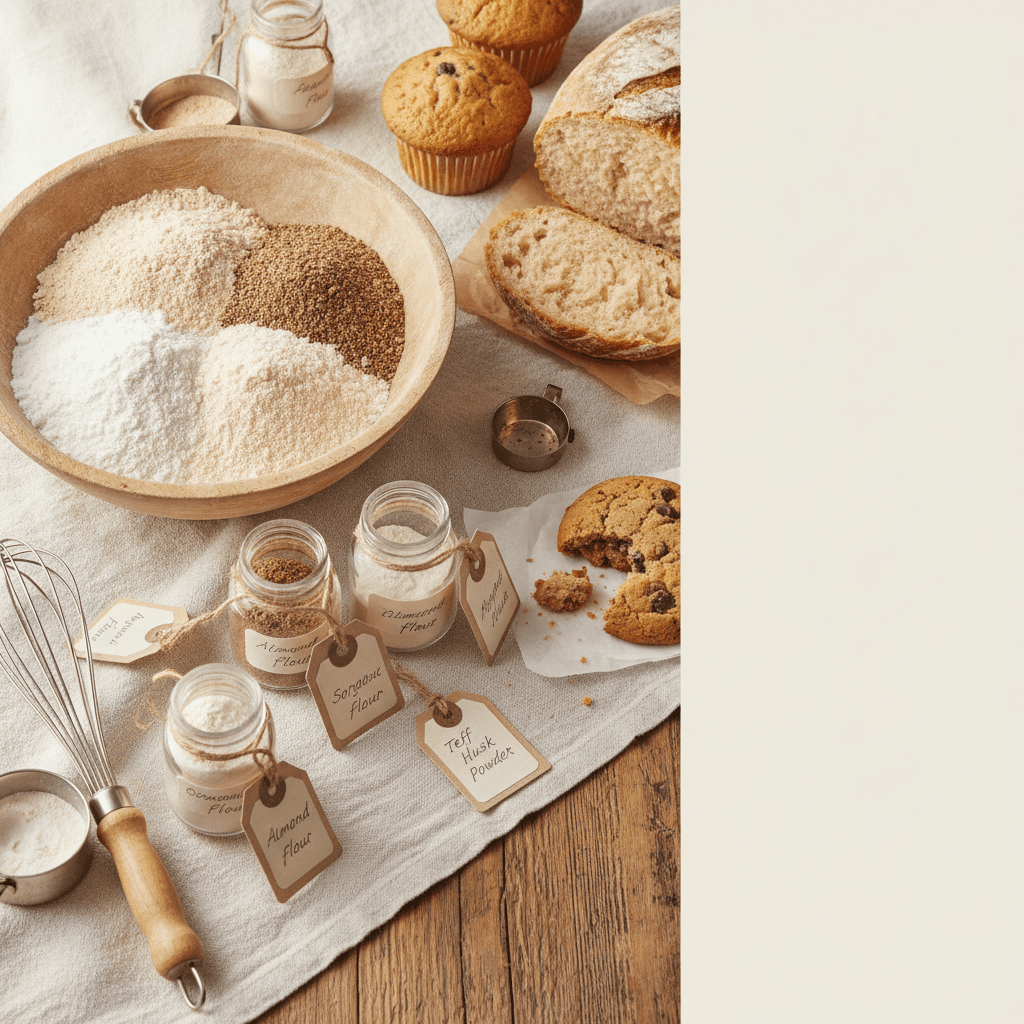
Most bakers reach for all-purpose flour without thinking twice, but if you need more fiber in your baked goods — whether for health reasons, dietary restrictions, or better texture in gluten-free baking — swapping in a high fiber flour changes everything from hydration to rise to crumb structure. Here are seven alternatives worth knowing, along with the specific situations where each one shines.
Key takeaways
- Not all high fiber flours behave the same way — some absorb significantly more liquid than all-purpose flour, and others contribute strong flavors that limit their use.
- Coconut flour absorbs roughly 3 to 4 times as much liquid as wheat flour, making it the most hydration-hungry option on this list.
- Oat flour is one of the easiest high fiber swaps for conventional baking because its flavor is mild and its absorption rate is relatively predictable.
- Almond flour adds fiber and fat but almost no starch, so it cannot replace wheat flour 1:1 in most applications without structural changes.
- Blending two or three high fiber flours together typically produces better results than relying on a single alternative.
- If you are baking gluten-free, pairing a high fiber flour with a binding agent like psyllium husk or xanthan gum is usually necessary to prevent crumbling.
Why high fiber flour alternatives matter for baking
Fiber does more than add nutritional value. In baking, fiber-rich flours affect moisture retention, shelf life, and crumb density in ways that standard refined flours do not. A muffin made with a portion of oat flour, for example, tends to stay moist longer than one made entirely with all-purpose flour because the soluble fiber in oats holds onto water during and after baking.
For gluten-free bakers especially, high fiber alternatives solve a common complaint: baked goods that go stale within hours. If you have been struggling with quick staling in gluten-free baking, adding a fiber-rich flour to your blend can meaningfully extend freshness.
The tradeoff is that high fiber flours rarely work as simple 1:1 swaps. Each one has a different protein content, fat content, starch level, and absorption rate. Understanding those differences is what separates a dense, gummy loaf from something you would actually want to eat.
7 high fiber flour alternatives compared
| Flour | Fiber per 1/4 cup (approx.) | Gluten-free | Best for | Watch out for |
|---|---|---|---|---|
| Coconut flour | 10g | Yes | Pancakes, muffins, quick breads | Extreme liquid absorption |
| Almond flour | 3g | Yes | Cookies, cakes, crusts | High fat, no starch structure |
| Oat flour | 4g | Yes (if certified GF) | Muffins, cookies, pancakes | Can turn gummy if overmixed |
| Buckwheat flour | 4g | Yes | Pancakes, rustic breads, crepes | Strong earthy flavor |
| Teff flour | 4g | Yes | Flatbreads, brownies, dark breads | Distinct malty taste, dark color |
| Chickpea flour | 5g | Yes | Savory baking, flatbreads, dense cakes | Beany taste if undercooked |
| Whole wheat flour | 4g | No | Bread, muffins, pizza dough | Contains gluten, heavier crumb |
The fiber numbers above are approximate and vary by brand, but they give you a useful baseline for comparison. Standard all-purpose flour has less than 1g of fiber per quarter cup, so even the lowest-fiber options on this list represent a significant jump.
Coconut flour: the fiber heavyweight that needs extra eggs
Coconut flour packs more fiber per serving than any other baking flour commonly available — roughly 10g per quarter cup. That fiber content is the reason coconut flour absorbs so much liquid. Bakers who try to substitute it cup-for-cup with all-purpose flour end up with something closer to a brick than a muffin.
A widely cited guideline is to use about one-third to one-quarter the amount of coconut flour compared to wheat flour, then increase the eggs or other liquid substantially. For a recipe calling for 1 cup of all-purpose flour, you might use 1/4 to 1/3 cup of coconut flour and add 2 to 4 extra eggs depending on the recipe type.
Coconut flour works well in quick breads, pancakes, and muffins where a slightly denser, more cake-like crumb is acceptable. It has a mild sweetness that pairs naturally with tropical flavors, chocolate, and banana. Where it struggles is in anything that needs a light, airy structure — think angel food cake or croissants.
One thing that catches people off guard: coconut flour continues to absorb moisture after mixing. If your batter looks right immediately after combining, it may thicken considerably within 5 to 10 minutes. Letting the batter rest briefly before baking gives you a more accurate sense of the final consistency.
Almond flour: high fat, moderate fiber, excellent texture
Almond flour is one of the most popular gluten-free and high fiber alternatives, though its fiber content is moderate compared to coconut flour. Its real strength is the fat content — roughly 14g per quarter cup — which creates a tender, moist crumb that mimics the richness of butter-heavy recipes.
That richness comes at a cost. Almond flour costs $0.50 to $0.75 per ounce compared to $0.03 to $0.05 per ounce for all-purpose flour. That is a 10x to 15x ingredient cost difference that has to show up somewhere in the pricing, so if you sell almond flour cookies, price them above your standard cookies.
Almond flour excels in cookies, pie crusts, and cakes where a slightly dense, rich texture is desirable. It does not work well in bread or anything that needs significant rise because it contains almost no starch and no gluten — the two things that create structure in traditional bread baking. If you are getting a poor rise in gluten-free baking, almond flour on its own will not solve the problem.
Blanched vs. unblanched for fiber
Unblanched almond flour (made with the skins on) has more fiber than blanched. If fiber is your primary goal, choose unblanched. If appearance and a smoother texture matter more — say, for macarons or light-colored cakes — blanched is the better choice despite the slightly lower fiber content.
Oat flour: the easiest swap for conventional bakers
Oat flour is simply ground oats, and you can make it at home by pulsing rolled oats in a blender or food processor for about 30 seconds. It has a mild, slightly sweet flavor that does not overpower other ingredients, which makes it one of the most versatile high fiber alternatives.
The soluble fiber in oats — specifically beta-glucan — gives oat flour a slight binding quality that other gluten-free flours lack. This does not replace the need for xanthan gum or psyllium husk in gluten-free baking, but it does mean oat flour produces a less crumbly result than, say, rice flour on its own.
One important note: oats are naturally gluten-free, but they are frequently cross-contaminated with wheat during processing. If you are baking for someone with celiac disease, you need oats that are certified gluten-free. Bob's Red Mill and Avena Foods both produce certified gluten-free oat flour. Regular grocery store oats are not safe for celiac bakers.
Oat flour can replace up to about half the all-purpose flour in most muffin and cookie recipes without dramatic changes to the outcome. Going beyond 50% usually requires adjustments to liquid and leavening. If you are running a home bakery and want to offer a higher-fiber option without completely reworking your recipes, a partial oat flour swap is one of the lowest-risk changes you can make. If you are thinking about whether to specialize or sell variety, a fiber-focused product line using oat flour could be a meaningful differentiator.
Buckwheat flour: earthy flavor, strong nutritional profile
Despite the name, buckwheat is not related to wheat and is completely gluten-free. It is a pseudocereal — a seed that is milled like a grain. Buckwheat flour has about 4g of fiber per quarter cup along with a notable amount of protein, making it one of the more nutritionally complete alternative flours.
The flavor is the main consideration. Buckwheat has a strong, earthy, almost nutty taste that some people love and others find overpowering. It works beautifully in pancakes, galettes, and rustic dark breads where that flavor is an asset. In a delicate vanilla cake, it would be a distraction.
Light buckwheat flour (sometimes labeled "fancy" buckwheat) has a milder flavor than dark buckwheat flour, which includes more of the hull. If you are new to buckwheat, start with the light variety and blend it with a neutral flour like white rice flour or tapioca starch.
Teff flour and chickpea flour: two underused options
Teff flour comes from the world's smallest grain, a staple in Ethiopian cuisine where it is used to make injera. It has about 4g of fiber per quarter cup and a distinctive malty, slightly sweet flavor. Teff works well in brownies, chocolate cakes, and dark breads where its color and flavor complement the other ingredients. It is less suited to light, delicate baked goods.
Chickpea flour (also called garbanzo bean flour or besan) is a legume flour with roughly 5g of fiber per quarter cup and a high protein content. It is widely used in savory baking — flatbreads, socca, and savory pancakes — but can also work in denser sweet baked goods like blondies or banana bread. The main challenge is a raw, beany taste that only disappears with thorough cooking. Underbaked chickpea flour goods taste unpleasant, so err on the side of longer bake times.
Both of these flours are best used as part of a blend rather than as the sole flour in a recipe. A common approach is to use 20% to 30% teff or chickpea flour combined with a starch (like arrowroot or tapioca) and a milder flour (like white rice flour).
Whole wheat flour: the simplest high fiber option (if gluten is not a concern)
For bakers who do not need to avoid gluten, whole wheat flour is the most straightforward way to add fiber. It contains the bran, germ, and endosperm of the wheat kernel, giving it about 4g of fiber per quarter cup compared to less than 1g in refined all-purpose flour.
The bran in whole wheat flour cuts through gluten strands during kneading, which is why 100% whole wheat bread tends to be denser and heavier than white bread. Many bakers find a 50/50 blend of whole wheat and all-purpose flour gives the best balance of fiber and texture.
White whole wheat flour — milled from hard white wheat instead of hard red wheat — has the same fiber content as regular whole wheat but a milder, less bitter flavor. It is worth seeking out if you want the nutritional benefits without the strong wheaty taste.
How to blend high fiber flours for better results
Single-flour baking with high fiber alternatives almost always produces inferior results compared to a thoughtful blend. The reason is simple: each flour brings strengths and weaknesses, and blending lets you balance them.
A basic framework for gluten-free high fiber blends:
- Base flour (40-50%): Something relatively neutral with some starch — brown rice flour, oat flour, or sorghum flour
- High fiber flour (20-30%): Coconut, almond, buckwheat, teff, or chickpea flour
- Starch (20-30%): Tapioca starch, arrowroot powder, or potato starch for lightness and binding
- Binder (small amount): Xanthan gum, guar gum, or psyllium husk to replace the structural role of gluten
This is a starting framework, not a rigid formula. The proportions shift depending on what you are baking. Bread needs more structure and binding. Cookies need less. Pancakes are forgiving. Pastry is not.
If your gluten-free baked goods are coming out with a gritty texture, the problem is often too much of a coarsely ground flour (like almond or buckwheat) and not enough starch to smooth things out.
The contrarian take: more fiber is not always better
There is a ceiling to how much fiber you can add to baked goods before the texture becomes unacceptable to most people. A muffin with 8g of fiber per serving can taste great. A muffin with 15g of fiber per serving usually tastes like cardboard held together with hope.
The baking community sometimes treats fiber as an unqualified good — more is always better. But baked goods are not supplements. They need to taste good enough that people actually eat them, or the fiber content is irrelevant. If you are selling high fiber baked goods through a farmers market booth or home bakery, the repeat orders come from flavor and texture, not from the nutrition label.
A more practical goal is to increase fiber modestly — replacing 30% to 50% of the refined flour in a recipe with a high fiber alternative — rather than trying to maximize fiber at the expense of everything else.
Cost considerations for home bakers
High fiber flours cost significantly more than all-purpose flour. Here is a rough comparison based on typical retail pricing:
| Flour | Approximate cost per pound |
|---|---|
| All-purpose flour | $0.50 - $0.80 |
| Whole wheat flour | $0.80 - $1.50 |
| Oat flour | $1.50 - $3.00 |
| Buckwheat flour | $3.00 - $5.00 |
| Coconut flour | $3.00 - $5.00 |
| Almond flour | $6.00 - $10.00 |
| Teff flour | $5.00 - $8.00 |
| Chickpea flour | $2.00 - $4.00 |
These prices vary by brand, region, and whether you buy in bulk. But the pattern is clear: switching to high fiber flours can increase your ingredient costs by 3x to 10x for the flour component alone. If you are running a home bakery, that cost difference needs to be reflected in your pricing. Check out our guide on whether your home bakery is actually profitable to make sure your margins hold up after an ingredient upgrade.
Making your own oat flour from rolled oats is one way to cut costs. A 2-pound canister of certified gluten-free rolled oats typically costs $4 to $6 and yields roughly the same amount of flour. That is about half the price of pre-ground oat flour from specialty brands.
Frequently asked questions
What is the best high fiber flour for gluten-free baking?
Coconut flour has the highest fiber content of any commonly available baking flour, but oat flour (certified gluten-free) is the most versatile and easiest to work with. For most gluten-free bakers, a blend of oat flour with a starch like tapioca or arrowroot and a small amount of a higher-fiber flour like coconut or buckwheat produces the best results.
Can I substitute high fiber flour 1:1 for all-purpose flour?
In most cases, no. High fiber flours absorb more liquid, contribute different flavors, and lack the gluten structure of wheat flour. Coconut flour in particular cannot be swapped 1:1 — you typically need only one-quarter to one-third the amount. Oat flour and whole wheat flour come closest to a direct swap, but even those work best when replacing only 30% to 50% of the all-purpose flour in a recipe.
Does high fiber flour change the texture of baked goods?
Yes. Higher fiber generally means a denser, more moist crumb. Baked goods made with high fiber flours tend to be heavier than those made with refined flour. This can be a positive quality in muffins, banana bread, and brownies, but it works against you in recipes that need a light, airy structure like chiffon cake or puff pastry. Adding starch to your flour blend helps counteract some of the density.
Is almond flour high in fiber?
Almond flour has moderate fiber — about 3g per quarter cup — which is higher than all-purpose flour but lower than coconut flour, chickpea flour, or buckwheat flour. Its main nutritional contribution is healthy fat and protein rather than fiber. If maximizing fiber is your primary goal, coconut flour or chickpea flour are stronger choices.
How do I store high fiber flours to keep them fresh?
High fiber flours — especially nut-based ones like almond flour and whole grain flours like buckwheat — contain more fat than refined flour, which means they go rancid faster. Store them in airtight containers in the refrigerator for up to 3 months or in the freezer for up to 6 months. Bring them to room temperature before baking for more predictable results. Coconut flour and chickpea flour are more shelf-stable and can be stored in a cool, dry pantry.

Written by
Co-founder, BakingSubs
Co-founder of BakingSubs, where he turns the science of ingredient substitutions into tested, reliable guidance for home bakers.
Related Posts

Bake with Confidence
See all
Confident Gluten-Free Baker Toolkit
The science-based system that replaces gluten's seven invisible jobs so your baking turns out soft, fluffy, and foolproof — every time.

Gluten-Free Recipe Vault
Instant access to our complete library of proven gluten-free recipes — no waiting, no guesswork, just results that work tonight.

Fix Your Gluten-Free Bread
Learn the 3-step formula to make bread rise and stay soft, discover why your loaves collapse, and get a tested sandwich bread recipe that actually works.