

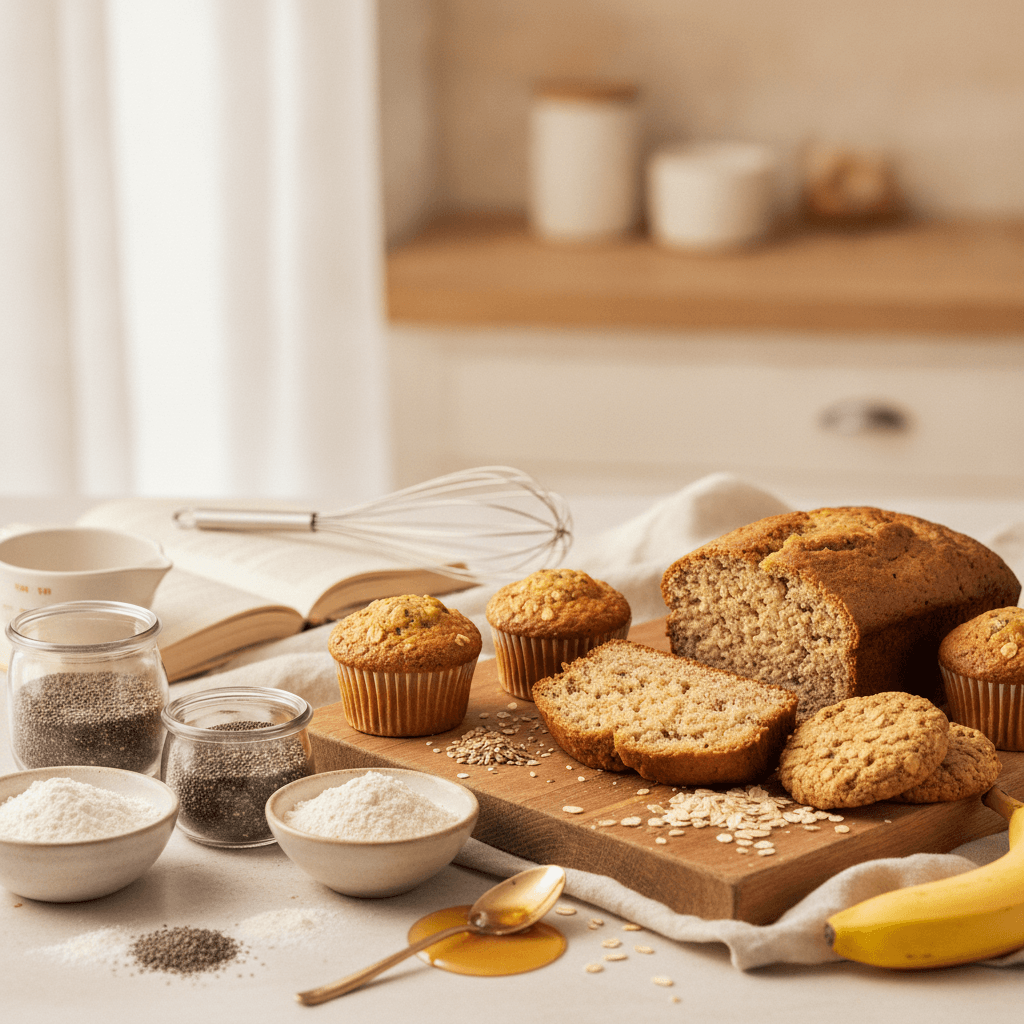
Most bakers who try to add fiber to their baked goods end up with dense, gritty, or dry results — not because fiber is inherently difficult to work with, but because different fiber sources behave in wildly different ways. Here are eight ingredients that reliably boost fiber content, along with the practical limits and tradeoffs each one brings to your batter or dough.
Key takeaways
- Fiber absorbs water at different rates depending on the source — psyllium husk can absorb roughly 10 times its weight in water, while wheat bran absorbs far less. Adjusting liquid is the single most important step.
- Replacing more than 25% of all-purpose flour with a high-fiber alternative in a standard recipe usually causes noticeable texture problems. Start at 10–15% and adjust from there.
- Soluble fiber sources (psyllium, oat fiber, inulin) affect moisture and binding. Insoluble fiber sources (wheat bran, flax meal) affect grittiness and density. Knowing which type you're adding determines what you need to fix.
- Ground flaxseed and chia seeds pull double duty as fiber boosters and egg substitutes, but they change texture in different ways — flax adds earthiness, chia adds crunch unless finely ground.
- Some fiber additions like inulin can cause digestive discomfort in amounts above about 10g per serving for many people, so more is not always better.
- Coconut flour is one of the highest-fiber flours available but absorbs roughly 3–4 times more liquid than all-purpose flour, making it a partial replacement only.
Why fiber changes baked goods (and why it matters which kind)
Fiber is not a single substance. It falls into two broad categories — soluble and insoluble — and each type does something different in your batter.
Soluble fiber dissolves in water and forms a gel-like consistency. Psyllium husk, oat beta-glucan, and inulin (chicory root fiber) all fall into this camp. They tend to add moisture retention and binding, which can actually improve texture in gluten-free baking. But they can also make baked goods gummy if you use too much.
Insoluble fiber does not dissolve. Wheat bran, the outer shell of flaxseeds, and cellulose-based fiber powders stay intact and create bulk. They can make baked goods feel coarser, drier, and denser if you don't compensate with extra liquid or fat.
The mistake most bakers make is treating all fiber the same. A tablespoon of psyllium husk and a tablespoon of wheat bran need completely different handling, even though both "add fiber."
8 ingredients that add fiber to baked goods
1. Psyllium husk powder
Psyllium husk powder is one of the most effective fiber additions for baking, especially in gluten-free applications where it serves as both a fiber source and a structural binder. It is almost entirely soluble fiber and absorbs roughly 10 times its weight in water, which means even small amounts — typically 1–2 teaspoons per cup of flour — have a significant impact on dough hydration.
The key limitation: too much psyllium makes baked goods slimy or gummy. If you're adding it purely for fiber rather than as a gluten substitute, keep the amount modest and increase your recipe's liquid by about 1 tablespoon per teaspoon of psyllium added. It works best in bread, muffins, and pancakes. In delicate items like sponge cakes, it can weigh down the crumb.
2. Ground flaxseed (flax meal)
Ground flaxseed adds about 2g of fiber per tablespoon, with a roughly even split between soluble and insoluble fiber. It also forms a gel when mixed with water, which is why it works as an egg replacement in baking — but that gel-forming property means it changes your batter's consistency even when you're not using it as an egg sub.
Flax meal adds an earthy, slightly nutty flavor that works well in whole-grain breads, muffins, and banana bread but can taste out of place in vanilla cakes or sugar cookies. A practical ceiling is about 3 tablespoons per cup of flour before the flavor and density become dominant. Always use ground flax, not whole seeds — whole seeds pass through without contributing much nutritionally and create an unpleasant crunch in most baked goods.
3. Chia seeds
Chia seeds are similar to flax in their dual role as fiber booster and binder, but they absorb even more liquid — roughly 12 times their weight. One tablespoon of chia seeds contains about 5g of fiber, making them one of the most fiber-dense additions available.
The catch is texture. Whole chia seeds create visible specks and a slight pop when bitten, which some people enjoy in muffins and quick breads but find distracting in cakes. Grinding chia into a fine powder before adding it eliminates the visual speckle and the crunch, but it also makes the gel-forming effect stronger, so you may need to add less. Start with 1 tablespoon of ground chia per cup of flour and add 2–3 tablespoons of extra liquid.
4. Oat fiber
Oat fiber is not the same as oat flour. Oat flour is ground from the whole oat groat and contains starch, protein, and fat. Oat fiber is made from the hull — the outer casing — and is almost pure insoluble fiber with virtually no calories, no starch, and no protein.
This makes oat fiber useful for adding bulk and fiber without significantly changing the calorie count, but it also means it contributes zero structure. You cannot replace more than about 20–25% of your flour with oat fiber without the final product becoming crumbly and dry. It absorbs a lot of moisture, so recipes need extra liquid — typically an additional 1–2 tablespoons per quarter-cup of oat fiber used. It works best in recipes that already have plenty of moisture and fat, like brownies, banana bread, and dense muffins. Note that while oat fiber is naturally gluten-free, cross-contamination during processing is common, so look for certified gluten-free oat fiber if that matters for your baking.
5. Coconut flour
Coconut flour contains roughly 10g of fiber per quarter-cup, making it one of the highest-fiber flours you can buy. It's also extremely absorbent — it soaks up 3–4 times more liquid than all-purpose flour — which is why it can never be used as a 1:1 swap.
The practical approach is to replace 15–25% of the all-purpose flour in a recipe with coconut flour and increase eggs or liquid to compensate. A common starting point is one extra egg for every quarter-cup of coconut flour added. Coconut flour adds a mild sweetness and subtle coconut flavor that pairs well with tropical and chocolate baked goods but can taste off in savory items like dinner rolls.
6. Wheat bran
Wheat bran is the classic fiber addition — your grandmother's bran muffins exist for a reason. Two tablespoons of wheat bran contain about 3g of fiber, almost all insoluble. It adds a distinctive nutty, slightly bitter flavor and a coarse texture that works in rustic breads, muffins, and hearty scones.
The limitation is that wheat bran contains no gluten of its own (the gluten proteins are in the endosperm, not the bran), so replacing flour with bran weakens the gluten network. This means less rise and a denser crumb. Keep bran additions under about a quarter-cup per cup of flour in yeast breads. In quick breads and muffins where gluten development is less critical, you can push that ratio a bit higher. Obviously, wheat bran is not suitable for gluten-free baking since it comes from wheat.
7. Inulin (chicory root fiber)
Inulin is a soluble fiber powder extracted from chicory root. It's nearly tasteless in small amounts and dissolves completely, which makes it one of the most "invisible" fiber additions — it won't change the color, texture, or flavor of most baked goods when used in moderate quantities.
The typical range is 1–3 tablespoons per batch. At higher amounts, inulin starts to add a slightly sweet taste and can make baked goods brown faster due to its sugar-like behavior under heat. The more significant concern is digestive tolerance. Inulin is a FODMAP and a prebiotic fiber that ferments in the gut. Many people experience bloating, gas, or cramping when consuming more than about 10g in a single sitting, and some are sensitive to even smaller amounts. If you're baking for others, this is worth keeping in mind — a batch of muffins with 4 tablespoons of inulin split across 6 servings could push individual portions past that comfort threshold.
8. High-fiber flour blends
Rather than adding a single fiber source, many bakers get better results by switching part of their flour to a high-fiber flour alternative. Options include buckwheat flour (about 4g fiber per quarter-cup), amaranth flour (about 3g per quarter-cup), and teff flour.
The advantage of using a high-fiber flour instead of a pure fiber supplement is that these flours also contribute starch, protein, and flavor — they behave more like "real flour" in your recipe and cause fewer texture problems. The tradeoff is that the fiber boost per gram is lower than a concentrated source like psyllium or oat fiber. For many home bakers, swapping 30–50% of all-purpose flour for a high-fiber flour is the easiest path to more fiber without any recipe engineering.
How much flour can you actually replace?
This is where most fiber-boosting attempts go wrong. The answer depends entirely on what you're replacing it with and what you're baking.
| Fiber source | Safe replacement range (% of AP flour) | Best applications | Main texture risk |
|---|---|---|---|
| Psyllium husk powder | Not a flour replacement — add 1–2 tsp per cup of flour | GF bread, muffins | Gummy, slimy |
| Ground flaxseed | 10–20% | Muffins, quick breads, pancakes | Dense, earthy flavor |
| Chia seeds (ground) | 5–15% | Muffins, quick breads | Gel-heavy, too moist |
| Oat fiber | 15–25% | Brownies, dense muffins | Dry, crumbly |
| Coconut flour | 15–25% (with extra liquid/eggs) | Cakes, muffins, pancakes | Dry, crumbly, coconut flavor |
| Wheat bran | 15–25% | Bran muffins, rustic bread | Dense, coarse, less rise |
| Inulin powder | Not a flour replacement — add 1–3 tbsp per batch | Any (flavor-neutral) | Faster browning, digestive issues |
| High-fiber flours (buckwheat, amaranth, teff) | 30–50% | Bread, muffins, pancakes | Flavor change, denser crumb |
Notice that the concentrated fiber sources (psyllium, inulin) aren't flour replacements at all — they're additions. Treating them like flour is the fastest way to wreck a recipe.
The liquid adjustment rule most bakers skip
Nearly every fiber source absorbs more water than the all-purpose flour it replaces. If you swap in a high-fiber ingredient without adding liquid, you'll get a dry, dense, crumbly result every time. This is the single most common failure point.
A reasonable starting guideline: for every quarter-cup of high-fiber ingredient added (replacing an equal amount of AP flour), add 1–2 tablespoons of extra liquid. For extremely absorbent ingredients like coconut flour or psyllium husk, you may need double that. The exact amount depends on your specific recipe, your oven, and even your altitude, so treat these as starting points and adjust based on how the batter looks and feels.
If your batter looks thicker than the original recipe intended, it probably is. Add liquid a tablespoon at a time until you reach a consistency that matches what you'd expect from the original.
Combining fiber sources for better results
Using two or three fiber sources in smaller amounts often produces better results than loading up on a single one. For example, a muffin recipe might use 15% buckwheat flour (for fiber plus structure), 1 tablespoon of ground flaxseed (for fiber plus binding), and 1 teaspoon of psyllium husk (for moisture retention). Each ingredient contributes fiber, but because the amounts are moderate, no single one dominates the flavor or texture.
This blending approach is especially useful in low-carb bread baking, where multiple alternative flours are already standard practice. The same logic applies to fiber: spread the load across several sources and you avoid the pitfalls of any single one.
For example, a gluten-free sandwich bread might combine oat fiber, psyllium husk, and ground chia, keeping each one under 10% of the total dry weight. That can deliver a high fiber count per slice without any one ingredient making the bread taste "health food-y," which is why blending works better than going all-in on one fiber source.
Fiber additions that change flavor (and how to handle it)
Not all fiber is flavor-neutral. Here's what to expect:
- Ground flaxseed: Earthy, nutty, slightly bitter in large amounts. Pairs well with chocolate, banana, and whole-grain flavors. Clashes with delicate vanilla or citrus profiles.
- Coconut flour: Mild sweetness with a faint coconut note. Works in tropical-flavored bakes, less so in savory applications.
- Wheat bran: Nutty with a slight bitterness. Classic in bran muffins for a reason — the flavor is the feature, not a bug.
- Buckwheat flour: Earthy and assertive. Excellent in chocolate baked goods where the earthiness reads as depth rather than distraction.
- Psyllium husk, oat fiber, inulin: Largely flavor-neutral in typical baking amounts. These are your best bets when you want fiber without any taste change.
If you're adding a strongly flavored fiber source, lean into complementary flavors rather than fighting them. A tablespoon of flax meal in a lemon poppy seed cake will taste off. That same tablespoon in a banana-based muffin disappears completely.
Common mistakes when adding fiber to baked goods
These are the errors that turn a well-intentioned fiber boost into a baking failure:
- Replacing too much flour at once. Going from 0% to 50% high-fiber flour in a single recipe is a recipe for disappointment. Start at 10–15% and work up gradually.
- Not adding extra liquid. This bears repeating because it's the number-one cause of dry, crumbly high-fiber baked goods.
- Using whole seeds instead of ground. Whole flaxseeds and whole chia seeds pass through the digestive system largely intact, meaning you don't actually absorb much of the fiber. Grind them first.
- Ignoring the digestive impact. Dramatically increasing fiber intake can cause bloating and discomfort, especially with inulin and large amounts of psyllium. If you're baking for a crowd, keep per-serving fiber additions reasonable.
- Treating all fiber sources as interchangeable. Swapping psyllium for wheat bran at the same ratio will give you a completely different product. They absorb different amounts of water, contribute different textures, and serve different structural roles.
Fiber in gluten-free baking: a special case
Adding fiber to gluten-free baked goods is both easier and harder than in conventional baking. Easier because many gluten-free flours (like coconut flour and buckwheat flour) are already higher in fiber than all-purpose wheat flour. Harder because gluten-free batters are more sensitive to hydration changes, and fiber sources that absorb a lot of water can push an already-tricky recipe past the point of rescue.
Psyllium husk is arguably the most useful fiber addition in gluten-free baking because it does triple duty: it adds fiber, binds moisture, and mimics some of the structural role that gluten normally plays. Many gluten-free bread formulas already include it for exactly this reason. If your gluten-free recipe doesn't already contain psyllium or xanthan gum, adding a small amount of psyllium (about 1 teaspoon per cup of GF flour blend) can improve both fiber content and texture simultaneously.
Frequently asked questions
What is the best fiber to add to baked goods without changing the taste?
Inulin (chicory root fiber) and oat fiber are the most flavor-neutral options in typical baking amounts. Psyllium husk powder is also nearly tasteless when used at 1–2 teaspoons per cup of flour. All three can boost fiber content without noticeably altering the flavor of your finished product, though inulin can cause digestive discomfort in larger amounts.
Can you add psyllium husk to any baking recipe?
Psyllium husk works in most recipes, but it's best suited to breads, muffins, and pancakes where its moisture-binding and gel-forming properties are an advantage. In delicate recipes like angel food cake or thin, crispy cookies, even a small amount of psyllium can make the texture heavier or chewier than intended. Always start with a small amount — about 1 teaspoon per cup of flour — and increase gradually.
How much fiber can you add to muffins before the texture changes?
Most muffin recipes tolerate replacing 15–25% of the flour with a high-fiber flour alternative before texture changes become obvious. Beyond that range, muffins tend to become dense, dry, or gritty depending on the fiber source. Using a combination of two or three fiber sources in smaller amounts — for example, 10% buckwheat flour plus a tablespoon of ground flax — usually gives better results than maxing out a single ingredient.
Does adding fiber to baked goods change the baking time?
It can. Fiber-rich batters often retain more moisture internally, which can mean the center of your baked goods takes longer to set even if the outside looks done. This is especially true with psyllium husk and chia seeds, which hold water in a gel. Check for doneness with a toothpick or instant-read thermometer rather than relying on visual cues alone. Some fiber sources like inulin also promote faster surface browning, so you may need to lower your oven temperature by about 25 degrees or tent with foil to prevent over-browning.
Is coconut flour a good way to add fiber to baking?
Coconut flour is one of the highest-fiber flours available, but it's not a simple swap. It absorbs 3–4 times more liquid than all-purpose flour, so you can only use it as a partial replacement (typically 15–25% of total flour) and must add extra eggs or liquid to compensate. It also adds a mild coconut flavor. For bakers who want fiber without the hydration headache, blending a smaller amount of coconut flour with other flours is usually the most practical approach.

Written by
Co-founder, BakingSubs
Co-founder of BakingSubs, where he turns the science of ingredient substitutions into tested, reliable guidance for home bakers.
Related Posts
7 Common Healthy Baking Mistakes That Ruin Texture (and How to Fix Each One)
7 Texture Changes With Health Swaps That Catch Bakers Off Guard (and How to Handle Each One)

Gluten-Free Flour Weight Chart: Grams per Cup for 9 Major Brands (and Why the Spread Is Over 20%)
Bake with Confidence
See all
Confident Gluten-Free Baker Toolkit
The science-based system that replaces gluten's seven invisible jobs so your baking turns out soft, fluffy, and foolproof — every time.

Gluten-Free Recipe Vault
Instant access to our complete library of proven gluten-free recipes — no waiting, no guesswork, just results that work tonight.

Fix Your Gluten-Free Bread
Learn the 3-step formula to make bread rise and stay soft, discover why your loaves collapse, and get a tested sandwich bread recipe that actually works.