

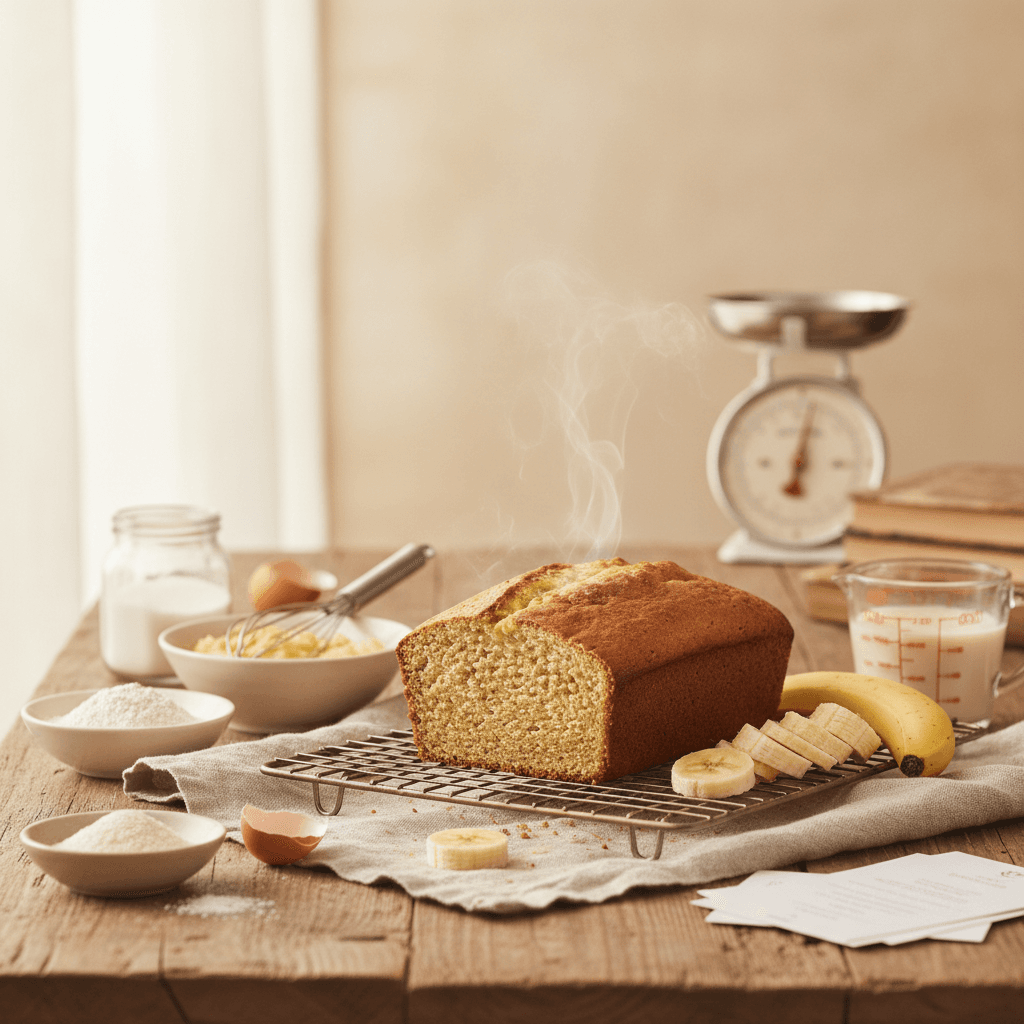
Banana pulls double duty in baking. It binds batters the way eggs do and sweetens them the way sugar does, which makes it one of the most efficient single-ingredient swaps available. But using it well means understanding exactly what it replaces in each role — and where it quietly sabotages texture if you treat it as a drop-in fix.
Key takeaways
- One medium mashed banana (roughly 110g) replaces one egg for binding in muffins, quick breads, and pancakes, but it will not whip or leaven like a beaten egg.
- Banana adds natural sugars (about 14g per 100g of fruit), so you can reduce granulated sugar by 25–50% in most recipes — but cutting more than that changes browning, spread, and crumb structure.
- The banana flavor is always detectable. If your bake cannot tolerate that flavor, a different substitute is the better move.
- Riper bananas (heavily spotted or fully brown skin) contain more free sugar and mash more smoothly, making them better for both egg and sugar replacement.
- Banana adds moisture that eggs and dry sugar do not, so you may need to reduce another liquid or increase dry ingredients to compensate.
What banana actually does when it replaces an egg
Eggs serve multiple functions in baking: they bind ingredients together, add moisture, contribute to leavening when beaten, emulsify fats and liquids, and help set structure as proteins coagulate in the oven. Banana handles some of these jobs well and others not at all. For a deeper look at all the roles eggs play, the egg functions guide breaks them down individually.
Mashed banana is a strong binder. Its pectin and starch hold dry and wet ingredients together in a way that keeps muffins, pancakes, and quick breads from crumbling apart. That binding capacity is why one mashed banana per egg works reliably in dense, moist baked goods.
Where banana fails as an egg substitute is leavening and structure. A whipped whole egg traps air and creates lift. Banana does neither. If you swap banana into a recipe that depends on beaten eggs for volume — angel food cake, chiffon cake, souffles — the result will be flat and dense. For those applications, aquafaba is a better choice because it can be whipped to stiff peaks.
Banana also cannot replicate the structural set that egg proteins provide. Egg proteins coagulate between 62-70 degrees Celsius, forming a semi-rigid network that holds cake crumb in place once cooled. Banana's pectin gels somewhat, but it does not set the same way. This is why banana-for-egg swaps work best in recipes that are already forgiving: quick breads, brownies, cookies, and pancakes.
The moisture problem nobody warns you about
A large egg weighs about 50g and contributes roughly 37g of water. A medium banana weighs about 110g and is approximately 75% water — that is around 82g of moisture, more than double what the egg contributed. If you swap one banana for one egg without adjusting anything else, your batter will be noticeably wetter.
The fix is straightforward: reduce another liquid in the recipe by 2-3 tablespoons, or add 1-2 tablespoons of extra flour. In gluten-free baking, where moisture balance is already tricky, this adjustment matters even more. Too much liquid in a gluten-free batter can lead to gummy centers that never fully set.
What banana actually does when it replaces sugar
Sugar does far more in baking than sweeten. It tenderizes by competing with flour for water, it helps baked goods brown through caramelization and Maillard reactions, it stabilizes whipped eggs and creamed butter, and it affects spread in cookies. The sugar functions guide covers each role in detail.
Banana brings natural sugars — primarily glucose, fructose, and sucrose — that increase as the fruit ripens. A very ripe banana with a fully brown skin can contain 30-40% more sugar than a just-yellow one. That is why bakers who use banana as a sugar replacement always reach for the ripest fruit available.
But banana's sugars are diluted in a lot of water and fiber. You cannot replace a cup of granulated sugar (about 200g of nearly pure sucrose) with a cup of mashed banana and expect the same sweetness, browning, or texture. The realistic range for sugar reduction when adding banana is 25-50%. Cut more than half the sugar, and you will notice changes in crumb structure, crust color, and how long the baked good stays fresh.
Browning and caramelization changes
Granulated sugar caramelizes predictably. Banana's mixed sugars — especially fructose, which browns at lower temperatures — can cause uneven browning or overly dark crusts if oven temperature is not adjusted. Dropping the oven temperature by about 15 degrees Fahrenheit (roughly 10 degrees Celsius) from the original recipe helps prevent over-browning when banana replaces a significant portion of sugar.
Texture and tenderness shifts
Sugar tenderizes baked goods by absorbing water that would otherwise develop gluten (or, in gluten-free baking, hydrate starches). When you reduce sugar and add banana, you are swapping a dry tenderizer for a wet one. The result is often a denser, moister crumb. That can be a plus in banana bread or muffins, but it works against you in cookies that should be crisp or cakes that should be light and airy.
For more on what goes wrong when sugar is reduced, the post on low-sugar baking substitutes that actually fix texture covers the mechanics and several alternative approaches.
Using banana as both egg and sugar substitute simultaneously
This is where banana becomes genuinely useful — and where most advice online oversimplifies. When banana replaces both egg and sugar in the same recipe, the effects compound. You are adding significantly more moisture, changing the sweetness profile, altering browning behavior, and losing structural support all at once.
The baked goods where this dual substitution works best share a few traits:
- They are naturally dense and moist (muffins, quick breads, pancakes)
- They already have strong flavors that complement banana (chocolate, cinnamon, peanut butter, oats)
- They do not rely on creamed butter-and-sugar for leavening
- They use chemical leaveners (baking powder or baking soda) rather than beaten eggs for rise
A practical starting point for dual substitution: use one medium mashed banana to replace one egg and reduce the recipe's sugar by about one-third. Reduce another liquid by 2-3 tablespoons. Expect the finished product to taste noticeably of banana and to have a denser crumb than the original.
A contrarian take: banana is overrated as a universal substitute
Here is an opinion that goes against most substitution advice: banana is one of the most over-recommended egg and sugar substitutes in baking. It works in a narrow band of recipes — moist, dense, forgiving ones — and fails quietly in everything else. The banana flavor is impossible to fully mask, the moisture addition is substantial, and it cannot replicate any of the structural or leavening functions of eggs. Bakers who default to banana for every egg-free or low-sugar recipe end up with a portfolio of baked goods that all taste vaguely like banana bread. If you are selling baked goods, that limits your menu more than you might realize.
For egg replacement specifically, choosing the right egg substitute depends on which egg function matters most in the recipe. Banana is a binder. If you need leavening, emulsification, or structure, it is the wrong tool.
Banana ripeness matters more than most bakers realize
The ripeness of the banana directly affects both its sweetness and its binding ability. This is not a minor detail — it is the single biggest variable in whether the substitution works well or poorly.
| Ripeness stage | Skin appearance | Sugar content | Best use |
|---|---|---|---|
| Under-ripe | Green to pale yellow | Low (mostly starch) | Poor substitute — starchy, not sweet, does not mash smoothly |
| Ripe | Yellow with a few brown spots | Moderate | Decent binder, mild sweetness, still has some firmness |
| Very ripe | Heavily spotted brown | High | Best for both egg and sugar replacement — mashes easily, sweetest |
| Overripe | Fully brown or black skin | Highest | Maximum sweetness, very soft, can be overly wet — reduce liquid more |
As bananas ripen, enzymes convert starch into simple sugars. A green banana is roughly 80% starch and 1% sugar by dry weight. A fully ripe banana flips that ratio dramatically. This enzymatic conversion is why a brown-spotted banana tastes so much sweeter than a yellow one, even though the total carbohydrate content barely changes.
Recipes where banana substitution works well
Not every baked good is a good candidate. Here is a practical breakdown:
Strong candidates
- Muffins — Already dense and moist. Banana adds flavor that usually complements the existing profile. One banana replaces one egg and allows a 25-50% sugar reduction.
- Quick breads — Same logic as muffins. Banana bread is the obvious example, but zucchini bread, pumpkin bread, and carrot bread all tolerate banana substitution well.
- Pancakes and waffles — Banana binds the batter effectively, and the sweetness means you can skip added sugar entirely in many pancake recipes.
- Brownies — The chocolate flavor dominates, which helps mask banana. The dense, fudgy texture is actually enhanced by banana's moisture.
- Oat-based cookies and bars — Oats absorb banana's extra moisture, and the flavors pair naturally.
Poor candidates
- Angel food cake or chiffon cake — These depend entirely on whipped egg whites for structure and volume. Banana cannot replicate that.
- Crisp cookies (like shortbread or biscotti) — Banana's moisture works against the dry, snappy texture these cookies need.
- Puff pastry or laminated doughs — Eggs provide structure and sheen. Banana would make the dough wet and heavy.
- Custards and flans — These are essentially cooked egg proteins. No fruit puree can substitute.
Adjustments for gluten-free baking
Gluten-free batters are already more sensitive to moisture changes than wheat-based ones. Adding banana — with its high water content — into a gluten-free recipe requires extra care.
The main risk is a gummy, underbaked center. Gluten-free flours (rice flour, cassava flour, almond flour) absorb water differently than wheat flour, and excess moisture can prevent the crumb from setting properly. If you are using banana as an egg substitute in a gluten-free recipe, reduce another liquid by at least 2 tablespoons and consider adding an extra tablespoon of starch (arrowroot or tapioca starch) to absorb the additional moisture.
One advantage of banana in gluten-free baking: its pectin contributes to binding, which helps compensate for the lack of gluten. Gluten-free baked goods often struggle with crumbliness, and banana's natural binding capacity addresses that directly. The dry and crumbly troubleshooting guide covers other strategies for the same problem.
How to store and prep bananas for baking substitution
Overripe bananas can be frozen whole (in their peel or peeled and stored in a freezer bag) for months. Thawed bananas are even easier to mash than fresh ones and release more liquid, so account for that extra moisture when using them.
For the smoothest incorporation into batter, mash bananas with a fork until no large chunks remain, or use a blender for a completely smooth puree. Lumpy banana in a batter creates pockets of moisture that bake unevenly.
A baker named Rachel, who runs a small gluten-free muffin operation in Portland, keeps a dedicated freezer drawer of overripe bananas sorted by weight. She pulls exactly 110g (one medium banana equivalent) per bag, which eliminates measuring on bake day and keeps her batches consistent. That kind of prep matters when you are scaling up — even small inconsistencies in banana quantity change the moisture balance enough to affect crumb texture across a batch of 48 muffins.
Frequently asked questions
How much banana replaces one egg in baking?
One medium mashed banana (about 110g or roughly one-third cup) replaces one egg for binding purposes. This works well in muffins, quick breads, pancakes, and brownies. It does not replace egg's leavening or structural functions, so recipes that depend on whipped eggs for volume need a different substitute. See the egg substitute choosing guide for options matched to specific functions.
Can banana replace both egg and sugar in the same recipe?
Yes, but with limits. One banana can replace one egg and allow you to reduce sugar by 25-50%. The baked good will be denser, moister, and will taste noticeably of banana. This dual substitution works best in naturally dense baked goods like muffins, quick breads, and oat bars. It does not work in recipes that need light, airy structure.
Does banana change the flavor of baked goods?
Always. Even in chocolate-heavy recipes, banana flavor is detectable. Very ripe bananas have a stronger, sweeter flavor than just-ripe ones. If banana flavor is unwelcome in your recipe, consider applesauce as an alternative — it is a milder-flavored fruit puree that also works as both a binder and partial sugar replacement.
Why do my banana-substituted baked goods come out gummy?
Banana adds significantly more moisture than the egg or sugar it replaces. If you do not reduce another liquid or add extra dry ingredients to compensate, the center of the baked good may not set properly. This is especially common in gluten-free baking. Reduce other liquids by 2-3 tablespoons and consider adding a tablespoon of starch to absorb excess moisture.
Do I need to use overripe bananas for baking substitution?
You do not strictly need to, but very ripe bananas (heavily spotted or brown-skinned) work significantly better. They are sweeter, mash more smoothly, and bind more effectively because their starch has converted to sugar. Under-ripe bananas are starchy, less sweet, and harder to incorporate evenly into batter.

Written by
Co-founder, BakingSubs
Co-founder of BakingSubs, where he turns the science of ingredient substitutions into tested, reliable guidance for home bakers.
Related Posts
Bake with Confidence
See all
Confident Gluten-Free Baker Toolkit
The science-based system that replaces gluten's seven invisible jobs so your baking turns out soft, fluffy, and foolproof — every time.

Gluten-Free Recipe Vault
Instant access to our complete library of proven gluten-free recipes — no waiting, no guesswork, just results that work tonight.

Fix Your Gluten-Free Bread
Learn the 3-step formula to make bread rise and stay soft, discover why your loaves collapse, and get a tested sandwich bread recipe that actually works.