

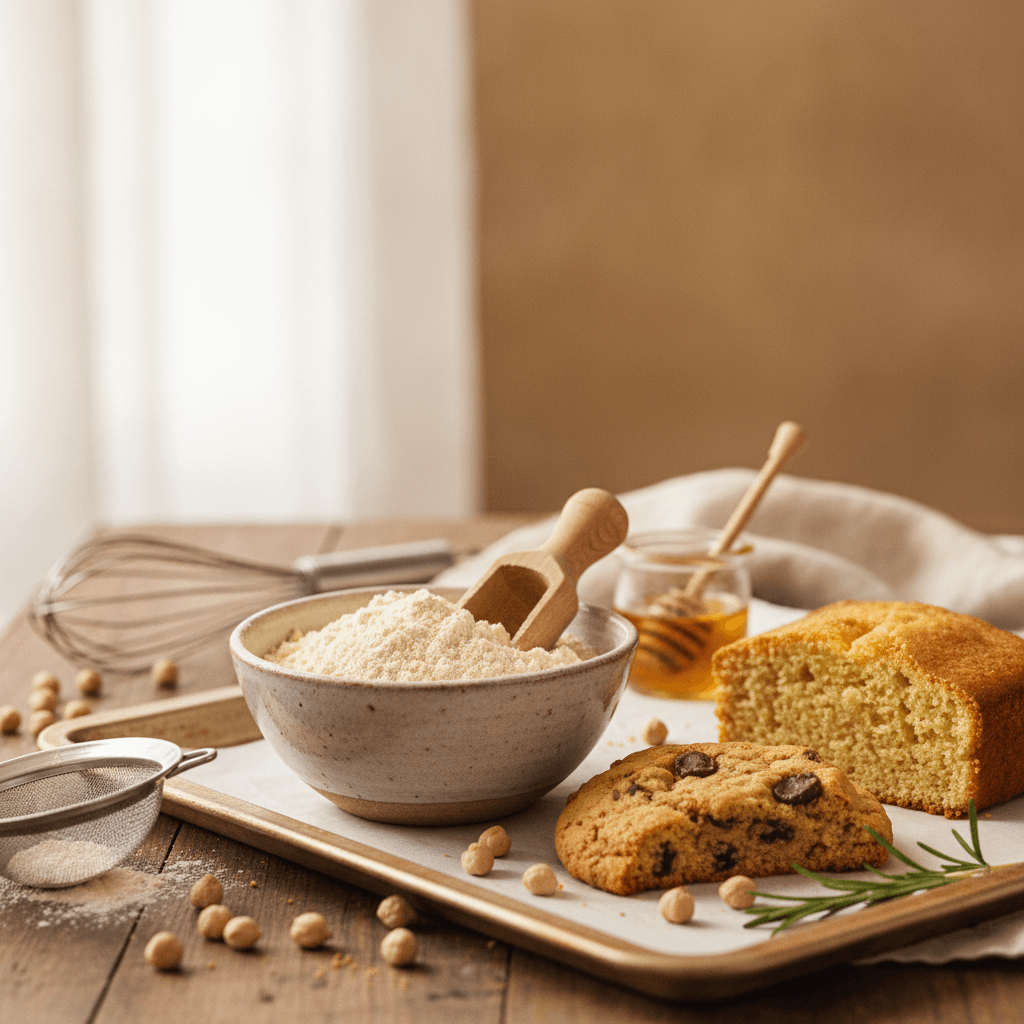
Chickpea flour packs roughly twice the protein of all-purpose flour, and it is naturally gluten-free. But swapping it straight into a recipe designed for wheat flour will produce dense, bitter, sometimes gummy results. Here is what actually works, what does not, and how to handle the tricky parts.
Key takeaways
Chickpea flour (also called besan or gram flour) typically contains around 20–22g of protein per 100g, compared to about 10g in all-purpose flour — making it one of the most protein-dense baking flours available.
It works best as a partial substitute (25–50% of total flour weight) rather than a full 1:1 replacement, because it has zero gluten and absorbs moisture differently than wheat flour.
Raw chickpea flour has a strong, bitter, beany flavor that diminishes significantly with thorough cooking or toasting the flour before use.
Chickpea flour performs well in flatbreads, socca, savory pancakes, and dense quick breads, but struggles in light, airy applications like angel food cake or croissants.
Blending chickpea flour with a starch (tapioca or potato starch) and a binder (xanthan gum or psyllium husk) produces far better results than using chickpea flour alone.
Why chickpea flour works as a high protein flour substitute
Chickpea flour stands out among high protein flour substitutes because it brings more than just protein. It contributes binding ability — the proteins in chickpeas gel when heated, which helps hold baked goods together even without gluten. That is partly why chickpea batter has been used for centuries in dishes like Italian farinata and Indian besan chilla.
It is also a complete pantry ingredient in ways that some other high-protein options are not. Unlike protein powder, which often fails as a flour replacement because it lacks starch and fat, chickpea flour has starch, fiber, fat, and protein all in one package. That gives it structural capacity that isolated protein powders simply cannot match.
Nutritionally, chickpea flour is also a source of iron and folate, and it is naturally gluten-free — though cross-contamination during milling is common, so anyone with celiac disease should look for certified gluten-free versions from brands like Bob's Red Mill or Authentic Foods.
Where chickpea flour actually performs well
Chickpea flour is not a universal swap. It excels in specific categories and falls flat in others. Here is where it reliably works:
Flatbreads and socca
This is chickpea flour's home territory. A simple batter of chickpea flour, water, olive oil, and salt — baked or pan-fried at high heat — produces a crisp, savory flatbread. The high protein content creates a firm exterior, and the flavor complements savory herbs and toppings. No blending with other flours required.
Savory pancakes and fritters
Chickpea flour makes excellent savory pancakes and vegetable fritters. The binding proteins help hold shredded vegetables together, and the earthy flavor works with spices like cumin, turmeric, and black pepper. A batter of roughly 100g chickpea flour to 150ml water gives a thick, pourable consistency that holds its shape in a hot pan.
Dense quick breads and muffins
In banana bread, pumpkin bread, and other heavily flavored quick breads, chickpea flour can replace 25–50% of the total flour weight. The strong flavors from banana, pumpkin, chocolate, or spices mask the beany taste, and the dense crumb of these baked goods is forgiving of chickpea flour's heaviness.
Brownies and blondies
Brownies are one of the more surprising success stories. The fudgy, dense texture that brownies need aligns well with chickpea flour's natural density. Some bakers use up to 100% chickpea flour in brownies, though blending with a starch typically produces a less gummy center. Black bean flour works in brownies for similar reasons — legume flours and fudgy textures are a natural match.
Where chickpea flour breaks down
Knowing the limits matters more than knowing the strengths. These three categories are where chickpea flour consistently causes problems.
Light, airy cakes
Angel food cake, chiffon cake, and sponge cake all depend on a delicate crumb structure held together by gluten or egg proteins and aerated with whipped egg whites. Chickpea flour is too heavy and too dense for these applications. Even at 25% substitution, it weighs down the batter and produces a noticeably flatter, denser result. If you are baking gluten-free cakes that need lift, a blend of rice flour and tapioca starch with xanthan gum will perform far better.
Laminated and flaky pastries
Croissants, puff pastry, and pie crusts rely on layers of fat and flour separating during baking. Chickpea flour does not create those layers. Its protein structure is fundamentally different from wheat gluten — it gels rather than stretches. Attempting laminated dough with chickpea flour produces a crumbly, dense mass rather than flaky sheets.
Delicate cookies that need spread
Thin, crispy cookies like tuiles or lace cookies need a flour that melts and spreads in the oven. Chickpea flour holds its shape too firmly. The result is a cookie that stays thick and cakey rather than spreading into a thin, crisp disc. For cookies where texture matters, almond flour tends to be a better alternative flour choice because its fat content encourages spread.
The flavor problem (and how to fix it)
The single biggest complaint about chickpea flour in baking is taste. Raw chickpea flour has a distinctly bitter, beany flavor that many people find unpleasant. This is not a subtle undertone — in a plain sugar cookie or white cake, it dominates.
The good news: heat breaks down the compounds responsible for that bitterness. There are two common approaches:
Toasting before use. Spread chickpea flour on a sheet pan in a thin layer and bake at around 175°C (350°F) for 6–8 minutes, stirring once, until it smells nutty and turns slightly golden. This reduces the raw flavor significantly. Let it cool completely before measuring and using it.
Pairing with strong flavors. Chocolate, warm spices (cinnamon, ginger, cardamom), molasses, and peanut butter all mask the beany taste effectively. Vanilla alone is usually not enough. If you are baking something lightly flavored — like a vanilla cake or shortbread — chickpea flour is probably the wrong choice regardless of toasting.
How to blend chickpea flour for better results
Using chickpea flour as the sole flour in most baked goods produces heavy, dense, sometimes gummy results. Blending it with complementary flours and starches solves most of these problems.
A commonly recommended starting blend for general gluten-free baking is:
Component | Proportion by weight | Purpose |
|---|---|---|
40% | Protein, binding, structure | |
White rice flour or brown rice flour | 30% | Lightness, neutral flavor |
25% | Chewiness, moisture retention | |
5% | Tenderness |
Add xanthan gum at roughly 1 teaspoon per 150g of flour blend for recipes that need structure (muffins, quick breads). For flatbreads and pancakes, you can skip the xanthan entirely.
This blend keeps the protein benefit of chickpea flour while using the rice flour and starches to lighten the texture and soften the flavor. Adjusting the chickpea flour proportion down to 25–30% produces an even milder taste for bakers who are sensitive to the beany notes.
If you are working with low-carb flour alternatives for bread, keep in mind that chickpea flour is not particularly low-carb — it has roughly 45–50g of carbohydrates per 100g. It is lower in carbs than all-purpose flour (about 76g per 100g), but it is nowhere near as low as almond flour or coconut flour.
Chickpea flour vs. other high protein flour options
Chickpea flour is not the only game in town. Here is how it compares to other popular high-protein alternatives:
Flour | Protein (approx. per 100g) | Gluten-free | Best for | Biggest drawback |
|---|---|---|---|---|
20–22g | Yes (check for cross-contamination) | Flatbreads, dense baked goods, brownies | Bitter raw flavor, dense texture | |
21g | Yes | Cookies, cakes, macarons | High fat, does not rise well alone | |
12–13g | Yes (despite the name) | Pancakes, crepes, rustic breads | Strong earthy flavor | |
14–15g | Yes | Flatbreads, crackers, partial blends | Grassy taste, very dense | |
Vital wheat gluten (added to flour) | 75–80g | No | Boosting protein in bread flour | Not gluten-free, only works as an additive |
Chickpea flour's main advantage over almond flour is cost — it is typically $3–5 per pound compared to $7–12 per pound for blanched almond flour. Its main disadvantage is flavor. Almond flour tastes mild and slightly sweet, while chickpea flour requires active flavor management.
For anyone dealing with tree nut allergies, chickpea flour is one of the better nut-free high-protein options, alongside oat flour (which has moderate protein at about 13g per 100g but is not as protein-dense).
Moisture and hydration adjustments
Chickpea flour absorbs more liquid than all-purpose flour. If you substitute it into a recipe without adjusting hydration, the batter or dough will be noticeably drier and stiffer.
A general rule: add an extra 1–2 tablespoons of liquid per 100g of chickpea flour compared to what the recipe calls for with all-purpose flour. The exact amount depends on the brand — some chickpea flours are ground finer than others, and finer grinds absorb more moisture.
Start with the lower end and add liquid gradually. Chickpea flour batter that is too wet will produce gummy centers — a common gluten-free baking problem that is harder to fix than a slightly dry batter.
Eggs help significantly here. The moisture and fat from eggs counterbalance chickpea flour's dryness, and the egg proteins complement the chickpea proteins for better structure. If you are also replacing eggs, use a binder that adds moisture — flax eggs work reasonably well in combination with chickpea flour, though the result will be denser than an egg-based version.
Common mistakes when baking with chickpea flour
These are the errors that trip up most bakers trying chickpea flour for the first time:
Using it at 100% in recipes designed for wheat flour. This almost always produces something too dense and too beany. Start at 25–30% and increase only if the application supports it.
Not toasting it first for sweet baking. In savory applications, the raw flavor can work. In sweet baking, it rarely does. Those 6–8 minutes of toasting make a dramatic difference.
Measuring by volume instead of weight. Chickpea flour packs differently than wheat flour — a cup of chickpea flour can weigh anywhere from 85g to 120g depending on how you scoop it. Use a kitchen scale for consistent results.
Underbaking. Chickpea flour needs thorough cooking to taste good. Pulling muffins or quick breads out early — when a toothpick comes out barely clean — often leaves a raw, bitter center. Bake until the center is fully set and the edges are golden.
Skipping binders in structured bakes. Without gluten, chickpea flour alone cannot hold a muffin or loaf together reliably. Xanthan gum, psyllium husk, or extra eggs are not optional — they are structural necessities.
A note on digestive tolerance
Chickpeas are legumes, and chickpea flour retains the oligosaccharides (specifically raffinose and stachyose) that can cause gas and bloating in some people. Cooking reduces these compounds somewhat, but does not eliminate them entirely. People who struggle with beans and lentils may also struggle with chickpea flour, especially in larger quantities.
This is worth mentioning because some bakers switch to chickpea flour for health reasons and then consume significantly more of it than they would whole chickpeas. A slice of chickpea-flour banana bread might contain 30–40g of chickpea flour — roughly equivalent to eating a small handful of cooked chickpeas. That is usually fine for most people, but those with IBS or FODMAP sensitivities should be aware.
Storing chickpea flour
Chickpea flour has a higher fat content than all-purpose flour (about 6g per 100g versus 1g), which means it goes rancid faster. An opened bag stored in the pantry at room temperature will typically stay fresh for 2–3 months. In the refrigerator, it lasts 4–6 months. In the freezer, up to a year.
Rancid chickpea flour smells noticeably bitter and sharp — even more so than fresh chickpea flour, which already has a strong aroma. If it smells off, discard it. Using rancid flour will amplify every flavor problem chickpea flour already has.
Store it in an airtight container. Chickpea flour also absorbs odors from nearby foods more readily than wheat flour, so keep it away from strong-smelling items in the pantry or fridge.
Frequently asked questions
Can you substitute chickpea flour 1:1 for all-purpose flour?
Not in most cases. Chickpea flour has no gluten, absorbs more moisture, and has a strong flavor. A 1:1 swap typically produces dense, dry, beany results. It works best as a partial replacement — 25–50% of the total flour — blended with a lighter flour and a starch. The exception is recipes specifically designed for chickpea flour, like socca or besan pancakes, where it is used at 100%.
Does chickpea flour taste like chickpeas in baked goods?
Yes, especially when raw or underbaked. The flavor is more bitter and beany than the taste of cooked whole chickpeas. Toasting the flour before baking and pairing it with strong flavors like chocolate, spices, or peanut butter reduces the taste significantly. In lightly flavored baked goods like vanilla cake, the chickpea flavor will likely be noticeable even with toasting.
Is chickpea flour safe for people with celiac disease?
Chickpeas themselves are naturally gluten-free, but many chickpea flours are milled in facilities that also process wheat. Cross-contamination is a real risk. Anyone with celiac disease should look for chickpea flour that is certified gluten-free and processed in a dedicated gluten-free facility. Brands like Bob's Red Mill offer certified gluten-free chickpea flour. For more on avoiding common gluten-free baking problems, see our learn section.
What is the difference between chickpea flour and besan?
They are very similar but not always identical. Besan (also called gram flour) is traditionally made from desi chickpeas — a smaller, darker variety — while chickpea flour sold in Western markets is often made from larger kabuli chickpeas. Desi-based besan tends to have a slightly finer texture and milder flavor. Both work in baking, but the absorption rates may differ slightly between brands.
Can you make chickpea flour at home?
Yes. Dried chickpeas can be ground into flour using a high-powered blender or grain mill. The result is a coarser grind than commercially milled chickpea flour, which can produce a grittier texture in baked goods. Sifting the home-ground flour through a fine-mesh sieve and re-grinding the larger pieces helps. Toasting the dried chickpeas lightly before grinding can also reduce the raw flavor. However, commercial chickpea flour is inexpensive enough — typically $3–5 per pound — that home grinding is more of a convenience option than a cost saver.

Written by
Co-founder, BakingSubs
Co-founder of BakingSubs, where he turns the science of ingredient substitutions into tested, reliable guidance for home bakers.
Related Posts
Bake with Confidence
See all
Confident Gluten-Free Baker Toolkit
The science-based system that replaces gluten's seven invisible jobs so your baking turns out soft, fluffy, and foolproof — every time.

Gluten-Free Recipe Vault
Instant access to our complete library of proven gluten-free recipes — no waiting, no guesswork, just results that work tonight.

Fix Your Gluten-Free Bread
Learn the 3-step formula to make bread rise and stay soft, discover why your loaves collapse, and get a tested sandwich bread recipe that actually works.