

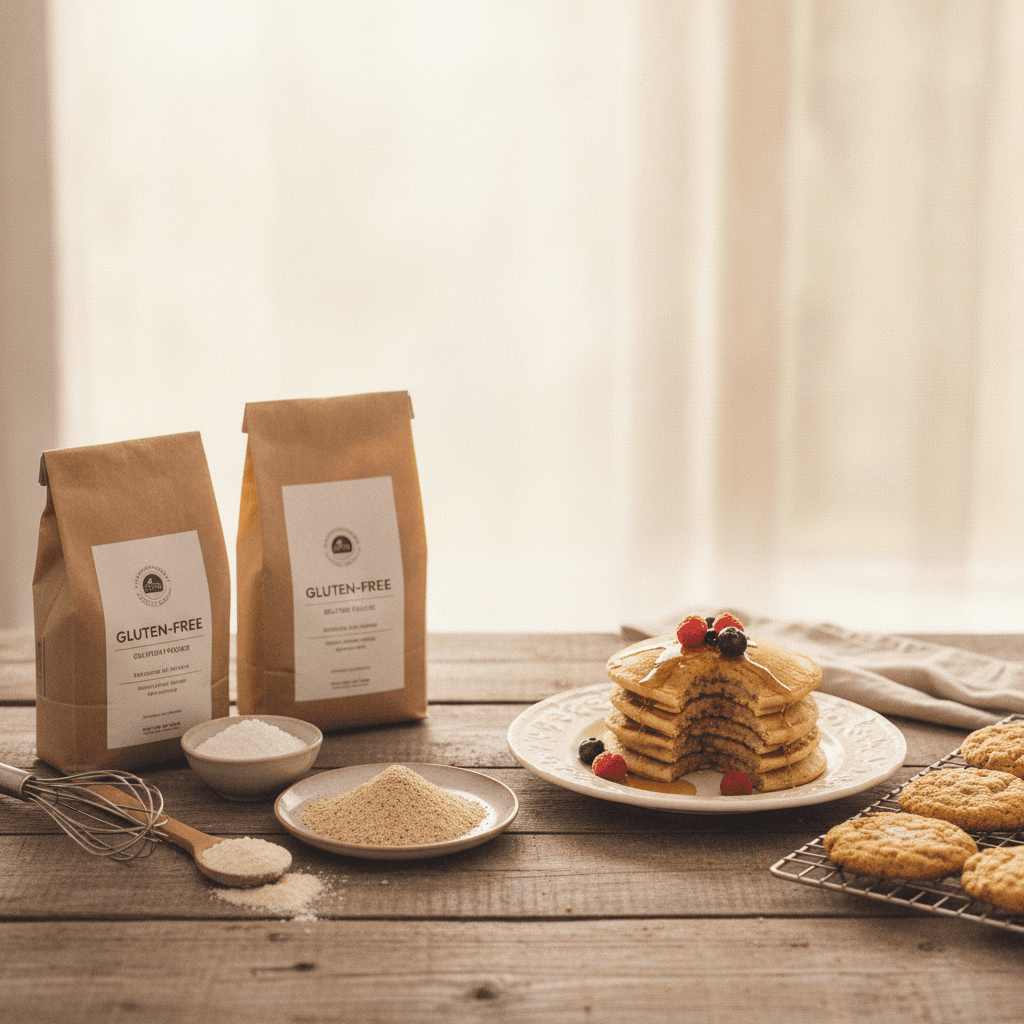
Bob's Red Mill 1-to-1 Baking Flour already contains xanthan gum and is designed to replace wheat flour cup-for-cup in most non-yeast recipes, while Bob's Red Mill Gluten Free All Purpose Baking Flour is a bean-based blend without xanthan gum that requires you to add your own binder. That single difference — built-in xanthan gum versus none — changes how you measure, what you add, and what your finished bake looks and tastes like.
Prices checked September 2026 and vary by store.
Key takeaways
- The 1-to-1 contains xanthan gum; the All Purpose does not. If your recipe already calls for xanthan gum, using the 1-to-1 can give you a gummy, rubbery result from double-binding.
- Both flours are labeled gluten-free and are not GFCO certified. Bob's Red Mill says both are mixed and packaged in its 100% dedicated gluten-free facility and batch-tested with an ELISA gluten assay to below 20 ppm; only Bob's oat-based bars and granolas currently carry the GFCO mark.
- By Bob's own nutrition labels, the 1-to-1 weighs 148 g per cup (37 g per 1/4 cup) and the All Purpose weighs 136 g per cup (34 g per 1/4 cup). Swapping one for the other by volume without adjusting will change your ratio of flour to liquid.
- The All Purpose blend gives experienced gluten-free bakers more control, while the 1-to-1 is better for beginners converting standard wheat recipes.
- Neither flour contains a high-protein grain — both are starch-heavy blends. If you want more structure in bread, you'll need to add protein or a stronger binder like psyllium husk.
What is in each flour (first three ingredients and beyond)
The ingredient lists look similar at first glance, but the order and the extras matter.
Bob's Red Mill 1-to-1 Baking Flour
First three ingredients: sweet white rice flour, whole grain brown rice flour, pearled white sorghum flour. The full list on Bob's site continues with potato starch, tapioca flour, and xanthan gum. The xanthan gum is the key differentiator — it acts as a gluten substitute, giving structure and elasticity. Bob's positions this blend for non-yeast recipes (cookies, cakes, muffins, pancakes).
Bob's Red Mill Gluten Free All Purpose Baking Flour
First three ingredients: garbanzo bean flour, potato starch, tapioca flour. It also contains whole grain sorghum flour and fava bean flour. No xanthan gum, no guar gum, no binder of any kind. The garbanzo and fava bean flours give this blend a little more protein (3 g per 34 g serving) compared to the 1-to-1 (2 g per 37 g serving), but they also bring a distinct earthy, slightly beany flavor that some bakers dislike.
| Feature | 1-to-1 Baking Flour | GF All Purpose Baking Flour |
|---|---|---|
| First ingredient | Sweet white rice flour | Garbanzo bean flour |
| Contains xanthan gum | Yes | No |
| Protein per 1/4-cup serving | 2 g (37 g serving) | 3 g (34 g serving) |
| Bean flours included | No | Yes (garbanzo + fava) |
| Weight per cup (from label serving size) | 148 g | 136 g |
| GFCO certified (under 10 ppm) | No | No |
| Labeled gluten-free (under 20 ppm, batch-tested) | Yes | Yes |
| Dedicated GF facility | Yes (Bob's dedicated gluten-free facility) | Yes (Bob's dedicated gluten-free facility) |
| Price per ounce (22 oz bag) | About $0.26 (about $5.50 at Target) | About $0.19 (about $4.00 at Walmart) |
Checked: September 2026
6 differences that change your baking results
1. Xanthan gum: built in versus add your own
This is the difference that trips up the most bakers. The 1-to-1 already has xanthan gum blended in at a ratio Bob's Red Mill calibrated for general baking. If you're converting a wheat recipe — say, a standard chocolate chip cookie — you just measure the 1-to-1 in place of all-purpose wheat flour and skip any xanthan gum.
The All Purpose flour has no binder. You need to add your own. A common starting point is 1/2 teaspoon of xanthan gum per cup of flour for cookies and cakes, and 1 teaspoon per cup for bread. Some bakers prefer psyllium husk for bread — about 6 g per 100 g of flour — because it absorbs water more gradually and gives a chewier crumb.
The mistake to avoid: Using the 1-to-1 in a recipe that already calls for xanthan gum. Double-binding creates a rubbery, dense texture. If the recipe specifies xanthan gum, use the All Purpose flour and add the amount called for, or use the 1-to-1 and skip the xanthan gum line entirely.
2. Flavor profile: neutral versus beany
The 1-to-1 tastes relatively neutral. Sweet white rice flour and brown rice flour have a mild, slightly sweet flavor. Most people cannot distinguish it from wheat flour in a well-seasoned cookie or cake.
The All Purpose blend has garbanzo bean flour as its first ingredient and fava bean flour further down the list. These add a savory, earthy undertone. In chocolate brownies or heavily spiced gingerbread, you won't notice it. In a delicate vanilla cake or sugar cookie, some bakers find it off-putting. If you're sensitive to that flavor, see our guide on strange aftertaste in gluten-free baking for workarounds.
The beany flavor is the most common complaint in published reviews of the All Purpose blend, and "tastes like hummus" is a recurring description in reviews of vanilla-forward bakes made with it. Switching to the 1-to-1 for light-flavored recipes is the usual fix.
3. Cup weight differences (and why they matter)
Bob's nutrition labels list a 1/4-cup serving as 37 g for the 1-to-1 and 34 g for the All Purpose, which works out to 148 g and 136 g per cup. That's a 12 g difference per cup, or roughly 8–9% of the flour's mass. If a recipe calls for 2 cups of one and you swap in the other by volume, you're adding or subtracting about 24 g of flour. That's enough to nudge a muffin from tender toward dense, or from structured toward crumbly.
The fix: Weigh your flour. A kitchen scale like the OXO Good Grips 11 lb eliminates this variable entirely. If you don't have a scale, use the spoon-and-level method and know that your results may shift.
4. Protein content and structural strength
The All Purpose blend's garbanzo and fava bean flours give it about 50% more protein than the 1-to-1 (3 g versus 2 g per 1/4-cup serving). More protein means slightly more structure — useful in bread and pizza dough, less relevant in cookies. But neither flour comes close to the 12–14% protein content of wheat bread flour. For gluten-free baking where you need serious structure — sandwich bread, for example — you'll likely need to supplement with something like protein powder or additional egg whites regardless of which blend you choose.
5. Recipe flexibility
The 1-to-1 is designed to be a drop-in replacement. That makes it rigid by design — you can't easily adjust the binder level because it's already mixed in. For simple conversions (wheat muffin recipe to gluten-free, wheat pancake recipe to gluten-free), that rigidity is a feature.
The All Purpose gives you full control. You choose the binder, the amount, and the type. That's better for experienced gluten-free bakers who have recipes tuned to their preferences, or for recipes that already specify a binder amount. It's also better when you want to use guar gum instead of xanthan gum, or psyllium husk for bread.
6. Texture in finished baked goods
In side-by-side comparisons reported by gluten-free baking communities, the 1-to-1 tends to produce a softer, more tender crumb in cakes and cookies. The All Purpose (with added xanthan gum) tends to produce a slightly denser, chewier result with more structure but also a higher risk of gummy centers if over-mixed or over-bound.
Bob's own guidance backs this up: the company markets the 1-to-1 for non-yeast recipes such as cookies, cakes, brownies, muffins, and pancakes, and describes the All Purpose as a versatile base to which you add xanthan or guar gum according to the guide on the package.
How both compare to King Arthur and Cup4Cup
Bob's Red Mill isn't the only option. Here's how the two Bob's blends stack up against two other popular gluten-free flour blends.
| Feature | Bob's 1-to-1 | Bob's GF All Purpose | King Arthur GF Measure for Measure | Cup4Cup Multipurpose |
|---|---|---|---|---|
| Contains xanthan gum | Yes | No | Yes | Yes |
| First ingredient | Sweet white rice flour | Garbanzo bean flour | Rice flour | Rice flour blend or cornstarch (order changed with the late-2024 reformulation; check the bag) |
| Bean flours | No | Yes | No | No |
| Contains milk powder | No | No | No | No in the current dairy-free formula; the original milk-powder formula is still sold in 2 lb bags |
| GFCO certified | No | No | Yes (under 10 ppm) | Yes (under 10 ppm) |
| Dedicated GF facility | Yes | Yes | No — King Arthur says its certified gluten-free products share equipment with wheat and other allergens | Yes (SQF-certified gluten-free facility) |
| Weight per cup | 148 g | 136 g | 120 g | 140 g |
| Price per ounce | About $0.26 (22 oz, Target) | About $0.19 (22 oz, Walmart) | About $0.23 (3 lb, kingarthurbaking.com) | About $0.36 (3 lb, Walmart) |
Checked: September 2026
The safety picture is more nuanced than "certified versus not." King Arthur's Measure for Measure is GFCO certified to under 10 ppm, but King Arthur's own allergen page says its certified gluten-free products share production equipment with allergens including wheat, relying on cleaning and testing rather than a separate building. Bob's flours have no third-party seal, but Bob's says they are mixed and packaged in a 100% dedicated gluten-free facility and batch-tested to under 20 ppm. Cup4Cup offers both: GFCO certification and a dedicated gluten-free facility. Cup4Cup also removed milk powder from its Multipurpose Flour in late 2024, though the original formula is still sold in 2 lb bags, so dairy-free bakers should read the label.
For a deeper comparison of Bob's 1-to-1 against King Arthur's blend, we have a full Bob's vs King Arthur breakdown.
Who should buy the 1-to-1 (and who should skip it)
Buy the 1-to-1 if you:
- Are new to gluten-free baking and want to convert wheat recipes with minimal changes
- Dislike the beany flavor of garbanzo/fava flour blends
- Mostly bake cookies, cakes, muffins, and quick breads
- Want fewer ingredients to measure and less guesswork about binder ratios
Skip the 1-to-1 if you:
- Have a recipe that already specifies xanthan gum — you'll double-bind
- Want to use psyllium husk or guar gum instead of xanthan gum
- Need a GFCO seal (under 10 ppm) on the bag — consider King Arthur Measure for Measure or Cup4Cup instead
- Are an experienced gluten-free baker who prefers to control every variable
Who should buy the All Purpose (and who should skip it)
Buy the All Purpose if you:
- Already have gluten-free recipes that specify adding your own binder
- Want a little more protein from the bean flours for bread or pizza dough
- Prefer to control the type and amount of binder (xanthan, guar, psyllium)
- Don't mind the slightly earthy flavor, or you bake mostly chocolate and spiced goods where it's masked
Skip the All Purpose if you:
- Are converting standard wheat recipes — you'll forget the binder and wonder why everything crumbles
- Are sensitive to the flavor of garbanzo or fava bean flour
- Want a true 1-to-1 swap with no extra steps
Certification and safety for celiac bakers
Neither Bob's Red Mill gluten-free flour carries GFCO certification. Both are labeled gluten-free, which under FDA rules means they must test below 20 ppm. Bob's Red Mill says its gluten-free flours are processed and packaged in a separate, dedicated gluten-free facility and that every batch is tested in its quality-control lab using an ELISA gluten assay. As of 2025, the only Bob's products carrying the GFCO logo are its oat-based bars and granolas.
For many gluten-sensitive bakers, that combination — dedicated facility plus batch testing — is sufficient. For celiac bakers who want a third-party seal and a stricter 10 ppm threshold, King Arthur's Measure for Measure and Cup4Cup are both GFCO certified. Note the trade-off: King Arthur's certified line shares equipment with wheat under a cleaning-and-testing program, while Cup4Cup is both certified and made in a dedicated gluten-free facility.
This doesn't mean Bob's flours are unsafe. It means the type of assurance is different, and you should choose based on your personal sensitivity and risk tolerance.
Tips for getting the best results with either flour
- Weigh, don't scoop. The roughly 9% cup-weight difference between these two flours makes volume measurements unreliable when switching between them.
- Rest your batter. Both blends benefit from a 15–20 minute rest after mixing. The starches hydrate more fully, which reduces gritty texture and improves rise.
- Add moisture. Gluten-free batters often need 10–15% more liquid than their wheat equivalents. If your muffins come out dry and crumbly, try adding 2 tablespoons of milk or yogurt per cup of flour before you blame the blend.
- Don't over-mix. Xanthan gum (whether you added it or it came in the 1-to-1) activates with agitation. Over-mixing makes baked goods tough and gummy. Mix until just combined.
- Store in airtight containers. Rice flour and bean flour both go stale faster than wheat flour. Seal the bag or transfer to a container, and use within 3 months for best flavor. Freezing extends shelf life to 6+ months.
Frequently asked questions
Can I use Bob's Red Mill 1-to-1 and All Purpose interchangeably?
Not without adjustments. The 1-to-1 already contains xanthan gum, so if you swap it into a recipe designed for the All Purpose (which calls for adding xanthan gum separately), you'll double-bind and get a rubbery texture. Going the other direction, if you use the All Purpose in place of the 1-to-1 without adding xanthan gum, your bake will likely crumble apart. Always check whether the recipe accounts for a built-in binder.
Is Bob's Red Mill 1-to-1 safe for celiac disease?
It meets the FDA gluten-free labeling requirement of under 20 ppm, and Bob's says it is made in a dedicated gluten-free facility and batch-tested with an ELISA assay. It is not GFCO certified (under 10 ppm). Many celiac bakers use it without issues, but those who want a third-party seal may prefer a GFCO-certified flour such as King Arthur Measure for Measure or Cup4Cup. Talk to your doctor if you're unsure about your personal threshold.
Why does Bob's Red Mill All Purpose flour taste beany?
Because its first ingredient is garbanzo bean flour, and it also contains fava bean flour. These legume flours have a naturally earthy, savory flavor. You can mask it with chocolate, warm spices (cinnamon, ginger), or strong vanilla extract. If the flavor bothers you in lighter bakes like vanilla cake, the 1-to-1 blend (which uses rice flour instead of bean flour) is a better choice. Our guide on strange aftertaste in gluten-free baking has more fixes.
How much xanthan gum should I add to Bob's Red Mill All Purpose flour?
A standard starting point is 1/4 teaspoon per cup for pancakes and crepes, 1/2 teaspoon per cup for cookies and cakes, and 1 teaspoon per cup for bread and pizza dough. These are guidelines — your ideal amount depends on the recipe's other binders (eggs, for instance, provide structure too). For bread, some bakers get better results with 6 g of psyllium husk powder per 100 g of flour instead of xanthan gum.
Which Bob's Red Mill flour is better for gluten-free bread?
The All Purpose flour gives you more control for bread because you can choose your own binder type and amount, and its bean flours provide slightly more protein. Bob's itself markets the 1-to-1 for non-yeast recipes, so it is best kept to quick breads and simple loaves; for yeast bread that needs a chewy, structured crumb, most experienced gluten-free bakers prefer the All Purpose with psyllium husk. For more on store-bought options, see our roundup of the best gluten-free bread.

Written by
Co-founder, BakingSubs
Co-founder of BakingSubs, where he turns the science of ingredient substitutions into tested, reliable guidance for home bakers.
Related Posts
Bake with Confidence
See all
Confident Gluten-Free Baker Toolkit
The science-based system that replaces gluten's seven invisible jobs so your baking turns out soft, fluffy, and foolproof — every time.

Gluten-Free Recipe Vault
Instant access to our complete library of proven gluten-free recipes — no waiting, no guesswork, just results that work tonight.

Fix Your Gluten-Free Bread
Learn the 3-step formula to make bread rise and stay soft, discover why your loaves collapse, and get a tested sandwich bread recipe that actually works.