

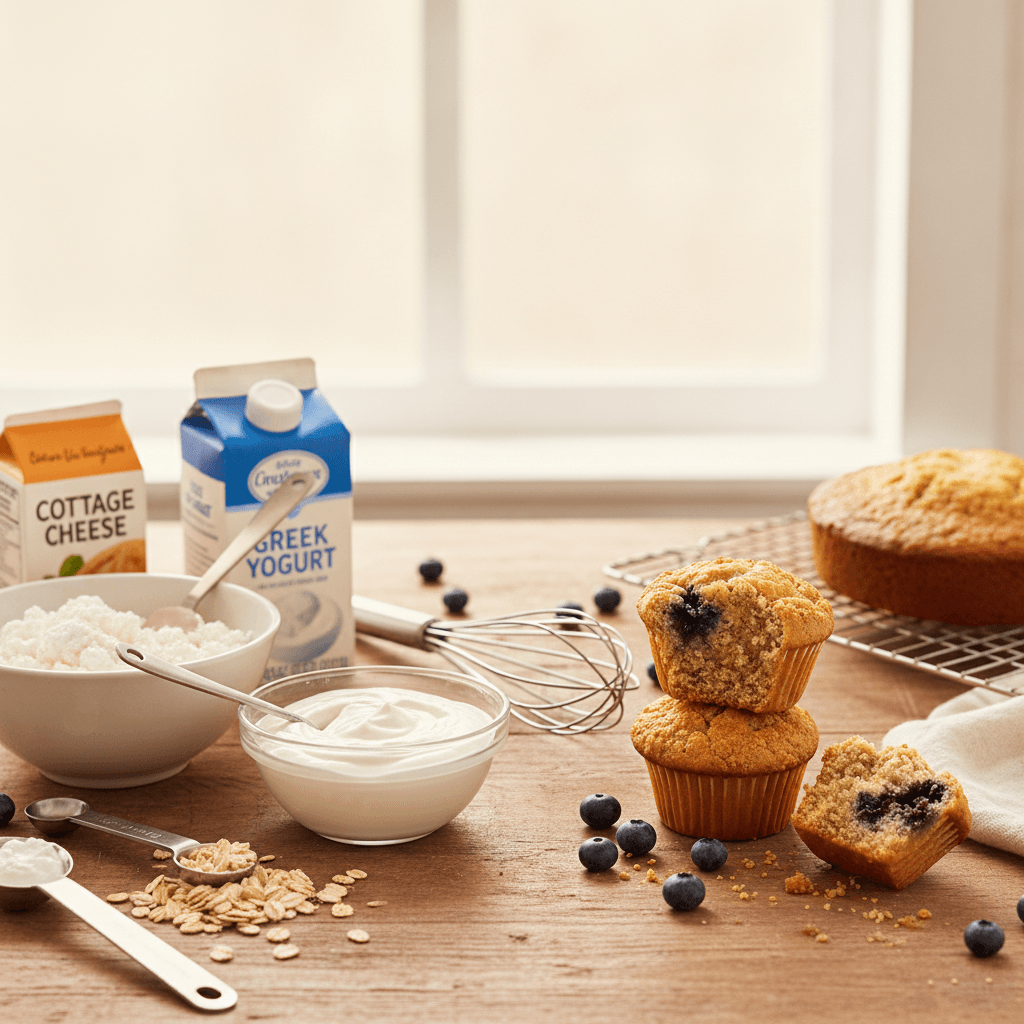
Cottage cheese adds more protein per cup, keeps baked goods moist longer, and costs roughly $0.30 less per serving than Greek yogurt at most retailers. Greek yogurt wins when you need a smooth batter with zero blending, reliable tang, and consistent acidity for leavening reactions. For high-protein muffins, pancakes, and quick breads, cottage cheese is our pick, but only after you blend it smooth. Below, we break down nine brands, the equipment that actually matters, and every texture problem you might hit.
Key takeaways
Blended cottage cheese delivers 10-12g protein per 100g versus 8-10g for most Greek yogurts, making it the stronger protein booster in baked goods.
Cottage cheese has higher water content (roughly 79-82%) than Greek yogurt (roughly 75-78%), so you may need to reduce other liquids by 1-2 tablespoons per cup.
Greek yogurt activates baking soda more reliably because its pH sits at 4.0-4.5, while cottage cheese ranges from 4.8-5.2.
Large curds from brands like Breakstone's and Friendship resist blending; a food processor or high-speed blender is essential.
Both work as partial buttermilk or oil replacements, but cottage cheese handles fat reduction better because its casein structure traps moisture during baking.
Kirkland (Costco) organic cottage cheese is the best value at roughly $0.18 per ounce; Muuna is the smoothest out of the container but costs nearly double.
Why cottage cheese is suddenly everywhere in baking
High-protein baking took off in 2023 and cottage cheese rode the wave. Unlike protein powder, which dries out baked goods fast, cottage cheese adds protein while also contributing fat and moisture. A single cup of 4% cottage cheese delivers about 25g of protein, 9g of fat, and 180 calories. A cup of full-fat Greek yogurt gives you about 20g of protein, 10g of fat, and 220 calories. That protein gap matters when you are building a recipe around macros.
The catch is texture. Greek yogurt is already smooth. Cottage cheese is not. If you skip the blending step, you will get pockets of unmelted curd in your muffin crumb, and that is a deal-breaker for most people.
Brand-by-brand comparison: 9 cottage cheeses for baking
Not all cottage cheese behaves the same in batter. Curd size, water content, and protein density vary wildly across brands. We compared nine widely available options on what matters for baking.
Brand | Protein per 100g | Fat % | Curd size | Approx. water content | Blends smooth? | Where to buy |
|---|---|---|---|---|---|---|
Good Culture (4%) | 12.3g | 4% | Medium | ~79% | Yes | Target, Whole Foods, Walmart |
Daisy (4%) | 10.6g | 4% | Small | ~80% | Yes | Walmart, Target, Kroger |
Breakstone's (4%) | 10.2g | 4% | Large | ~81% | Large curds; blend longer | Walmart, most grocery chains |
Nancy's Organic (4%) | 11.0g | 4% | Medium | ~80% | Yes | Whole Foods, natural grocers |
Friendship (4%) | 11.5g | 4% | Large | ~79% | Large curds; blend longer | Northeast US grocery chains |
Kalona SuperNatural (4%) | 10.8g | 4% | Medium-large | ~80% | Yes | Whole Foods, natural grocers |
Muuna (4%) | 11.8g | 4% | Small | ~78% | Smoothest out of container | Target, select Walmarts |
Trader Joe's (4%) | 10.5g | 4% | Small | ~81% | Yes | Trader Joe's only |
Kirkland Organic (4%) | 10.9g | 4% | Medium | ~80% | Yes | Costco only |
A few notes on this table. Good Culture and Muuna have the highest protein per 100g, which matters if you are trying to add protein to baked goods without wrecking texture. Breakstone's and Friendship have large curds that resist blending. If you use either one, plan on 45-60 seconds in a food processor rather than a quick blitz. Kirkland at Costco is the value play: a 3-pound tub runs about $6.49, which works out to roughly $0.14 per ounce. Compare that to Muuna at $0.26 per ounce.
For Greek yogurt, the brand matters less because the texture is already uniform. Fage Total 5%, Chobani Whole Milk, and Kirkland Greek Yogurt (Costco) all behave much the same in batter. The main variable is fat percentage, not curd structure.
The equipment that actually makes cottage cheese bakeable
You need something that pulverizes curds. A fork will not do it. A whisk will not do it. Here is what works, ranked by how smooth the result gets.
Food processor (best results)
A full-size food processor turns cottage cheese into a Greek-yogurt-like consistency in 20-30 seconds. A full-size model like the Cuisinart 14-Cup Food Processor has the power to break down even large Breakstone's curds. If you bake with cottage cheese more than once a month, this is the tool to own.
High-speed blender
A Vitamix E310 or similar high-speed blender works, but you need at least 1.5 cups of cottage cheese for the blades to catch. For smaller amounts, a food processor is more practical.
Immersion blender
An immersion blender works in a pinch. Use a tall, narrow container and blend for 30-45 seconds. You will get 90% smooth, which is fine for pancakes and quick breads. For cake batters where every lump shows, go with the food processor.
Fine mesh sieve (backup method)
If you have no blending equipment, press cottage cheese through a fine mesh sieve with the back of a spoon. This takes 3-4 minutes per cup and gets you a ricotta-like texture. It works, but it is slow.
How each one performs in specific bakes
Muffins and quick breads
Cottage cheese is the stronger choice here. The extra protein creates a tighter crumb that holds together well, and the higher water content keeps muffins moist a little longer than Greek yogurt does. Use blended cottage cheese as a 1:1 replacement for Greek yogurt. If the original recipe calls for oil, you can replace up to half of it with cottage cheese and still get a tender result.
Pancakes
Both work well. Greek yogurt pancakes are tangier and slightly thinner. Cottage cheese pancakes are fluffier because the casein proteins set firmly when heated. If you want the highest protein count, cottage cheese wins: a batch of 8 pancakes using 1 cup of Kirkland cottage cheese hits about 28g of protein from the dairy alone.
Cakes
Greek yogurt is safer for cakes. The smooth texture integrates without any blending step, and the consistent acidity means your baking soda reacts predictably. If you do use cottage cheese in cake batter, blend it until it is absolutely smooth (at least 30 seconds in a food processor) and reduce other liquids by 1-2 tablespoons. The extra water in cottage cheese can make a delicate cake gummy if you do not compensate.
Cheesecake
This is where cottage cheese quietly excels. Blended cottage cheese plus cream cheese creates a lighter, higher-protein cheesecake filling. Use a 50/50 split. The cottage cheese adds about 6g more protein per slice compared to an all-cream-cheese version, and the texture stays creamy as long as you blend it completely smooth.
Adjusting recipes when you swap one for the other
These are not perfectly interchangeable. Here is what to change.
Factor | Adjustment needed | ||
|---|---|---|---|
Water content | ~79-82% | ~75-78% | Reduce other liquids by 1-2 tbsp per cup of cottage cheese |
pH (acidity) | 4.8-5.2 | 4.0-4.5 | Add 1/2 tsp lemon juice per cup of cottage cheese if recipe relies on acid for leavening |
Fat (4% versions) | ~4g per 100g | ~5g per 100g | Minimal difference; no adjustment needed |
Protein | ~10-12g per 100g | ~8-10g per 100g | No adjustment needed; higher protein slightly firms the crumb |
Texture | Curds; must blend | Smooth | Always blend cottage cheese before adding to batter |
When you are scaling a recipe up or down, keep these ratios proportional. The liquid reduction is the most important adjustment. Skip it and your banana bread will be dense and wet in the center.
Troubleshooting common problems
Grainy texture in the finished bake
This happens when curds survive the mixing process. Large-curd brands like Breakstone's and Friendship are the worst offenders. The fix: blend cottage cheese separately in a food processor for 30-45 seconds before adding it to your batter. Do not just stir it in. If you already baked and the texture is grainy, the damage is done, but you can mask it in recipes like protein bars or crumble toppings where some texture is expected.
Excess moisture and gummy centers
Cottage cheese is roughly 3-4% higher in water than Greek yogurt. If you swap 1:1 without reducing other liquids, the extra moisture gets trapped in the crumb. Pull back milk, water, or other liquid ingredients by 1-2 tablespoons per cup of cottage cheese. Also check your bake time. Cottage cheese batters often need 2-3 extra minutes in the oven. Use the toothpick test at the original time, then add time in 2-minute increments.
Curdling at high heat
Cottage cheese proteins can curdle if exposed to temperatures above 350F (175C) without enough fat or starch to buffer them. This shows up as a grainy, split texture in the finished product. Two fixes: make sure there is at least 2 tablespoons of fat (butter, oil, or the cottage cheese's own fat) per cup of cottage cheese in the recipe, and do not bake above 350F unless the recipe also contains a significant amount of flour or starch. Greek yogurt is more heat-stable because its proteins have already been partially denatured during straining.
If you are working with pumpkin puree as an oil substitute alongside cottage cheese, be especially careful about total moisture. Both ingredients add water, and the combination can push a recipe past the tipping point into gummy territory.
When to pick cottage cheese over Greek yogurt (and vice versa)
Pick cottage cheese when:
You want the highest possible protein per serving
You are making muffins, pancakes, or quick breads that benefit from extra moisture
You are replacing some of the fat in a recipe (cottage cheese handles oil or butter reduction better)
You want a milder flavor, since cottage cheese is less tangy than Greek yogurt
Budget matters: Kirkland at Costco runs $0.14/oz vs $0.20/oz for most Greek yogurts
Pick Greek yogurt when:
You need a smooth batter with no blending step
The recipe depends on acid to activate baking soda (Greek yogurt's lower pH is more reliable)
You are making cake, where even small lumps ruin the crumb
You want a tangier flavor profile
You do not own a food processor or blender
For more on how dairy ingredients function in baking, our guide to milk functions covers the science behind protein coagulation, fat emulsification, and moisture retention.
A note on low-fat and fat-free versions
This post assumes 4% (full-fat) cottage cheese and whole-milk Greek yogurt throughout. Low-fat (2%) versions of both work fine in most recipes but produce a slightly drier crumb. Fat-free versions are a different story. Fat-free cottage cheese has about 83-85% water, which sounds like it would add moisture, but the lack of fat means the proteins tighten aggressively during baking. The result is rubbery muffins and tough pancakes. If you must go fat-free, add 1 tablespoon of oil per cup to compensate.
For more detail on the cottage cheese ingredient page, including substitution ratios for other dairy products, check our full reference.
Frequently asked questions
Can I substitute cottage cheese for Greek yogurt in baking 1:1?
Yes, but with two adjustments. Blend the cottage cheese until completely smooth first, and reduce other liquids in the recipe by 1-2 tablespoons per cup because cottage cheese contains about 3-4% more water than Greek yogurt. If the recipe uses baking soda for leavening, add 1/2 teaspoon of lemon juice per cup of cottage cheese to compensate for its lower acidity.
Which cottage cheese brand is best for baking?
Good Culture and Muuna have the highest protein per 100g (12.3g and 11.8g respectively), and Muuna is the smoothest out of the container. For value, Kirkland Organic at Costco costs roughly $0.14 per ounce and its medium curds blend smooth easily. Avoid large-curd brands like Breakstone's unless you have a powerful food processor.
Does cottage cheese make baked goods taste different than Greek yogurt?
Cottage cheese is milder and less tangy. In muffins and pancakes, most people cannot tell the difference once it is blended and baked. In recipes where tang is part of the flavor profile, like lemon yogurt cake, Greek yogurt is the better choice because its acidity contributes a noticeable brightness that cottage cheese cannot replicate.
Why does my cottage cheese batter look curdled?
Visible curds in the batter mean the cottage cheese was not blended long enough. Process it separately for at least 30 seconds in a food processor before adding it to other ingredients. If the batter looks split or curdled after mixing, the cottage cheese may have been too cold. Let it sit at room temperature for 15-20 minutes before blending, which helps it emulsify more smoothly into the batter.
Can I use cottage cheese in gluten-free baking?
Absolutely. Cottage cheese actually helps prevent the dry, crumbly texture common in gluten-free bakes. The casein proteins add structure that partially compensates for the missing gluten network, and the extra moisture keeps gluten-free flours from drying out. Use blended cottage cheese as a 1:1 swap for Greek yogurt in any gluten-free recipe.

Written by
Co-founder, BakingSubs
Co-founder of BakingSubs, where he turns the science of ingredient substitutions into tested, reliable guidance for home bakers.
Related Posts

Gluten-Free Flour Weight Chart: Grams per Cup for 9 Major Brands (and Why the Spread Is Over 20%)
Best Sugar-Free Cake Mix and Brownie Mix (2026): 14 Options Ranked by Net Carbs, Sweetener, and Price
Best Low Carb Bread Brands (2026): 8 Compared by Net Carbs, Ingredients, and Price
Bake with Confidence
See all
Confident Gluten-Free Baker Toolkit
The science-based system that replaces gluten's seven invisible jobs so your baking turns out soft, fluffy, and foolproof — every time.

Gluten-Free Recipe Vault
Instant access to our complete library of proven gluten-free recipes — no waiting, no guesswork, just results that work tonight.

Fix Your Gluten-Free Bread
Learn the 3-step formula to make bread rise and stay soft, discover why your loaves collapse, and get a tested sandwich bread recipe that actually works.