
Sugar Alcohols in Baking Explained: 6 Types, What Each One Does, and Why Most Bakers Pick the Wrong One
Sugar alcohols in baking explained: erythritol, xylitol, maltitol, sorbitol, isomalt, and allulose compared by sweetness, browning, texture, and digestive tolerance.

Malik
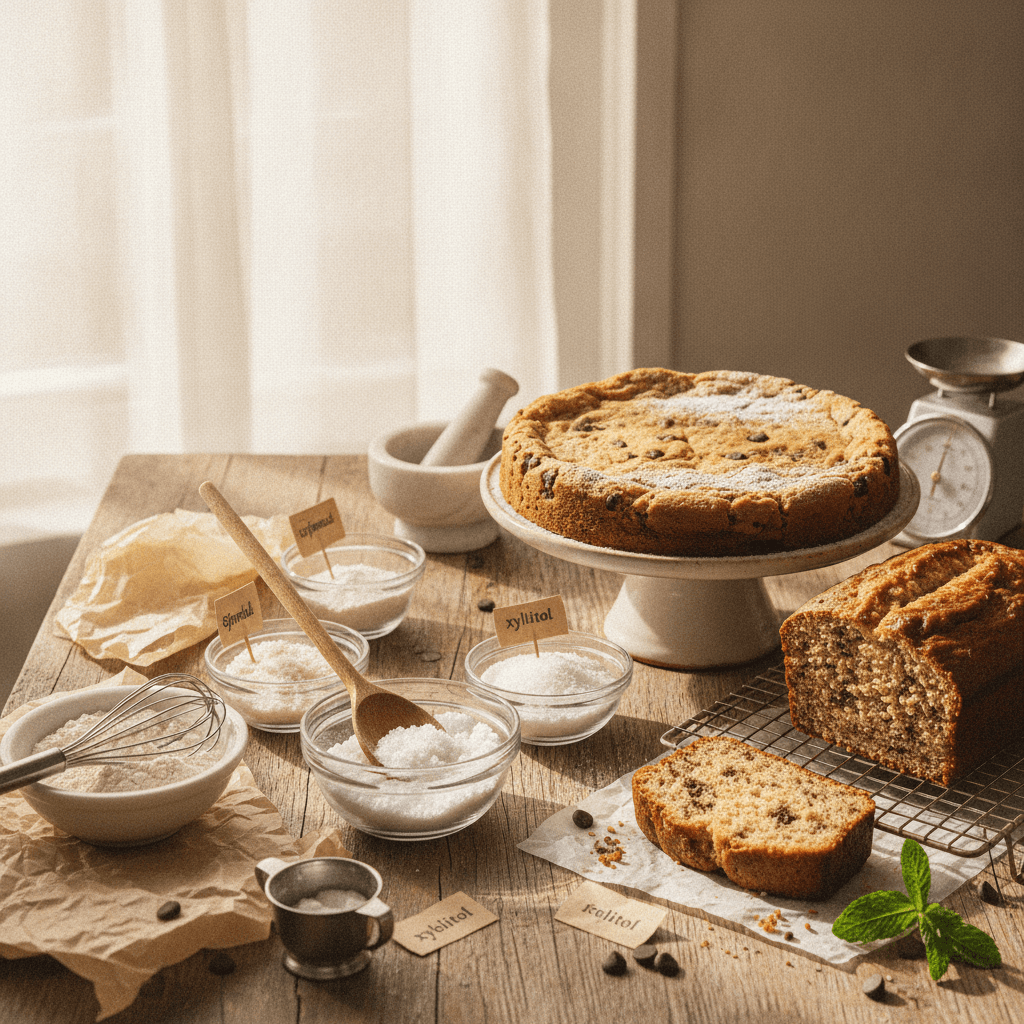
Sugar alcohols show up in nearly every "sugar-free" baking product on the shelf, but they behave nothing like sugar in a mixing bowl. Each one melts differently, sweetens differently, and can wreck texture in its own specific way. Here's what actually matters when you're choosing one for baking.
Key takeaways
- Sugar alcohols are neither sugars nor alcohols — they're polyols, a class of carbohydrate that the body only partially absorbs, which is why they have fewer calories per gram than sucrose.
- Erythritol, xylitol, sorbitol, maltitol, isomalt, and allulose (technically a rare sugar, often grouped with sugar alcohols) each behave differently in batter, dough, and finished baked goods.
- Erythritol provides about 70% of sugar's sweetness but zero browning — cookies made with pure erythritol come out pale and can develop a gritty, cooling mouthfeel within hours.
- Xylitol is the closest 1:1 volume swap for granulated sugar, but it cannot feed yeast, so it fails in any risen bread or roll.
- Maltitol browns and caramelizes more like sugar than any other sugar alcohol, but it has the highest glycemic impact of the group (GI around 36 vs. erythritol's near-zero).
- Digestive tolerance varies widely — erythritol is generally the best tolerated, while sorbitol and maltitol are well-known for causing gastrointestinal discomfort when consumed in moderate amounts.
What sugar alcohols actually are (and why the name is misleading)
Sugar alcohols — also called polyols — are hydrogenated carbohydrates. The "alcohol" in the name refers to the hydroxyl group in their chemical structure, not ethanol. They won't get anyone tipsy. Common examples include erythritol, xylitol, sorbitol, maltitol, isomalt, and mannitol.
They occur naturally in small amounts in fruits like apples, pears, and stone fruits. Commercial versions are produced industrially, usually by hydrogenating the corresponding sugar (glucose becomes sorbitol, xylose becomes xylitol, and so on).
The reason bakers care about them: they provide sweetness with fewer calories than sucrose (ranging from about 0.2 calories per gram for erythritol up to roughly 2.7 calories per gram for maltitol, compared to sugar's 4 calories per gram) and generally have a lower glycemic impact. That makes them popular in keto, diabetic-friendly, and reduced-sugar baking. But sweetness is only one of sugar's many functions in baking — and that's where the trouble starts.
How sugar works in baking (and what sugar alcohols can't replace)
Sugar does at least six things in baked goods beyond making them sweet: it tenderizes gluten structure, retains moisture, enables Maillard browning and caramelization, helps cream with butter to create air cells, lowers the freezing point, and feeds yeast. No single sugar alcohol replicates all six.
This is why bakers who swap sugar 1:1 with erythritol and expect the same chocolate chip cookie are always disappointed. The cookie won't brown. It won't spread the same way. And it may develop a cooling, almost minty sensation on the tongue within a few hours as erythritol recrystallizes. Understanding common sugar substitution mistakes before you start saves a lot of wasted ingredients.
6 sugar alcohols compared for baking
The table below covers the six sugar alcohols (and one rare sugar) most commonly used in home baking. Sweetness is relative to sucrose at 100%.
| Sugar alcohol | Sweetness vs. sugar | Calories/gram | Glycemic index (approx.) | Best baking use | Biggest limitation |
|---|---|---|---|---|---|
| Erythritol | 60–70% | 0.2 | 0–1 | Cakes, frostings (blended with monk fruit or stevia) | Recrystallizes; cooling aftertaste; no browning |
| Xylitol | 100% | 2.4 | 7–13 | Cookies, quick breads, muffins | Cannot feed yeast; toxic to dogs |
| Sorbitol | 50–60% | 2.6 | 9 | Moisture retention in soft baked goods | High laxative effect; low sweetness |
| Maltitol | 75–90% | 2.7 | 35–36 | Brownies, bars, chocolate coatings | Highest GI of the group; GI discomfort common |
| Isomalt | 45–65% | 2.0 | 2–9 | Sugar work, hard candies, decorations | Very low sweetness; hygroscopic in humid conditions |
| Allulose | 70% | 0.2–0.4 | 0 | Closest to sugar behavior — browning, moisture, spread | Expensive ($12–18/lb retail); not available everywhere; limited regulatory approval in some countries |
A quick note on allulose: it's technically classified as a rare sugar (a monosaccharide), not a polyol. But it's so frequently grouped with sugar alcohols in baking conversations — and solves so many of the same problems — that leaving it out would be more confusing than including it.
Erythritol: the most popular choice and its biggest problem
Erythritol dominates the sugar-free baking aisle because it has almost zero calories, a glycemic index near zero, and is generally well tolerated digestively compared to other sugar alcohols. Most "monk fruit sweetener" and "stevia baking blend" products are actually 98% erythritol by weight, with a tiny amount of the high-intensity sweetener mixed in to boost sweetness to a 1:1 sugar ratio.
The problem is recrystallization. Erythritol dissolves in batter during mixing and baking, but as the baked good cools, it comes out of solution and forms crystals. In a cookie, this shows up as a sandy, gritty texture within 4–6 hours. In frosting, it can feel crunchy. The cooling menthol-like sensation compounds the issue — it's subtle, but noticeable, especially in items eaten at room temperature.
Bakers who work with erythritol-based sweeteners often pair them with a small amount of a humectant ingredient (like a tablespoon of honey or a liquid sweetener) to reduce recrystallization. Blending erythritol with allulose — if budget allows — also helps significantly, because allulose stays dissolved and adds the moisture-retention and browning that erythritol lacks. For more on how monk fruit sweetener (which is usually erythritol-based) behaves in baking, that guide covers the five most common texture failures.
Xylitol: the easiest swap with one deal-breaking limitation
Xylitol measures cup-for-cup like granulated sugar and tastes remarkably similar. It dissolves cleanly, doesn't recrystallize the way erythritol does, and produces a texture in cookies and quick breads that's closer to the sugar original than almost any other option.
Two caveats matter. First, xylitol is extremely toxic to dogs — even small amounts can cause life-threatening hypoglycemia and liver failure in dogs. If there's a dog in the household, many bakers avoid xylitol entirely or store and label it with extreme care. Second, xylitol cannot be fermented by yeast. Saccharomyces cerevisiae (baker's yeast) simply can't metabolize it, so any yeasted bread, roll, or cinnamon bun made with xylitol as the sole sweetener won't rise properly. For low-carb bread baking, this matters a lot — you'd need at least a small amount of real sugar or honey to feed the yeast, then use xylitol for the remaining sweetness.
Xylitol also browns less than sugar, though more than erythritol. Expect lighter-colored crusts and less caramelization.
Maltitol: the closest texture match with the highest glycemic trade-off
Maltitol is the sugar alcohol most commonly used in commercial "sugar-free" chocolate, candy bars, and baked goods. There's a reason: it caramelizes, it browns, it holds moisture, and it produces a chew and mouthfeel closer to sugar than erythritol or xylitol do.
The trade-off is glycemic impact. With a glycemic index around 35–36, maltitol raises blood sugar more than any other sugar alcohol — roughly half as much as table sugar (GI ~65), but enough that many people following strict keto or managing diabetes find it unsuitable. It also has a well-documented laxative effect at moderate doses. The threshold varies by individual, but amounts above 30–40g in a sitting commonly cause bloating, gas, and diarrhea.
If you're baking brownies or bars where texture and browning matter more than strict carb counts, maltitol delivers. If glycemic impact is the whole reason you're avoiding sugar, maltitol may defeat the purpose. For a broader comparison of sweeteners for keto baking specifically, that guide ranks seven options by how they actually perform.
Sorbitol: the moisture hero nobody talks about
Sorbitol is a humectant — it attracts and holds water. This makes it genuinely useful for keeping baked goods soft and moist over several days, which is why commercial bakeries have used it for decades in packaged cakes, soft cookies, and snack bars.
For home baking, sorbitol is rarely used as a primary sweetener because it's only about 50–60% as sweet as sugar. You'd need to pair it with a high-intensity sweetener (stevia, monk fruit) to hit the right sweetness level. Where it shines is as a supporting ingredient: adding 1–2 tablespoons of sorbitol syrup to a cake batter that uses erythritol as the main sweetener can dramatically improve moisture retention and reduce that dry, crumbly texture that plagues low-sugar baked goods.
The digestive caveat with sorbitol is significant. It's one of the most poorly absorbed sugar alcohols, and the laxative threshold is lower than maltitol for many people. Products containing sorbitol are required to carry a "excess consumption may have a laxative effect" warning in many countries.
Isomalt: for sugar work and decorations, not for cookies
Isomalt occupies a niche in baking that no other sugar alcohol fills well: pulled sugar, blown sugar, and hard candy decorations. It resists crystallization better than sucrose, stays clear when melted, and can be shaped and molded into decorative pieces that hold up for days without getting sticky.
For actual baked goods — cookies, cakes, breads — isomalt is a poor choice. It's only about half as sweet as sugar, doesn't cream well with butter, and contributes almost no browning. Professional cake decorators keep it in the toolkit for show-stopping sugar flowers and garnishes, not for the cake underneath.
Allulose: the closest thing to real sugar (with caveats)
Allulose behaves more like sugar in baking than any sugar alcohol. It browns via the Maillard reaction. It stays dissolved and doesn't recrystallize. It holds moisture. It produces spread in cookies. It even lowers the freezing point of ice cream bases, just like sugar does.
For cookies in particular, switching from erythritol to allulose is one of the biggest single improvements you can make, largely because it avoids erythritol's cooling aftertaste.
The caveats are real, though. Allulose is expensive — retail prices typically run $12–18 per pound, compared to $3–5 per pound for erythritol. It's also only about 70% as sweet as sugar, so you either accept less sweetness or add a small amount of monk fruit or stevia to bridge the gap. And in some countries (parts of the EU, for example), allulose isn't approved for sale as a food ingredient, which limits availability.
For bakers who can access and afford it, allulose is worth considering — especially blended with erythritol at a 50/50 ratio by weight. The erythritol handles sweetness and keeps costs down, while the allulose handles browning, moisture, and prevents the recrystallization problem. For a deeper look at how to choose between sugar alternatives, the learn guide walks through the decision by baking application.
Why blending sugar alcohols works better than using one alone
This is the contrarian take that most "sugar-free baking" content gets wrong: no single sugar alcohol replaces sugar well on its own. The bakers getting the best results are blending two or three together, the same way gluten-free bakers blend multiple flours to approximate wheat flour's behavior.
A blend of 50% erythritol and 50% allulose by weight, for instance, gives you near-zero glycemic impact, adequate sweetness (boosted with a pinch of monk fruit if needed), proper browning, no recrystallization, and reasonable cost. A blend of xylitol and a small amount of sorbitol works well in soft cookies where moisture retention matters.
The principle is simple: each sugar alcohol has one or two strengths and several weaknesses. Blending lets you stack the strengths while diluting the weaknesses. This is also why commercial sugar-free products almost never use a single sweetener — check any label and you'll typically see two or three polyols listed alongside a high-intensity sweetener.
If you're baking cookies with sugar substitutes, understanding these blending principles makes the difference between a cookie that tastes "diet" and one that people actually reach for a second time.
Digestive tolerance: the elephant in the room
Sugar alcohols are only partially absorbed in the small intestine. The unabsorbed portion passes to the large intestine, where gut bacteria ferment it — producing gas, bloating, and in higher amounts, osmotic diarrhea. This is not a rare side effect; it's the expected physiological response at sufficient doses.
Tolerance varies by the specific sugar alcohol and by the individual. General rankings from best to worst tolerated:
- Erythritol — about 90% absorbed in the small intestine and excreted via urine, so very little reaches the colon. Most people tolerate 30–50g without symptoms.
- Xylitol — moderate tolerance. Symptoms common above 30–40g.
- Allulose — generally well tolerated, though some people report bloating at higher amounts (above 30–40g per sitting).
- Isomalt — lower tolerance than xylitol for many people.
- Maltitol — poorly tolerated at moderate doses. The internet is full of cautionary tales about sugar-free gummy bears for a reason.
- Sorbitol — among the worst tolerated. Even 10–15g causes symptoms in sensitive individuals.
If you're baking for others — especially selling baked goods — this matters. Labeling sugar alcohol content is both a courtesy and, in some jurisdictions, a regulatory requirement. People with IBS or FODMAP sensitivities may react to amounts that wouldn't bother most people.
How to choose the right sugar alcohol for your baking project
Rather than memorizing properties, ask these three questions:
Does the item need to brown?
If yes — cookies, pie crusts, caramel, anything where Maillard browning matters — erythritol alone won't work. You need allulose, maltitol, or a blend. If browning doesn't matter (white cake, vanilla frosting, whipped cream sweetening), erythritol or xylitol work fine.
Does the item use yeast?
If yes — bread, rolls, pizza dough — no sugar alcohol can replace sugar's role as yeast food. You'll need at least a small amount of fermentable sugar (honey, table sugar, even a tablespoon) to get the rise, then use a sugar alcohol for additional sweetness if desired.
Who is eating it, and how much?
If you're baking a full batch of brownies and someone might eat three, the total sugar alcohol load matters. Choose erythritol or allulose for better tolerance. If it's a single-serving application (one muffin, one cookie), you have more flexibility because the per-serving amount stays low.
For bakers working with natural sweeteners for low-sugar baking, sugar alcohols are just one category in a broader toolkit that includes stevia, monk fruit, and fruit-based sweeteners like date paste.
Frequently asked questions
Can you substitute erythritol for sugar 1:1 in baking?
By volume, yes — most granulated erythritol products are designed to measure cup-for-cup like sugar. But the results won't be identical. Erythritol is only 60–70% as sweet as sugar, doesn't brown, and recrystallizes as baked goods cool, creating a gritty or sandy texture. Blending erythritol with allulose or pairing it with a high-intensity sweetener like stevia or monk fruit produces better results than using erythritol alone.
Are sugar alcohols safe for people with diabetes?
Most sugar alcohols have a lower glycemic index than sucrose, meaning they raise blood sugar less. Erythritol and allulose have a glycemic index near zero. However, maltitol has a GI around 35–36, which is lower than sugar but still significant. People managing diabetes should check with their healthcare provider and monitor individual blood sugar responses, as tolerance varies.
Why do sugar-free baked goods taste cold or minty?
That cooling sensation comes primarily from erythritol. When erythritol dissolves (either in your mouth or during baking), it absorbs heat — an endothermic reaction that creates a noticeable cooling effect. This is the same principle behind sugar-free mints and gums. Blending erythritol with allulose, using it in strongly flavored baked goods (chocolate, spice cakes), or reducing the total amount can minimize the effect.
Which sugar alcohol is best for keto baking?
Erythritol and allulose are the most commonly recommended for keto because both have a glycemic index near zero and are generally subtracted from net carb counts on nutrition labels in the US. Xylitol is also low-glycemic but has more calories per gram. Maltitol is often considered not truly keto-friendly due to its higher glycemic impact. For a full comparison, the keto-friendly sugar substitutes guide ranks seven options by real baking performance.
Is xylitol dangerous for pets?
Yes — xylitol is extremely toxic to dogs. Even small amounts (as little as 0.1g per kilogram of body weight) can cause rapid insulin release, leading to dangerous hypoglycemia. Higher doses can cause liver failure. Cats appear less susceptible, but the data is limited. If you bake with xylitol and have dogs in the home, store it securely and label all baked goods clearly. Many bakers with pets choose erythritol or allulose instead to eliminate the risk entirely.

Written by
Co-founder, BakingSubs
Co-founder of BakingSubs, where he turns the science of ingredient substitutions into tested, reliable guidance for home bakers.
Related Posts
Bake with Confidence
See all
Confident Gluten-Free Baker Toolkit
The science-based system that replaces gluten's seven invisible jobs so your baking turns out soft, fluffy, and foolproof — every time.

Gluten-Free Recipe Vault
Instant access to our complete library of proven gluten-free recipes — no waiting, no guesswork, just results that work tonight.

Fix Your Gluten-Free Bread
Learn the 3-step formula to make bread rise and stay soft, discover why your loaves collapse, and get a tested sandwich bread recipe that actually works.