

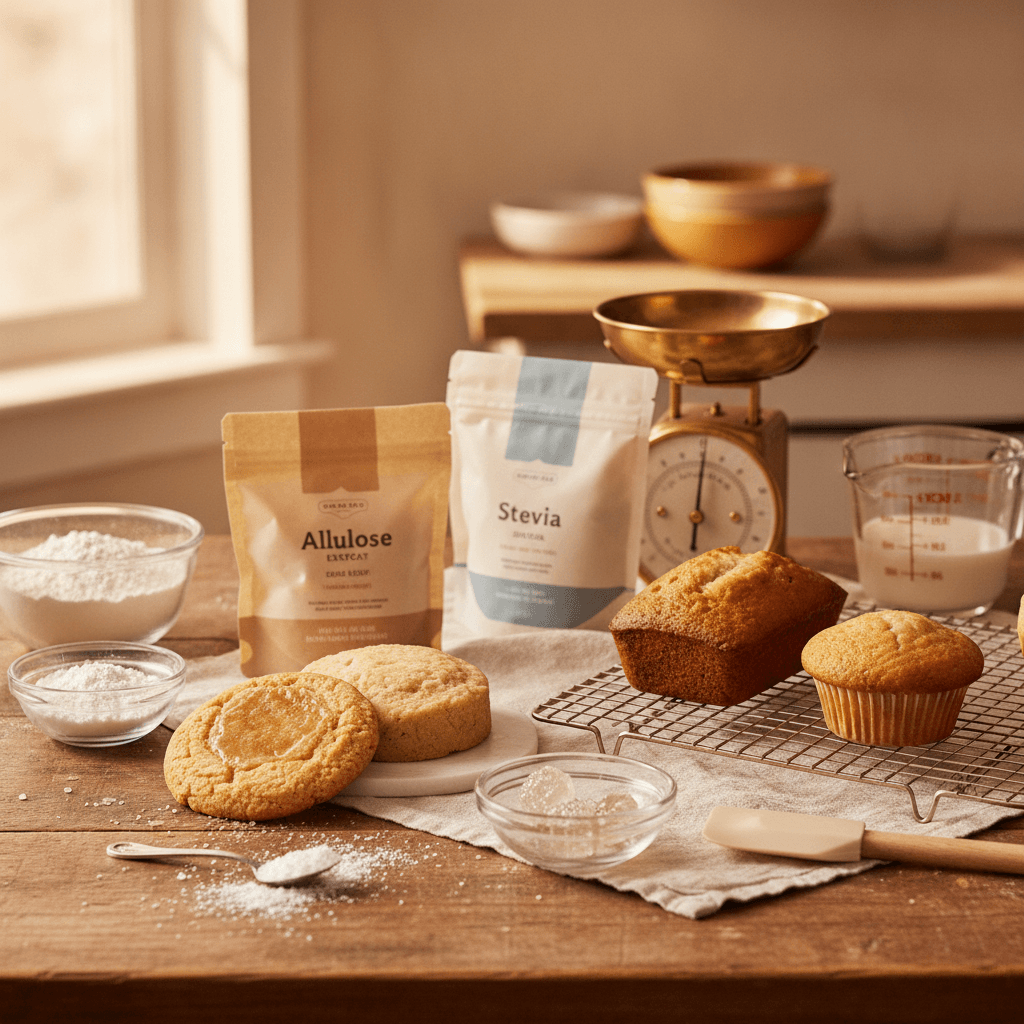
Allulose and stevia solve different problems in a sugar-free kitchen: one behaves like sugar in the oven but isn't as sweet, the other is aggressively sweet but adds no bulk, browning, or crystallization at all. Here's how they actually compare on sweetness, calories, blood sugar, baking behavior, gut tolerance, and where FDA and EFSA stand on each.
Key takeaways
- Allulose is about 70% as sweet as sugar and weighs roughly the same per cup, so recipes typically need about 1 1/3 cups (roughly 260g) of allulose to match the sweetness of 1 cup (200g) of sugar, according to the FDA's 2020 labeling guidance and standard weight conversions.
- Stevia's steviol glycosides run 200-450x sweeter than sugar depending on the glycoside, so straight stevia extract is measured in teaspoons, not cups, and needs a bulking agent to fill a pan the way sugar does.
- Allulose runs about 0.4 calories per gram versus sugar's 4, and FDA guidance lets manufacturers exclude it from Total Sugars and Added Sugars on the Nutrition Facts label, though it still counts toward Total Carbohydrate.
- Only highly purified steviol glycosides (like Reb A) are FDA GRAS; the FDA has told multiple companies in warning letters that whole-leaf and crude stevia extract are not approved for use as a food additive.
- The EU has approved steviol glycosides as a food additive since 2010 with a 4 mg/kg body weight daily limit, but a June 2025 EFSA opinion found the safety of D-allulose "cannot be established" from the data submitted, so it isn't authorized as a novel food there.
- Allulose browns and holds moisture the way sugar does, which is why it works in cookies and cakes; stevia does neither on its own, so stevia-only bakes tend to come out pale and can dry out unless it's blended with a bulking sweetener.
Allulose vs stevia at a glance
This table pulls from FDA guidance, EFSA opinions, and the label data on two widely sold products — Wholesome Yum Allulose and Pyure Organic Stevia Blend — so you can see where the two sweeteners actually diverge before getting into the why.
| Trait | Allulose | Stevia (steviol glycosides) |
|---|---|---|
| Sweetness vs. sugar | ~70% as sweet, by weight | ~200-450x sweeter, depending on the glycoside |
| Grams to replace 1 cup (200g) sugar | ~260g (about 1 1/3 cups) | As little as 1 tsp of pure extract, or ~100g (1/2 cup) of a granular erythritol-stevia blend |
| Calories | ~0.4 kcal/g (about 10% of sugar's 4 kcal/g) | Effectively 0 kcal at the doses used; blends add calories from whatever bulking agent carries them |
| Nutrition label treatment | Counts as Total Carbohydrate but excluded from Total Sugars and Added Sugars (FDA, 2020) | Steviol glycosides themselves contribute 0g sugar and 0 calories |
| Glycemic impact | Near-zero; 5-10g doses have blunted the glucose response to a separate high-GI meal in trials | Near-zero from the glycosides themselves |
| Browning | Browns faster than sugar — active around 220-230°F vs. roughly 320°F for sucrose | Little to none; it isn't a reducing sugar |
| Crystallization on cooling | Resists crystallizing, so baked goods stay soft rather than turning crisp | N/A on its own — pure extract has no bulk to crystallize |
| Cooling sensation | Not reported | None from the glycoside itself; erythritol-based blends can produce one |
| Digestive tolerance | GI symptoms reported above roughly 0.4 g/kg body weight in a single dose | Glycosides aren't fermented in the gut; blends may cause issues from the bulking agent instead |
| FDA status | GRAS since 2012; excluded from Total/Added Sugars per 2020 guidance | Purified steviol glycosides (Reb A) GRAS since 2008; whole-leaf/crude extract is NOT GRAS or an approved food additive |
| EFSA/EU status | Not authorized as a novel food — a June 2025 opinion found safety "cannot be established" from the data submitted | Approved food additive (E 960a-d) since 2010, ADI of 4 mg/kg body weight/day as steviol equivalents |
Difference 1: How much sweeter each one is than sugar
Allulose is less sweet than sugar; stevia is far more sweet. Allulose runs roughly 70% of sugar's sweetness by weight. Stevia's steviol glycosides sit at the opposite extreme — a 2024/2025 review of steviol glycosides in a peer-reviewed nutrition journal put individual glycosides, like Reb D and Reb M, as sweet as 450 times sugar, while manufacturer Pyure describes its stevia leaf extract as "around 300x sweeter than sugar" on its own FAQ page. That gap is why the two are used so differently: allulose is scooped and measured like sugar, while stevia extract is dosed in fractions of a teaspoon.
Difference 2: How much you actually need per cup of sugar
A level cup of granulated allulose weighs about the same as a cup of sugar — roughly 200g — but because it's only 70% as sweet, matching sugar's sweetness takes about 1.3x the volume, or roughly 260g (about 1 cup plus a scant 1/3 cup) per 200g of sugar replaced. Stevia math runs the other way: Pyure's granular blend, which mixes organic erythritol with stevia leaf extract, is labeled roughly 2x as sweet as sugar, so about 1/2 cup (roughly 100g) matches a full cup's sweetness. Pure stevia extract powder needs even less — often under a teaspoon per cup of sugar replaced — which is also why it can't fill a cake pan on its own. Say a recipe calls for 1 cup (200g) of sugar in a batch of blondies, purely as a hypothetical example: swapped for allulose you'd use roughly 260g, but swapped for a stevia-erythritol blend you'd use only about 100g for sweetness and still need to make up the missing bulk some other way, since sugar's volume does real structural work in a batter. For the exact ratios and common fillers, see our stevia baking conversion guide.
Difference 3: Calories and how they show up on the label
Allulose provides about 0.4 calories per gram versus 4 for table sugar — roughly a 90% cut by weight. Per FDA guidance finalized in October 2020, manufacturers may use that 0.4 kcal/g factor and exclude allulose from Total Sugars and Added Sugars, even though it still counts toward Total Carbohydrate and appears in the ingredients. That's the regulatory basis for "0g net carbs" claims on products like Wholesome Yum Allulose, whose label lists a single ingredient — allulose. Stevia doesn't need the same workaround: at the tiny doses used, purified steviol glycosides contribute effectively 0 calories and 0g sugar on their own. Calories in a stevia product come from whatever it's blended with — Pyure's granular blend lists organic erythritol as its first ingredient, ahead of the stevia leaf extract itself.
Difference 4: Effect on blood sugar and insulin
Both sweeteners have a near-zero glycemic impact, for different reasons. A systematic review and meta-analysis of allulose's effect on postprandial blood glucose in healthy adults found it blunted the glucose spike from meals it was added to, and separate trials found 5-10g "catalytic" doses reduced the glycemic response to a separate high-glycemic-index meal eaten alongside it — an effect not seen at a 2.5g dose. Stevia's glycosides aren't metabolized into glucose, which is the mechanism a 2024/2025 review in a peer-reviewed nutrition journal points to for its near-zero glycemic index. The caveat is for blended retail products: if a "stevia" blend lists dextrose or maltodextrin as a carrier, that filler — not the stevia — can raise blood sugar.
Difference 5: How each behaves in the oven
Allulose is a reducing sugar, so it's highly reactive in the Maillard browning reaction — food-science sourcing on allulose baking behavior puts its browning threshold at roughly 220-230°F, well below the roughly 320°F where sucrose starts to color. Chemistry predicts allulose-sweetened cookies and cakes brown faster and darker at the same oven temperature, which is why several baking guides recommend dropping the temperature about 25°F when swapping it in. Allulose is also more hygroscopic than sugar and resists crystallizing as it cools, so bakes made with it tend to stay soft rather than developing sugar's crisp edge. Stevia does none of this: it isn't a reducing sugar, so it browns nothing on its own, and pure extract has essentially no mass to crystallize, add chew, or hold moisture with. The "cooling" sensation some sugar-free products give off comes from sugar alcohols like erythritol dissolving endothermically in the mouth — chemistry predicts pure steviol glycosides, which aren't sugar alcohols, don't produce that sensation, though a stevia-erythritol blend inherits it from the erythritol.
Difference 6: Digestive tolerance
Allulose has a documented dose ceiling. A 2018 gastrointestinal-tolerance study of D-allulose in 30 healthy adults, published in the journal Nutrients, found symptoms like diarrhea and abdominal pain at single doses around 0.5 g per kilogram of body weight, with severe symptoms at higher daily intakes, and recommended staying under about 0.4 g/kg body weight (roughly 24g for a 60kg adult) per dose. Allulose is also reported to pass through largely unfermented, unlike sugar alcohols such as xylitol. Steviol glycosides carry a different profile: EFSA's evaluation set an acceptable daily intake of 4 mg/kg body weight per day (as steviol equivalents), and the glycosides aren't fermented by gut bacteria the way sugar alcohols are. The practical GI risk with a stevia product usually traces back to its carrier — an erythritol-heavy blend can cause the same bloating and loose stools erythritol causes on its own at high amounts.
FDA and EFSA: where each one actually stands
In the US, allulose has cleared several rounds of FDA review, with the agency raising no objections to GRAS conclusions on D-psicose (allulose) since 2012. FDA's October 2020 guidance went further, letting allulose skip the Total Sugars and Added Sugars lines on labels and use the reduced 0.4 kcal/g calorie factor. Stevia's FDA status is more layered: the agency has never approved whole-leaf or crude stevia extract as a food additive, and told several companies in separate warning letters that using it as a sweetener wasn't authorized. What is FDA GRAS, since 2008, is highly purified steviol glycosides like Reb A — the form in nearly every commercial "stevia" sweetener on shelves.
In the EU, the picture flips. Steviol glycosides have been an approved food additive (E 960a-d) since a 2010 EFSA opinion set the 4 mg/kg body weight/day ADI, with extensions evaluated since. Allulose has no such approval: it's classified as a novel food requiring EFSA authorization before sale, and a June 2025 opinion concluded the safety of D-allulose "cannot be established" because the applicant never supplied the genotoxicity, stability, and human-consumption data EFSA had requested since 2020. In practice, stevia is settled across both regions, while allulose remains an open regulatory question in the EU even as it's freely sold in the US.
Which one should you use?
Reach for allulose when the recipe needs sugar's physical behavior — browning on a cookie edge, moisture retention in a cake, a soft chew instead of a crumbly one. It's the closer match to sugar's role in the oven, even though it needs more volume and a lower bake temperature to get there. Reach for stevia when you don't need sugar's bulk at all — a glaze, a drink, or a filling where flour, eggs, or fat already do the structural work — and when you want zero calories rather than allulose's modest 0.4 kcal/g. For candy, caramel, or anything that depends on sugar crystallizing into a specific structure, neither is a straight swap; that's a job for a bulking sweetener blend, and our allulose vs. erythritol comparison and monk fruit vs. stevia comparison cover those alternatives. Some brands split the difference by blending the two directly, pairing allulose's browning with stevia's zero-calorie sweetness in one product.
If you're shopping for either, check the ingredient panel before the marketing copy. Wholesome Yum Allulose lists a single ingredient with 0g net carbs per the label, while Pyure Organic Stevia Blend leads with organic erythritol ahead of the stevia leaf extract — worth knowing if you're avoiding sugar alcohols specifically. Our allulose brand comparison and the stevia ingredient page go deeper on individual products, and allulose as a sugar substitute covers the texture trade-offs. If a swap isn't working, texture changes with health swaps and our guide to choosing a sugar alternative walk through fixes.
Frequently asked questions
Is allulose or stevia better for baking?
Allulose is the closer match for baking because it browns, retains moisture, and resists crystallizing the way sugar does, while stevia contributes sweetness but none of sugar's structural behavior. Stevia works better in drinks, glazes, or fillings where you don't need sugar's bulk.
Does allulose raise blood sugar?
Research reviewed in a systematic review and meta-analysis found allulose has a near-zero effect on blood glucose, and some trials found 5-10g doses blunted the glucose response to a separate high-glycemic meal eaten with it. It's still worth checking with a doctor for individual conditions like diabetes, since FDA and EFSA opinions address food safety, not personal medical guidance.
How much stevia equals one cup of sugar?
It depends on the product. A granular stevia-erythritol blend labeled 2x as sweet as sugar (like Pyure's) needs about 1/2 cup to match a cup of sugar's sweetness, while pure stevia extract powder needs well under a teaspoon. See our stevia baking conversion guide for ratios by product type.
Can you mix allulose and stevia in a recipe?
Yes — some commercial blends already combine the two specifically to pair allulose's browning and moisture retention with stevia's zero-calorie sweetness, and home bakers can do the same by using allulose for bulk and a small amount of stevia extract to boost sweetness without adding more volume.
Is allulose approved in Europe?
Not yet as of a June 2025 EFSA opinion, which concluded the safety of D-allulose as a novel food "cannot be established" because the applicant did not supply requested safety data. Stevia's steviol glycosides, by contrast, have been an approved EU food additive since 2010.
Sources
- FDA GRAS Notice 693, D-psicose (allulose) — filed 2017; the original allulose GRAS no-objection letter was GRN 400 in 2012
- FDA: Declaration of Allulose and Calories From Allulose on Nutrition Facts Labels (2020)
- EFSA: Safety of D-allulose as a novel food (2025)
- EFSA: Scientific opinion on the safety of steviol glycosides as a food additive (2010)
- FDA GRAS response letter, GRN 000638 (steviol glycosides) — a 2016 letter for Rebaudioside A; the original Reb A GRAS no-objection letters were GRN 252/253 in 2008
- FDA warning: whole stevia leaf not GRAS or an approved food additive
- Gastrointestinal tolerance of D-allulose in healthy adults, Nutrients (2018)
- Allulose and postprandial blood glucose: systematic review and meta-analysis
- Icon Foods: baking with allulose (browning and moisture behavior)
- Allulose weight-per-cup and sweetness conversion data
- Pyure Organic: sweetener FAQ (sweetness ratio, conversion notes)

Written by
Co-founder, BakingSubs
Co-founder of BakingSubs, where he turns the science of ingredient substitutions into tested, reliable guidance for home bakers.
Related Posts

Bake with Confidence
See all
Confident Gluten-Free Baker Toolkit
The science-based system that replaces gluten's seven invisible jobs so your baking turns out soft, fluffy, and foolproof — every time.

Gluten-Free Recipe Vault
Instant access to our complete library of proven gluten-free recipes — no waiting, no guesswork, just results that work tonight.

Fix Your Gluten-Free Bread
Learn the 3-step formula to make bread rise and stay soft, discover why your loaves collapse, and get a tested sandwich bread recipe that actually works.