

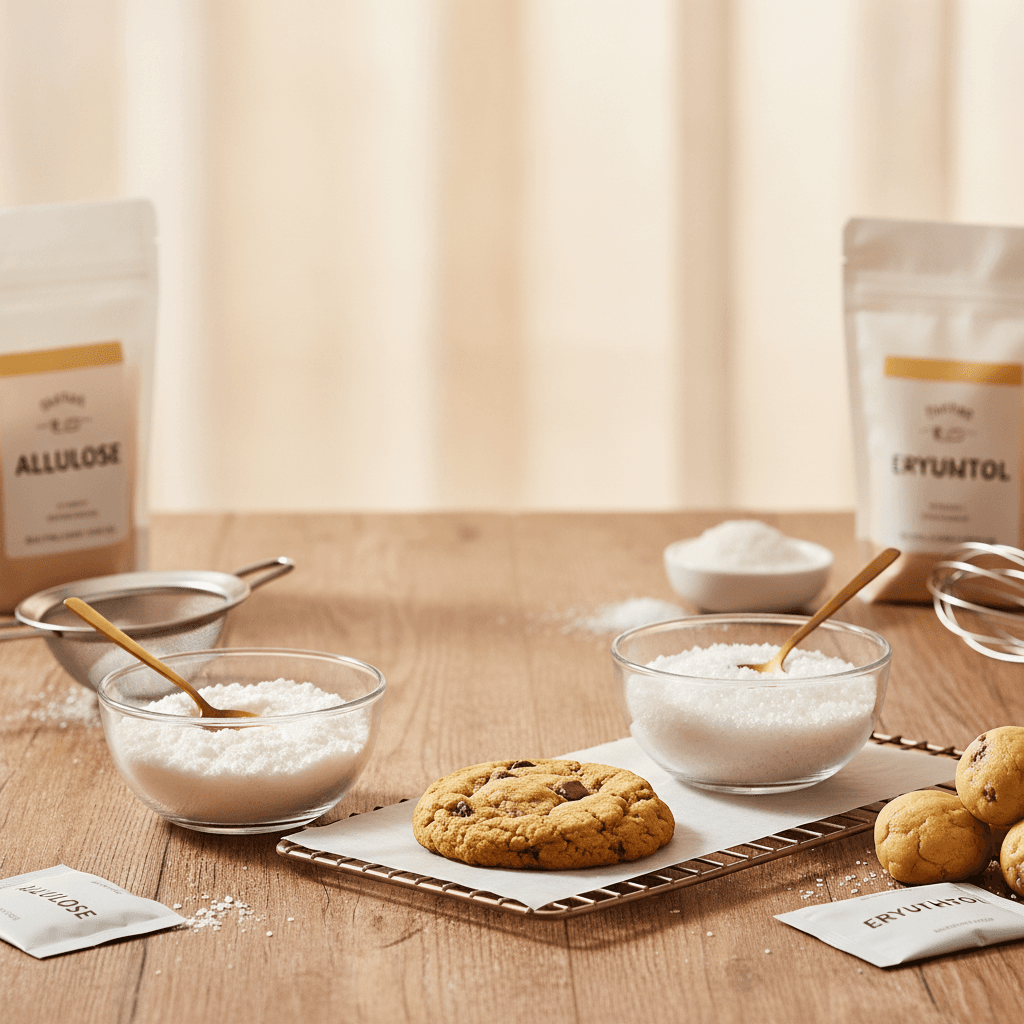
Allulose and erythritol are both zero-glycemic sweeteners, but they behave very differently in a batter. Allulose is a rare sugar that browns, holds moisture, and resists recrystallizing; erythritol is a sugar alcohol that cools the palate, crystallizes as it cools, and bakes drier. The right pick depends on what you're making and which tradeoffs matter most to you.
Key takeaways
- Allulose has about 0.4 calories per gram (under 2 calories per teaspoon) and a glycemic index of 0. Erythritol has 0.2 cal/g and a GI of 0. Neither raises blood sugar meaningfully.
- Erythritol is 60–70% as sweet as sugar; allulose is about 70% as sweet. You need more of either to match 1 cup of granulated sugar.
- Erythritol recrystallizes as baked goods cool, which can make frostings gritty and cookies crunchy-then-sandy. Allulose stays dissolved.
- Allulose undergoes Maillard browning like real sugar. Erythritol does not brown, so crusts stay pale.
- A 2023 Cleveland Clinic study linked erythritol blood levels to increased platelet clotting and cardiovascular events — but the study had major limitations (observational, older high-risk population). The FDA still lists erythritol as GRAS.
- Allulose is more expensive: roughly $0.60–$1.20 per ounce in granular form versus $0.25–$0.50 per ounce for erythritol, depending on brand and format.
Side-by-side comparison table
| Criteria | Allulose | Erythritol |
|---|---|---|
| Chemical class | Rare monosaccharide (D-psicose) | Sugar alcohol (polyol) |
| Sweetness vs sugar | ~70% | ~60–70% |
| Calories per gram | 0.4 | 0.2 |
| Glycemic index | 0 | 0 |
| Net carbs per teaspoon | 0 g (FDA excludes from total/added sugars) | 0 g (sugar alcohol, not counted as net carb on keto) |
| Maillard browning | Yes — browns faster than sucrose | No — stays pale |
| Crystallization on cooling | Does not recrystallize | Recrystallizes, can turn gritty |
| Cooling sensation | None | Noticeable menthol-like cooling |
| Moisture retention | Humectant — holds moisture well | Drying — absorbs less water than sugar |
| Digestive tolerance (typical threshold) | ~0.4 g per kg body weight before GI distress (about 27 g for a 150 lb person) | ~0.66–0.8 g per kg body weight (about 45–54 g for a 150 lb person) |
| FDA GRAS status | Yes (since 2019 for labeling; GRAS since 2012) | Yes |
| Price range (granular) | Mid-range to premium (~$0.60–$1.20/oz) | Budget to mid-range (~$0.25–$0.50/oz) |
For a deeper look at how each one performs on its own, see our guides on allulose as a sugar substitute for baking and erythritol vs xylitol for baking.
How we ranked these
Every claim in this comparison is based on verifiable data: FDA label rules, published nutrition facts, glycemic index values from peer-reviewed databases, manufacturer-stated properties, and the chemical behavior each sweetener's molecular structure predicts. We have not tasted, tested, or baked with these products ourselves. Taste and texture descriptions come from manufacturer claims or from what the ingredient's chemistry predicts, and we say which each time. Price ranges are approximate and shift by retailer and bag size.
Sweetness level and how much you need per cup of sugar
Both sweeteners are less sweet than sugar, so you need more than a 1:1 swap by volume. Allulose at 70% sweetness means you need roughly 1⅓ cups to match 1 cup of sugar's sweetness. Erythritol at 60–70% sweetness calls for about 1⅓ to 1⅔ cups. That extra volume matters — it changes batter hydration and spread.
In practice, many bakers use a 1:1 volume swap and accept slightly less sweetness, or they add a high-intensity sweetener like monk fruit extract to close the gap; extract strength varies, so follow the product's label. Our monk fruit sweetener brand comparison covers options if you go that route. Several erythritol brands already include monk fruit in the blend — check the label before adding more.
How each one behaves in baking
Browning
Allulose participates in the Maillard reaction because it is a reducing sugar. Chemically, its open-chain form reacts with amino acids in flour and eggs to produce brown pigments and flavor compounds. In fact, allulose browns faster than sucrose, so you may need to lower your oven temperature by 25°F (about 15°C) or shorten bake time by 3–5 minutes to avoid over-darkening. This is one of the most common healthy-baking mistakes with allulose.
Erythritol does not brown. It is a sugar alcohol with no reducing end, so it cannot participate in Maillard reactions. Cookies, muffin tops, and pie crusts will stay noticeably paler than their sugar-based versions. If golden color matters, you can brush an egg wash on top or add a tiny amount of molasses (1 teaspoon per batch) — though that adds a few grams of sugar.
Crystallization
This is the biggest practical difference. Erythritol's solubility in water drops sharply as temperature falls. At 25°C, erythritol's solubility is about 37% by weight (roughly 58 g per 100 g of water), compared with about 200 g per 100 g of water for sugar. That means as a cookie or frosting cools, dissolved erythritol crashes out of solution and forms crystals. The result is a gritty, sandy, or crunchy texture that many people find unpleasant, especially in frostings, glazes, and soft cookies.
Allulose is far more soluble (about 291 g per 100 g of water at 25°C), so it is much less prone to recrystallizing as baked goods cool. That is why it is favored for smooth frostings, chewy caramels, and soft-centered cookies. If you've had texture problems with health swaps, crystallization is often the culprit when erythritol is involved.
Moisture and shelf life
Allulose is hygroscopic — it pulls moisture from the air and holds it in the crumb. Baked goods made with allulose tend to stay softer longer, similar to how honey or corn syrup works. The downside: in humid climates, allulose-sweetened items can get sticky on the surface if left uncovered.
Erythritol is the opposite. It has low hygroscopicity, meaning it does not attract or hold much water. Baked goods can dry out faster. Adding a tablespoon of vegetable glycerin or a mashed banana per batch can help compensate, though both change the flavor profile.
Cooling effect
Erythritol has a high negative heat of solution (−43 cal/g), which means it absorbs heat as it dissolves on the tongue. The result is a cooling, almost minty sensation — noticeable in frostings and thin cookies, less so in dense cakes where other flavors dominate.
Allulose is not associated with the cooling effect that erythritol causes.
Glycemic impact and carb counting
Both sweeteners have a glycemic index of 0 and do not raise blood glucose in most people, according to published glycemic index studies. However, they show up differently on nutrition labels.
Under FDA guidance issued in draft in April 2019 and finalized in October 2020, manufacturers may exclude allulose from both "Total Sugars" and "Added Sugars" on Nutrition Facts panels. It still appears under Total Carbohydrates, but most keto dieters subtract it to arrive at net carbs of 0 g.
Erythritol is listed under "Sugar Alcohols" on the label. Keto carb-counting conventions also treat it as 0 net carbs, since the body absorbs but does not metabolize it — about 90% is excreted unchanged in urine.
For more on choosing the right sugar alternative and understanding how sugar functions in baking, our sugar functions guide breaks down what you're actually replacing when you swap out sucrose.
Digestive tolerance
Both sweeteners are better tolerated than other sugar alcohols like sorbitol or maltitol, but they are not consequence-free in large amounts.
Published tolerance studies suggest allulose causes gastrointestinal symptoms (bloating, gas, diarrhea) at doses above roughly 0.4 g per kilogram of body weight in a single sitting. For a 150 lb (68 kg) person, that is about 27 g — roughly 2 tablespoons of granular allulose. A batch of cookies using 160 g of allulose split into 24 cookies puts each cookie at roughly 6.7 g, so eating 4 cookies in one sitting would approach that threshold.
Erythritol is tolerated at somewhat higher doses — a laxative threshold of about 0.66 g per kg body weight for men and 0.80 g per kg for women (Oku and Okazaki, 1996), or about 45–54 g for the same 150 lb person. Because erythritol is absorbed in the small intestine and excreted via urine rather than fermenting in the colon, it causes less bloating than other polyols. But at high doses, osmotic diarrhea is still possible.
Safety: FDA status and the 2023 erythritol study
Both sweeteners hold FDA Generally Recognized as Safe (GRAS) status. Allulose received GRAS status in 2012, with updated labeling guidance in 2019. The FDA first responded with no questions to an erythritol GRAS notice in 2001.
The 2023 Cleveland Clinic erythritol study
In February 2023, researchers at the Cleveland Clinic published a study in Nature Medicine (Witkowski et al.) that found an association between high blood levels of erythritol and increased risk of cardiovascular events (heart attack, stroke, death) over a 3-year follow-up. The study also showed that erythritol enhanced platelet reactivity and clot formation in lab and animal experiments.
The limitations are significant and should be stated plainly:
- The observational cohorts consisted primarily of older adults who already had heart disease risk factors or existing cardiovascular disease. This population does not represent healthy younger adults.
- The study measured blood erythritol levels, not dietary intake. The human body produces small amounts of erythritol endogenously (through the pentose phosphate pathway), and elevated blood levels could be a marker of metabolic dysfunction rather than a cause of it.
- The platelet-clotting experiments used erythritol concentrations that may not reflect typical dietary exposure.
- The study was observational and cannot prove causation. In the same 2023 paper, 8 healthy volunteers who drank 30 g of erythritol saw blood levels rise more than 1,000-fold, and a 2024 follow-up by the same group (Arteriosclerosis, Thrombosis, and Vascular Biology) found that 30 g of erythritol, but not glucose, increased platelet reactivity in 20 healthy volunteers. Neither measured actual cardiovascular events.
The FDA has not changed erythritol's GRAS status in response to this research. In December 2023, the European Food Safety Authority set an acceptable daily intake for erythritol of 0.5 g per kg of body weight, about 34 g a day for a 150 lb adult. However, if you have existing heart disease, clotting disorders, or diabetes, talk to your doctor before consuming erythritol regularly.
No comparable cardiovascular concern has been published for allulose. A 2018 systematic review and meta-analysis in Nutrients (Noronha et al.) found that small doses of allulose lowered the blood glucose response to carbohydrate meals. Again, if you have diabetes or metabolic conditions, consult your physician.
Price comparison
Erythritol is the clear budget winner. Granular erythritol from brands like Swerve, Wholesome, and Anthony's typically runs $0.25–$0.50 per ounce at major retailers. A 5 lb bag of Anthony's Erythritol Granules lists at about $32 on the brand's site, roughly $0.40 per ounce.
Allulose costs roughly 2–3 times more. Granular allulose from brands like Wholesome, RxSugar, and Keystone Pantry runs $0.60–$1.20 per ounce. Liquid allulose (syrup form) is also sold, for example by RxSugar. For a deeper brand-by-brand breakdown, see our best allulose brands comparison and best erythritol brands for baking.
If you're running a recipe cost sheet for a home bakery, this difference adds up fast. Say you bake 30 batches of keto cookies per month, each using 1 cup (about 6 oz) of sweetener. At an assumed $0.75/oz for allulose, that is $135/month in sweetener alone. At $0.40/oz for erythritol, it is $72. The $63 monthly difference is real money for a cottage food business.
When to use allulose vs erythritol
There is no single "better" sweetener — the right choice depends on the recipe.
Use allulose when:
- Soft texture matters — soft cookies, chewy brownies, moist cakes. Allulose's moisture retention and lack of crystallization keep things tender.
- You need browning — caramel, golden cookie edges, browned muffin tops. Allulose is one of the only zero-glycemic sweeteners that browns naturally.
- Frostings, glazes, and caramels — any application where grittiness would ruin the result.
- You want the closest sugar-like behavior — allulose mimics sugar's functional properties more closely than any other alternative sweetener.
Use erythritol when:
- Budget is the priority — erythritol costs roughly half as much per ounce.
- Crisp texture is the goal — biscotti, shortbread, sugar-cookie crunch. Erythritol's crystallization actually helps here.
- You want the lowest possible calories — at 0.2 cal/g, erythritol has half the (already low) calories of allulose.
- The recipe is served warm — erythritol stays dissolved at higher temperatures, so items eaten warm (fresh-from-the-oven cookies, warm muffins) sidestep the crystallization problem.
Consider blending both
A 50/50 blend of allulose and erythritol is a common approach. The allulose can reduce the erythritol's tendency to recrystallize, while the erythritol brings the cost down. A blend also dilutes the cooling effect. Our best sugar substitute for baking roundup covers several pre-made blends that use this strategy.
Frequently asked questions
Is allulose or erythritol better for keto baking?
Both have 0 net carbs and a glycemic index of 0, so both are keto-compatible. Allulose is the better functional choice for soft baked goods because it does not crystallize and holds moisture. Erythritol works well for crispy recipes and costs less. Many keto bakers blend the two at a 50/50 ratio to get the best of both.
Does erythritol cause heart attacks?
A 2023 Cleveland Clinic study published in Nature Medicine found an association between elevated blood erythritol levels and cardiovascular events in an older, high-risk population. The study was observational and cannot prove causation. The FDA has not changed erythritol's GRAS status. If you have existing heart disease or clotting disorders, discuss erythritol use with your doctor.
Why does erythritol get gritty in frosting?
Erythritol's solubility drops sharply as temperature decreases — its solubility at 25°C is only about 37% by weight, compared with roughly 67% for sugar. As frosting cools, excess erythritol crashes out of solution and forms crystals, creating a sandy or gritty texture. Using powdered (confectioners'-style) erythritol and blending it with allulose or a small amount of vegetable glycerin can reduce this problem. Learn more about common sugar-swap mistakes.
Can you substitute allulose 1:1 for erythritol in a recipe?
Not directly, because they behave differently. Allulose adds moisture and browns; erythritol dries and stays pale. If a recipe was developed for erythritol and you swap in allulose at the same volume, expect faster browning (lower oven temp by 25°F), a softer texture, and possibly a slightly wetter crumb. You may need to reduce other liquid in the recipe slightly to compensate for its humectant properties.
Is allulose safe for people with diabetes?
Published studies show allulose does not raise blood glucose or insulin levels in most people, and a 2018 meta-analysis in Nutrients found small doses lowered the blood glucose response to carbohydrate meals. The FDA permits allulose to be excluded from "Added Sugars" on nutrition labels. That said, individual responses can vary, and anyone managing diabetes should consult their physician before making significant dietary changes.

Written by
Co-founder, BakingSubs
Co-founder of BakingSubs, where he turns the science of ingredient substitutions into tested, reliable guidance for home bakers.
Related Posts
Erythritol vs Stevia for Baking: 6 Differences That Actually Change Your Results
Best Sugar-Free Cake Mix and Brownie Mix (2026): 14 Options Ranked by Net Carbs, Sweetener, and Price
Lakanto Monk Fruit Sweetener Review: 0g Net Carbs, but Worth the Premium Price?
Bake with Confidence
See all
Confident Gluten-Free Baker Toolkit
The science-based system that replaces gluten's seven invisible jobs so your baking turns out soft, fluffy, and foolproof — every time.

Gluten-Free Recipe Vault
Instant access to our complete library of proven gluten-free recipes — no waiting, no guesswork, just results that work tonight.

Fix Your Gluten-Free Bread
Learn the 3-step formula to make bread rise and stay soft, discover why your loaves collapse, and get a tested sandwich bread recipe that actually works.