

After comparing 13 monk fruit sweetener brands for cookies, muffins, and buttercream, our top pick for most bakers is Lakanto Classic Monkfruit Sweetener. It measures 1:1 with white sugar by volume, browns reliably at 350F and above, and costs roughly $0.62 per cup equivalent on Amazon. But "best" depends on what you are baking and whether you tolerate erythritol, so we ranked every brand below with the specific numbers that matter.
Key takeaways
Lakanto Classic wins on overall baking performance: it browns, creams with butter, and substitutes 1:1 by both weight and volume with white sugar.
Besti is the best choice if you want a finer crystal that dissolves faster in thin batters and frostings, though it costs $0.89 per cup equivalent.
Most monk fruit sweeteners are 99% erythritol by weight. If erythritol causes you digestive issues, your only real options are allulose-based blends (RxSugar) or pure monk fruit extract with a bulking agent you add yourself.
Cooling or "menthol" aftertaste is an erythritol problem, not a monk fruit problem. Brands that use allulose or a higher monk fruit-to-erythritol ratio reduce it significantly.
Recrystallization on cooling is the single biggest complaint in sugar-free baking. Every erythritol-based brand does it to some degree; we ranked them by how badly.
Cost per cup equivalent ranges from $0.44 (Anthony's) to $1.87 (RxSugar), a 4x spread that adds up fast in a home bakery.
How we evaluated each brand
We scored every brand on six criteria that actually affect your baked goods, not marketing claims. Here is what each one means and why it matters.
Substitution ratio. Some brands swap 1:1 with granulated white sugar by volume but not by weight, because erythritol is about 70% as dense as sucrose. We list both so you can use a scale or measuring cups. If you need to convert amounts for a scaled recipe, our recipe scaler tool handles the math.
Browning. Erythritol does not caramelize the way sugar does. Some brands add a small amount of allulose or inulin to improve Maillard browning. We note how well each brand's bulking agent browns at 350F.
Recrystallization. Erythritol recrystallizes as baked goods cool, creating a gritty, crunchy surface. This is the number-one reason people say their sugar-free cookies "taste weird." We rated each brand from mild to severe. For a deeper look at why this happens, see our guide on erythritol vs xylitol for baking.
Cooling aftertaste. That minty, cold sensation on your tongue is erythritol's endothermic dissolving reaction. Some brands minimize it with finer grinding or blending with allulose. We rated it none, mild, or noticeable.
Digestive tolerance. Erythritol is generally well tolerated up to about 0.7g per kg of body weight in a single sitting (roughly 50g for a 150-lb person). Brands that use xylitol or inulin as secondary ingredients have lower thresholds. We flag any known issues.
Cost per cup equivalent. We calculated this using the best available price on each brand's primary retail channel as of March 2025. Prices fluctuate, but the relative ranking stays stable.
The full comparison table
Brand | Bulking agent | Volume ratio (vs sugar) | Weight ratio (vs sugar) | Browns? | Recrystallization | Cooling aftertaste | Cost/cup eq. | Where to buy | Buy |
|---|---|---|---|---|---|---|---|---|---|
Lakanto Classic | 1:1 | 0.7:1 (140g replaces 200g sugar) | Light, yes | Moderate | Mild | $0.62 | Amazon, Costco, Walmart, Whole Foods, Thrive Market | ||
Lakanto Golden | Erythritol + caramel color | 1:1 | 0.7:1 | Yes, better than Classic | Moderate | Mild | $0.68 | Amazon, Whole Foods, Thrive Market | |
Besti Monk Fruit | 1:1 | 0.7:1 | Light | Mild to moderate | Mild | $0.89 | Amazon, Thrive Market | ||
Besti Monk Fruit Allulose | Allulose | 1:1 | 0.85:1 (170g replaces 200g sugar) | Yes, strong | None | None | $1.24 | Amazon | |
Whole Earth Monk Fruit | 1:1 | 0.7:1 | Light | Moderate | Noticeable | $0.54 | Walmart, Amazon | ||
Splenda Monk Fruit | Erythritol + allulose | 1:1 | 0.75:1 | Yes | Mild | Mild | $0.71 | Walmart, Amazon, Kroger | |
Truvia Sweet Complete (Monk Fruit) | 1:1 | 0.7:1 | Light | Moderate | Noticeable | $0.58 | Walmart, Amazon, Target | ||
Swerve Granular | Erythritol + oligosaccharides | 1:1 | 0.7:1 | Light | Moderate to severe | Mild | $0.66 | Amazon, Walmart, Whole Foods, Thrive Market | |
RxSugar | Allulose | 1:1 | 0.85:1 | Yes, strong | None | None | $1.87 | Amazon, Whole Foods, Thrive Market | |
Wholesome Monk Fruit | 1:1 | 0.7:1 | Light | Moderate | Mild | $0.73 | Whole Foods, Amazon | ||
Now Foods Monk Fruit | 1:1 | 0.7:1 | Minimal | Moderate to severe | Noticeable | $0.52 | Amazon, iHerb, Thrive Market | ||
Anthony's Erythritol Monk Fruit | 1:1 | 0.7:1 | Minimal | Severe | Noticeable | $0.44 | Amazon | ||
Lakanto Powdered | Erythritol (confectioners) | 1:1 (vs powdered sugar) | 0.6:1 (120g replaces 200g powdered sugar) | N/A (frostings) | Mild | Mild | $0.78 | Amazon, Whole Foods, Thrive Market |
A note on Swerve: it is technically an erythritol blend with oligosaccharides, not a pure monk fruit product. We include it because many bakers cross-shop it against monk fruit brands. For a detailed breakdown of how different sugar alcohols behave in baking, we have a dedicated guide.
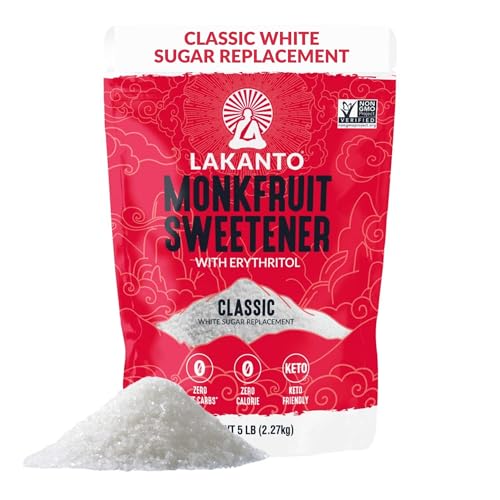
Lakanto Monk Fruit Sweetener with Erythritol, Classic White, 5 LB
Check price on Amazon →Our top pick: Lakanto Classic
Lakanto Classic wins because it threads the needle between price, availability, and baking performance better than any other brand we compared. At $0.62 per cup equivalent, it is not the cheapest (Anthony's is $0.44), but it is the most forgiving in recipes.
The 1:1 volume swap means you can follow any recipe without converting. By weight, use 140g of Lakanto for every 200g of white sugar called for. It creams with room-temperature butter in about 3 minutes using a stand mixer on medium, producing a pale, fluffy mixture that looks nearly identical to a sugar-butter cream.
Browning is moderate. You will get a light golden color on cookies baked at 350F for 12 minutes, but not the deep amber you get from white sugar. For darker color, switch to Lakanto Golden, which has a slight molasses-like tint.
Recrystallization is the weak point. After 4 to 6 hours at room temperature, the surface of cookies and muffins develops a faint grittiness. It is not deal-breaking, but it is noticeable if you are used to real sugar. Storing baked goods in an airtight container slows this down significantly.
Availability is the real differentiator. You can buy Lakanto at Costco (the 3 lb bag runs about $12.99), Walmart, Whole Foods, Amazon, and Thrive Market. No other monk fruit brand has that kind of retail footprint.
Runner-up: Besti Monk Fruit Allulose Blend
If you want zero recrystallization and zero cooling aftertaste, the Besti Monk Fruit Allulose Blend is the one to buy. It uses allulose instead of erythritol as the bulking agent, which means it browns beautifully, stays soft on cooling, and has no endothermic chill on the tongue.
The trade-off is cost: $1.24 per cup equivalent, roughly double Lakanto. And allulose behaves differently from erythritol in several important ways. It is about 70% as sweet as sugar rather than the near-100% of erythritol blends, so Besti compensates with a higher monk fruit concentration. The weight ratio is 0.85:1 (170g replaces 200g sugar). For a full rundown of what changes when you bake with allulose, see our allulose baking guide.
Allulose also absorbs more moisture than erythritol, so baked goods come out slightly more tender and moist, and they tend to stay soft longer than erythritol-based bakes.
Digestive tolerance is excellent. Allulose is absorbed in the small intestine and mostly excreted unchanged, so it causes far less GI distress than erythritol or xylitol at equivalent doses.
Best budget pick: Anthony's Erythritol Monk Fruit
At $0.44 per cup equivalent, Anthony's is the cheapest monk fruit sweetener in our comparison. It is a perfectly functional 1:1 erythritol-monk fruit blend that works fine in recipes where recrystallization is not a concern: quick breads, banana bread, muffins that get eaten the same day.
The downsides are real, though. Anthony's has the most noticeable cooling aftertaste of any brand in our lineup and the most severe recrystallization. Cookies left out overnight develop a crunchy, almost sandy shell. If you are baking for yourself and eating things fresh, this is a non-issue. If you are selling at a farmers market or gifting, spend the extra $0.18 per cup on Lakanto.
Anthony's is Amazon-only, which limits convenience but keeps the price low. The 5 lb bag typically runs $21 to $24.
Best for frosting and no-bake recipes: Lakanto Powdered
Granular monk fruit sweeteners do not dissolve well in buttercream, ganache, or whipped cream. You end up with gritty frosting that feels like wet sand. Lakanto Powdered solves this. It is milled to the same fineness as confectioners' sugar and dissolves cleanly in fat-based frostings.
Use it 1:1 by volume in place of powdered sugar. By weight, use 120g of Lakanto Powdered for every 200g of powdered sugar. It does not contain cornstarch (traditional powdered sugar does), so your frosting may be slightly less stiff. Add 1 teaspoon of tapioca starch per cup if you need more body.
At $0.78 per cup equivalent, it is pricier than the granular version, but you typically use less total volume in frosting recipes.
Monk fruit chocolate: Lily's vs ChocZero vs Hu
If you are baking with sugar-free chocolate chips or bars, the sweetener inside matters as much as the one in your batter. Here is how the three main brands compare. For more options and detailed performance notes, see our guide on sugar-free chocolate substitutes for baking.
Brand | Sweetener used | Melts cleanly? | Blooms on cooling? | Price per 9 oz bag | Where to buy | Buy |
|---|---|---|---|---|---|---|
Lily's Dark Chocolate Chips | Yes, with tempering | Occasionally | $4.99 | Walmart, Amazon, Target, Whole Foods | ||
ChocZero Dark Chocolate Chips | Monk fruit (no sugar alcohols) | Yes | Rarely | $6.49 | Amazon, Thrive Market | |
Hu Baking Gems | Coconut sugar (not sugar-free) | Yes | No | $7.99 | Amazon, Whole Foods, Target |
Important clarification: Hu Baking Gems are not sugar-free. They use coconut sugar, which has a glycemic index of about 54 (compared to 65 for white sugar). We include them because they are frequently cross-shopped. If you want the full picture on coconut sugar as a swap, we cover that in our coconut sugar substitute guide.
ChocZero is the only chocolate chip brand sweetened purely with monk fruit extract and no sugar alcohols. It melts cleanly, holds its shape in cookies, and has no cooling aftertaste. At $6.49 per bag, it costs 30% more than Lily's, but the flavor is noticeably less "diet."
The erythritol question: should you avoid it?
A 2023 Cleveland Clinic study linked high blood erythritol levels to increased cardiovascular risk. The study measured blood levels, not dietary intake, and the participants were already at high cardiovascular risk. Subsequent research has been mixed, and the FDA has not changed erythritol's GRAS status.
We are not doctors and this is not medical advice. What we can tell you from a baking perspective is this: if you want to avoid erythritol entirely, your monk fruit options narrow to allulose-based blends (Besti Allulose, RxSugar) or pure monk fruit extract that you pair with your own bulking agent. Pure extract is extremely concentrated (150 to 200 times sweeter than sugar) and requires precise measurement. Most home bakers find it impractical without a 0.01g scale.
For a broader comparison of sugar alcohol options and their baking behavior, our sugar alcohols in baking guide covers erythritol, xylitol, sorbitol, maltitol, and isomalt side by side.
Substitution ratios: the weight vs volume trap
This is where most bakers get tripped up. Monk fruit sweetener bags all say "1:1 sugar replacement" on the front, and by volume that is true. One cup of Lakanto fills a measuring cup the same way one cup of sugar does. But erythritol weighs about 70% of what sugar weighs for the same volume. One cup of granulated sugar weighs roughly 200g. One cup of Lakanto Classic weighs roughly 140g.
If you bake by weight (and you should), use these conversions:
Bulking agent | Weight ratio (sweetener : sugar) | Volume ratio | Example: recipe calls for 200g sugar |
|---|---|---|---|
Erythritol-based (Lakanto, Besti, Swerve, etc.) | 0.7:1 | 1:1 | Use 140g sweetener |
Allulose-based (Besti Allulose, RxSugar) | 0.85:1 | 1:1 | Use 170g sweetener |
Pure monk fruit extract | Varies by brand (typically 1/4 tsp per cup sugar equivalent) | Not applicable | Use per package directions + add your own bulk |
When scaling recipes up or down, our recipe scaler can help you convert quantities accurately.
Where to buy: retailer breakdown
Availability matters because shipping heavy bags of sweetener gets expensive. Here is where each brand is sold in-store as of early 2025:
Retailer | Brands carried | Best deal |
|---|---|---|
Costco | Lakanto Classic (3 lb bag) | $12.99 for 3 lbs ($0.54/cup eq.) |
Walmart | Lakanto, Whole Earth, Splenda Monk Fruit, Swerve, Truvia | Whole Earth 2 lb bag, $7.98 |
Whole Foods | Lakanto, Wholesome, Swerve, RxSugar | Lakanto 28 oz, $9.99 |
Trader Joe's | Trader Joe's brand monk fruit (erythritol blend) | $4.99 for 8.5 oz |
Thrive Market | Lakanto, Besti, Swerve, ChocZero | Lakanto 28 oz, $8.49 (member price) |
Amazon | All brands | Anthony's 5 lb bag, ~$22 |
Trader Joe's sells its own monk fruit blend, which is a repackaged erythritol-monk fruit product similar in performance to Whole Earth. At $4.99 for 8.5 oz, it is not the best per-ounce value, but it is convenient if you shop there already.
Which brand to pick based on what you are baking
Cookies that need to stay soft
Go with Besti Allulose Blend. Allulose does not recrystallize, so your cookies stay chewy for days. Erythritol-based brands will firm up and develop a crunchy shell within 6 to 8 hours. If you are selling cookies at a weekend market and baking on Friday night, this matters.
Muffins, quick breads, and banana bread
Lakanto Classic works perfectly here. The crumb hides any mild recrystallization, and the 1:1 volume swap makes converting recipes effortless. For banana bread specifically, Lakanto Golden adds a slight caramel note that complements the banana.
Cakes
Use Lakanto Classic for the batter and Lakanto Powdered for the frosting. Granular erythritol in buttercream is gritty and unpleasant. The powdered version dissolves into butter cleanly.
Meringues and whipped applications
Honestly, none of these work well for meringue. Erythritol does not stabilize egg white foam the way sugar does, and allulose is too hygroscopic. If you need a sugar-free meringue, look into a small amount of pure monk fruit extract combined with inulin as a bulking agent, but expect compromises.
Keto baking with nut flours
Any erythritol-based brand works fine alongside almond flour or sunflower seed flour. The fat content of nut flours masks the cooling aftertaste. In almond flour brownies, for example, the cocoa powder and almond fat hide the erythritol flavor well enough that a budget brand like Anthony's works fine, and at $0.44 per cup, the savings add up if you are making 8 batches a week for a cottage bakery.
A contrarian take on monk fruit purity
Here is something most monk fruit content will not tell you: the monk fruit extract itself contributes almost nothing to baking performance. It is there for sweetness and marketing. The bulking agent (erythritol, allulose, or whatever else fills the bag) is what determines how your recipe turns out. A bag of Lakanto is roughly 99% erythritol and less than 1% monk fruit extract. A bag of Besti Allulose is roughly 99% allulose with a trace of monk fruit.
This means the real decision is not "which monk fruit brand" but "which bulking agent do I want." If you want erythritol behavior, any erythritol-monk fruit blend will perform similarly. The differences between Lakanto, Whole Earth, and Anthony's are grind size, monk fruit concentration (which affects sweetness intensity by maybe 5%), and price. If you want allulose behavior, buy an allulose-based blend. The monk fruit part is almost irrelevant to the outcome.
We say this not to diminish monk fruit but to help you make a smarter buying decision. Do not pay a premium for "more monk fruit" or "higher purity" unless you are buying pure extract for liquid applications. For baking, the carrier is what matters.
For a broader view of how all these sweeteners compare on the glycemic index, our GI sweetener rankings lay out the numbers. And if you are considering reducing sugar gradually rather than replacing it entirely, our guide on reducing sugar without artificial sweeteners covers seven methods that preserve texture.
Frequently asked questions
Can you substitute monk fruit sweetener 1:1 for sugar in baking?
By volume, yes. One cup of granular monk fruit sweetener (erythritol-based) replaces one cup of sugar. By weight, you need only about 140g of monk fruit sweetener for every 200g of sugar, because erythritol is less dense. Allulose-based blends are closer: 170g replaces 200g sugar. Always check whether your recipe measures by weight or volume before swapping. Our sugar alternatives guide covers the full decision process.
Does monk fruit sweetener brown in the oven?
Erythritol-based monk fruit sweeteners produce light browning at 350F but will not deeply caramelize like sugar. Allulose-based blends (Besti Allulose, RxSugar) brown more aggressively because allulose participates in Maillard reactions. If golden color matters in your recipe, choose an allulose blend or add 1 tablespoon of maple syrup for color without significant sugar content.
Why do my monk fruit cookies get gritty after cooling?
That grittiness is erythritol recrystallizing as it cools. Erythritol is a sugar alcohol that forms crystals readily at room temperature. Storing cookies in an airtight container while still slightly warm helps. Switching to an allulose-based monk fruit blend eliminates the problem entirely, since allulose does not recrystallize. For more on this behavior, see our erythritol vs xylitol comparison.
Which monk fruit sweetener brand is cheapest per cup?
Anthony's Erythritol Monk Fruit Blend is the cheapest at roughly $0.44 per cup equivalent when buying the 5 lb bag on Amazon. Whole Earth is next at $0.54 per cup at Walmart. The cheapest in-store option is Lakanto Classic at Costco, which works out to about $0.54 per cup in the 3 lb bag.
Is monk fruit sweetener safe for people with digestive issues?
Monk fruit extract itself causes no known digestive issues. The bulking agent is what matters. Erythritol is generally well tolerated up to about 50g per sitting for a 150-lb person, but some people report bloating at lower amounts. Allulose is better tolerated for most people. If you have IBS or known sugar alcohol sensitivity, choose an allulose-based blend like Besti Allulose or RxSugar, or consult your gastroenterologist before using erythritol-based products regularly.

Written by
Co-founder, BakingSubs
Co-founder of BakingSubs, where he turns the science of ingredient substitutions into tested, reliable guidance for home bakers.
Related Posts

Bake with Confidence
See all
Confident Gluten-Free Baker Toolkit
The science-based system that replaces gluten's seven invisible jobs so your baking turns out soft, fluffy, and foolproof — every time.

Gluten-Free Recipe Vault
Instant access to our complete library of proven gluten-free recipes — no waiting, no guesswork, just results that work tonight.

Fix Your Gluten-Free Bread
Learn the 3-step formula to make bread rise and stay soft, discover why your loaves collapse, and get a tested sandwich bread recipe that actually works.