

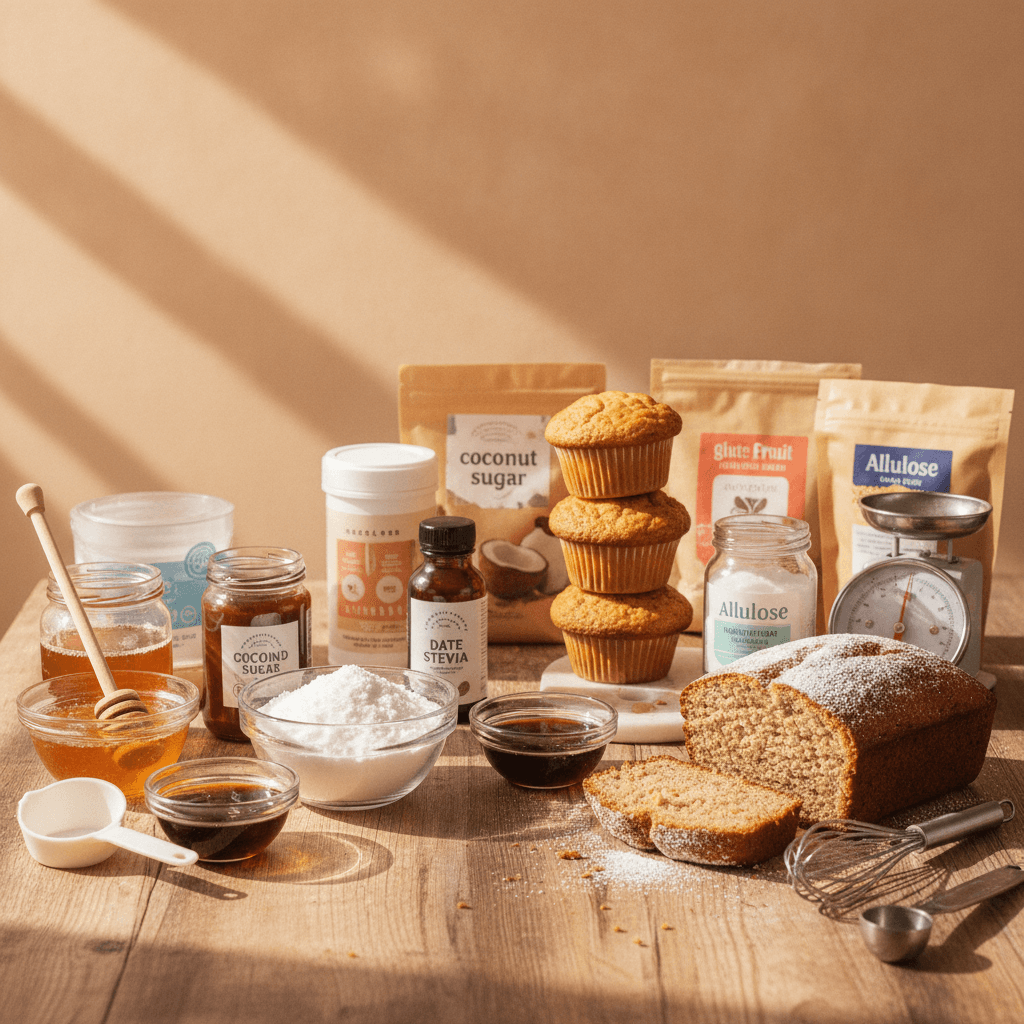
Choosing a sweetener for baking based on glycemic index sounds straightforward until you realize the numbers shift depending on the source, the form, and what else is in the batter. Here's a clear breakdown of where common baking sweeteners actually land on the GI scale, what those numbers mean in practice, and why GI alone doesn't tell the full story.
Key takeaways
- White sugar (sucrose) has a GI of about 65, which is moderate — not as high as many people assume.
- Coconut sugar sits around GI 54, lower than white sugar but not dramatically so, despite frequent marketing claims.
- Honey ranges from roughly GI 45 to 64 depending on floral source and fructose-to-glucose ratio.
- Agave nectar has a low GI (around 15–30) because it is mostly fructose, but high fructose intake carries its own metabolic concerns.
- Erythritol, monk fruit, stevia, and allulose have a GI of 0 or near 0, but each one changes baking texture differently.
- Glycemic load (GL) — which factors in serving size — is often more useful than GI for evaluating a sweetener in a finished baked good.
What the glycemic index actually measures
The glycemic index ranks foods from 0 to 100 based on how quickly they raise blood glucose after eating, compared to pure glucose (GI 100). A GI below 55 is considered low, 56–69 is moderate, and 70 or above is high. The scale was developed at the University of Toronto in the early 1980s and has been refined through thousands of clinical feeding studies since then.
For bakers, the critical detail is this: GI is measured on the sweetener in isolation, consumed in a quantity that delivers 50 grams of available carbohydrate. In a real muffin or cookie, fat, protein, fiber, and other ingredients slow digestion and lower the effective glycemic response. A cookie made with white sugar does not spike blood glucose the same way 50 grams of loose sugar dissolved in water does. That context matters more than most sweetener comparison charts acknowledge.
GI values for 9 common baking sweeteners
The table below uses values from the University of Sydney's GI database and peer-reviewed studies. Where a range exists (because different brands or sources vary), both ends are listed.
| Sweetener | Approximate GI | Category | Key note for bakers |
|---|---|---|---|
| White sugar (sucrose) | 65 | Moderate | Baseline reference for most baking |
| Brown sugar | 64 | Moderate | Essentially the same GI as white sugar |
| Honey | 45–64 | Low to moderate | Varies widely by floral source |
| Maple syrup | 54 | Low | Contains some minerals; adds moisture |
| Coconut sugar | 54 | Low | Often marketed as much lower; real data is around 54 |
| Agave nectar | 15–30 | Low | Very high in fructose (up to 90%) |
| Molasses | 55 | Low to moderate | Strong flavor limits quantity in most baked goods |
| Date sugar / date paste | 42–50 | Low | Contains fiber from whole dates; does not dissolve |
| Erythritol, monk fruit, stevia, allulose | 0–1 | Negligible | No meaningful blood glucose impact; texture trade-offs |
One thing that stands out: the gap between white sugar (GI 65) and coconut sugar (GI 54) is only 11 points. Some coconut sugar brands market GI values as low as 35, but that figure traces back to a single small Philippine study that has not been replicated in larger trials. The more widely cited value from the University of Sydney database is 54.
Why GI alone is a poor guide for choosing a baking sweetener
There is a common assumption that picking a low-GI sweetener automatically makes a baked good healthier or more blood-sugar-friendly. That assumption has three problems.
Glycemic load matters more than glycemic index
Glycemic load accounts for how much carbohydrate you actually eat in a serving. A tablespoon of honey has a lower GL than a cup of honey, obviously, but the GI number is the same for both. If a cake recipe uses 150 grams of coconut sugar, the glycemic load of a single slice is modest — regardless of whether the sweetener's GI is 54 or 65. The difference between those two numbers, spread across 12 servings, is nearly negligible in real-world blood glucose response.
Fructose is low-GI but not consequence-free
Agave nectar has the lowest GI of any caloric sweetener commonly used in baking — around 15 to 30. The reason is simple: it's roughly 75–90% fructose, and fructose does not trigger an immediate blood glucose spike because it's metabolized primarily by the liver rather than entering the bloodstream as glucose. But high fructose intake in large amounts has been linked in research to increased triglycerides and fatty liver concerns. A low GI number does not automatically mean metabolically favorable.
Other ingredients in the batter change everything
Fat slows gastric emptying. Fiber slows carbohydrate absorption. Protein triggers insulin co-secretion. A brownie made with almond flour (high fat, moderate protein, very low carb) and white sugar will produce a lower blood glucose response than a fat-free angel food cake made with coconut sugar. The flour, the fat, and the eggs matter as much as — or more than — which sweetener you choose.
How each sweetener category performs in baking
Caloric sweeteners with moderate GI (sugar, brown sugar, honey, maple syrup)
These are the workhorses. White sugar and brown sugar provide structure, browning, moisture retention, and tenderness. Honey and maple syrup add moisture and flavor but also add liquid, which means you need to reduce other liquids in a recipe or accept a denser, moister crumb.
From a GI perspective, swapping white sugar for honey or maple syrup saves you roughly 5–15 GI points on the sweetener itself. Whether that translates to a meaningful difference in the finished baked good depends on the total carbohydrate load and what else is in the recipe. For most standard cakes and cookies, the difference is small enough that flavor preference is a better decision driver than GI.
If you're exploring how honey, maple syrup, and other caloric sweeteners behave differently in baked goods, our guide on natural sweeteners for low sugar baking covers the practical trade-offs.
Coconut sugar and date-based sweeteners
Coconut sugar is a granulated sweetener that can replace white sugar 1:1 by volume in most applications. Its GI of 54 puts it in the low category, and it contains small amounts of minerals like potassium and zinc — though not in quantities that are nutritionally significant in typical baking amounts. It browns faster than white sugar, so reducing oven temperature by about 25°F (roughly 15°C) is a common adjustment.
Date paste and date sugar behave very differently from granulated sweeteners. Date sugar is ground whole dates — it doesn't dissolve in liquid or melt during baking. Date paste adds significant moisture. Both carry the fiber from whole dates, which is part of why their GI (around 42–50) is lower. But neither can replace sugar 1:1 without changing texture substantially. Date sugar works best in crumble toppings, streusel, and recipes where a slightly gritty texture is acceptable.
Zero-GI and near-zero-GI sweeteners
Erythritol, monk fruit sweetener, stevia, and allulose all have a GI of 0 or functionally 0. They do not raise blood glucose in any meaningful way. For bakers managing blood sugar, these are the only sweeteners that make a dramatic GI difference.
But each one creates baking challenges that sugar does not:
- Erythritol provides about 70% of sugar's sweetness and adds bulk, but it has a cooling sensation and can crystallize on the surface of baked goods, creating a gritty texture. Some people experience digestive discomfort at higher doses, though erythritol is generally better tolerated than other sugar alcohols like maltitol or xylitol.
- Monk fruit sweetener is typically sold blended with erythritol or allulose to add bulk, since pure monk fruit extract is 150–200 times sweeter than sugar. The baking behavior depends entirely on the bulking agent in the blend.
- Stevia is 200–300 times sweeter than sugar, so very little is needed. It cannot provide the bulk, browning, or moisture-retention functions that sugar performs. Using stevia means you need to replace sugar's structural role with something else — often a combination of a bulking sweetener and additional fat or binding agents.
- Allulose is the closest to sugar in baking behavior. It browns via the Maillard reaction, dissolves cleanly, and provides about 70% of sugar's sweetness. It has a GI of 0 and provides roughly 0.2–0.4 calories per gram (compared to sugar's 4 calories per gram). The main limitation is cost — allulose typically runs $8–$15 per pound, compared to $0.50–$1.00 per pound for granulated sugar. Some people experience digestive discomfort (bloating, loose stools) at higher intakes, typically above 30–50 grams in a single sitting.
For a deeper look at how these zero-calorie and low-calorie sweeteners perform in cookies specifically, see our breakdown of keto-friendly sugar substitutes for baking.
The contrarian take: GI is the wrong metric for most bakers
Here's something that runs against the grain of most sweetener comparison content: for the majority of home bakers, glycemic index is not the most useful way to choose a sweetener. The reason is that GI was designed to compare foods, not ingredients within foods. The GI of a sweetener tells you what happens when you consume that sweetener alone. The moment it's baked into a muffin with eggs, butter, and flour, the glycemic response of the finished product is governed by the entire nutritional profile — not just the sweetener.
Consider a brownie sweetened with coconut sugar (GI 54) and marketed as "low glycemic." If each brownie also contains 30 grams of carbohydrate from flour, it will still raise blood sugar meaningfully. Switching the sweetener to allulose (GI 0) eliminates the sweetener's glycemic contribution entirely, but the flour carbs remain — so the impact is lower, but not zero.
The takeaway: if blood sugar management is the primary goal, reducing total carbohydrate in the recipe matters more than swapping one caloric sweetener for another. Pairing a zero-GI sweetener with a low-carb flour alternative produces a much bigger effect than simply switching from white sugar to coconut sugar.
How to actually use GI information when choosing a sweetener
Rather than chasing the lowest possible GI number, consider these practical decision points:
- Are you baking for someone who monitors blood glucose? If yes, zero-GI sweeteners (allulose, erythritol, monk fruit blends, stevia) are the only options that make a clinically meaningful difference. Coconut sugar and honey are not low enough to matter for most people actively managing diabetes.
- Are you trying to reduce sugar for general wellness? Reducing the total amount of sweetener — regardless of type — is more impactful than switching between caloric sweeteners with slightly different GI values. Our guide on low sugar baking substitutes covers how to reduce sweetener quantity without wrecking texture.
- Is flavor the primary concern? Honey, maple syrup, and molasses each add distinct flavors. Coconut sugar adds caramel notes. If you're choosing between these, pick based on taste — the GI differences are too small to be the deciding factor.
- Is cost a constraint? White sugar costs roughly $0.50–$1.00 per pound. Coconut sugar runs $3–$6 per pound. Allulose is $8–$15 per pound. Monk fruit blends land around $10–$20 per pound. For a home baker selling cookies with alternative sweeteners, ingredient cost directly affects margins.
A note on sugar alcohols beyond erythritol
Maltitol, sorbitol, and xylitol are sugar alcohols that appear in many commercial "sugar-free" baked goods. Their GI values are higher than you might expect:
| Sugar alcohol | Approximate GI | Digestive tolerance |
|---|---|---|
| Maltitol | 35–52 | Poor — commonly causes gas and bloating |
| Sorbitol | 9 | Poor at higher doses |
| Xylitol | 7 | Moderate — better tolerated than maltitol |
| Erythritol | 0 | Good — best tolerated of the sugar alcohols |
Maltitol is worth flagging specifically because it's the most common sugar alcohol in commercial "sugar-free" chocolate chips and baking chips. With a GI that can reach 52, it's not dramatically lower than regular sugar (GI 65). Many people assume "sugar-free" means low glycemic impact, but maltitol-sweetened products can still raise blood glucose meaningfully. If you're baking for someone managing diabetes, check labels carefully.
What about applesauce and banana as sweetener replacements?
These are often recommended as "natural" sugar replacements, but they're not really low-GI alternatives. Ripe bananas have a GI of about 51, and applesauce (unsweetened) sits around 35–44. Both add moisture, which means they change texture significantly.
More importantly, neither one is sweet enough to replace sugar on a 1:1 basis. Banana as a sugar substitute works best when you're reducing sugar by 25–50% and accepting a denser, moister result. Applesauce as a sugar replacement similarly works as a partial swap — replacing all the sugar with applesauce produces a baked good that's more like a steamed pudding than a cake.
From a GI standpoint, these fruit-based options land in the low-to-moderate range, but they also add their own carbohydrates (from natural fruit sugars and fiber). The net glycemic impact of a recipe using banana instead of sugar is not dramatically different from one using sugar — you're trading one source of carbohydrate for another, just with added fiber and moisture.
Frequently asked questions
What sweetener has the lowest glycemic index for baking?
Erythritol, allulose, monk fruit extract, and stevia all have a GI of 0 or effectively 0. Among caloric sweeteners, agave nectar has the lowest GI (15–30), though its high fructose content is a concern for some. For a practical comparison of how these perform in baked goods, see our guide on choosing sugar alternatives.
Is coconut sugar really low glycemic?
Coconut sugar has a GI of approximately 54, which is technically in the low category (below 55). However, it's only about 11 points lower than white sugar (GI 65). Some brands claim a GI of 35, but that figure comes from a single small study and has not been confirmed in larger trials. The difference between coconut sugar and white sugar is modest in real-world baking applications.
Does honey have a lower glycemic index than sugar?
It depends on the type of honey. Honey's GI ranges from about 45 to 64, depending on the floral source and its fructose-to-glucose ratio. Acacia honey tends to be on the lower end because it's higher in fructose. Clover and wildflower honeys tend to be closer to sugar's GI of 65. The difference is not large enough to be the sole reason to choose honey over sugar in baking.
Can I use allulose as a 1:1 sugar replacement in baking?
Allulose can replace sugar at a 1:1 ratio by weight in most applications, though it's only about 70% as sweet as sugar, so the result will taste less sweet. It browns well, dissolves cleanly, and behaves more like sugar than any other zero-GI sweetener. The main caveats are cost ($8–$15 per pound) and potential digestive discomfort at intakes above roughly 30–50 grams per sitting. Reducing the amount slightly and pairing it with a small amount of monk fruit or stevia can compensate for the sweetness gap.
Does the glycemic index of a sweetener change when it's baked into something?
The GI of the sweetener itself doesn't change, but the glycemic response of the finished baked good is typically lower than the sweetener's standalone GI. Fat, protein, and fiber in other ingredients slow digestion and glucose absorption. A cookie with butter, eggs, and flour will produce a lower blood sugar spike than the same amount of sugar eaten on its own. This is why glycemic load of the whole serving is a more useful measure than the GI of a single ingredient.

Written by
Co-founder, BakingSubs
Co-founder of BakingSubs, where he turns the science of ingredient substitutions into tested, reliable guidance for home bakers.
Related Posts
Bake with Confidence
See all
Confident Gluten-Free Baker Toolkit
The science-based system that replaces gluten's seven invisible jobs so your baking turns out soft, fluffy, and foolproof — every time.

Gluten-Free Recipe Vault
Instant access to our complete library of proven gluten-free recipes — no waiting, no guesswork, just results that work tonight.

Fix Your Gluten-Free Bread
Learn the 3-step formula to make bread rise and stay soft, discover why your loaves collapse, and get a tested sandwich bread recipe that actually works.