

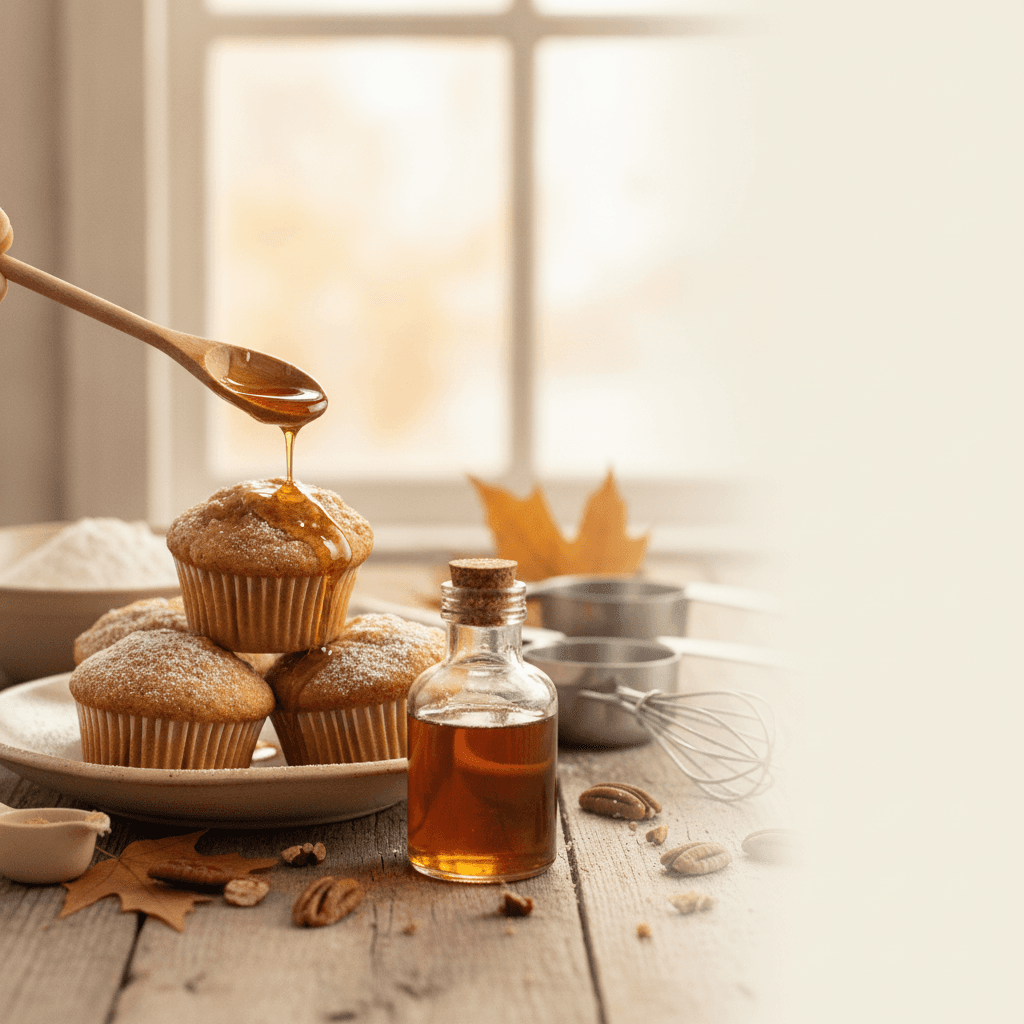
Maple syrup can replace refined sugar in most baked goods, but it changes moisture, browning, and flavor in ways that catch bakers off guard. Here's what actually shifts when you make the swap, what breaks if you don't adjust, and the specific tweaks that keep your results close to the original.
Key takeaways
Maple syrup is roughly 33% water by weight, so every cup you add introduces extra liquid that must be offset elsewhere in the recipe.
The commonly cited replacement ratio is 3/4 cup maple syrup for every 1 cup of granulated sugar, with a reduction of about 3 tablespoons of other liquid in the recipe.
Baked goods brown faster because maple syrup's sugars caramelize at lower temperatures than sucrose — plan on reducing oven temperature by about 25°F (roughly 15°C).
Maple syrup works best in recipes where moisture and chewiness are welcome (quick breads, muffins, pancakes) and struggles in recipes that depend on dry, crisp structure (meringues, shortbread, sugar cookies).
It is not a low-sugar or low-calorie swap — maple syrup contains roughly the same calories per serving as granulated sugar and still raises blood glucose.
Why maple syrup behaves differently than granulated sugar
Granulated sugar is pure sucrose in crystalline form. It's dry, it dissolves slowly, and it plays several structural roles in baking beyond sweetness: it aerates butter during creaming, it stabilizes egg foams, and it absorbs moisture to keep baked goods tender over time. Those are the roles outlined in our guide to sugar's functions in baking, and every one of them changes when you pour in a liquid sweetener instead.
Maple syrup is roughly 67% sugar (a mix of sucrose with smaller amounts of glucose and fructose) and about 33% water. That water content is the single biggest factor driving every adjustment you'll need to make. It also contains trace minerals and organic compounds that contribute a distinctive caramel-butterscotch flavor — great in banana bread, potentially unwelcome in a delicate vanilla sponge.
The flavor intensity matters more than most guides acknowledge. Grade A Dark (Robust Taste) maple syrup carries a noticeably stronger flavor than Grade A Golden (Delicate Taste). If you want maple flavor to stay in the background, use the lightest grade you can find. If you want it front and center, go darker.
The standard replacement ratio and why it needs context
The widely cited starting point is 3/4 cup maple syrup for every 1 cup granulated sugar, because maple syrup is sweeter per volume than dry sugar due to its dissolved sugar concentration. Alongside that swap, reduce other liquids in the recipe by about 3 tablespoons per cup of sugar replaced.
That ratio works reasonably well in forgiving recipes like muffins, banana bread, and pancake batter. But it's a starting point, not a universal rule. Here's why:
Small-batch recipes amplify errors. In a recipe calling for just 1/3 cup sugar, the liquid offset is roughly 1 tablespoon — easy to undershoot or overshoot.
Recipes with no other liquid to reduce (some cookie doughs, for example) leave you with nowhere to compensate. You can try adding a tablespoon or two of extra flour instead, but that changes texture too.
Partial replacement often works better than full replacement. Swapping half the sugar for maple syrup gives you some maple flavor and reduced refined sugar without pushing moisture balance past the tipping point. This is especially true in cookies, where sugar's structural role is harder to replicate with any liquid sweetener — something covered in depth in our post on sugar substitutes for baking cookies.
5 things that change when you use maple syrup
1. Moisture and density increase
Because you're adding liquid, batters become thinner and finished baked goods come out denser and moister. Quick breads and muffins often benefit from this — they can taste richer and stay soft longer. Cakes, especially ones meant to be light and airy, tend to come out heavier. If a cake recipe relies on the creaming method (beating sugar into butter to incorporate air), you lose that aeration step entirely when you switch to a liquid sweetener.
That's why a maple-sweetened zucchini bread tends to turn out well, while a yellow cake sweetened entirely with maple syrup often comes out dense and soggy. For cakes like that, a 50/50 split with granulated sugar is the safer starting point.
2. Browning accelerates
The glucose and fructose in maple syrup undergo Maillard browning and caramelization at lower temperatures than pure sucrose. The practical result: your muffins or bread may look done 5–8 minutes before they actually are, or they'll over-brown on top while the center stays underbaked. Dropping the oven temperature by about 25°F helps. So does tenting with foil if the top gets too dark before the center sets.
3. Flavor shifts toward caramel and butterscotch
This is either a feature or a problem depending on what you're baking. Maple syrup pairs naturally with warm spices (cinnamon, nutmeg, ginger), nuts, oats, and brown butter. It clashes with delicate citrus flavors, light fruit, and anything where you want a clean, neutral sweetness. A lemon poppy seed muffin sweetened entirely with dark maple syrup tastes confused.
4. Spread and texture change in cookies
Cookies sweetened with maple syrup spread more because of the extra liquid, and they tend to stay soft and chewy rather than crisp. If you want a crisp cookie, maple syrup is working against you. For chewy cookies — oatmeal raisin, molasses-style, or snickerdoodles — it can actually be an advantage. But expect a flatter cookie regardless. Our post on low-sugar baking substitutes that fix texture covers the broader structural challenges when you remove or replace granulated sugar.
5. Shelf life shifts
Maple syrup is hygroscopic — it attracts and holds moisture. Baked goods made with it tend to stay moist longer than their granulated-sugar counterparts, which is a genuine advantage for items like quick breads and muffins that you want to last 3–4 days at room temperature. The flip side is that they can also become gummy or overly sticky in humid conditions, and they're more prone to mold because of the higher moisture content.
2 things that break (and can't easily be fixed)
Meringues and whipped egg foams
You cannot make a traditional meringue with maple syrup. Granulated sugar stabilizes the protein network in whipped egg whites by dissolving into the foam and increasing its viscosity. A liquid sweetener destabilizes the foam instead. Italian meringue technique (pouring hot sugar syrup into whipping whites) requires a specific sugar concentration that maple syrup can't reliably provide without careful candy-thermometer work, and even then the result is a different product — softer, wetter, and maple-flavored. If your recipe depends on stiff peaks, stick with granulated sugar or look into monk fruit granulated blends that behave more like dry sugar.
Crisp, dry-textured baked goods
Shortbread, biscotti, tuile cookies, and any baked good that needs to shatter when you bite into it — these rely on low moisture content. Adding a sweetener that's 33% water works directly against crispness. You can partially compensate by increasing bake time at a lower temperature, but the texture will never match a version made with dry sugar. Partial replacement (25–30% of the sugar as maple syrup) is the furthest you can push it without losing the snap entirely.
Where maple syrup works best as a sugar substitute
Baked good | Full replacement viable? | Notes |
|---|---|---|
Quick breads (banana, zucchini, pumpkin) | Yes | Ideal use case — extra moisture is a benefit, maple flavor complements warm spices |
Muffins | Yes | Reduce liquid by 3 tbsp per cup sugar replaced; drop oven temp 25°F |
Pancakes and waffles | Yes | Batter is already liquid-heavy, so the swap barely changes consistency |
Granola and oat bars | Yes | Acts as both sweetener and binder; pairs well with oats and nuts |
Chewy cookies (oatmeal, molasses-style) | Partial (50–75%) | Full replacement causes excessive spread; partial swap adds flavor without breaking structure |
Layer cakes | Partial (25–50%) | Full replacement makes crumb too dense; creaming method doesn't work with liquid sweetener |
Crisp cookies (shortbread, sugar cookies) | No | Too much moisture; texture won't crisp properly |
Meringues | No | Cannot stabilize egg white foam with liquid sweetener |
Common mistakes when baking with maple syrup
Our guide to common sugar substitution mistakes covers the broad patterns, but here are the ones specific to maple syrup:
Not reducing other liquids. This is the number-one reason maple syrup bakes turn out soggy. If a recipe has milk, water, or juice, reduce it. If it doesn't have another liquid to reduce, add 1–2 tablespoons of extra flour or starch instead.
Using the darkest grade for everything. Grade A Very Dark (Strong Taste) maple syrup can overpower delicate baked goods. Save it for gingerbread and baked beans; use Golden or Amber for cakes and lighter muffins.
Forgetting to lower oven temperature. The accelerated browning catches people off guard every time. Set a timer for 5 minutes before you think it'll be done and check.
Treating it as a health food swap. Maple syrup contains trace minerals (manganese, zinc, riboflavin), but it's still predominantly sugar. Calorie-for-calorie, it's comparable to granulated sugar. Replacing white sugar with maple syrup doesn't meaningfully change the glycemic impact of a muffin. If you're looking for a swap that actually reduces sugar's caloric contribution, options like stevia blends or monk fruit sweetener are better suited for that goal.
Measuring by volume instead of weight. A cup of maple syrup weighs about 322g. A cup of granulated sugar weighs about 200g. If you're using the 3/4 cup ratio by volume, you're adding significantly more mass to the recipe. Weighing ingredients with a kitchen scale like the OXO Good Grips 11lb removes the guesswork.
How maple syrup compares to other liquid sugar substitutes
Maple syrup isn't the only liquid sweetener that can stand in for granulated sugar. Here's how it stacks up against the other common options:
Sweetener | Sweetness vs. sugar | Flavor profile | Best for | Biggest limitation |
|---|---|---|---|---|
Slightly sweeter | Caramel, butterscotch, woodsy | Quick breads, muffins, granola | Strong flavor; can't do crisp textures | |
Sweeter (use less) | Floral, varies by source | Quick breads, soft cakes, glazes | Even more browning than maple; flavor can dominate | |
Sweeter (use less) | Mild, neutral | Where you want sweetness without flavor change | Very high fructose content; thin consistency | |
Less sweet | Bitter, robust, mineral-heavy | Gingerbread, dark breads, baked beans | Too strong for most baked goods as sole sweetener | |
Similar | Caramel, fruity | Brownies, energy bars, dense cakes | Thick and fibrous; changes texture significantly |
If you want a neutral-flavored liquid sweetener that won't change the taste of your baked goods, agave is the closest option. If you want depth and complexity, maple syrup and date paste are stronger choices. Our roundup of natural sweeteners for low-sugar baking covers more options in detail.
A contrarian take: maple syrup is overrated as a "healthier" sugar swap
Here's the thing nobody selling maple syrup wants to say: as a baking substitute, its main value is flavor, not health. The mineral content is real but marginal — you'd need to consume unreasonable amounts to get meaningful nutrition from it. A tablespoon of maple syrup provides about 33% of the daily value for manganese, but it also delivers about 12g of sugar. You're not eating maple syrup for the manganese.
Where maple syrup genuinely shines is as a flavor ingredient. It brings something to baked goods that granulated sugar simply cannot: warmth, complexity, and a depth that pairs beautifully with fall and winter baking. Use it because you want your pumpkin bread to taste like a Vermont autumn, not because you think it's a health upgrade. That honest framing saves a lot of disappointment.
For bakers who genuinely need to reduce sugar intake for health reasons, the more effective path is using high-intensity sweeteners (stevia, monk fruit, allulose) that actually reduce caloric sweetener content, or reducing total sweetener volume and compensating for the structural loss — something covered in our guide to choosing sugar alternatives.
Tips for getting the best results
Start with a partial swap. Replace 50% of the sugar with maple syrup on your first attempt. This limits the moisture and flavor disruption while you learn how your specific recipe responds.
Add 1/4 teaspoon baking soda per cup of maple syrup if the recipe doesn't already include it. Maple syrup is slightly acidic (pH around 6.5–7.0 depending on grade), and the baking soda helps neutralize that acidity while contributing to browning and rise.
Use parchment paper. The extra sugars in maple syrup make baked goods stick more aggressively to pans. Parchment or silicone baking mats are non-negotiable.
Store maple-sweetened baked goods in the fridge if you won't eat them within 2 days. The higher moisture content accelerates spoilage at room temperature compared to sugar-based versions.
Weigh your maple syrup. Pouring it into a measuring cup is messy and imprecise. Tare your mixing bowl on a scale and pour directly. A digital kitchen scale makes this effortless.
Frequently asked questions
Can you substitute maple syrup for sugar in any baking recipe?
No. Maple syrup works well in moist baked goods like quick breads, muffins, and granola, but it fails in recipes that require dry, crisp texture (shortbread, meringues, sugar cookies). For those, granulated sugar or a dry sugar substitute is necessary. Partial replacement — swapping 25–50% of the sugar — extends the range of recipes where maple syrup can work without breaking structure.
How much maple syrup equals 1 cup of sugar?
The standard ratio is 3/4 cup maple syrup for 1 cup granulated sugar. You also need to reduce other liquids in the recipe by about 3 tablespoons and lower the oven temperature by approximately 25°F to prevent over-browning. This ratio is a starting point — some recipes need further adjustment depending on their moisture balance.
Is maple syrup healthier than white sugar for baking?
Maple syrup contains trace minerals like manganese and zinc that white sugar lacks, but it has comparable calories and sugar content per serving. It still raises blood glucose. The main reason to use maple syrup in baking is flavor, not health benefits. If reducing sugar intake is the goal, high-intensity sweeteners like monk fruit or stevia are more effective options.
Why do my maple syrup baked goods come out too dark?
Maple syrup contains glucose and fructose, which caramelize at lower temperatures than the sucrose in granulated sugar. This causes faster browning. Reduce your oven temperature by about 25°F and check for doneness 5–8 minutes earlier than the recipe suggests. Tenting with aluminum foil can also help if the top browns before the center is set.
Does maple syrup work in gluten-free baking?
Yes, and in some cases it works better than in conventional baking. Many gluten-free baked goods already tend toward dryness, and the extra moisture from maple syrup can help counteract that. The same ratio and adjustments apply. Just be aware that the added liquid may interact differently with starches like arrowroot or tapioca, potentially making the crumb gummier. Start with a partial swap and adjust from there.

Written by
Co-founder, BakingSubs
Co-founder of BakingSubs, where he turns the science of ingredient substitutions into tested, reliable guidance for home bakers.
Related Posts
Bake with Confidence
See all
Confident Gluten-Free Baker Toolkit
The science-based system that replaces gluten's seven invisible jobs so your baking turns out soft, fluffy, and foolproof — every time.

Gluten-Free Recipe Vault
Instant access to our complete library of proven gluten-free recipes — no waiting, no guesswork, just results that work tonight.

Fix Your Gluten-Free Bread
Learn the 3-step formula to make bread rise and stay soft, discover why your loaves collapse, and get a tested sandwich bread recipe that actually works.