

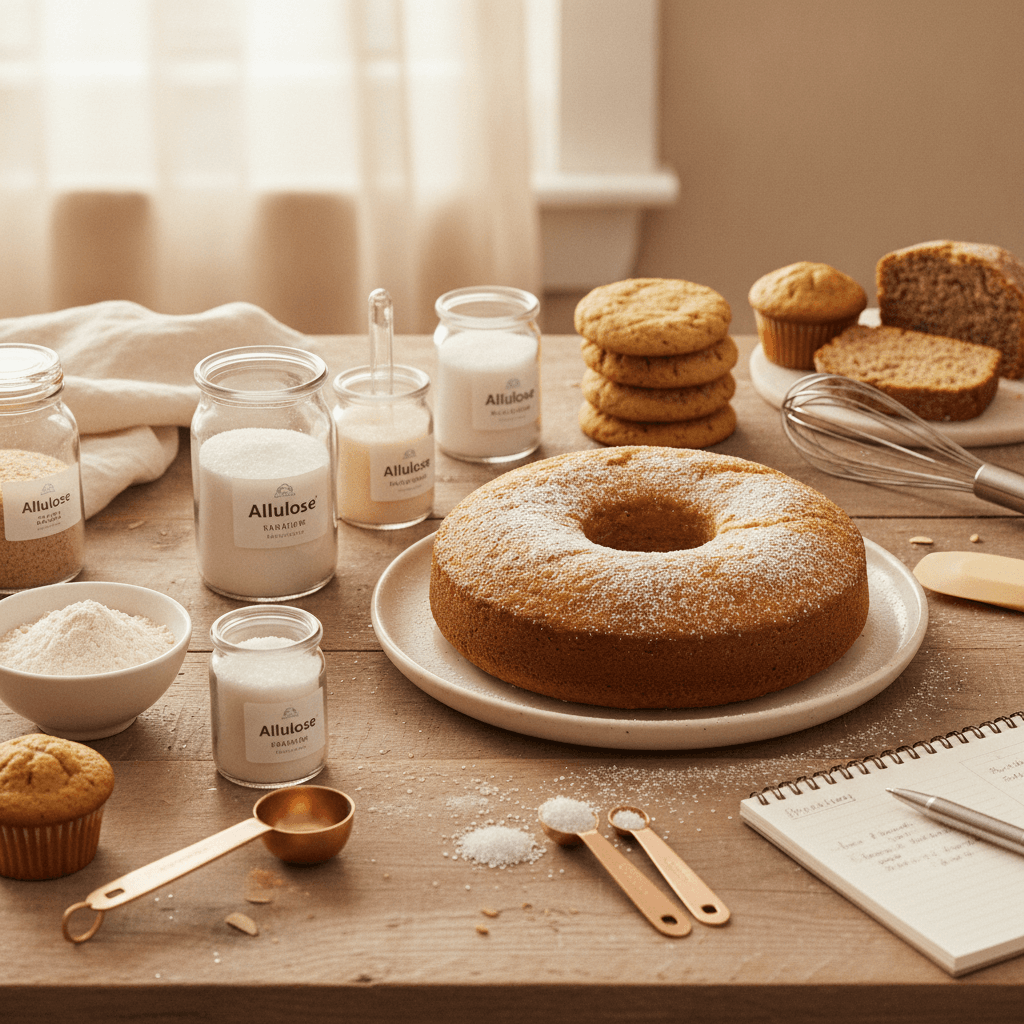
After comparing nine allulose brands for cookies, cakes, and caramel, our top pick is Besti Allulose. It dissolves cleanly, browns predictably, costs $0.78 per sugar-equivalent cup, and ships in a resealable 5 lb bag that lasts most home bakers two to three months. Here is how every brand we compared stacks up, with exact substitution ratios, real costs, and the baking-specific details that matter.
Key takeaways
Allulose is roughly 70% as sweet as white sugar by weight, so you need about 1.3x the weight (or 1.5x the volume for granulated forms) to match sweetness. Every brand follows this ratio.
Besti wins overall for baking because of consistent crystal size, clean dissolve, and competitive per-cup pricing at $0.78.
RxSugar liquid is the best option for caramels and glazes where you need zero crystal interference, but it costs $1.42 per sugar-equivalent cup.
All allulose brands brown faster than sugar. Reduce oven temp by 25°F or pull 3 to 5 minutes early.
Digestive tolerance varies person to person, but staying under 40g per sitting (roughly 3 tablespoons granulated) avoids GI issues for most people.
If you want the full breakdown of how allulose behaves differently from sugar in baked goods, read our allulose as sugar substitute guide first.
How we ranked these brands
We scored each allulose brand on six criteria that matter specifically for baking. Taste panels and nutrition label comparisons are everywhere online. What bakers actually need to know is whether the stuff performs in a 350°F oven.
Substitution accuracy: Does the stated ratio on the bag actually produce equivalent sweetness in a finished bake?
Browning behavior: How fast does it Maillard? Does it burn before the center sets?
Recrystallization: Does it stay soft after cooling, or does it develop a gritty crust overnight?
Aftertaste and cooling effect: Any menthol sensation or metallic note? (Unlike erythritol and xylitol, pure allulose should have none, but blends sometimes sneak in sugar alcohols.)
Digestive tolerance: Reported GI discomfort at typical baking portions.
Cost per sugar-equivalent cup: The real number, not the sticker price per pound.
We did not cover monk fruit, stevia, or erythritol here. We have dedicated posts for sugar alcohols in baking and choosing sugar alternatives. This guide is strictly about which allulose brand to buy and why.
The full brand comparison table
Brand | Form | Weight ratio vs. sugar | Volume ratio vs. sugar | Browns? | Recrystallizes? | Aftertaste | Digestive notes | Cost per sugar-equiv. cup | Where to buy |
|---|---|---|---|---|---|---|---|---|---|
Granulated | 1.3:1 | 1.5:1 | Yes, fast | No | None | Mild above 50g | $0.78 | Amazon, Thrive Market | |
Liquid syrup | 1.3:1 (by dry equiv.) | 0.75:1 (syrup is denser) | Yes, very fast | No | None | Mild above 40g | $1.42 | Amazon, Whole Foods, Thrive Market | |
Granulated | 1.3:1 | 1.5:1 | Yes, fast | No | None | Mild above 50g | $0.92 | Walmart, Amazon, Whole Foods | |
Powder (fine) | 1.3:1 | 1.3:1 (packs tighter) | Yes, fast | No | Faint cooling | Mild above 45g | $0.88 | Amazon, Whole Foods, Thrive Market | |
Granulated | 1.3:1 | 1.5:1 | Yes, fast | Slight in dry climates | None | Mild above 50g | $0.74 | Amazon | |
Granulated | 1.3:1 | 1.5:1 | Yes, fast | No | None | Mild above 50g | $1.18 | Amazon, Whole Foods, Costco (seasonal) | |
Granulated / liquid | 1.3:1 | 1.5:1 (granulated) | Yes, fast | No | None | Mild above 50g | $1.05 | Walmart, Amazon, Kroger | |
Blend (allulose + stevia) | 1:1 (blend is pre-adjusted) | 1:1 | Yes, moderate | No | Slight stevia finish | Mild above 50g | $0.61 | Walmart, Amazon | |
Blend (allulose + stevia) | 1:1 (blend is pre-adjusted) | 1:1 | Yes, moderate | No | Slight stevia finish | Mild above 50g | $0.65 | Walmart, Amazon, Target |
A note on the blends: Whole Earth and Truvia both cut allulose with stevia extract to hit a 1:1 sugar swap ratio. That is convenient, but some bakers detect a lingering stevia bitterness in vanilla-forward recipes like sugar cookies. If you are sensitive to stevia, stick with a pure allulose brand and just use 1.3x the weight. Our sweetener GI ranking post covers the glycemic impact differences in detail.
Best overall: Besti granulated allulose

Wholesome Yum Besti Natural Sugar Substitute, Monk Fruit Allulose Sweetener
Check price on Amazon →Besti granulated allulose lands at the top because it nails the things bakers care about most: predictable crystal size, zero aftertaste, and a 5 lb resealable bag that keeps the per-cup cost under a dollar.
In a standard chocolate chip cookie recipe (like the one in our allulose baking guide), Besti dissolves readily during creaming, browns evenly at a reduced oven temperature, and, like other pure allulose, resists the gritty recrystallization that makes erythritol cookies go hard overnight. At $0.78 per sugar-equivalent cup, it is not the cheapest option (Anthony's edges it out at $0.74), but its consistent crystal size makes it the more predictable pick.
Substitution ratio: Use 130g of Besti for every 100g of white sugar. By volume, that is roughly 1.5 cups of Besti for every 1 cup of sugar. Use our recipe scaler to convert full recipes quickly.
Where to buy: Amazon (Prime eligible in the 5 lb bag) and Thrive Market. Not currently stocked at Walmart, Costco, or Trader Joe's.
Best budget pick: Anthony's granulated allulose
Anthony's comes in at $0.74 per sugar-equivalent cup, making it the cheapest pure allulose on this list. As a pure allulose, its taste and browning should be nearly identical to Besti. The one possible knock: in dry winter kitchens (below 30% humidity), cooled cookies can develop a faint surface crystallization after a day or two, more of a slightly sandy feel on the top crust than anything dramatic. In humid climates or in recipes with higher fat content (brownies, pound cake), this is much less likely.
Where to buy: Amazon only. Anthony's does not have retail distribution at Walmart, Costco, or Whole Foods as of mid-2025.
Best liquid allulose: RxSugar syrup
RxSugar liquid allulose is the go-to for caramels, glazes, and any application where you want zero graininess. It behaves almost identically to corn syrup in terms of viscosity but with 70% of sugar's sweetness and essentially zero glycemic impact. The catch is price: at $1.42 per sugar-equivalent cup, it is nearly double the cost of granulated options.
For caramel specifically, expect RxSugar to color faster than a standard sugar caramel. Watch it closely. Pull it the moment you see medium amber because it will keep darkening off heat.
Where to buy: Amazon, Whole Foods (in the baking aisle, not the supplement section), and Thrive Market.
Best 1:1 blend: Whole Earth allulose baking blend
If you want to skip ratio math entirely, Whole Earth's allulose baking blend swaps 1:1 for sugar by both weight and volume. It achieves this by blending allulose with stevia leaf extract. The result is a product that measures like sugar and sweetens like sugar, but the stevia component adds a faint herbal finish that shows up most in plain vanilla or lemon recipes.
In chocolate-heavy bakes (brownies, chocolate cake), the stevia note disappears completely. At $0.61 per cup equivalent, it is also the most affordable option on this list, which makes it a smart choice for high-volume baking where you are going through a bag every couple of weeks.
Where to buy: Walmart (in-store and online), Amazon. Not currently at Costco or Trader Joe's.
How the other brands compare
Lakanto allulose
Lakanto is a reliable pure allulose with no aftertaste and no recrystallization issues. The only reason it did not rank higher is price: $1.18 per sugar-equivalent cup puts it 51% above Anthony's for a functionally identical product. If you already buy Lakanto monk fruit sweetener and want to consolidate orders, it is a fine choice. Otherwise, you are paying a brand premium. Available on Amazon, at Whole Foods, and seasonally at Costco.
Splenda allulose
Splenda's allulose (not to be confused with their sucralose-based original product) is a pure allulose with solid baking performance. At $1.05 per cup equivalent, it sits in the middle of the pack. Its biggest advantage is retail availability: you can pick it up at Walmart and Kroger alongside your flour and butter, no Amazon order required. If convenience matters more than saving $0.27 per cup, Splenda is a reasonable pick.
Now Foods allulose
Now Foods sells a powdered (fine crystal) allulose that dissolves faster than any granulated option. That is a plus for meringues and whipped applications. However, the fine grind means it packs more densely in a measuring cup, so the volume ratio shifts to roughly 1.3:1 instead of 1.5:1. It may leave a very faint cooling sensation in uncooked applications (frostings, no-bake cheesecake), which is less noticeable in baked goods. At $0.88 per cup equivalent, it is mid-range. Available on Amazon, at Whole Foods, and on Thrive Market.
Wholesome allulose
Wholesome (the brand behind organic sugars you see at Whole Foods) makes a clean granulated allulose with no additives. Performance is on par with Besti and Anthony's. At $0.92 per cup equivalent it is slightly pricier, but it has the widest retail footprint of any pure allulose: Walmart, Amazon, and Whole Foods all carry it. If you want to grab a bag during your regular grocery run, Wholesome is the easiest to find in person.
Truvia Sweet Complete
Truvia Sweet Complete is another allulose-stevia blend that swaps 1:1. It performs nearly identically to the Whole Earth blend, with the same faint stevia finish in light-flavored bakes. At $0.65 per cup equivalent, it is $0.04 more than Whole Earth but has slightly wider availability: Walmart, Amazon, and Target. If you can find it on sale at Target (it frequently goes on Cartwheel deals), it can drop below $0.50 per cup equivalent, making it the cheapest option period.
What about sugar-free chocolate chips and chocolate bars?
Several brands in the low-sugar baking space use allulose as their primary sweetener in chocolate products. If you are building a fully allulose-sweetened recipe, pairing your allulose with allulose-sweetened chocolate keeps the flavor profile consistent.
ChocZero uses monk fruit and soluble fiber rather than allulose, so the melt and snap are slightly different from standard chips. Hu Kitchen uses coconut sugar, not allulose. Lily's relies on erythritol and stevia, which can produce a cooling sensation. For a deeper comparison of all these, see our post on sugar-free chocolate substitutes for baking.
As of mid-2025, there is no widely available allulose-only sweetened chocolate chip on the market. The closest option is making your own with allulose syrup and unsweetened cocoa butter, but that is a project in itself.
Browning, oven temp, and timing adjustments
Every allulose brand browns faster than white sugar because allulose participates in the Maillard reaction at a lower temperature. This is not a defect; it is actually one of allulose's biggest advantages for baking. You get deep golden color and caramel flavor without needing as much heat or time.
The practical adjustment: drop your oven temperature by 25°F from whatever the recipe calls for, and start checking 3 to 5 minutes before the stated bake time. For a cookie recipe that says 350°F for 12 minutes, bake at 325°F and check at 9 minutes. This holds true across all nine brands on this list.
The blends (Whole Earth, Truvia Sweet Complete) brown slightly less aggressively because the stevia component does not participate in Maillard reactions. With those, a 15°F reduction is usually sufficient.
Digestive tolerance: the number that matters
Allulose is not a sugar alcohol, so it does not cause the dramatic GI distress that erythritol or xylitol can at high doses. But it is not consequence-free either. Clinical studies point to a consistent threshold: most people tolerate up to 36 to 40g of allulose per sitting without issues. Above that, bloating and mild cramping become common.
In practical terms, 40g of granulated allulose is about 3 level tablespoons. A single cookie made with allulose typically contains 8 to 12g, so you would need to eat four or five cookies in one sitting to hit the threshold. For most people, that is a non-issue. But if you are making a recipe where a single serving is sweetener-heavy (caramel sauce spooned over ice cream, heavily sweetened frosting), keep the per-serving allulose content in mind.
Which brand to buy based on what you bake
Not every baker needs the same product. Here is a quick decision framework:
Cookies, cakes, muffins (general baking): Besti granulated or Anthony's granulated. Both perform identically in these applications. Pick Besti if you want guaranteed consistency; pick Anthony's if you want to save $0.04 per cup.
Caramels, glazes, syrups: RxSugar liquid. No contest. Granulated allulose works for caramel but requires a dissolving step that liquid skips entirely.
High-volume baking on a budget: Whole Earth blend at $0.61 per cup, if you do not mind the stevia note. Otherwise, Anthony's at $0.74.
Meringues and whipped applications: Now Foods powdered. The fine crystal dissolves into egg whites without leaving grit.
Grocery store convenience (no Amazon): Wholesome at Walmart or Whole Foods, or Splenda Allulose at Walmart or Kroger.
If you are converting an existing recipe and need help scaling the amounts, our recipe scaler tool handles allulose ratios automatically.
Frequently asked questions
How much allulose equals 1 cup of sugar in baking?
For pure granulated allulose (Besti, Anthony's, Wholesome, Lakanto, Splenda, Now Foods), use 1.5 cups of allulose for every 1 cup of white sugar by volume, or 130g of allulose for every 100g of sugar by weight. Pre-blended products like Whole Earth and Truvia Sweet Complete swap 1:1 because they include stevia to boost sweetness. Weighing is always more accurate than measuring by volume. For full conversion details, see our allulose substitution guide.
Does allulose recrystallize after baking?
Pure allulose resists recrystallization much better than erythritol. In a very dry (below 30% humidity) environment, a faint surface grittiness can show up after a day or two, but it is minor. If you are comparing this to sugar alcohols like erythritol, which recrystallize aggressively, allulose is a significant improvement.
Is Costco allulose a good deal?
Costco carries Lakanto allulose seasonally and occasionally stocks Besti in warehouse locations. When available, the Costco price for Lakanto typically drops to around $0.85 per sugar-equivalent cup, which is competitive with Anthony's on Amazon. Check the baking aisle, not the supplement section. As of mid-2025, Costco does not carry a Kirkland-brand allulose.
Can allulose cause stomach problems?
At portions under 40g per sitting (about 3 tablespoons granulated), most people report no digestive issues. Above that threshold, bloating and mild cramping are common. This is milder than the effects of erythritol or xylitol at similar doses. If you are new to allulose, start with half the amount in a recipe and increase over a few bakes to gauge your tolerance.
What is the difference between allulose and monk fruit sweetener for baking?
Allulose is a rare sugar that provides bulk, browning, and moisture in baked goods. Monk fruit extract is an intense sweetener with zero bulk, so it needs a carrier (usually erythritol or allulose) to measure like sugar. Monk fruit blends do not brown on their own and can leave a lingering aftertaste. For a full comparison, see our sugar alternatives guide.

Written by
Co-founder, BakingSubs
Co-founder of BakingSubs, where he turns the science of ingredient substitutions into tested, reliable guidance for home bakers.
Related Posts

Bake with Confidence
See all
Confident Gluten-Free Baker Toolkit
The science-based system that replaces gluten's seven invisible jobs so your baking turns out soft, fluffy, and foolproof — every time.

Gluten-Free Recipe Vault
Instant access to our complete library of proven gluten-free recipes — no waiting, no guesswork, just results that work tonight.

Fix Your Gluten-Free Bread
Learn the 3-step formula to make bread rise and stay soft, discover why your loaves collapse, and get a tested sandwich bread recipe that actually works.