

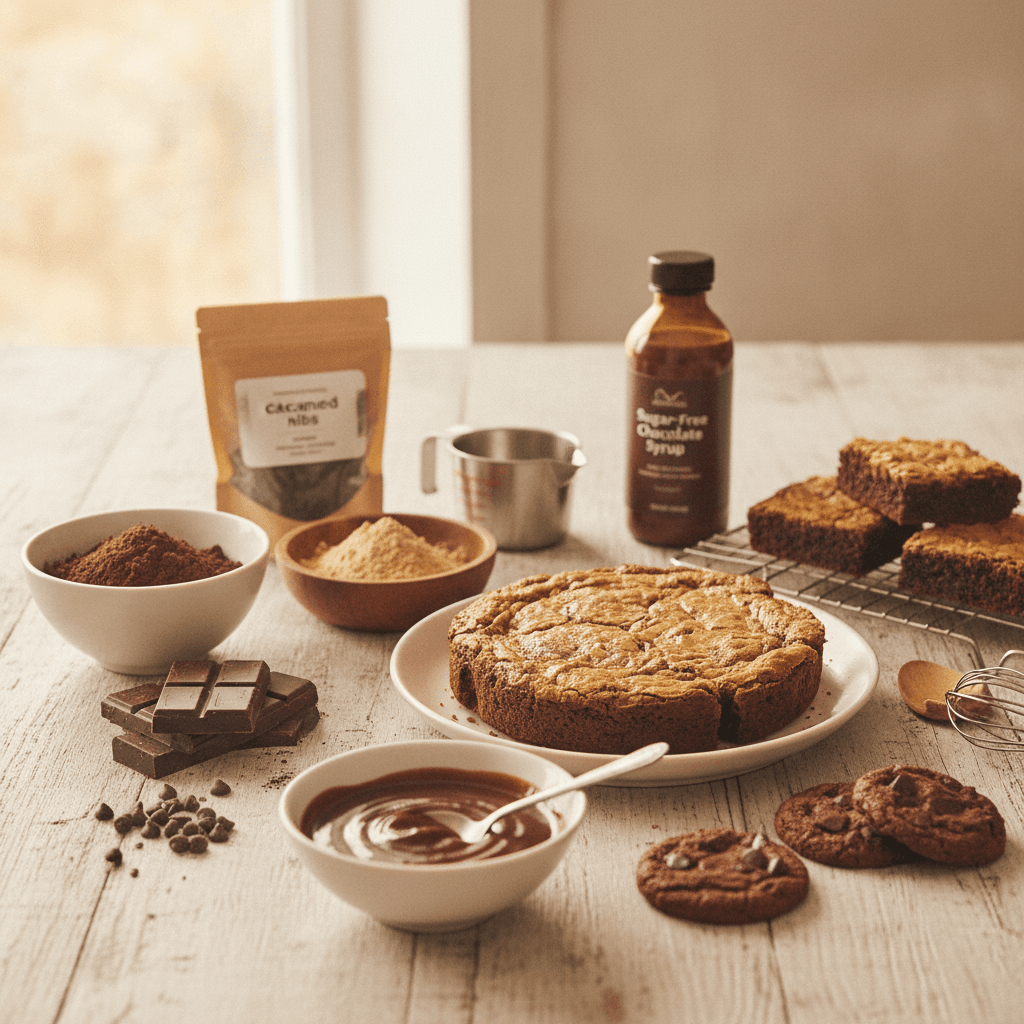
Sugar-free chocolate baking is tricky because chocolate and sugar are deeply intertwined — most chocolate products are 40–60% sugar by weight, and removing that sugar changes moisture, texture, browning, and sweetness all at once. Here are six sugar-free chocolate substitutes that actually work in baking, along with their real limitations.
Key takeaways
Unsweetened cocoa powder is the most versatile sugar-free chocolate base, but it needs a separate sweetener and added fat to replace chocolate bar functionality.
Sugar-free chocolate chips (sweetened with erythritol, allulose, or stevia) are the simplest swap, but many brands behave differently when melted — some seize, some stay gritty.
Cacao nibs add real chocolate flavor and crunch but will not melt, so they only work as mix-ins.
Unsweetened baking chocolate gives the deepest flavor but is intensely bitter without a sweetener pairing.
Carob powder is naturally sweeter than cocoa but tastes noticeably different — it is not a 1:1 flavor match for chocolate.
Allulose-sweetened chocolate is currently the closest to conventional chocolate behavior in baked goods, but it can be hard to source and costs roughly $1.50–$2.50 per ounce.
Why sugar-free chocolate substitutes behave differently in baking
Sugar does more than sweeten chocolate. It adds bulk, helps retain moisture, contributes to browning through the Maillard reaction, and affects how chocolate melts and sets. When you remove sugar from a chocolate product, you lose all of those functions simultaneously. That is why a sugar-free chocolate chip does not behave the same as a regular one — the sugar alcohol or high-intensity sweetener replacing the sugar may provide sweetness, but it does not caramelize the same way, hold moisture the same way, or melt with the same viscosity.
This matters most in applications where chocolate is a structural ingredient — ganache, mousse, brownies — rather than just a flavor accent. If you are making cookies where chocolate chips are a mix-in, the swap is simpler. If you are making a flourless chocolate cake where melted chocolate is the batter, every property change compounds. For a deeper look at how sugar functions beyond sweetness, our guide to sugar's roles in baking covers the mechanics.
Unsweetened cocoa powder paired with a sugar-free sweetener
This is the most flexible approach because it separates the chocolate flavor from the sweetening, letting you control each one independently. Natural (non-alkalized) cocoa powder is acidic and pairs well with baking soda for leavening. Dutch-process cocoa is alkalized, darker, and milder in flavor, but it does not react with baking soda the same way — it needs baking powder instead.
The limitation: cocoa powder is essentially chocolate with most of the cocoa butter removed. It contributes flavor and color but very little fat. If your original recipe calls for melted chocolate, you will need to add fat back — typically 1 tablespoon of butter, coconut oil, or another fat for every 3 tablespoons of cocoa powder to approximate the fat content of 1 ounce of baking chocolate. This is a well-established ratio from multiple baking references.
For the sweetener side, you have options. Erythritol-based blends, monk fruit sweetener, and allulose all work, but each one changes texture differently. Erythritol can create a cooling sensation and sometimes crystallizes in baked goods. Monk fruit blends vary widely by brand — some use bulking agents that behave like sugar, others do not. Our posts on monk fruit sweetener for baking and stevia baking conversions break down how each sweetener affects the final product.
Best applications for cocoa powder
Brownies, chocolate cakes, chocolate cookies, hot cocoa mixes, and any recipe where you can independently control fat and sweetness. It is less ideal for truffles, ganache, or anything that relies on melted chocolate setting into a smooth solid.
Sugar-free chocolate chips and bars
The most straightforward swap. Brands like Lily's (now owned by Hershey), ChocZero, and Hu Kitchen make chocolate chips and bars sweetened with alternatives like erythritol, monk fruit, or allulose instead of sugar. You use them roughly the same way you would use conventional chocolate chips.
But "roughly" is doing some work in that sentence. Here is where brands diverge:
Brand | Primary sweetener | Melting behavior | Common issues |
|---|---|---|---|
Lily's | Melts adequately but can be thicker than conventional chocolate | Cooling aftertaste from erythritol; some graininess | |
ChocZero | Monk fruit, soluble fiber | Melts relatively smoothly | Higher price point (~$0.80–$1.00/oz); limited availability in stores |
Hu Kitchen | Coconut sugar (not zero-sugar — lower glycemic but not sugar-free) | Melts well | Contains sugar, just not refined — check if this fits your definition of sugar-free |
A key caveat: Hu Kitchen bars use coconut sugar, which is still sugar. They are often marketed alongside sugar-free options, but they are not sugar-free. If your goal is zero added sugar or very low glycemic impact, Hu does not qualify. Always read labels.
For cookies specifically, sugar-free chips work well as mix-ins because they do not need to melt uniformly. For brownies or cakes where you melt chocolate into the batter, erythritol-sweetened chips can produce a slightly grainy texture that conventional chocolate does not. Allulose-sweetened options tend to behave more like regular chocolate when melted. If you are baking sugar-free cookies, the chip choice matters less than the sweetener you use in the dough itself.
Unsweetened baking chocolate with a separate sweetener
Unsweetened baking chocolate — sometimes labeled 100% cacao or 100% cacao mass — is pure chocolate liquor with no added sugar. Baker's, Ghirardelli, and Guittard all make versions. It is intensely bitter on its own, which is the point: you add your own sweetener and control the sugar content completely.
This approach gives you the full cocoa butter content that cocoa powder lacks, so melted applications (ganache, brownie batter, glazes) work better. The trade-off is that you need a sweetener that dissolves well into melted chocolate. Granulated erythritol does not dissolve smoothly into melted chocolate — it stays gritty. Powdered erythritol works better. Allulose, which is liquid at room temperature, integrates most smoothly.
Switching from erythritol-sweetened chips to unsweetened chocolate (such as Guittard wafers) plus powdered allulose makes a significant difference in brownies — smoother, less grainy, and closer to conventional brownies. It costs more per batch, but the result is usually worth it.
If you are also reducing sugar across other parts of your baking, our post on why low-sugar baking fails and how to fix texture covers the structural problems that come up when sugar is reduced or removed from any recipe.
Cacao nibs as a sugar-free chocolate mix-in
Cacao nibs are roasted, crushed cacao beans — essentially chocolate in its least processed solid form. They contain no added sugar, and they have a deep, slightly bitter, nutty chocolate flavor. They are crunchy, not smooth, and they will not melt in your baked goods.
That last point is the critical one. Cacao nibs are not a substitute for chocolate chips in the way most people expect. They do not get soft and gooey in a warm cookie. They stay crunchy, like little chocolate-flavored gravel. Some people love this. Others find it jarring if they expected melty chocolate.
Nibs work best when you want chocolate flavor and texture contrast: in cookies, muffins, granola, or as a topping on brownies. They do not work in ganache, mousse, or any application that requires melting. A typical bag of cacao nibs costs around $8–$12 for 8 ounces, making them one of the pricier options per ounce.
One genuinely useful trick: you can grind cacao nibs in a spice grinder or food processor to create a coarse cacao powder. It is not as fine as commercial cocoa powder, but it works in rustic applications like bean-based brownies where a slightly textured chocolate flavor fits the style.
Carob powder as a chocolate alternative
Carob powder is made from dried, roasted carob pods. It is naturally sweeter than cocoa powder — sweet enough that some people use it without any added sweetener — and it is caffeine-free, which matters for people avoiding stimulants.
But carob does not taste like chocolate. It tastes like carob. The flavor is earthy, slightly malty, and reminiscent of chocolate in the way that a cousin resembles a sibling — related but clearly different. If you go in expecting chocolate, you will be disappointed. If you approach it as its own ingredient, it can be pleasant.
Carob powder can replace cocoa powder roughly 1:1 by volume in most recipes, but because carob is naturally sweeter and contains more natural sugars than cocoa, you will likely want to reduce whatever sweetener you are adding. Carob also lacks the acidity of natural cocoa, so if your recipe relies on cocoa's acidity to activate baking soda, you may need to adjust your leavening — switching to baking powder or adding a small amount of acid like apple cider vinegar.
Carob is worth considering if you are avoiding both sugar and caffeine, or if you have a sensitivity to the theobromine in chocolate. It is not the right choice if your goal is a sugar-free version of something that tastes exactly like chocolate.
Allulose-sweetened chocolate: the closest match (with caveats)
Allulose is a rare sugar that occurs naturally in small quantities in figs, raisins, and maple syrup. It tastes very similar to sucrose — about 70% as sweet — but is largely not absorbed by the body, so it contributes minimal calories and does not significantly raise blood sugar. The FDA does not require allulose to be listed as an added sugar on nutrition labels in the United States, which is unusual for a sweetener.
For baking, allulose is notable because it behaves more like real sugar than almost any other alternative. It browns, it caramelizes, it dissolves smoothly, and it does not crystallize the way erythritol does. Chocolate sweetened with allulose melts, sets, and bakes more like conventional chocolate than any erythritol- or stevia-based alternative.
The caveats are real, though. Allulose can cause digestive discomfort — bloating, gas, diarrhea — in some people, particularly at higher doses. Individual tolerance varies widely. Starting with smaller amounts is a common recommendation. It is also more expensive than erythritol or stevia blends. A bag of granulated allulose typically runs $10–$15 per pound, compared to $5–$8 for erythritol.
Brands making allulose-sweetened chocolate are still relatively few. ChocZero uses monk fruit plus fiber rather than allulose. Some smaller brands like Bake Believe (Walmart's store brand) use allulose in their sugar-free chips. Availability is growing but not yet universal.
If you are exploring keto-friendly sweeteners for baking, allulose is worth understanding even beyond chocolate applications — it solves many of the texture problems that other sugar substitutes create.
How to choose the right substitute for your recipe
The right sugar-free chocolate substitute depends on what role chocolate plays in your specific recipe. Here is a decision framework:
Recipe type | Best sugar-free chocolate option | Why |
|---|---|---|
Cookies (chips as mix-in) | Sugar-free chocolate chips (any brand) | Chips stay discrete; melting behavior matters less |
Brownies (chocolate melted into batter) | Unsweetened baking chocolate + powdered allulose | Smooth melt, good browning, closest to conventional |
Chocolate cake | Dutch-process cocoa + sweetener of choice | Even distribution, reliable flavor, easy to scale |
Ganache or glaze | Allulose-sweetened chocolate or unsweetened chocolate + allulose | Needs smooth melt and proper set — erythritol-based options often fail here |
Muffins or quick breads | Cocoa powder + sweetener, or cacao nibs for crunch | Flexible; texture is forgiving in these formats |
No-bake treats | Sugar-free chocolate chips or bars, melted | Convenience; just check that your brand melts smoothly before committing |
One more consideration: if your recipe also calls for natural sweeteners like date paste or applesauce alongside the chocolate, you are changing two variables at once. Each substitution compounds the other's effects on moisture, sweetness, and structure. Make one change at a time when possible, and keep notes on what worked.
Common mistakes when baking with sugar-free chocolate
Using granulated erythritol in melted chocolate applications
Granulated erythritol does not dissolve into melted chocolate. It stays gritty. If you are melting chocolate for a brownie batter or ganache, use powdered (confectioner's-style) erythritol or switch to allulose. This single change fixes most graininess complaints.
Assuming all sugar-free chips are interchangeable
They are not. A chip sweetened with erythritol and stevia behaves differently from one sweetened with allulose, which behaves differently from one sweetened with monk fruit and fiber. The sweetener determines melting point, texture, aftertaste, and how the chip interacts with your dough. Buy a small bag first and use it in a test batch before committing to a full recipe.
Not adjusting expectations for browning
Sugar caramelizes. Most sugar substitutes do not — or they caramelize differently. Allulose browns; erythritol does not. If your brownies or cookies look pale, it may not mean they are underbaked. Use a thermometer or the toothpick test rather than relying on color alone. For more on how removing sugar changes baked goods, our choosing sugar alternatives guide covers the structural trade-offs.
Ignoring digestive tolerance
Sugar alcohols like erythritol and sweeteners like allulose can cause gastrointestinal discomfort in some people. Erythritol is generally better tolerated than other sugar alcohols like maltitol or sorbitol, but individual responses vary. If you are baking for others — especially if selling baked goods — this is worth flagging. A brownie sweetened with 30g of erythritol affects people differently than one with 5g.
Frequently asked questions
What is the best sugar-free chocolate for brownies?
Unsweetened baking chocolate combined with powdered allulose produces the closest result to conventional brownies. The cocoa butter in baking chocolate gives brownies their fudgy texture, and allulose browns and dissolves smoothly. Sugar-free chocolate chips sweetened with erythritol can work but may produce a slightly grainier texture. For more on fixing texture in low-sugar baking, see our post on substitutes that fix texture in low-sugar baking.
Can I substitute cocoa powder for chocolate chips in a sugar-free recipe?
Not directly — cocoa powder and chocolate chips play different roles. Cocoa powder dissolves into batters and doughs, providing even chocolate flavor throughout. Chocolate chips are discrete pockets of chocolate. If a recipe calls for chips as a mix-in, cocoa powder cannot replicate that. If a recipe calls for melted chocolate in the batter, cocoa powder plus added fat can work as a substitute.
Does sugar-free chocolate taste the same as regular chocolate?
It depends on the sweetener. Allulose-sweetened chocolate comes closest to the taste of conventional chocolate. Erythritol-sweetened chocolate often has a mild cooling aftertaste. Stevia-sweetened chocolate can have a slightly bitter or licorice-like note at higher concentrations. Most people notice some difference, but the gap has narrowed significantly as formulations have improved.
Is carob a good substitute for chocolate in sugar-free baking?
Carob is naturally lower in sugar than sweetened chocolate and can be used without added sweetener, but it does not taste like chocolate. It has its own distinct earthy, malty flavor. It works well for people who want a chocolate-adjacent flavor without caffeine or theobromine, but it will not satisfy a craving for actual chocolate flavor.
Are sugar-free chocolate chips safe for diabetics?
Most sugar-free chocolate chips are formulated to have a lower glycemic impact than conventional chips, but the specific effect depends on the sweetener used, the total carbohydrate content, and individual metabolic response. Erythritol and allulose generally have minimal impact on blood sugar, while maltitol (used in some sugar-free chocolates) has a higher glycemic index. Anyone managing diabetes should check the specific product's nutrition label and consult their healthcare provider for personalized guidance.

Written by
Co-founder, BakingSubs
Co-founder of BakingSubs, where he turns the science of ingredient substitutions into tested, reliable guidance for home bakers.
Related Posts

Bake with Confidence
See all
Confident Gluten-Free Baker Toolkit
The science-based system that replaces gluten's seven invisible jobs so your baking turns out soft, fluffy, and foolproof — every time.

Gluten-Free Recipe Vault
Instant access to our complete library of proven gluten-free recipes — no waiting, no guesswork, just results that work tonight.

Fix Your Gluten-Free Bread
Learn the 3-step formula to make bread rise and stay soft, discover why your loaves collapse, and get a tested sandwich bread recipe that actually works.