

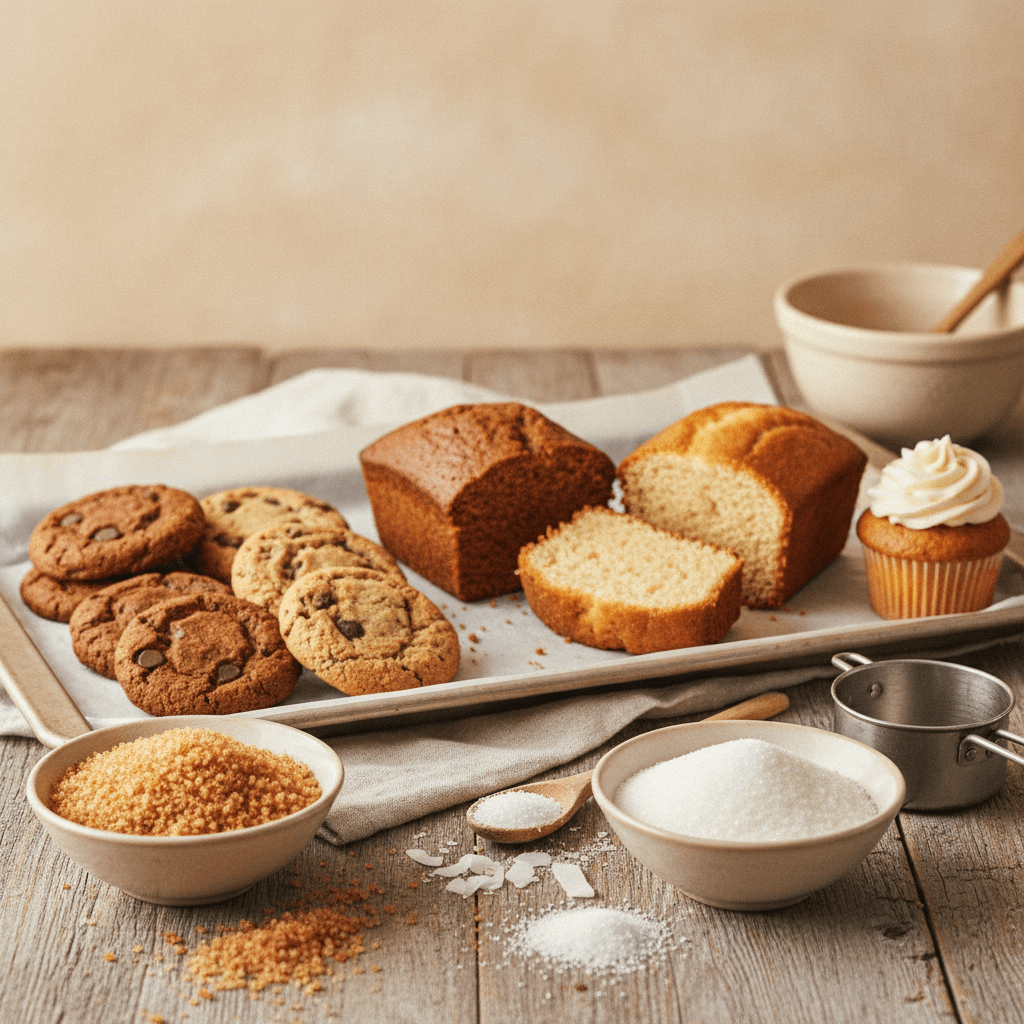
Coconut sugar is one of the most popular white sugar swaps in baking right now, but the substitution is not as simple as a 1:1 ratio and calling it done. Some things change dramatically — color, flavor, moisture — and a couple of things stay surprisingly close to white sugar. Here is what actually happens when you make the switch.
Key takeaways
- Coconut sugar can replace white sugar at a 1:1 ratio by weight or volume, but the results will look, taste, and sometimes feel different.
- Expect a darker color and a caramel-butterscotch flavor in every baked good — this is not a neutral sweetener.
- Coconut sugar has a slightly lower sucrose content than white sugar (about 70-80% sucrose compared to 99.9%), with small amounts of fructose, glucose, and trace minerals.
- It does not significantly reduce calories — coconut sugar runs roughly 45 calories per tablespoon versus about 48 for white sugar.
- Cookies and bars handle the swap best; delicate white cakes and meringues are where coconut sugar causes the most problems.
- Granule size varies between brands, which can affect creaming and dissolving behavior.
What coconut sugar actually is (and is not)
Coconut sugar comes from the sap of the coconut palm flower, not from coconuts themselves. The sap is collected, heated to evaporate moisture, and then crystallized into granules. The result looks like a coarse, tan-brown sugar with a flavor profile closer to light brown sugar or raw cane sugar than to white sugar.
A common misconception is that coconut sugar is dramatically healthier than white sugar. It does contain trace amounts of minerals like potassium, zinc, and iron, plus a fiber called inulin. But these amounts are small enough that you would need to eat unreasonable quantities to get meaningful nutritional benefit. It is still sugar. The calorie difference between coconut sugar and white sugar is negligible — roughly 3 calories per tablespoon. If you are looking for a natural sweetener that meaningfully reduces sugar content, coconut sugar is not the answer. It is, however, a less processed option that some bakers prefer for flavor reasons.
The 1:1 ratio — with caveats
The standard guidance is to substitute coconut sugar for white sugar at a 1:1 ratio, whether you measure by volume or weight. A cup for a cup, a gram for a gram. This works as a starting point, but there are important caveats that the ratio alone does not capture.
First, coconut sugar granules tend to be slightly coarser and more irregular than standard white sugar. This means they take longer to dissolve. In cookie doughs where you cream butter and sugar together, the larger granules can affect how much air gets incorporated. Some bakers grind their coconut sugar in a food processor or blender for 15-20 seconds before using it, which helps it behave more like the fine crystals of white sugar during creaming.
Second, coconut sugar contains a small amount of moisture that white sugar does not. This is usually not enough to wreck a recipe, but in very precise applications — like French macarons or Swiss meringue buttercream — even a slight moisture difference can throw off the result. For most cookies, muffins, quick breads, and brownies, the 1:1 swap works without other adjustments.
5 things that change when you swap coconut sugar for white sugar
1. Color gets noticeably darker
This is the most obvious change. Coconut sugar is brown, so everything it touches turns darker. A vanilla cake that would normally be pale golden comes out looking more like a spice cake. Sugar cookies lose their characteristic pale appearance. Blondies look more like brownies. If the visual appearance of your baked goods matters — say, for a wedding cake or decorated sugar cookies — this is a significant consideration.
The darkening is not just from the sugar's color mixing in. Coconut sugar also browns faster during baking due to its fructose and glucose content. You may need to reduce oven temperature by about 25 degrees Fahrenheit or check for doneness a few minutes earlier than usual to avoid over-browning.
2. Flavor shifts toward caramel and butterscotch
Coconut sugar does not taste like coconut. It has a warm, caramel-like flavor with notes of butterscotch and toffee. In some baked goods, this is a genuine improvement — banana bread, oatmeal cookies, gingerbread, and spice cakes all benefit from that deeper sweetness. In others, it competes with or masks delicate flavors. A lemon cake made with coconut sugar will taste muddled because the caramel notes fight the citrus brightness.
This flavor shift is why many bakers use a partial swap — replacing half the white sugar with coconut sugar — to get some of the depth without overwhelming the original flavor profile. If you are exploring sugar substitutes for cookies, this half-and-half approach is worth considering.
3. Texture can get slightly denser
Because coconut sugar granules are coarser and slightly more hygroscopic (moisture-attracting) than white sugar, baked goods made with a full swap can turn out marginally denser. This is most noticeable in cakes and less noticeable in cookies and bars. The difference is subtle in most recipes, but in something like an angel food cake — where sugar's role in creating a light, airy structure is critical — coconut sugar is a poor choice.
Grinding the coconut sugar finer before use helps here. So does sifting it with the dry ingredients to break up any clumps, since coconut sugar tends to clump more than white sugar due to its moisture content.
4. Spread and structure in cookies changes
White sugar encourages cookies to spread and crisp. Brown sugar encourages chewiness and less spread. Coconut sugar behaves more like brown sugar in this regard. Expect cookies made with coconut sugar to spread slightly less and have a chewier, denser texture than the same recipe made with white sugar. If your original recipe already uses a mix of white and brown sugar, swapping only the white sugar portion with coconut sugar will shift the cookie further toward chewy and thick.
For more on how different sweeteners affect cookie behavior, see our guide on how sugar functions in baking.
5. Caramelization happens faster
The fructose and glucose in coconut sugar caramelize at lower temperatures than pure sucrose. This means edges, bottoms, and thin portions of your baked goods will brown faster. A batch of cookies that normally takes 12 minutes at 350 degrees Fahrenheit might be done at 10-11 minutes with coconut sugar, or you might need to drop the temperature to 325 degrees Fahrenheit to prevent the bottoms from getting too dark.
This faster caramelization is especially important for items baked in thin layers — like tuile cookies, pizzelle, or thin bars. Keep a closer eye on the oven during the last few minutes of baking.
2 things that stay surprisingly close to white sugar
1. Sweetness level is nearly identical
Despite what some sources claim, coconut sugar and white sugar are very close in perceived sweetness. Coconut sugar is sometimes described as "slightly less sweet," but the difference is minor enough that most people cannot reliably detect it in a finished baked good. You do not need to add extra coconut sugar to compensate. The 1:1 ratio holds for sweetness.
2. Structural role in batters and doughs is similar
Sugar does more than sweeten — it tenderizes gluten, retains moisture, and helps with browning. Coconut sugar performs these structural functions in a similar way to white sugar. It still tenderizes. It still helps retain moisture (arguably slightly better, given its hygroscopic nature). It still contributes to Maillard browning. The baking chemistry is close enough that most recipes will hold together structurally with the swap.
This is a meaningful advantage over some other sugar alternatives. Monk fruit sweetener and stevia, for example, provide sweetness but lack the bulk and structural contributions of sugar, which often requires significant recipe reformulation. Coconut sugar does not have that problem.
Where coconut sugar works best (and where it does not)
| Baked good | How well coconut sugar works | Notes |
|---|---|---|
| Banana bread / quick breads | Excellent | Caramel flavor complements these recipes naturally |
| Brownies | Excellent | Darker color is a non-issue; flavor adds depth |
| Oatmeal cookies | Excellent | Butterscotch notes pair well with oats |
| Chocolate chip cookies | Good | Slightly chewier; color difference barely matters |
| Spice cakes / gingerbread | Good | Warm flavor profile is a natural fit |
| Muffins | Good | Works well in darker muffins (blueberry, chocolate); noticeable in vanilla |
| Vanilla cake | Fair | Color and flavor shift are obvious; consider a 50/50 blend |
| Sugar cookies | Poor | Color, flavor, and spread changes undermine the classic result |
| Meringue / pavlova | Poor | Does not dissolve cleanly; color and flavor are wrong for the application |
| Royal icing | Poor | Granule size and color make it unsuitable |
If you are baking something where white appearance and neutral sweetness are essential, coconut sugar is not the right substitute. For those applications, consider other options — our guide on choosing sugar alternatives covers the full range.
Common mistakes when baking with coconut sugar
Understanding common sugar substitution mistakes helps avoid the most frequent problems. Here are the ones specific to coconut sugar:
Not accounting for faster browning
This is the mistake that ruins the most batches. Bakers set the same timer and temperature they always use, then pull out cookies with burnt bottoms. Drop the temperature by 25 degrees Fahrenheit or set your timer 2-3 minutes shorter as a starting point.
Using it in recipes that need dissolved sugar
Coconut sugar does not dissolve as readily as white sugar, especially in cold or room-temperature mixtures. Recipes that call for dissolving sugar into egg whites, cream, or cold liquids will not work well with coconut sugar unless you grind it to a powder first. Even then, the results can be gritty.
Expecting it to be a low-calorie swap
This is not a mistake in technique but in expectation. Coconut sugar has essentially the same caloric density as white sugar. If calorie reduction is the goal, look at options like applesauce as a partial sugar replacement or date paste, both of which add bulk with fewer calories per gram (though they introduce their own tradeoffs).
Ignoring brand-to-brand variation
Coconut sugar is not a standardized product. Different brands vary in granule size, moisture content, and color. Some brands produce fine, sand-like crystals; others are coarse and chunky. This variation means a recipe that works perfectly with one brand might behave differently with another. If you find a brand that works well for your baking, stick with it.
Coconut sugar and glycemic index — what the evidence actually says
Coconut sugar is frequently marketed with claims about having a lower glycemic index (GI) than white sugar. This claim traces back to a single 2011 study conducted by the Philippine Food and Nutrition Research Institute, which measured a GI of 35 for coconut sugar compared to 65 for table sugar. However, this study had a small sample size and has not been widely replicated by independent researchers.
The University of Sydney's glycemic index database — widely considered the most comprehensive GI reference — does not list a verified GI value for coconut sugar. Given that coconut sugar is 70-80% sucrose, many nutrition researchers expect its actual GI to be higher than 35, though likely still somewhat lower than pure white sugar due to the presence of inulin fiber and other minor components.
The honest answer is that the evidence is limited. If you are managing blood sugar, do not assume coconut sugar is a safe alternative without consulting a healthcare provider. It is still sugar, and it still raises blood glucose.
Cost comparison
Coconut sugar typically costs $4-8 per pound at retail, compared to $0.50-1.00 per pound for white granulated sugar. That is a 4x to 8x price increase. For home baking, this might be acceptable. For a home bakery tracking profitability, the cost difference adds up fast. A recipe calling for 2 cups of sugar (roughly 400g) costs about $0.40 with white sugar and $2.00-3.50 with coconut sugar. Over dozens of batches per week, that difference can meaningfully erode margins.
Frequently asked questions
Can you substitute coconut sugar for white sugar in a 1:1 ratio?
Yes, coconut sugar can replace white sugar at a 1:1 ratio by weight or volume. The swap works well in most cookies, quick breads, muffins, and brownies. However, expect darker color, a caramel-butterscotch flavor, and slightly faster browning. For the best results, grind coconut sugar finer before using it in recipes that call for creaming butter and sugar together.
Does coconut sugar taste like coconut?
No. Despite the name, coconut sugar does not taste like coconut. It has a warm, caramel-like flavor similar to light brown sugar or raw cane sugar. The flavor comes from the sap of the coconut palm flower, which develops toffee and butterscotch notes during the evaporation process. This flavor works well in spiced and chocolate baked goods but can overwhelm delicate flavors like lemon or vanilla.
Is coconut sugar healthier than white sugar?
Coconut sugar contains trace minerals and a small amount of inulin fiber that white sugar lacks, but the quantities are too small to provide meaningful nutritional benefit at normal serving sizes. Calorie content is nearly identical — roughly 45 calories per tablespoon for coconut sugar versus 48 for white sugar. Claims about a significantly lower glycemic index are based on limited research. It is a less processed option, but it is still sugar.
Why are my cookies burning when I use coconut sugar?
Coconut sugar contains fructose and glucose that caramelize at lower temperatures than the pure sucrose in white sugar. This causes faster browning, especially on the bottoms and edges of cookies. Try reducing your oven temperature by about 25 degrees Fahrenheit and checking for doneness 2-3 minutes earlier than the recipe states. You can also learn more about how sugar substitutes affect texture in baking.
Can you use coconut sugar in meringue or royal icing?
Coconut sugar is a poor choice for meringue and royal icing. Its coarse granules do not dissolve cleanly into egg whites, which can result in a gritty texture. The brown color also makes white meringue and icing impossible. Even grinding coconut sugar to a powder does not fully solve the dissolving issue. For these applications, stick with white granulated or powdered sugar.

Written by
Co-founder, BakingSubs
Co-founder of BakingSubs, where he turns the science of ingredient substitutions into tested, reliable guidance for home bakers.
Related Posts
Bake with Confidence
See all
Confident Gluten-Free Baker Toolkit
The science-based system that replaces gluten's seven invisible jobs so your baking turns out soft, fluffy, and foolproof — every time.

Gluten-Free Recipe Vault
Instant access to our complete library of proven gluten-free recipes — no waiting, no guesswork, just results that work tonight.

Fix Your Gluten-Free Bread
Learn the 3-step formula to make bread rise and stay soft, discover why your loaves collapse, and get a tested sandwich bread recipe that actually works.