
Inulin as Sugar and Fiber Substitute in Baking: What It Actually Does (and Where It Falls Short)
Inulin adds fiber and mild sweetness to baked goods, but it can't replace sugar 1:1. Learn where inulin works, where it breaks, and how to pair it for best results.

Malik
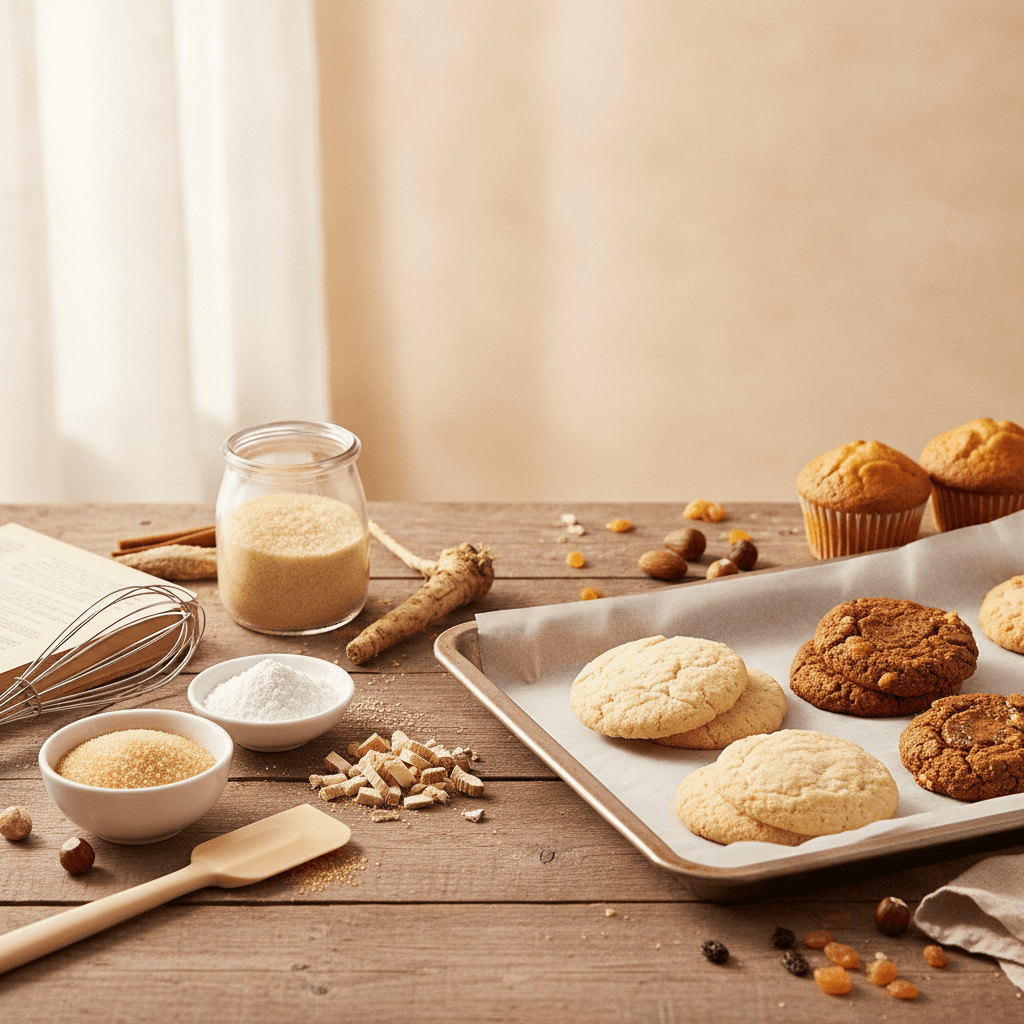
Inulin is a soluble fiber extracted from chicory root that can partially replace sugar in baked goods while adding fiber. But it behaves nothing like sugar in an oven, and treating it as a 1:1 swap leads to dense, gummy, or oddly sweet results. Here is what inulin actually does in baking, where it works, and where it breaks down.
Key takeaways
- Inulin is a prebiotic soluble fiber, not a sweetener — it provides roughly 25–35% of the sweetness of sugar and cannot replace sugar's full role in most baked goods.
- It works best as a partial replacement (typically up to 25–30% of the sugar in a recipe) rather than a full swap, because sugar does far more than sweeten.
- Inulin adds bulk and can mimic some of sugar's textural contributions — moisture retention, softness — but it does not caramelize, cream with butter, or create crunch the way sugar does.
- Digestive tolerance is a real concern: consuming more than about 10g of inulin in a sitting causes bloating and gas in many people.
- Pairing inulin with a high-intensity sweetener like monk fruit or stevia covers the sweetness gap that inulin alone cannot fill.
- Inulin is naturally gluten-free, making it compatible with gluten-free baking — but it does not replace the structural roles of flour or starch.
What inulin is and why bakers reach for it
Inulin is a type of fructo-oligosaccharide — a chain of fructose molecules linked together in a way that human digestive enzymes cannot break down. That is what makes it a fiber rather than a sugar. Commercially, most inulin comes from chicory root, though it also occurs naturally in garlic, onions, and Jerusalem artichokes.
Bakers use inulin for two reasons. First, it adds dietary fiber to baked goods — roughly 9g of fiber per 10g of inulin powder, depending on the brand. Second, it provides mild sweetness and a slightly creamy mouthfeel, which helps offset some of the textural losses that come with reducing sugar. Brands like NOW Foods and Jarrow Formulas sell chicory-root inulin powder marketed specifically for cooking and baking, while Orafti (by BENEO) produces inulin ingredients used in commercial food manufacturing.
But inulin is not a sweetener in the way most people think of one. Its sweetness is subtle — closer to a hint than a flavor. If you replace all the sugar in a cookie recipe with inulin, the result will taste flat and starchy, not sweet.
How inulin compares to sugar in baking
Sugar does at least six things in baked goods beyond making them sweet. Understanding which of those jobs inulin can and cannot handle is the key to using it well.
| Function | Sugar | Inulin |
|---|---|---|
| Sweetness | Full (reference point) | About 25–35% of sugar's sweetness |
| Browning / Maillard reaction | Yes — caramelizes and browns | Minimal — does not caramelize in the same way |
| Moisture retention | Hygroscopic — holds moisture well | Good — inulin gels hold water effectively |
| Bulk / volume | Provides structural bulk | Similar bulk by weight, but different density |
| Creaming with fat | Creates air pockets when creamed with butter | Does not cream — no crystalline structure |
| Crunch / crisp texture | Re-crystallizes to create crispness | Does not crystallize — tends toward soft or chewy |
| Spread in cookies | Melts and encourages spread | Less spread — holds shape more |
| Fiber content | 0g per serving | ~9g fiber per 10g inulin |
The table makes the tradeoff clear: inulin handles moisture and bulk reasonably well, but it cannot replicate browning, creaming, or crispness. Those are the functions that trip up bakers who try to use inulin as a straight sugar replacement. For a deeper look at what happens when you remove sugar from baked goods, our guide on sugar's functions in baking breaks it down in detail.
Where inulin works well as a partial sugar replacement
Inulin performs best in baked goods where softness and moisture matter more than crunch or browning. Think muffins, quick breads, banana bread, and soft cake layers. In those applications, replacing 25–30% of the sugar with an equal weight of inulin powder typically produces results that are close to the original — slightly less sweet, slightly softer, but recognizably the same product.
For example, in banana muffins you might replace 25% of the sugar with inulin and add a small amount of monk fruit sweetener to bring the sweetness back up. Thanks to inulin's water-binding properties, the muffins should also stay moist longer than an all-sugar version.
Inulin also works well in:
- Pancake and waffle batters — the soft, moist texture is a natural fit, and browning comes from the griddle rather than oven caramelization.
- Soft rolls and enriched breads — inulin's gel-forming ability helps retain moisture without interfering with yeast activity.
- Smoothie-style baked goods like blender muffins, where texture expectations are already different from traditional baking.
If you are exploring other ways to reduce sugar in baked goods, our post on low-sugar baking substitutes covers several approaches that pair well with inulin.
Where inulin falls short (and what breaks)
Inulin is a poor fit when a recipe depends on sugar's structural or thermal behavior. These are the situations where it consistently causes problems:
Crispy cookies
Sugar melts, spreads, and re-crystallizes as cookies cool — that is what creates a crisp edge. Inulin does none of that. Cookies made with high inulin ratios tend to come out pale, soft, and cake-like rather than crisp. If you are baking cookies and want to reduce sugar, this comparison of sugar substitutes for cookies covers options that handle the structural role better.
Meringues and whipped applications
Sugar stabilizes whipped egg whites by dissolving into the protein network. Inulin does not dissolve the same way and cannot stabilize a meringue. This is a hard limit — there is no workaround with inulin alone.
Caramel, brittle, and candy
Anything that relies on sugar reaching specific temperature stages (soft ball, hard crack) is off the table. Inulin does not undergo the same thermal transitions.
Recipes where browning matters
A golden-brown crust on a cake or the Maillard browning on a scone depends partly on sugar. Inulin contributes very little browning. If you replace more than about 30% of the sugar, expect noticeably paler results. Some bakers compensate by brushing the top with a thin milk or egg wash, but the interior color will still be lighter.
Full replacement at any ratio
Replacing 100% of sugar with inulin almost always fails. The sweetness drops too far, browning disappears, and the texture shifts dramatically. Even at 50% replacement, the results are usually noticeably different from the original. The sweet spot for most applications is 25–30% replacement by weight, with a secondary sweetener covering the gap.
Pairing inulin with other sweeteners
Because inulin brings fiber and bulk but not enough sweetness, it pairs naturally with high-intensity sweeteners that bring sweetness but no bulk. The most common combinations:
| Pairing | What inulin provides | What the partner provides | Best for |
|---|---|---|---|
| Inulin + monk fruit | Bulk, fiber, moisture | Sweetness (150–200x sugar) | Muffins, quick breads, soft cakes |
| Inulin + stevia | Bulk, fiber, moisture | Sweetness (200–300x sugar) | Pancakes, waffles, simple batters |
| Inulin + erythritol | Fiber, moisture retention | Bulk, sweetness (70% of sugar), some browning | Cookies, bars, recipes needing more structure |
| Inulin + allulose | Fiber, moisture | Sweetness (70% of sugar), browning, spread | Cookies, cakes where browning matters |
The inulin-plus-allulose combination is particularly interesting because allulose browns and behaves thermally much like sugar, covering inulin's biggest weakness. Allulose is also classified as a rare sugar that contributes minimal calories, though it is more expensive than standard sugar — typically $0.80–$1.20 per ounce for retail quantities.
For more on using monk fruit and stevia in baking, see our guides on monk fruit sweetener for baking and stevia baking conversions.
The digestive tolerance issue most posts skip
Here is the part that matters and that too many baking blogs gloss over: inulin is a FODMAP. It is fermented by gut bacteria in the large intestine, and that fermentation produces gas. For many people, consuming more than about 10g of inulin in a single sitting causes bloating, cramping, and flatulence. Some people are sensitive at even lower amounts, particularly those with irritable bowel syndrome (IBS).
This is not a minor footnote — it is a real constraint on how much inulin you can put in a baked good. If a muffin recipe makes 12 muffins and you add 60g of inulin to the batch, each muffin contains 5g of inulin. That is probably fine for most people. But if someone eats two muffins (10g), they may be at their tolerance threshold. Three muffins and they are likely uncomfortable.
The practical implication: keep inulin amounts moderate, especially in items people tend to eat multiples of (cookies, muffin bites, small bars). Label clearly if you are selling these products, and be upfront about the fiber content.
This tolerance issue is one reason why inulin works better as a partial replacement rather than a primary ingredient. It is also why pairing it with other sweeteners — rather than loading up on inulin to cover both the sweetness and fiber goals — tends to produce better results for both flavor and digestion.
Inulin as a fiber booster (separate from sugar replacement)
Some bakers use inulin not to replace sugar at all, but simply to add fiber to recipes that are otherwise low in it. This is a different use case, and it is actually where inulin shines brightest.
Adding 10–15g of inulin to a batch of muffins, pancake batter, or quick bread — without reducing any sugar — adds meaningful fiber without dramatically changing taste or texture. The inulin dissolves into the liquid components and forms a subtle gel that, if anything, makes the crumb slightly softer and more moist. At these low levels, most people will not detect a flavor difference.
This approach is common in gluten-free baking, where many flour blends (rice flour, tapioca starch, potato starch) are very low in fiber compared to whole wheat flour. If you are working with high-fiber flour alternatives, inulin can supplement the fiber content without adding the density or grittiness that some high-fiber flours bring.
Inulin is also sometimes added to low-carb bread formulations to improve moisture retention and add fiber, since many low-carb flours produce dry, crumbly results on their own.
Buying and storing inulin for baking
Inulin powder for baking is widely available. The two forms you will encounter are:
- Regular inulin powder — a fine white powder with mild sweetness. This is the most common form for home baking. NOW Foods Organic Inulin and Jarrow Formulas Inulin FOS are two widely available options, typically priced around $12–$18 for a 227g container.
- Inulin HP (high performance) — a longer-chain version that forms a creamier gel and has less sweetness. This is used more in fat replacement applications (mimicking the mouthfeel of fat in low-fat products) than in sugar replacement.
For sugar replacement and fiber boosting in home baking, regular inulin powder is what you want. Store it in an airtight container in a cool, dry place. It is shelf-stable and does not require refrigeration. It clumps easily in humid environments, so a container with a good seal matters.
Inulin is naturally gluten-free, but as with any specialty ingredient, check the label for facility cross-contamination warnings if you are baking for someone with celiac disease. Our gluten-free baking guide covers cross-contamination considerations in more detail.
A contrarian take: inulin is oversold as a sugar substitute
Most articles about inulin in baking position it as a versatile sugar replacement. That framing overpromises. Inulin is a good fiber supplement and a decent partial sugar replacer in soft, moist baked goods. But calling it a sugar substitute implies it can do sugar's job, and it cannot — not even close, in most applications.
If your goal is reducing sugar, you are better off starting with sweeteners that actually behave like sugar in an oven — allulose, date paste, or even applesauce — and then adding a small amount of inulin for the fiber benefit. Treating inulin as the primary sugar substitute, rather than a supporting player, is where most bakers run into trouble.
The most honest way to think about inulin: it is a fiber ingredient that happens to be mildly sweet, not a sweetener that happens to contain fiber.
Frequently asked questions
Can you replace all the sugar in a recipe with inulin?
No. Replacing 100% of the sugar with inulin produces baked goods that are not sweet enough, do not brown, and have a significantly different texture. Replacing 25–30% of the sugar with inulin by weight is the practical upper limit before the differences become too noticeable. Pair inulin with a high-intensity sweetener like monk fruit or stevia to cover the sweetness gap.
How much inulin per day is safe to eat?
Digestive tolerance varies widely between individuals. Many people tolerate up to about 10g per sitting without issues, but some experience bloating and gas at lower amounts. People with IBS or FODMAP sensitivities should start with very small amounts — around 2–3g — and increase gradually. This is not a safety issue (inulin is generally recognized as safe), but a comfort issue.
Does inulin work in gluten-free baking?
Yes. Inulin is naturally gluten-free and dissolves easily into batters and doughs. It is particularly useful in gluten-free baking because many gluten-free flour blends are low in fiber. Adding inulin boosts fiber content without adding grittiness or density. However, inulin does not replace the structural role of xanthan gum, psyllium husk, or other binders — it is a fiber and moisture ingredient, not a structural one.
Is inulin keto-friendly?
Inulin is generally considered keto-compatible because its fiber is not digested or absorbed as glucose. It does contain a small amount of calories (about 1.5 calories per gram, compared to sugar's 4 calories per gram), but it does not raise blood sugar the way sugar does. Many keto baking formulations use inulin as a bulking agent alongside erythritol or monk fruit.
What does inulin taste like on its own?
Inulin powder has a very mild sweetness — roughly a quarter to a third as sweet as sugar — with a slightly creamy, neutral flavor. It does not have the bitter or metallic aftertaste associated with stevia or some sugar alcohols. At low doses (under about 15g in a full batch), most people cannot detect its flavor in finished baked goods. At higher doses, it can contribute a faintly sweet, slightly starchy background note.

Written by
Co-founder, BakingSubs
Co-founder of BakingSubs, where he turns the science of ingredient substitutions into tested, reliable guidance for home bakers.
Related Posts

Bake with Confidence
See all
Confident Gluten-Free Baker Toolkit
The science-based system that replaces gluten's seven invisible jobs so your baking turns out soft, fluffy, and foolproof — every time.

Gluten-Free Recipe Vault
Instant access to our complete library of proven gluten-free recipes — no waiting, no guesswork, just results that work tonight.

Fix Your Gluten-Free Bread
Learn the 3-step formula to make bread rise and stay soft, discover why your loaves collapse, and get a tested sandwich bread recipe that actually works.