

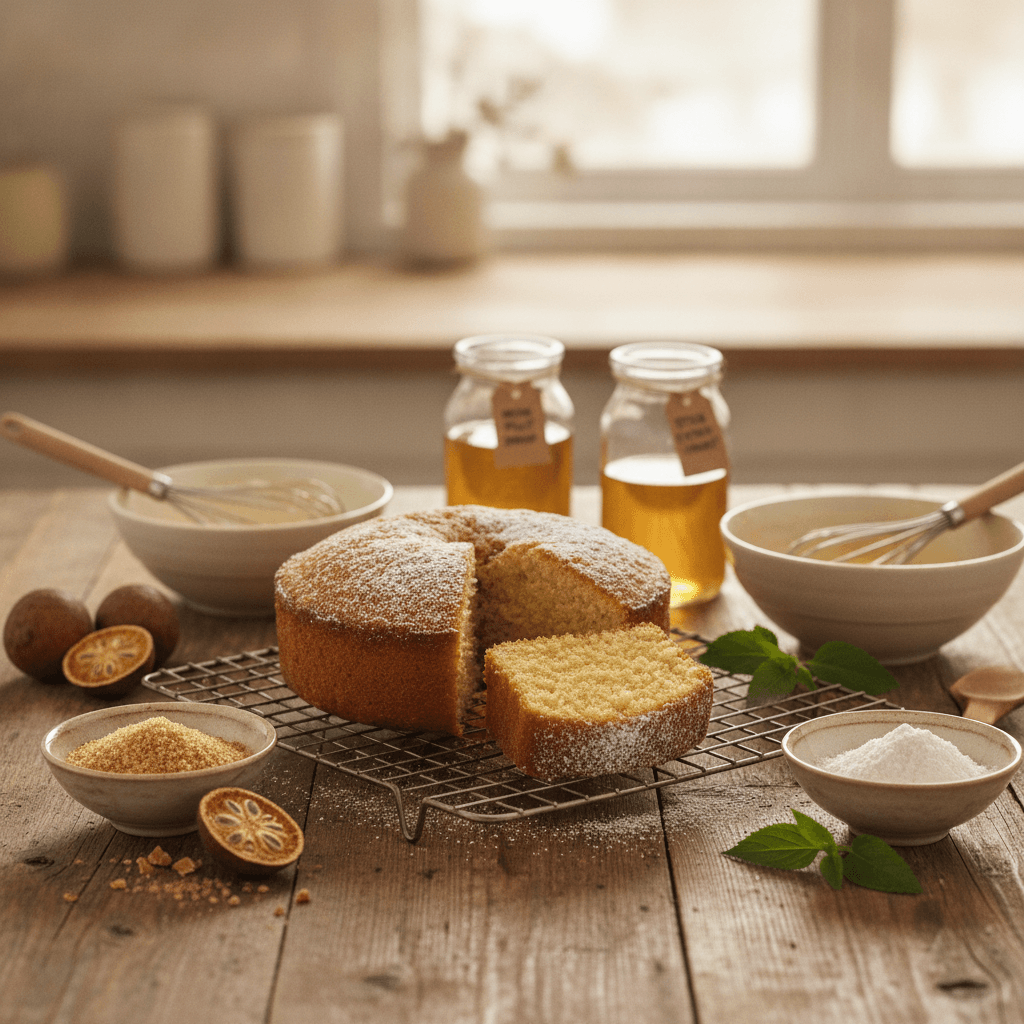
Monk fruit and stevia are both zero-calorie, zero-glycemic sweeteners, but they behave differently in batter. The short answer: monk fruit blends (usually cut with erythritol) measure cup-for-cup like sugar and add bulk, while pure stevia extract is 200–400 times sweeter than sugar and needs a separate bulking agent. Which one you pick depends on whether you need volume, how you feel about sugar alcohols, and what kind of baked good you're making.
Key takeaways
- Pure monk fruit extract (mogrosides) is roughly 100–250 times sweeter than sugar; pure stevia extract (steviol glycosides) is 200–400 times sweeter. Both have a glycemic index of 0 and 0 calories per serving.
- Most baking-ready monk fruit products are blended with erythritol or allulose to provide bulk. Most baking-ready stevia products are blended with erythritol, dextrose, or maltodextrin. The bulking agent matters more than the sweetener itself for texture.
- Neither sweetener caramelizes or feeds yeast, so neither produces Maillard browning on its own. Expect paler crusts without a workaround.
- Stevia can develop a bitter, licorice-like aftertaste at higher concentrations — a well-documented property of the steviol glycoside rebaudioside A (Reb A). Monk fruit makers describe their sweeteners as less bitter, though published head-to-head flavor data is limited.
- Both sweeteners hold FDA GRAS (Generally Recognized As Safe) status. Neither is linked to the cardiovascular concerns flagged in the 2023 Cleveland Clinic study on erythritol, though many monk fruit and stevia products contain erythritol as a bulking agent.
- For most cookie, cake, and muffin recipes, a monk fruit–erythritol blend is the easier 1:1 swap. For recipes where you need only a tiny amount of sweetness (a sauce, a glaze, a single-serve mug cake), liquid stevia is more practical.
Side-by-side comparison table
This table compares the two sweeteners on verifiable, label-level criteria. Where a range is shown, it reflects the spread across major retail brands.
| Criteria | Monk fruit (pure extract) | Stevia (pure extract) |
|---|---|---|
| Sweetness vs sugar | 100–250x | 200–400x |
| Calories per gram | 0 | 0 |
| Glycemic index | 0 | 0 |
| Net carbs per serving | 0g | 0g |
| FDA GRAS status | Yes (mogroside V) | Yes (high-purity steviol glycosides, ≥95% purity) |
| Common bulking agents in baking blends | Erythritol, allulose, inulin | Erythritol, dextrose, maltodextrin |
| Typical baking ratio (blend form) | 1:1 cup-for-cup with sugar | Varies widely — some blends are 1:1, some are 1:2, some are drops |
| Browning / Maillard reaction | None from mogrosides; erythritol does not brown either | None from steviol glycosides; dextrose or maltodextrin fillers may brown slightly |
| Crystallization risk | Erythritol-based blends can recrystallize as baked goods cool | Erythritol-based blends same; maltodextrin-based blends do not crystallize |
| Known aftertaste compounds | Described by manufacturers as less bitter; limited published data | Bitter/licorice note at higher concentrations (Reb A) |
| Digestive tolerance | Pure extract: well tolerated. Erythritol blends: a 50g single dose increased nausea and stomach rumbling in one clinical study | Pure extract: well tolerated. Erythritol/sugar alcohol blends: same GI threshold |
How we ranked these
We compared monk fruit and stevia on six criteria that any baker can verify from a product label or a published source: sweetness relative to sugar (from FDA and manufacturer data), glycemic index (published GI tables), net carbs and calories (Nutrition Facts panels), FDA regulatory status, chemical behavior in baking (based on food chemistry literature, not personal testing), and digestive tolerance thresholds (from published clinical data). We did not taste-test any product, and any flavor descriptions come from manufacturer claims or documented food chemistry, which we label accordingly.
Sweetness level and how much you need
Pure monk fruit extract delivers about 100–250 times the sweetness of sucrose, depending on the concentration of mogroside V (the primary sweet compound). Pure stevia extract (high-purity steviol glycosides) delivers about 200–400 times the sweetness of sucrose, per the FDA.
In practice, almost nobody bakes with pure extract of either sweetener. A tiny amount — about 1–2g of pure monk fruit extract — would replace a full cup of sugar in sweetness, but it would leave your batter short about 200g of dry bulk. That missing bulk means flat cookies, dense cakes, and crumbly muffins. This is the same structural problem covered in our guide to common healthy baking mistakes that ruin texture.
That's why retail "baking blends" pair the extract with a bulking agent. A monk fruit–erythritol blend like Lakanto Classic measures 1:1 with sugar: 1 cup of blend replaces 1 cup of sugar. A stevia blend like Truvia Cane Sugar Blend (formerly sold as Truvia Baking Blend), which combines erythritol, cane sugar, and stevia leaf extract, uses a 1:2 ratio — 1/2 cup replaces 1 cup of sugar. Liquid stevia drops are far more concentrated: SweetLeaf lists 15 drops of its Sweet Drops per tablespoon of sugar. Always check the specific product's conversion chart, because there is no universal stevia-to-sugar ratio.
Glycemic impact and net carbs
Both pure monk fruit extract and pure stevia extract register a glycemic index of 0. Neither contains digestible carbohydrates that raise blood glucose. For anyone tracking net carbs on a keto or low-carb protocol, both sweeteners contribute 0g net carbs per serving.
The bulking agent is where glycemic impact sneaks in. Erythritol has a GI of 0 and is generally considered keto-friendly. Allulose also has a GI near 0 and is excluded from total sugars on US Nutrition Facts labels per FDA guidance. But some stevia blends use dextrose (GI of 100) or maltodextrin (GI of 85–105) as fillers. A single packet of stevia sweetened with dextrose typically contains less than 1g of dextrose, which is negligible for most people — but if you're measuring cups of a maltodextrin-bulked stevia blend for a cake recipe, the carbs add up fast. Read the ingredient list, not just the front label.
For a deeper look at how allulose works as a sugar substitute in baking, including its unique FDA labeling rules, we have a separate breakdown.
How each sweetener behaves in baking
Browning
Sugar caramelizes at about 160°C (320°F) and participates in the Maillard reaction with amino acids to produce golden-brown crusts. Neither mogrosides nor steviol glycosides do either. Erythritol, the most common bulking agent in both monk fruit and stevia blends, also does not caramelize. The result: paler baked goods across the board.
If browning matters — and for cookies and quick breads, it usually does — add 1–2 tablespoons of real honey, molasses, or a small amount of brown sugar to the recipe. That's enough to trigger Maillard browning without significantly raising the sugar content. Alternatively, an allulose-based blend will brown, because allulose does caramelize (it's a rare sugar that behaves more like fructose in heat).
Crystallization
Erythritol recrystallizes as baked goods cool, which is why cookies made with erythritol-based monk fruit or stevia blends can develop a gritty, crunchy surface texture after sitting for a few hours. This is a chemical property of erythritol's crystal structure, not a defect of either sweetener. Our erythritol vs xylitol comparison covers this recrystallization issue in detail.
To reduce crystallization: use a finer grind (powdered erythritol dissolves more completely), add a humectant like glycerin or a tablespoon of allulose syrup, and store baked goods in an airtight container while still slightly warm.
Moisture retention
Sugar is hygroscopic — it pulls water from the air and holds moisture in crumb. Erythritol is much less hygroscopic, so baked goods made with erythritol-based blends (whether monk fruit or stevia) tend to dry out faster. Expect texture changes with health swaps like denser crumb and quicker staling. Adding 1–2 tablespoons of unsweetened applesauce, yogurt, or an extra egg yolk can compensate.
Cooling effect
Erythritol has a negative heat of solution, meaning it absorbs heat as it dissolves on the tongue. This produces a noticeable cooling sensation, similar to mint but without the flavor. Both monk fruit–erythritol blends and stevia–erythritol blends share this property. It's more noticeable in frostings and no-bake applications where erythritol crystals dissolve directly in the mouth. Pure liquid stevia drops, which contain no erythritol, have no cooling effect at all.
Aftertaste: what the chemistry says
Stevia's bitter, licorice-like aftertaste is a commonly reported complaint. Researchers have identified two human bitter taste receptors, hTAS2R4 and hTAS2R14, that respond to Reb A and other steviol glycosides (Hellfritsch et al., 2012). This bitterness is attributed to specific steviol glycosides, particularly Reb A at concentrations above a threshold that varies by individual sensitivity. Newer stevia extracts marketed as "Reb M" or "Reb D" are reported by manufacturers (including PureCircle and SweeGen) to have a cleaner flavor profile with less bitterness, though these extracts are more expensive.
Monk fruit's mogrosides do not produce the same bitter compounds. Manufacturers of monk fruit sweeteners (Lakanto, Monk Fruit In The Raw) describe the flavor as closer to sugar with a slight fruity note. We did not find comparable published receptor data for mogroside V. However, some people do detect a slight "off" flavor in monk fruit, which may come from other mogrosides present in lower-purity extracts.
To be clear: we have not tasted either sweetener. These descriptions come from manufacturer claims and published flavor chemistry research, and we've labeled which is which.
Digestive tolerance
Pure monk fruit extract and pure stevia extract are both well tolerated in the small amounts needed for sweetening. The digestive issues people report — bloating, gas, osmotic diarrhea — almost always come from the bulking agent, not the sweetener itself.
Erythritol is better tolerated than other sugar alcohols (like xylitol or sorbitol) because about 90% of ingested erythritol is absorbed in the small intestine and excreted unchanged in urine, rather than fermenting in the colon. In one controlled study of young adults, single doses of 20g and 35g of erythritol in a drink caused no significant symptoms, while 50g increased nausea and stomach rumbling (Storey et al., 2007). For reference, a full cup of granular erythritol-based sweetener weighs roughly 190–200g, so a recipe using 1 cup split across 12 servings delivers about 16g per serving — below the doses that caused symptoms in that study.
If you're sensitive to sugar alcohols, look for monk fruit blends that use allulose instead of erythritol, or use pure liquid stevia drops (which contain no sugar alcohols at all). Our monk fruit brand comparison identifies which brands use erythritol vs allulose as the bulking agent.
Safety: what regulators and researchers have found
Both sweeteners hold FDA GRAS status. The FDA has not objected to the use of high-purity mogroside V extracts or high-purity steviol glycoside extracts (95% minimum purity) as food ingredients. The European Food Safety Authority (EFSA) has also approved steviol glycosides, setting an acceptable daily intake (ADI) of 4mg per kg of body weight per day, expressed as steviol equivalents. For a 70kg (154lb) adult, that's 280mg of steviol equivalents per day.
Neither monk fruit mogrosides nor steviol glycosides were implicated in the widely reported 2023 Cleveland Clinic study (Witkowski et al., published in Nature Medicine) that found an association between elevated blood erythritol levels and increased risk of cardiovascular events, including heart attack and stroke. That study specifically examined erythritol, not monk fruit or stevia. However, because many monk fruit and stevia baking blends contain erythritol as their primary ingredient by weight, the finding is relevant to users of those blends.
Important context on the erythritol study: it was observational (not a randomized controlled trial), the participants were already at elevated cardiovascular risk, and the study measured blood erythritol levels rather than dietary intake. The authors themselves noted that causation was not established. The FDA has not changed erythritol's GRAS status based on this research. For more detail, see our erythritol brands for baking post, which covers this study and its limitations.
If you have diabetes, heart disease, or another condition that makes sweetener choice medically relevant, talk to your doctor. We are not qualified to give medical advice, and a blog post is not a substitute for clinical guidance.
Worked example: converting a sugar cookie recipe
Say your standard sugar cookie recipe calls for 1 cup (200g) of granulated white sugar. Here's what the swap looks like with each sweetener:
Monk fruit–erythritol blend (1:1 ratio, e.g., Lakanto Classic): Use 1 cup of the blend. The blend weighs roughly 192g per cup (slightly lighter than sugar). The recipe's net carbs from sweetener drop from about 200g to 0g. Expect a paler cookie with a slightly crisper, more crystalline texture after cooling. Add 1 tablespoon of molasses if you want browning and a chewier center.
Stevia–erythritol–sugar blend (1:2 ratio, e.g., Truvia Cane Sugar Blend): Use 1/2 cup of the blend. This product contains real cane sugar, so it is not zero-carb. You've now removed half the dry volume from the recipe, which will change the dough's consistency. You'll need to reduce the flour by about 2–3 tablespoons or add a filler (more erythritol, or allulose) to restore bulk. This is where stevia blends get fiddly for baking — the ratio math isn't as clean.
Pure liquid stevia drops: A small amount replaces 1 cup of sugar in sweetness — SweetLeaf's figure of 15 drops per tablespoon works out to about 240 drops per cup (varies by brand concentration). But you've now removed 200g of dry bulk with nothing to replace it. You'd need to add roughly 3/4 cup of a neutral bulking agent — erythritol, allulose, or even extra almond flour — to get a workable dough. This is a significant recipe reformulation, not a simple swap.
This is why, for most bakers, a 1:1 monk fruit blend is the path of least resistance. You can learn more about how different sugar alternatives affect recipes in our learn section, and our best sugar substitute for baking roundup compares more options.
The verdict: which to use when
Use a monk fruit–erythritol or monk fruit–allulose blend when you want a straightforward 1:1 sugar replacement in cookies, cakes, muffins, and quick breads. The bulk is built in, the conversion math is simple, and manufacturers describe its flavor as closer to sugar than stevia's.
Use stevia when you need a tiny amount of sweetness without any bulk — a few drops in a glaze, a mug cake, a whipped cream, or a beverage. Liquid stevia is also the better choice if you're specifically avoiding erythritol (due to the 2023 cardiovascular study or digestive sensitivity) and don't want to buy a specialty allulose-based monk fruit blend.
Use either one if you're making a no-bake recipe (cheesecake filling, mousse, pudding) where bulk isn't an issue and you just need sweetness. In that context, the choice comes down to flavor preference and price.
If you're running a home bakery and costing recipes, compare cost per cup of sugar replaced using current prices, and remember that pure liquid stevia requires the most recipe reformulation, which costs time.
Frequently asked questions
Is monk fruit or stevia better for keto baking?
Both have 0g net carbs and a glycemic index of 0, so both are keto-compatible. The practical difference is bulk: a monk fruit–erythritol blend measures 1:1 like sugar, making it easier to adapt standard recipes. Stevia blends often require ratio adjustments or added bulking agents. For keto baking specifically, monk fruit blends tend to be the simpler swap.
Does monk fruit taste better than stevia in baked goods?
Stevia's Reb A is known to activate human bitter taste receptors, which helps explain its aftertaste; we found no comparable published receptor data for monk fruit's mogrosides. Manufacturers of monk fruit sweeteners describe the flavor as closer to sugar. However, individual sensitivity varies widely, and some people detect an off-note in monk fruit as well. We have not conducted taste tests — these descriptions come from manufacturer claims and food science literature.
Can you mix monk fruit and stevia together in baking?
Yes. The idea is that using two different sweetener compounds at lower individual concentrations reduces the chance of either one's aftertaste becoming noticeable. If mixing yourself, start by replacing half the sweetener amount with each and adjust from there.
Are monk fruit and stevia safe during pregnancy?
Both high-purity monk fruit extract (mogroside V) and high-purity stevia extract (≥95% steviol glycosides) hold FDA GRAS status, meaning the FDA has no objections to their use in food by the general population. However, safety during pregnancy is a medical question — talk to your OB-GYN rather than relying on a baking blog.
Does the 2023 erythritol heart study apply to monk fruit or stevia?
The 2023 Cleveland Clinic study (Witkowski et al., Nature Medicine) examined erythritol specifically, not monk fruit or stevia. It found an association — not proven causation — between high blood erythritol levels and cardiovascular events in a population already at elevated risk. The study was observational, and the FDA has not changed erythritol's GRAS status. That said, many monk fruit and stevia baking blends list erythritol as their first ingredient by weight, so if the study concerns you, look for blends that use allulose instead, or use pure liquid stevia drops.

Written by
Co-founder, BakingSubs
Co-founder of BakingSubs, where he turns the science of ingredient substitutions into tested, reliable guidance for home bakers.
Related Posts

Allulose vs Monk Fruit for Baking: 6 Differences That Actually Change Your Results
7 Common Healthy Baking Mistakes That Ruin Texture (and How to Fix Each One)
7 Texture Changes With Health Swaps That Catch Bakers Off Guard (and How to Handle Each One)
Bake with Confidence
See all
Confident Gluten-Free Baker Toolkit
The science-based system that replaces gluten's seven invisible jobs so your baking turns out soft, fluffy, and foolproof — every time.

Gluten-Free Recipe Vault
Instant access to our complete library of proven gluten-free recipes — no waiting, no guesswork, just results that work tonight.

Fix Your Gluten-Free Bread
Learn the 3-step formula to make bread rise and stay soft, discover why your loaves collapse, and get a tested sandwich bread recipe that actually works.